As
a child, back in New Jersey, I often took vicarious birding trips to
the sub-Tropics. Roger Tory Peterson was my virtual companion (See my
review of Birdwatcher: The
Life of Roger Tory Peterson). I
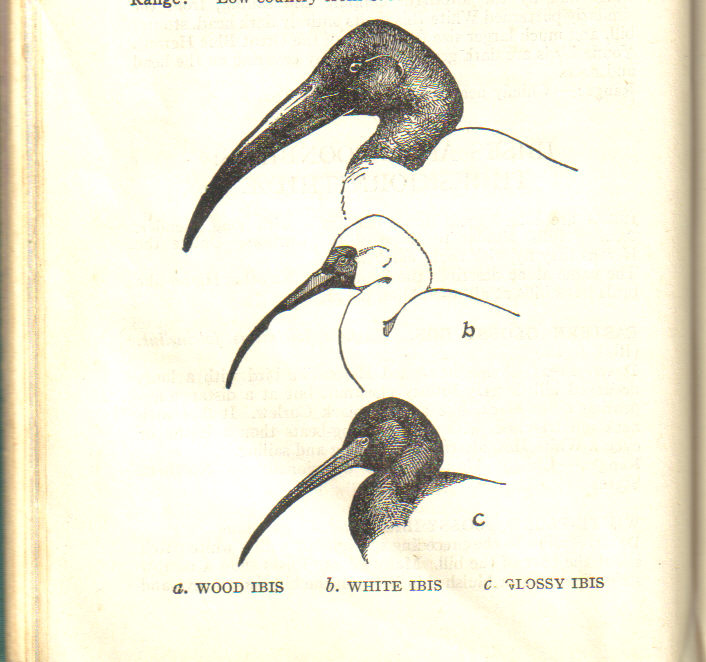
remember looking through my 1939 Peterson's A Field Guide to the Birds
at such exotic southern birds as the Wood Ibis (now properly known as
Wood Stork), White Ibis and Limpkin. None of these three were included
among Peterson's glossy plates. The former appeared as an ink drawing
of its head, comparing it to the White Ibis, which also was not
otherwise depicted. (The Reddish Egret, another Deep South specialty,
was considered to be so rare that it did not even deserve an image).
A
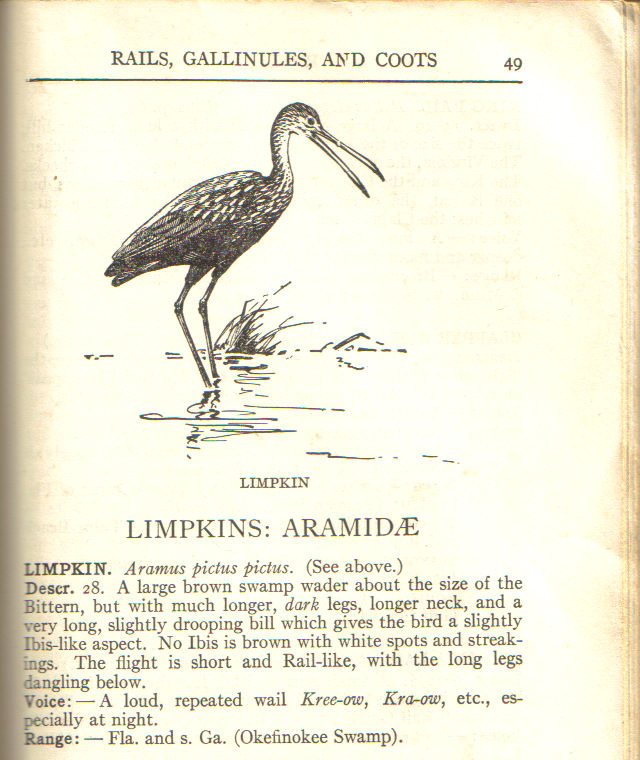
Limpkin was shown calling, and Roger described its cry as "A loud,
repeated wail, Kree-ow,
Kra-ow ,
etc.,
especially at night:"
All
these birds had two things in common: they were long-legged waders
that I imagined moving through still water among moss-draped trees, and
I held out little hope of ever seeing any of them. In those
post-Depression days our travel was constrained by the limitations of
our family car, a 1937 Ford sedan that, while younger than I,
already was showing signs of
age. Its exhaust pipe spewed blue smoke, and Dad carried at least a
couple of spare rebuilt fuel pumps and extra inner tubes so that he
could install replacements when they failed on the road. (I eventually
inherited this car and its problems, some aggravated by my own foibles:
(Chickie the Cops!)
For
our family, Florida was indeed a far-off place, as were
destinations anywhere north of Derby, Connecticut, west of
Philadelphia
or south of Washington, DC, places where we had close relatives. I held
hopes of one day seeing a Northern
Mockingbird, a Tufted Titmouse, or a Carolina Wren. In my day they were rarely observed in
the northern part of New Jersey, but now all three
species are common there, . Happily, the Northern Cardinal, which
disappeared from its northern range during the early 1900s, (presumably
driven out by severe winters) began to repopulate the area around New
York City in the mid-1930s and had become quite common in our suburbs
by 1945. Similarly, the Tufted Titmouse population was to explode there in
the mid-1950s.
Of
all the Florida specialties, I was most fascinated with the demure
Limpkin, named for its halting gait, and famous for its haunting "mad
widow" calls that pierced the night. Hear
the cry of the limpkin at this link.
Arthur Cleveland Bent, in his classic
Life Histories of North American Birds series wrote (ca 1927):"The
voice of one crying in the wilderness" is the first impression one gets
of this curious bird in the great inland swamps of Florida." He goes on
to quote from a letter he received from T. Gilbert Pearson, who
investigated the status of the limpkin in Florida : "In May, 192l, I
left Leesburg, Florida, in a motor boat, crossed Lake Griffin and
descended the Okiawaha River to its confluence with the St. Johns
River. During this trip of three days, in which a constant lookout was
kept for limpkins, only 11 individuals were seen and another was heard
calling one morning near our camp. Three of the birds were so tame that
it would have been very easy to have shot them from the boat with a .22
rifle. In one case we passed within 40 feet of a limpkin sitting on a
dead limb. The noise of the motor boat did not even cause it to leave
its perch. Natives along the river told me the bird was excellent for
food and some years ago it was not an uncommon custom to shoot 20 or 30
before breakfast... The bird is so easily killed, so highly esteemed as
food, and is found in a State where so little attention is paid to the
enforcement of the bird and game laws, the prospects of its long
survival are not at all encouraging.
If ever I got to Florida, the Limpkin was the bird I most wanted to
see. Highly specialized in its diet, the Limpkin subsists almost
entirely upon Florida Apple Snails, which it can pluck from their
shells in in 20 seconds. Its bill is specialized for the task, as it is
compressed laterally like scissors, and its tongue is long, thin and
barbed, the perfect tool for extracting the body of the snail.
Nearly extirpated from
Florida 100 years ago by hunting and drainage of
its habitat, the Limpkin's population has recovered. Of greatest
concern is the threat to the native apple snail by competition from
introduced Channeled and Island Apple Snails, and by invasive exotic
vegetation that replaces the snail's food sources. Although it is
currently on the US Fish & Wildlife Service list of Birds of
Conservation Concern, the Limpkin is not one of the 200 birds on the American
Bird Conservancy and National Audubon Society's United States
Watchlist of species in greatest need of
immediate conservation efforts.
Mary
Lou and I finally got to see our first Limpkin in August, 2002.
Our daughter and her husband had just moved to Florida, and we were
visiting them from our home in New Mexico. Responsive to our desire to see a
Limpkin, they drove us to Loxahatchee National Wildlife Refuge in west
Palm Beach County. We all walked the trails, frantically searching for
one, as the skies darkened and thunder boomed in the distance. Under
the threat of the approaching thunderstorm, I retreated to the car
ahead of them, but they continued their quest. Just as the rain started
falling, they ran back to join me, calling excitedly that they had
found a Limpkin!
Of
course, I thought they were fooling me, and after the storm's
initial fury subsided a bit, my son-in-law convinced me that they had
indeed seen the bird. Still suspicious, I accompanied him in the heavy
rain to a ditch about a hundred yards away from the parking lot. Sure
enough, there was a Limpkin, politely enduring the downpour as it
awaited my return. That Limpkin was our first Florida life bird. In
addition, we saw the endangered Snail Kite, which also is dependent
upon Apple Snails as its food source.
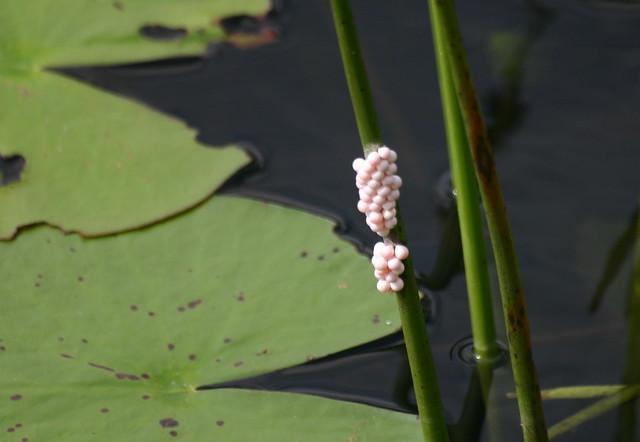
These
Apple Snail eggs were deposited on a suitable plant stalk at Long Key
Natural Area in Davie, Florida:
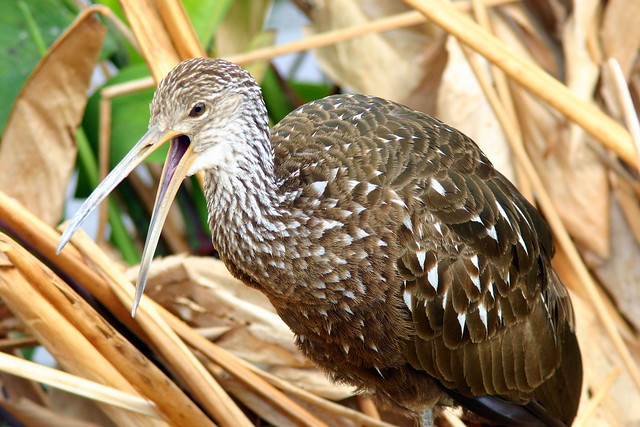
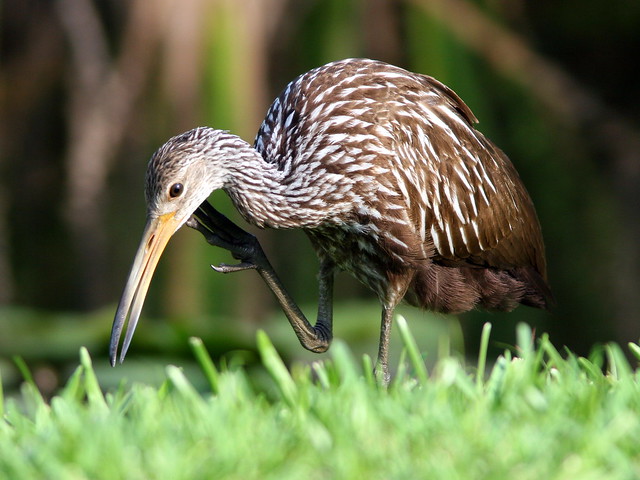
Limpkins
are quite common at Wakadohatchee
Wetlands in Delray Beach...
...In Green
Cay Wetlands in Boynton Beach...
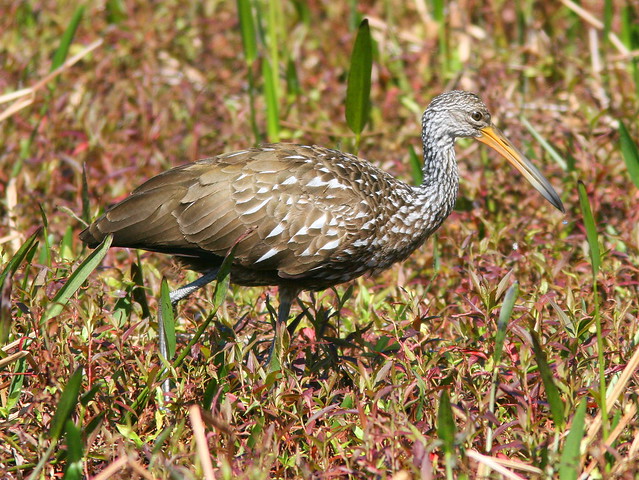
...and at Shark Valley in Everglades National Park:
In March, 2008 I found this Limpkin, well camouflaged, on a nest in
Loxahatchee NWR. Its mate was standing guard, and I did not approach
very closely. Males are known to viciously attack any creature that
gets too near, including humans:

Now,
most of our encounters with Limpkins take place at
nearby Chapel Trail Nature Preserve in Pembroke Pines, Florida..
Earlier this year, we heard two Limpkins calling, one on each side of
the boardwalk. To my ear, some of the Limpkin's cries include rattling
sounds somewhat similar to those of the Sandhill Crane, a related
species.
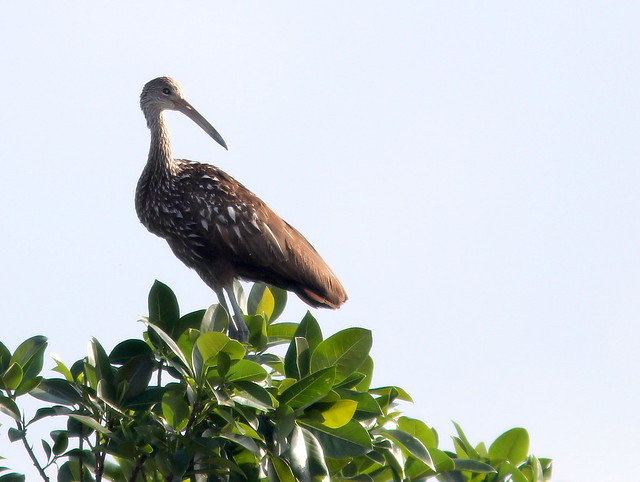
Suddenly, one of the Limpkins flew up to the top of a small tree:
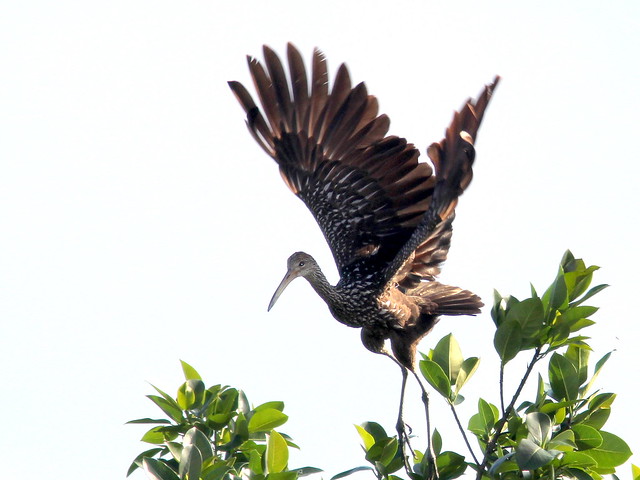
It
then surprised us by flying in our general direction:
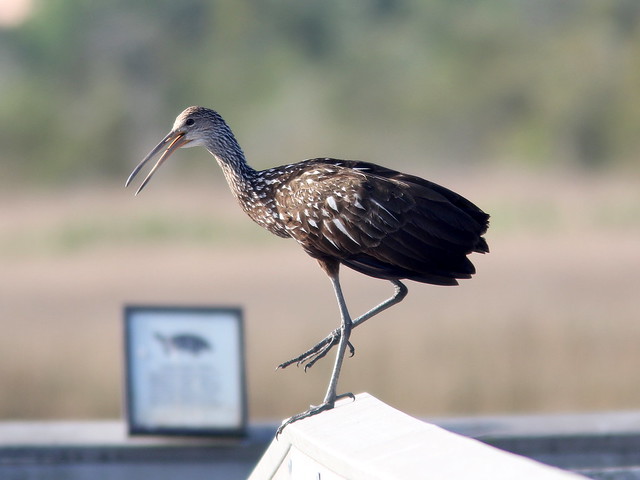
The
Limpkin landed on the boardwalk railing and called again :
When
I processed the photo, it provided a clear view of the Limpkin's
unusually long and slender tongue:
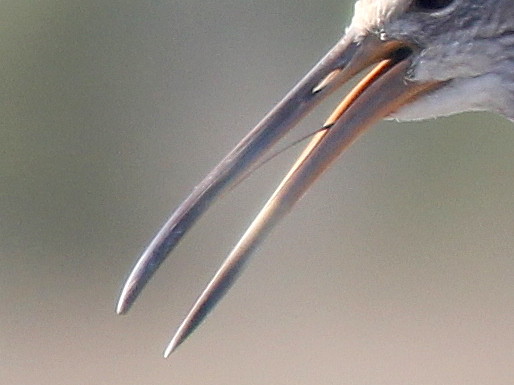
"Superficially
it looks like a large, heavyset ibis with an erect stance. The neck and
bill are long, the latter laterally-compressed and slightly decurved,
taking a sudden abrupt bend to the right close to the tip. Tip of the
lower mandible is twisted horizontally and sharpened against the tip of
the maxilla, an adaptation for removing snails from their shells. The
tongue reaches the end of the bill and splits into horny filaments at
the tip." www.faunaparaguay.com/aramidae.html
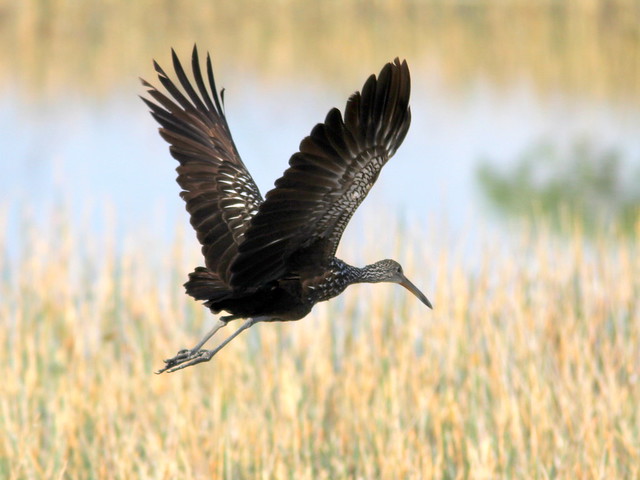
It
then flew off in the direction of the second Limpkin:
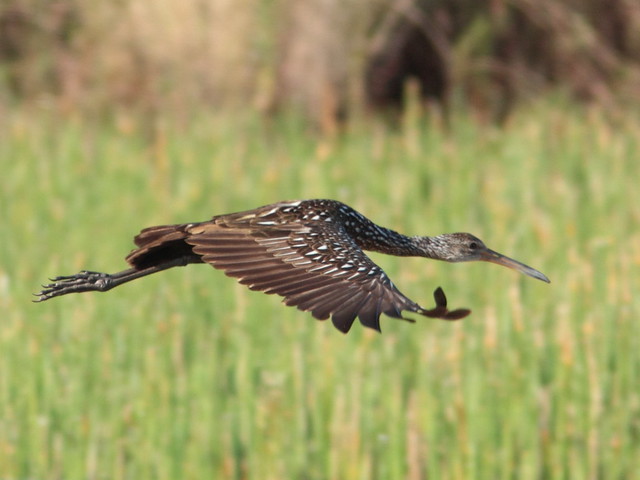
Our most recent Limpkin
sighting was this fly-by, also at Chapel Trail:
Visit http://blog.rosyfinch.com