We returned to NE Illinois for the second time this spring. Because of a flight cancellation we missed celebrating our daughter's birthday there, but MaryLou did take part in our granddaughter's Confirmation ceremony. Although our stay was brief and I was still fighting bronchitis, I made time to visit a few birding patches near our daughter's home.
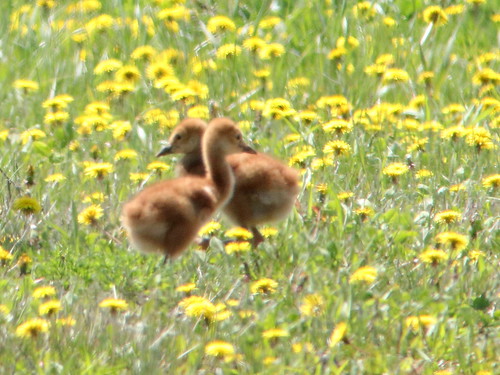
While looking for sparrows in the last undeveloped plot in the Village of North Aurora, adjacent to Jones Meadow Park, I encountered a pair of Sandhill Cranes with two very young colts. They foraged among the yellow flowers in the pasture:


Young cranes are called "colts." The dictionary defines "colt" loosely to include, besides male horses and firearms, as "a young or inexperienced person." Although I could not trace the origin of its application to these birds, it is said to reference their long strong legs.
The colts stayed close to their parents as they moved along. Although the chicks are hatched with their eyes open and are active and capable of foraging on their own, their parents feed them or help them find food for the first week or two. Their diet consists mostly of seeds and other plant material, but they do prey upon insects and small vertebrates when encountered.
I witnessed an adult feeding an unidentified morsel to one of the colts:


Colts become competitive as they age, and parents are said to tend them separately to discourage fighting, but these little ones seemed to get along very well:

Working out of my laptop in Illinois, I have fallen behind in processing the photos, so here are a few from Florida during the days between trips.
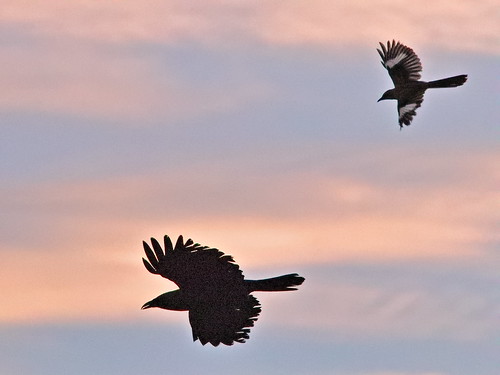
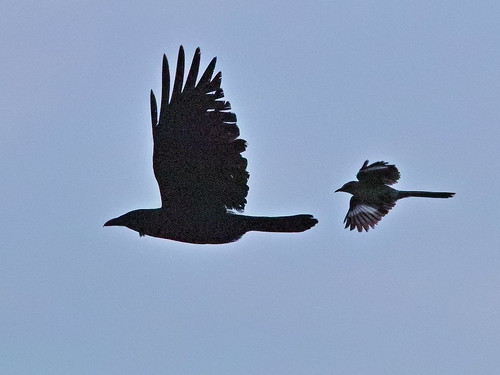
A Northern Mockingbird persistently attacked a Fish Crow:
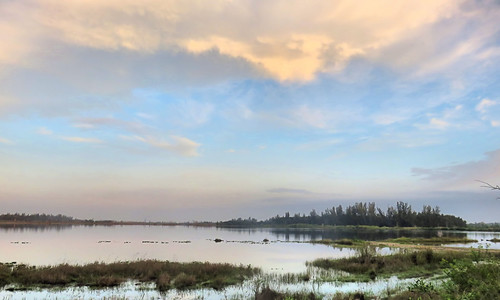
The Pine Bank reflected on still waters before sunrise on May 6:
 = = = = = = = = = = = = = = =
Linking to Misty's CAMERA CRITTERS,
Linking to Eileen's SATURDAY'S CRITTERS,
Linking to SKYWATCH FRIDAY by Yogi, Sylvia and Sandy
Linking to WEEKEND REFLECTIONS by James
Linking to BirdD'Pot by Anni
Linking to Our World Tuesday by Lady Fi
Linking to Wild Bird Wednesday by Stewart
Linking to Wordless Wednesday (on Tuesday) by NC Sue
Linking to ALL SEASONS by Jesh
________________________________________________
Please visit the links to all these memes to see some excellent photos on display
________________________________________________
It has been an eventful few days in our neighborhood Wounded Wetlands. Although spring migration has been slow, I added a (heard-only) Chuck-will's-widow to my patch list. A poor recording is my only documentation with no photos to share. It was quite near the trail about 40 minutes before sunrise. As has been the case with the Whip-poor-will, it stopped calling about a half hour before sunup.
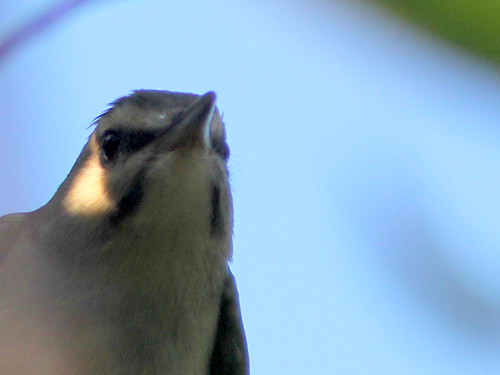
An unusual visitor was this Black-whiskered Vireo. It was only my second sighting at this location, and one of only two recorded in Broward County so far this year.
I found the first one at almost this exact spot on April 20, 2011. Its namesake throat stripes are distinctive:
This time I got much better photos when, for a few seconds, it sat still out in the open after it ate Lantana berries (May 4, 2019):


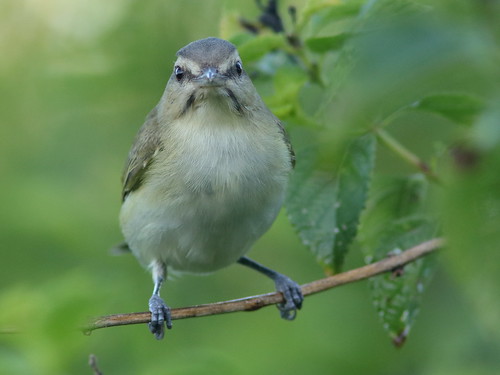
Black-whiskered Vireos breed in The Bahamas and Caribbean islands, but their US range is generally restricted to a migratory population in coastal mangroves of southern Florida. Their secretive habits make them hard to find as they glean for insects among the leaves. They are closely related to the similar Red-eyed Vireo. In fact, at first I misidentified it as the latter species. Close inspection reveals that, although its eyes have a reddish tint, it has a more massive bill and a duller brownish back:

Here is a Red-eyed Vireo for comparison (October 12, 2018):

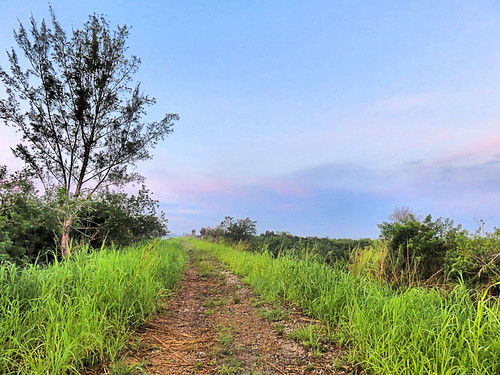
Two different Bobcats showed up, only two days apart. The first was a small female which stared at me from the high grass on the left side of this trail:
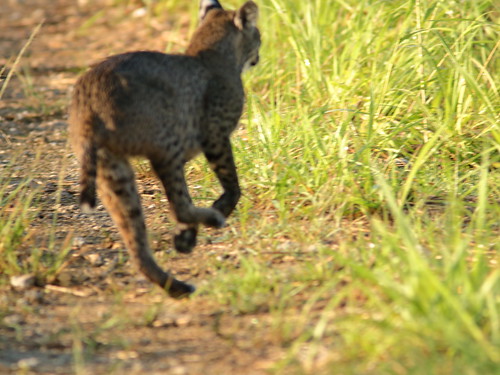
She jumped out and over the trail just as I raised my camera (May 3):

The other Bobcat was a large male, seen only about 100 yards away from where I saw the female. He walked leisurely across the gravel road (May 5):

He crouched down for a moment to check me out:

Male Bobcats usually occupy much larger territories than females. They seek out and mate with several but do not take part in rearing or defending the young. One of the local females appears to be quite pregnant (April 13, 2019):

We would expect her to avoid contact with the male and take such steps as covering feces and hiding in with her kits in a den. I can tell that a male is around when I find fresh Bobcat scat piles out in the open and close to each other, as this is one way they mark their territory.
A White-winged Dove peered out from the shadows (May 4):

Loggerhead Shrikes had disappeared for over two weeks, so I was happy when one posed in early morning sun on May 4:

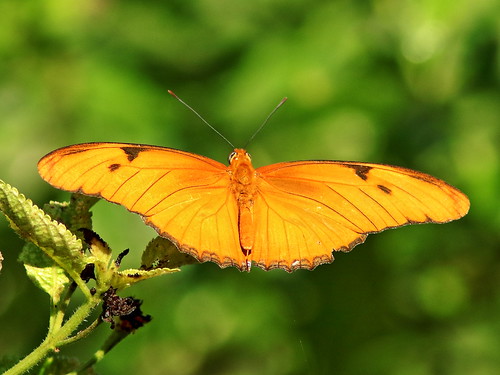
That same day I saw my first Julia longwing of the spring season. They have been very scarce since Hurricane Irma ravaged the area almost two years ago. This is a fresh male:
I had to get down on the ground to get a side view of a tiny but beautiful Dainty Sulphur:

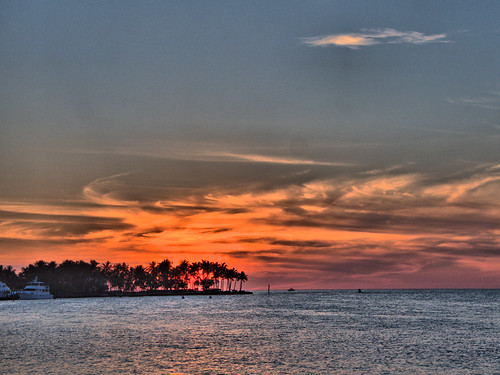
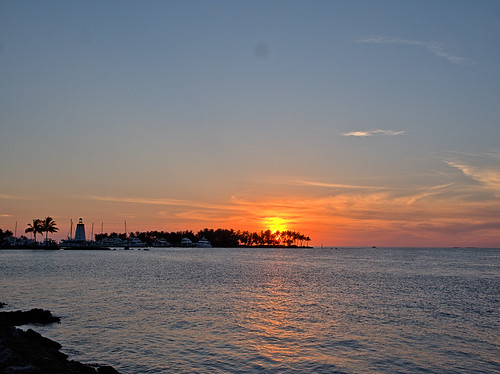
We spent the week after Easter at Tranquility Bay resort on the Florida Keys. These are views from the beach at sunset (April 22-25):

 = = = = = = = = = = = = = = =
Linking to Misty's CAMERA CRITTERS,
Linking to Eileen's SATURDAY'S CRITTERS,
Linking to SKYWATCH FRIDAY by Yogi, Sylvia and Sandy
Linking to WEEKEND REFLECTIONS by James
Linking to BirdD'Pot by Anni
Linking to Our World Tuesday by Lady Fi
Linking to Wild Bird Wednesday by Stewart
Linking to Wordless Wednesday (on Tuesday) by NC Sue
Linking to ALL SEASONS by Jesh
________________________________________________
Please visit the links to all these memes to see some excellent photos on display
________________________________________________