During the 18 years we resided in south Florida, I was disappointed if our early morning walks in the Wounded Wetlands provided sightings of less than 20 bird species. Here in inland northern Connecticut, I expected to find about ten "target" winter resident species. After settling in for a couple of weeks, I put up an iron shepherd's hook and hung a tube feeder filled with black oil sunflower seeds and a suet cake. It attracted absolutely no birds until the fourth day (January 13) when a Tufted Titmouse visited.


My photos were of poor quality, as I was shooting through the double-glazed windows of the front door, although I had carefully washed both inside and outside surfaces.
Almost immediately, there was an explosion of avian visitors. Black-capped Chickadees were next to arrive:


The titmice dominated the feeder, chasing away the chickadees, which flew in and quickly perched just long enough to grasp a single sunflower seed and fly back to a tree to hack open its shell.

I had mixed some white proso millet with the sunflower seeds. The titmice scattered the millet on the ground as they retrieved the black seeds. This was good for the ground-feeding Dark-eyed Juncos, which gathered under the feeder:


They were joined by White-throated Sparrows which scratched with both feet at the same time to expose the fallen millet seeds:


A male Northern Cardinal flew in. He attempted to take some of the sunflower seeds, but the perch was too small. He settled for whatever fell to the ground:

He was joined by a demure female cardinal:


The word "demure" popped into my vocabulary. I meant it to describe her more sudued but certainly beautiful plumage, not her attitude or "birdsonality."
A Blue Jay visited briefly:

The suet feeder attracted a Downy Woodpecker. Note that it has black bars on its tail.
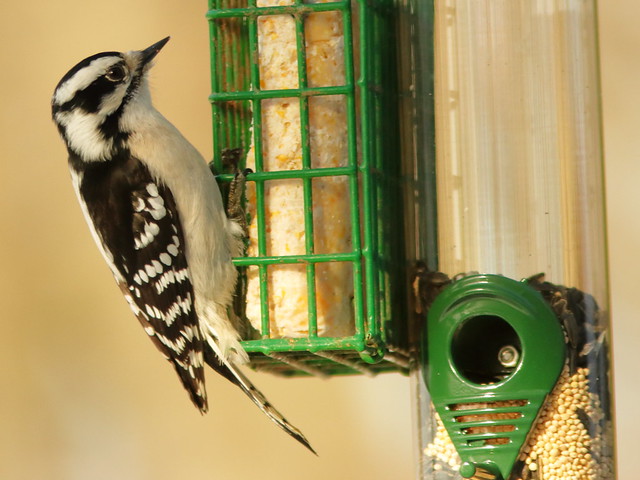
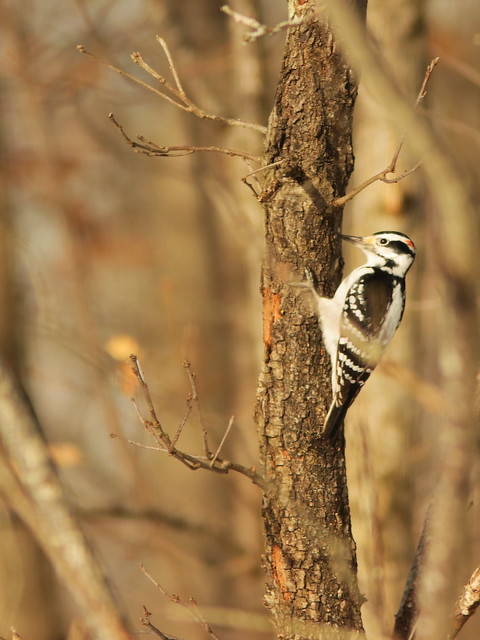
I was surprised when a Hairy Woodpecker suddenly arrived. While its plumage is nearly identical to that of the Downy Woodpecker, this larger bird has a proportionally longer bill (about the length of its head). It also lacks black bars on its outer tail feathers. (To remember this distinction I say that the Hairy "H'aint" got any black tail bars). Red on its head indicates that it is a male;:

While they did not visit the feeders, a flock of "Bonus Birds" settled into trees behind the feeder, too far away for good images but clearly identifiable as Cedar Waxwings:
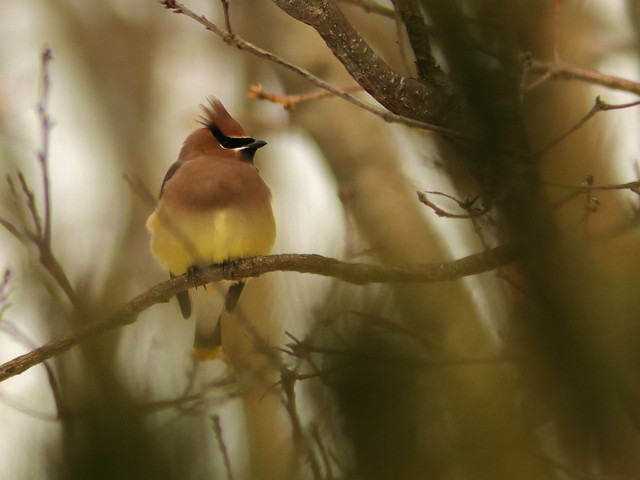
We were delighted when the waxwings flew into a holly tree next to our door to feed on its red berries. They were so close to an adjacent window that I could not fit the entire birds into the viewfinder:


Eight species on the first day! The birds seemed to be jumping for joy:


Cold night on January 15 (minus 16.1 C):

Over a foot of snow fell after I put up the feeder on January 9:

That night at 9:30 PM in ambient darkness I took this photo with my iPhone 11 Pro Max. The only light was a wash from a window to the left, and the hand-held exposure was 1.5 second. It revealed hidden color and beauty. The low light performance of the phone camera is amazing:

= = = = = = = = = = = = = = =
Linking to:
Fences Around the World
Skywatch Friday
Weekend Reflections
Saturday's Critters
BirdD'Pot
All Seasons
Wordless Wednesday (on Tuesday)
Natasha Musing
Our World Tuesday
Please visit the links to all these posts to see some excellent photos on display
________________________________________________