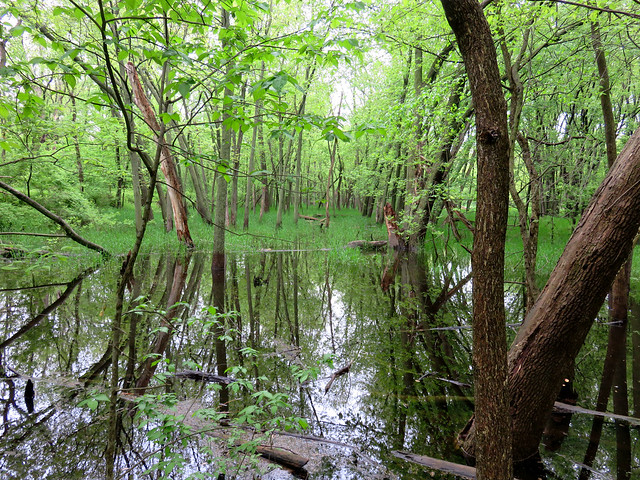
Due to the frequent rain, our NE Illinois second home was under a flood watch during the first part of May. The Fox River was quite high. Its flood plain provided some nice reflections:
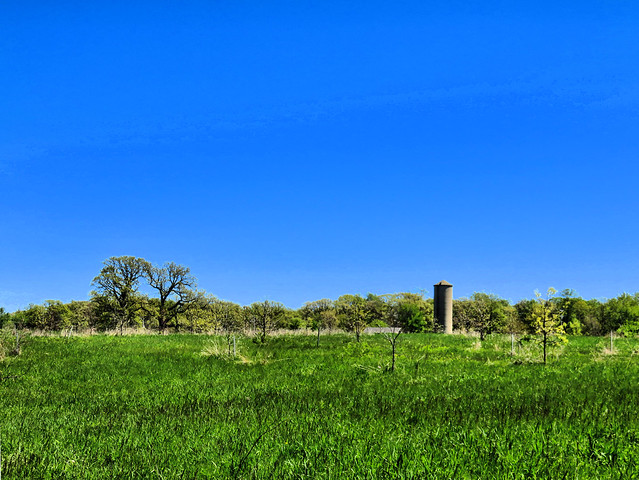
The skies were either cloud-bound or spotlessly blue. Here is the entrance to nearby Nelson Lake preserve in Batavia, on a beautiful morning in early May:
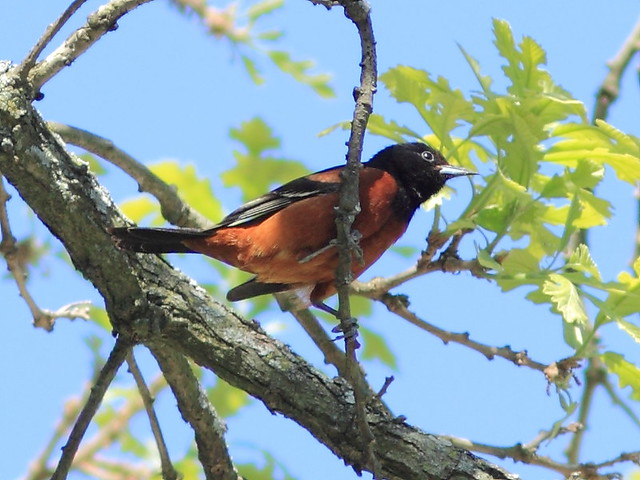
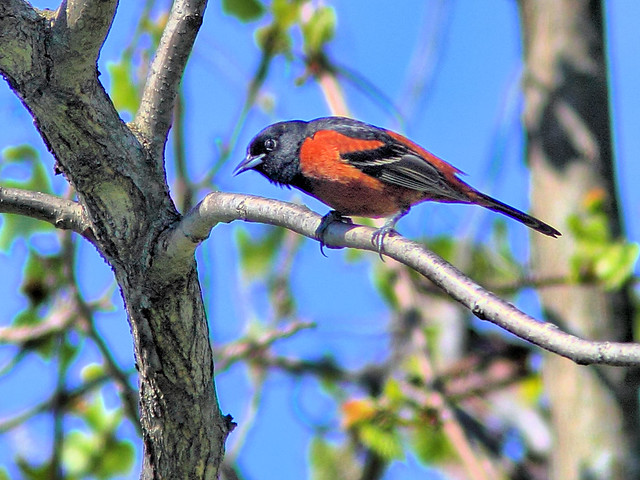
The Orchard Oriole is one bird which I have had trouble locating and photographing. It often mixes in with the much more colorful Baltimore Orioles, and seems to prefer to hide amid the leaves in the treetops. Its song is fairly distinctive, and I have heard it much more often than I have seen the originator.
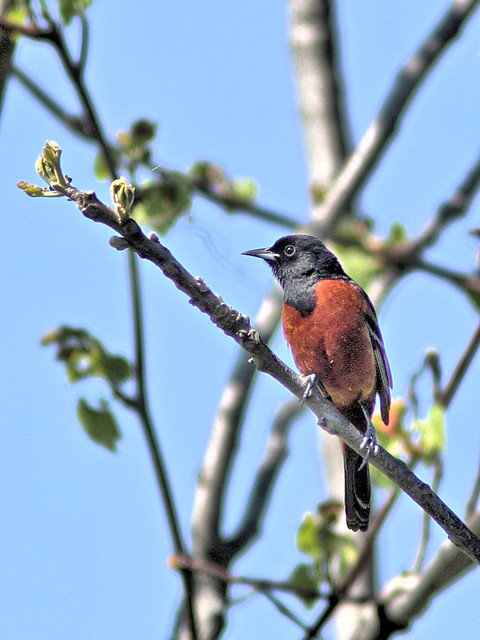
A bit drab, the male can appear to be all black in poor light. Indeed, orioles are members of the blackbird family, but the Orchard Oriole is smaller than any of our other native blackbirds. It breeds over the eastern half of the US into central Mexico but its range generally stops short of Canada and does not include the Florida peninsula. It winters in Central America. It spends relatively little time on its breeding grounds, arriving in May, raises only one brood, and usually departs south in July.
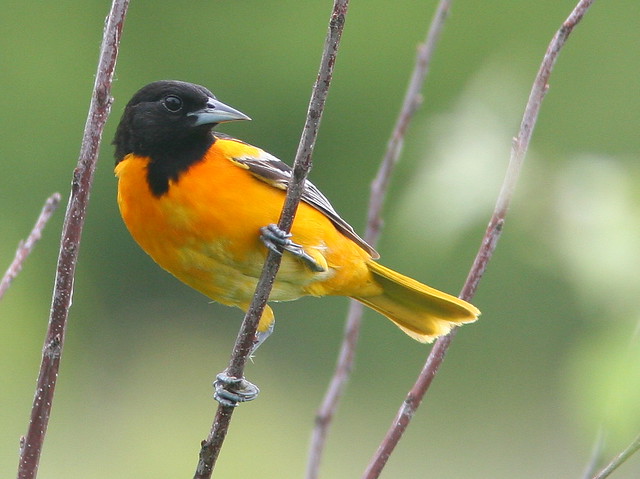
By way of comparison, here is the more conspicuous Baltimore Oriole, which is bright orange rather than chestnut brown:
This was my first decent image of an adult male Orchard Oriole, obtained back in May, 2013:
Last year, also in early May, another male cooperated with me:
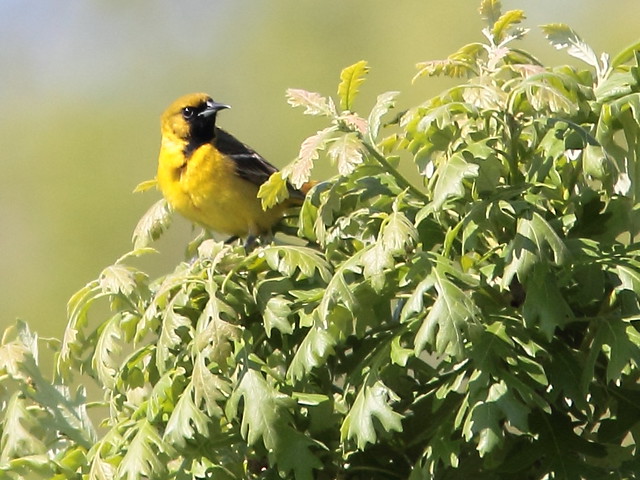
Immature males and females have yellow plumage rather than red. Younger males, up into their second year, have varying amounts of black on their face, head and upper breast. I first thought this one to be a female, but the heavy shadows on its chin and chest obscure the markings of a young male (May, 2015):
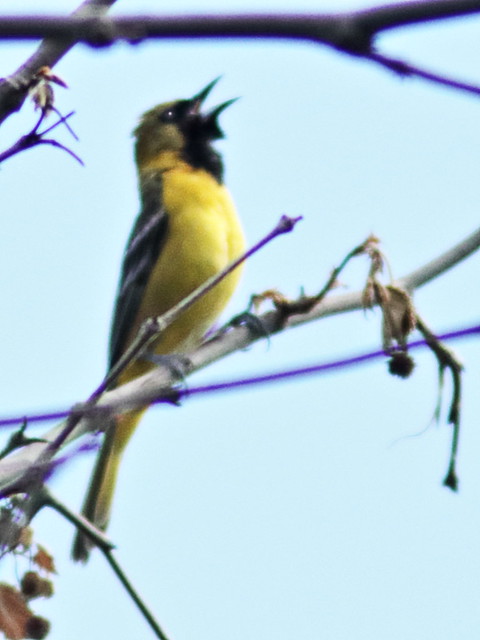
This spring, on May 12, at the Japanese Garden in Fabyan Forest Preserve in Geneva, I documented an adult male in a horrible photo:
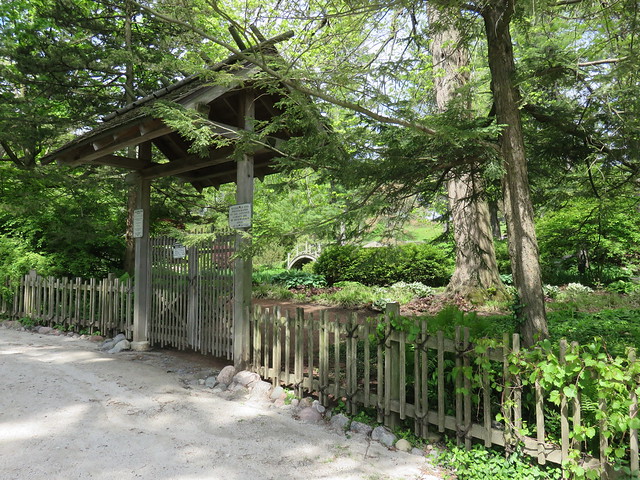
To compensate for such a poor showing, here is the fenced gateway to the Japanese Garden:
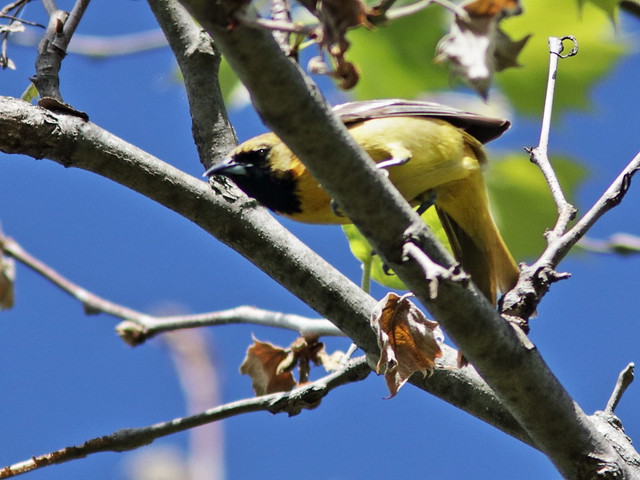
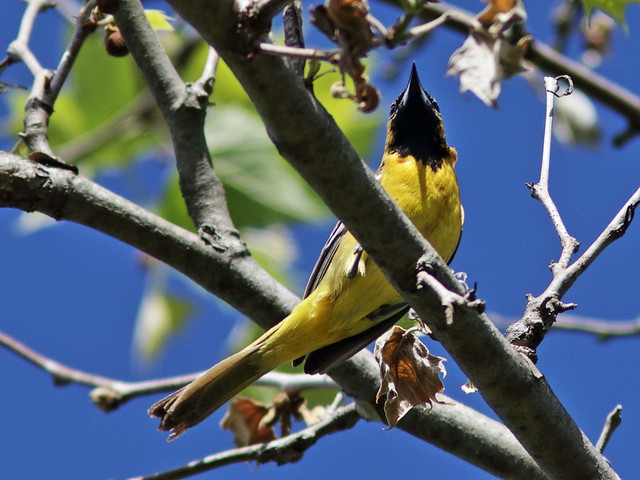
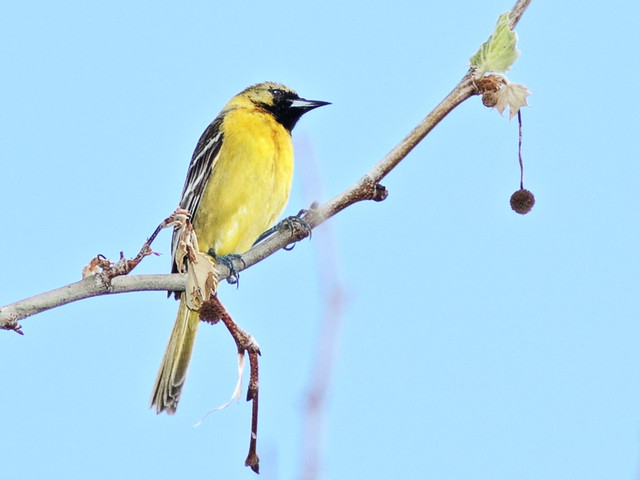
In late may, before returning to Florida, I heard the distinctive song of a sub-adult male Orchard Oriole coming from high in a tree along the trail in Lippold Park. It kept moving from one tree to another, usually flying away just as I brought it into focus. Mary Lou helped me track its meanderings, but continuing my run of bad luck despite my best efforts, I wasted many migapixels on blurry underbelly images and sky shots.
Here is a typical shot, heavily cropped...
...and a few more:
= = = = = = = = = = = = = = =
Linking to Misty's CAMERA CRITTERS,
Linking to Eileen's SATURDAY'S CRITTERS,
Linking to FENCES AROUND THE WORLD by Gosia
Linking to SKYWATCH FRIDAY by Yogi, Sylvia and Sandy
Linking to WEEKEND REFLECTIONS by James
Linking to BirdD'Pot by Anni
Linking to Wild Bird Wednesday by Stewart
Linking to Wordless Wednesday (on Tuesday) by NC Sue
Linking to ALL SEASONS by Jesh
________________________________________________
Please visit the links to all these memes to see some excellent photos on display
________________________________________________
A favorite birding site near our NE Illinois home is the 175 acre Bliss Woods Forest Preserve in Sugar Grove. A bike trail connects Bliss woods with the 402 acre Hannaford Woods-Nickels Farm Forest Preserve, forming a complex known as the Bliss Woods-Waubonsee College open space assemblage. This protects a varied habitat including hardwood forest, open prairies and wetlands. Most of this section of Illinois is flat land, planted in miles and miles of corn and soybeans, but thanks to preservation of the remnants of the Kaneville Esker, this preserve is a green gem, with rolling hills and valleys. Ridges (eskers) and prominent mounds (kames) interrupt the monotony of the prairie. These features, as well as prairie potholes (also known as kettles), were produced about 13,000 years ago by retreating glaciers. Many have been disturbed or removed, as they are a convenient source of gravel.
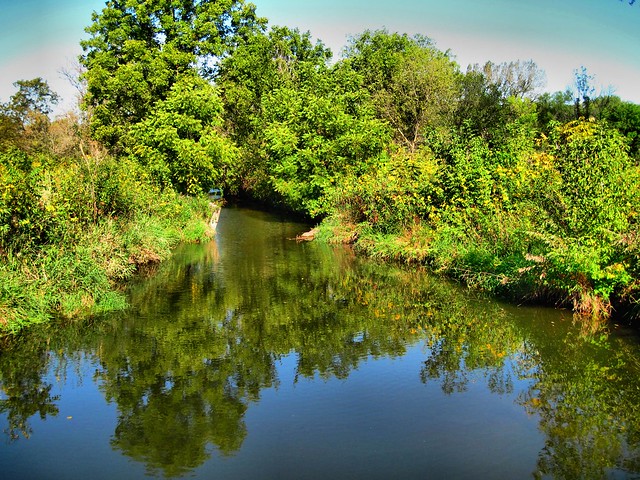
Blackberry Creek as it courses through Bliss Woods:
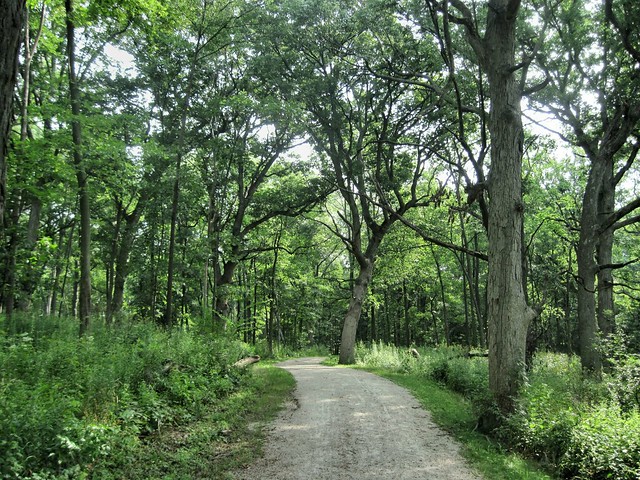
Woodland path in Hannford Woods:
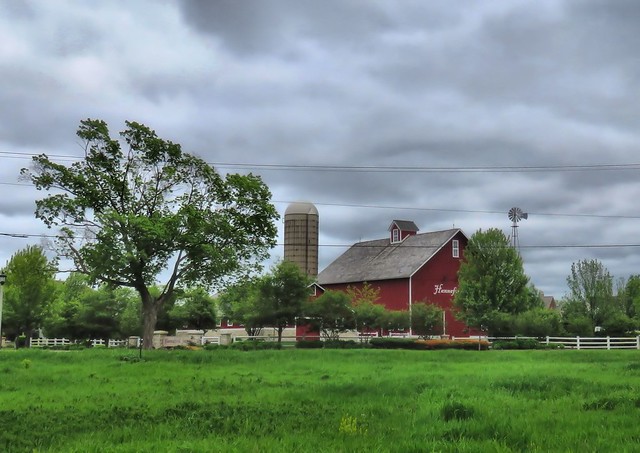
This barn, surrounded by a white rail fence, is on private property just across from the entrance to Hannaford Woods:
We visited the preserves several times before returning to Florida on May 24. On the first visit to Bliss Woods we obtained only distant views of a Scarlet Tanager, one of our favorite birds. Two days before returning to Florida we tried one last time. The morning started out windy and quite chilly at 46 degrees F (7.8 degrees Celsius). The tree limbs were moving so much that we held little hope of seeing many birds at all. Some of those which took flight actually flew backwards!
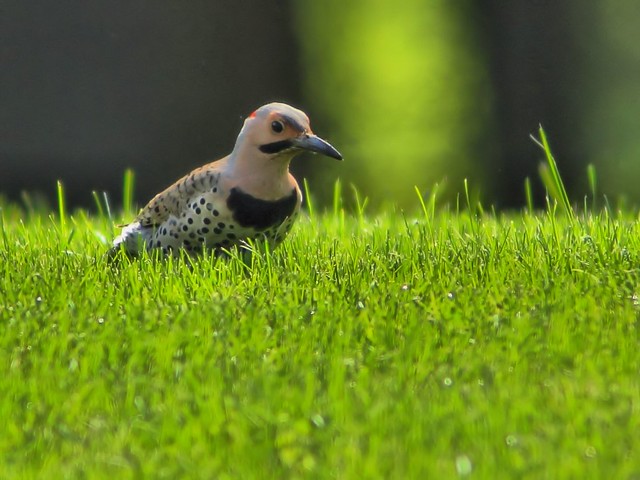
A male Northern Flicker was not affected by the wind as he searched for ants on the mowed lawn in the picnic area:
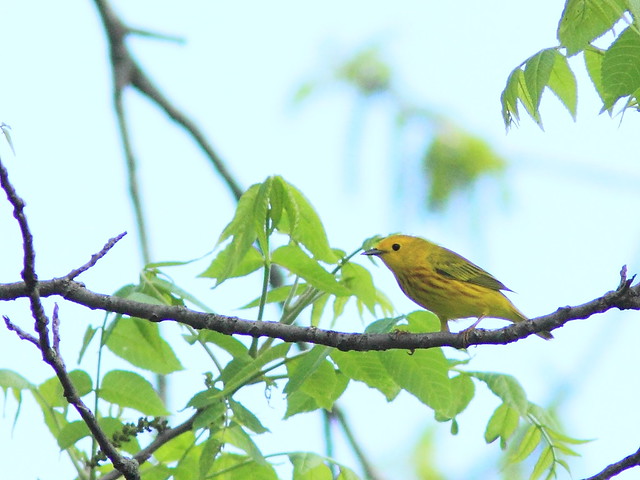
The winds subsided and the skies brightened, though the temperature dropped a couple of degrees. Yellow Warblers were already gathering nesting materials. This one sang in a small tree on its territory:
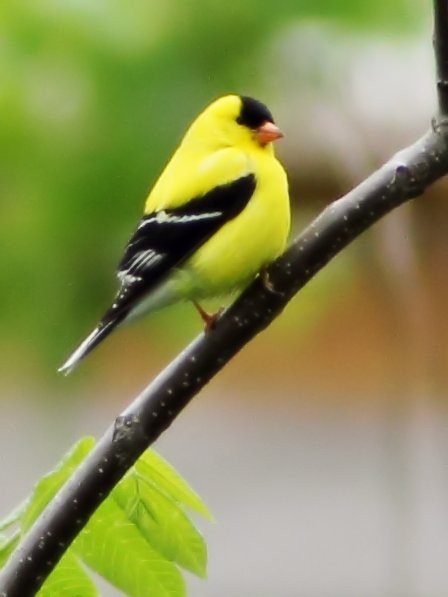
American Goldfinches bounded about, carefree, as they will not breed until later in the season:
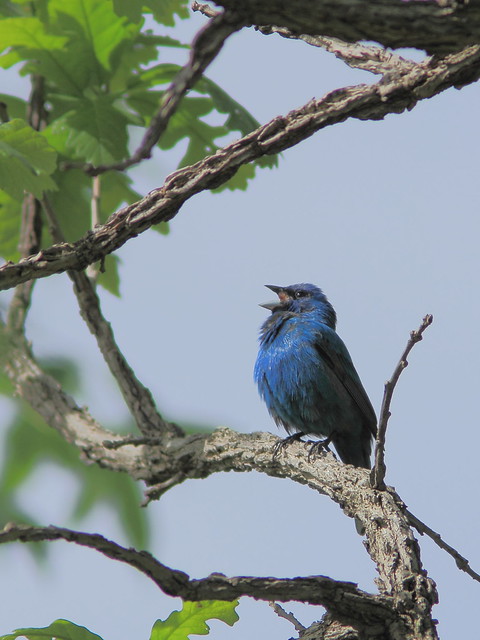
Indigo Buntings had arrived en masse:
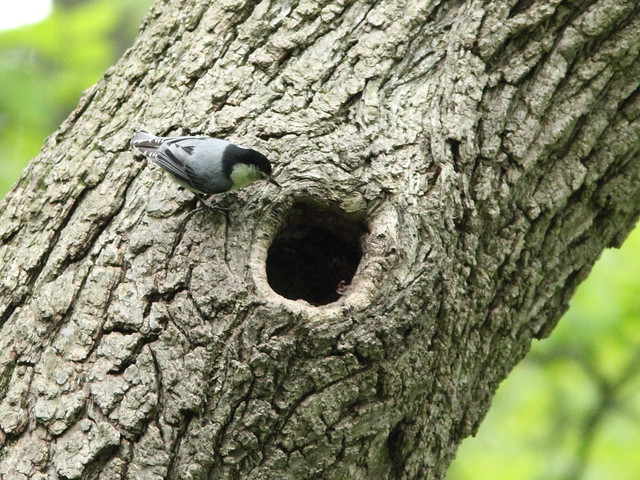
A White-breasted Nuthatch seemed to be exploring a nest hole. It kept poking its head in but never entered. I wondered if it might be occupied by another creature such as a squirrel or chipmunk:
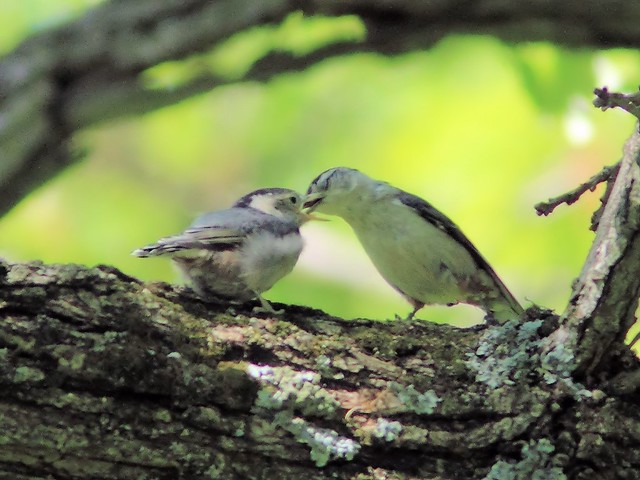
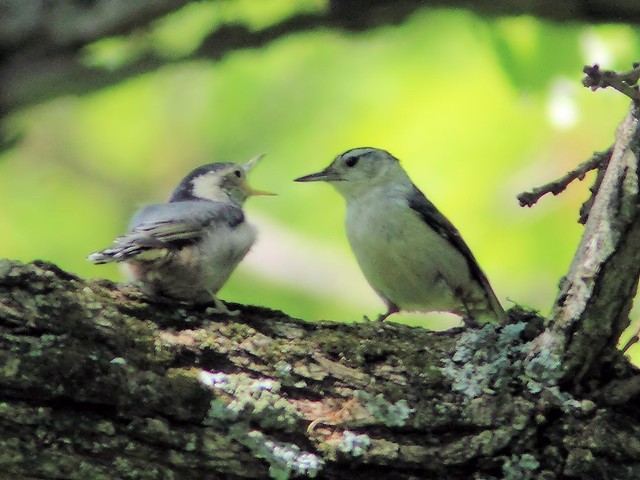
High in a nearby oak tree, I spotted a White-breasted Nuthatch fledgling:
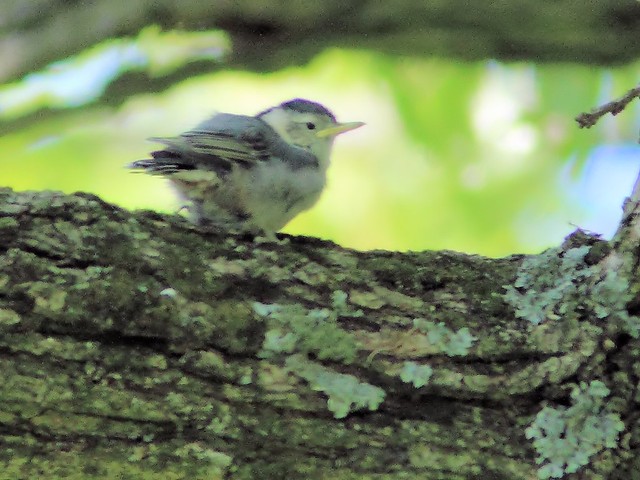
As a parent approached with a grub, it started begging silently:
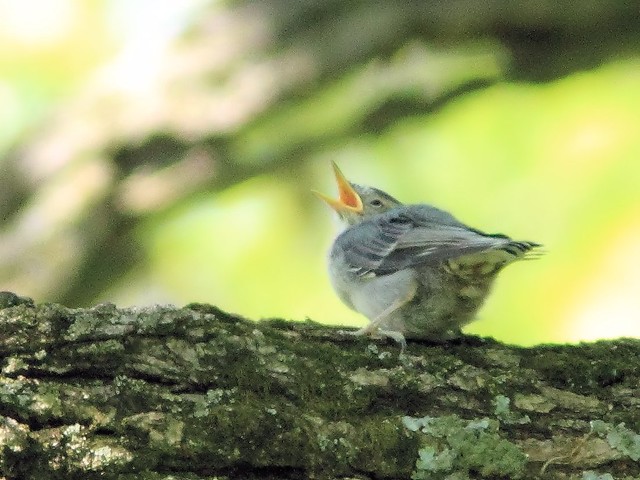
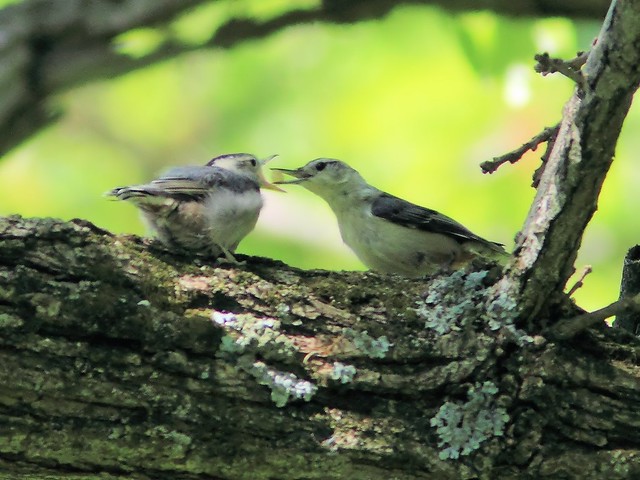
"I still want more!"
This first year male Orchard Oriole was the second we saw this week:
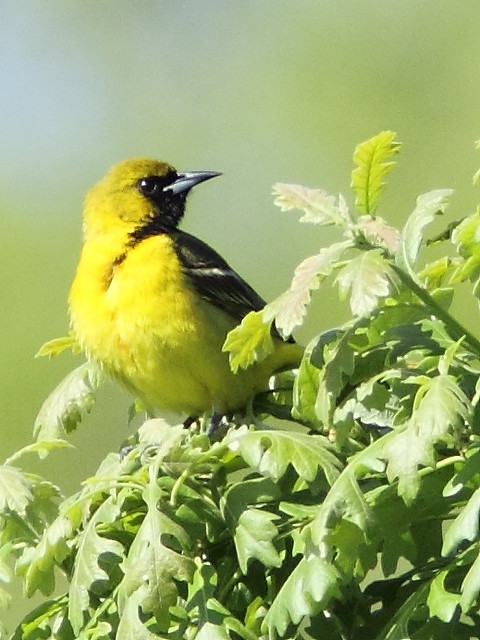
A male Orchard Oriole in full breeding plumage flew by but I was unable to get a photo, so here is one from May 14 a year ago. It is smaller than a Baltimore Oriole and has brick-red plumage rather than bright orange of the latter species:
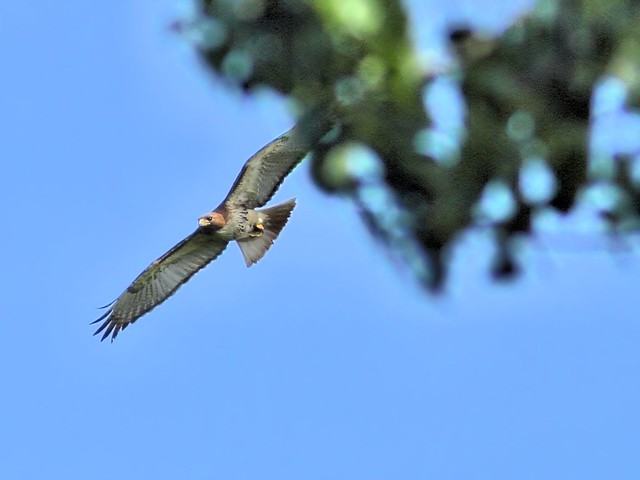
A Red-tailed Hawk swooped in low. Not a threat to small birds, it was probably hoping to surprise a rabbit or squirrel:
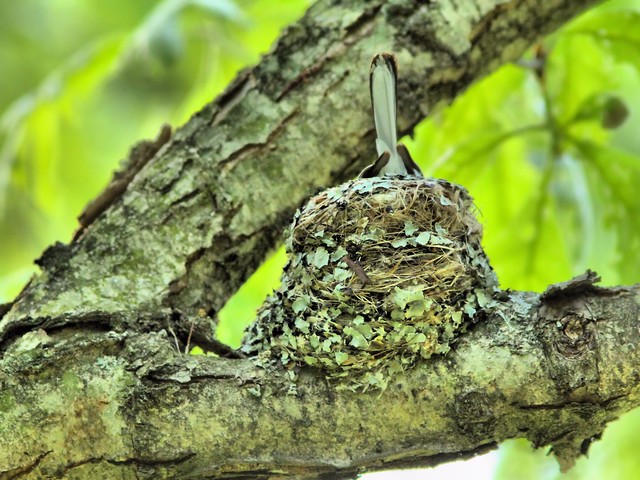
We have been watching a pair of Blue-gray Gnatcatcher build a nest which straddles a low-hanging limb of an old oak. Now the bird is sitting tight, surely incubating its eggs. We were pleasantly surprised to see that the fragile-looking nest had not been disrupted by the high winds and rain:
Finally, we were rewarded when a male Scarlet Tanager suddenly flew into full sun in a tree just above the trail:
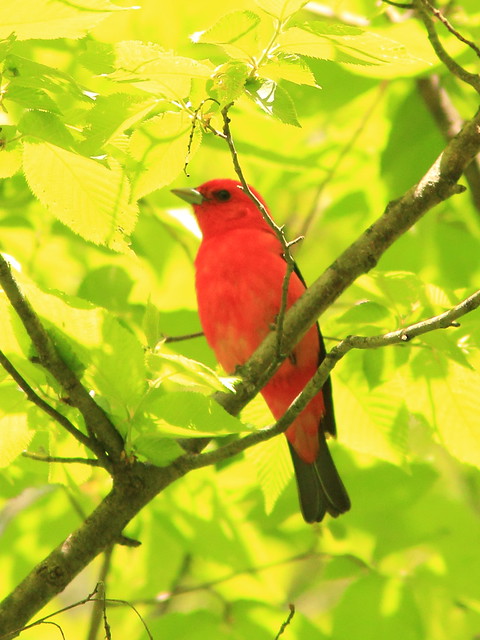
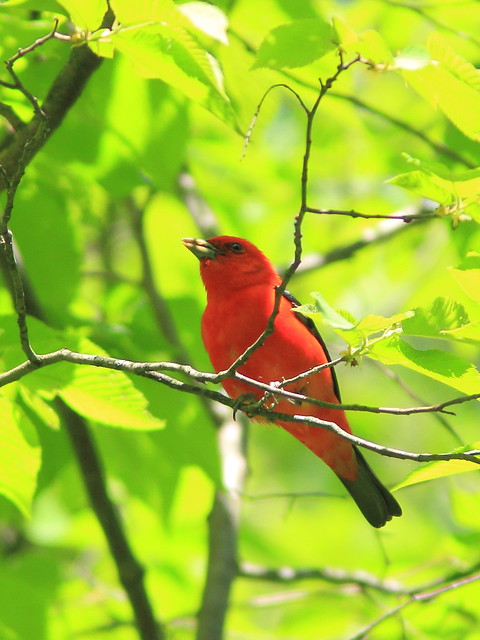
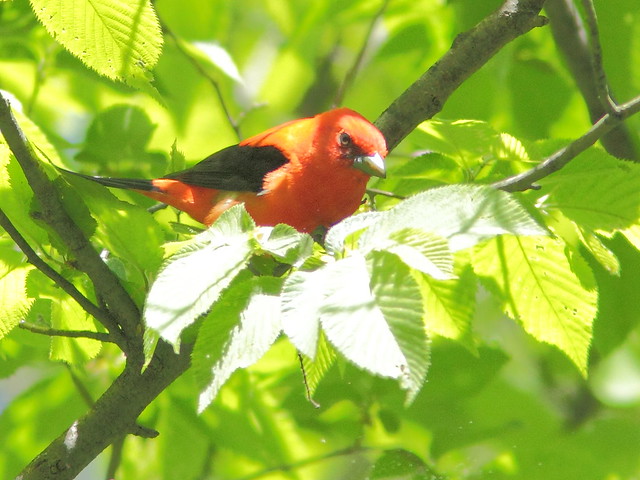
His coat is deeply scarlet except for black wings and tail. The sun was high and the leaves cast strong dappled shadows. Nearly all of my dozen photos were spoiled because of the sharp contrasting patches of light. This one better illustrates the problem, as the red color (and the green on the leaves) is washed out in the highlights:
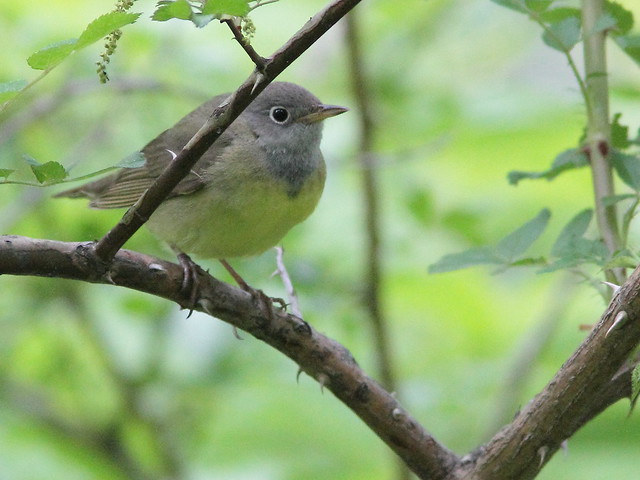
Speaking of highlights, my final visit to Hannaford Woods produced a Life Bird! This does not happen very often these days, as I have lost interest in chasing after target birds. While walking the trail I heard a very loud warbler song coming from close to the ground nearby. I simply could not identify the song and tried to find the bird for the better part of half an hour. The understory was so dense and it was so tantalizingly close by!
Before continuing down the trail, I recorded the song on my iPhone, hoping to research it and identify the singer. On the way back I replayed the song and the bird responded immediately. I caught a glimpse of it, singing a few inches off the ground. It had a brown back and a distinct eye ring, but it flew off in less than a second. It continued to sing in the distance, but to my surprise a second bird appeared and sat still long enough for me to capture a 25 second burst of images before it flew off. My photos confirmed that it was a Connecticut Warbler, the first I had ever seen, and the first County record this spring.
This seclusive but not rare warbler breeds in the far north Central US and central Canada. Despite its name it is rarely found in the NE United States, and then only in the fall. The few winter records are from South and Central America.
Connecticut Warbler (May 19, 2015):
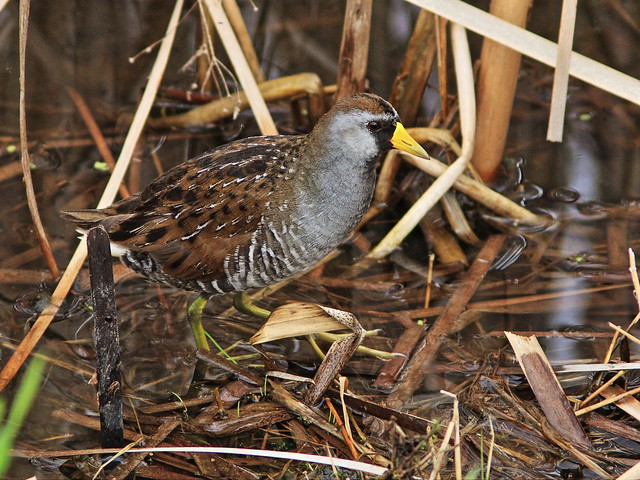
Another "first" occurred early in our stay. I was looking for a Sora in Jones Meadow Park, a small wetlands near our home. Sure enough, I saw two Soras and heard one or two others:
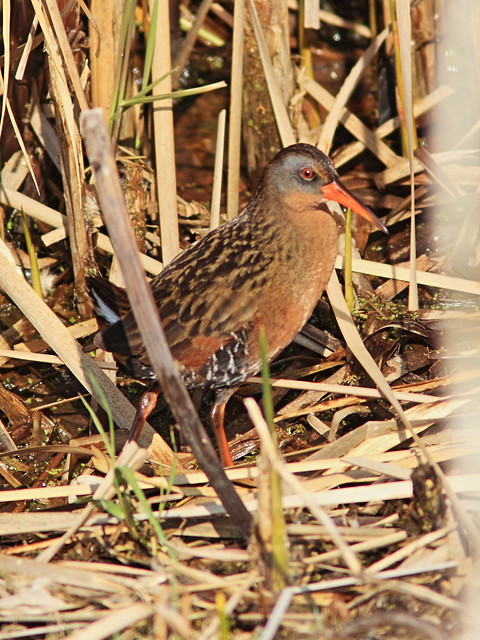
Then, a Virginia Rail started calling and suddenly strutted out at the edge of the marsh:
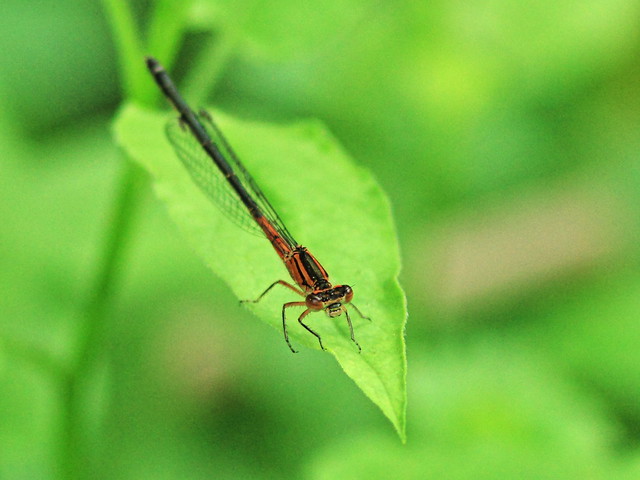
A damselfly, which I believe to be a female bluet species, allowed me a close-up shot:
 = = = = = = = = = = = = = = =
Linking to Misty's CAMERA CRITTERS,
Linking to Eileen's SATURDAY'S CRITTERS,
Linking to GOOD FENCES by Tex (Theresa).
Linking to SKYWATCH FRIDAY by Yogi, Sylvia and Sandy
Linking to WEEKEND REFLECTIONS by James
Linking to BirdD'Pot by Anni
Linking to Wild Bird Wednesday by Stewart
Linking to I Heart Macro by Laura
________________________________________________
Please visit the links to all these memes to see some excellent photos on display
________________________________________________