Showing posts with label Red-shouldered Hawk. Show all posts

Thursday, September 2, 2021

Crops & Clips: Flashback to September, 2018

As I do each month, I enjoyed looking back over my archived photos, taken three years previously, to remember how things were then and maybe get some idea of what to expect this year. As usual, I searched for images which reflected favorite memes: critters of all kinds (especially birds), skies and clouds, reflections, flowers and fences, as well as scenes which speak for themselves. 

We started the month at home in Florida. Southbound fall warblers were starting to pass through, but prevailing winds directed most of them to the west (Gulf) coast. My warbler photos were limited to--

Louisiana Waterthrush:

Prairie Warbler:

Female Common Yellowthroat:
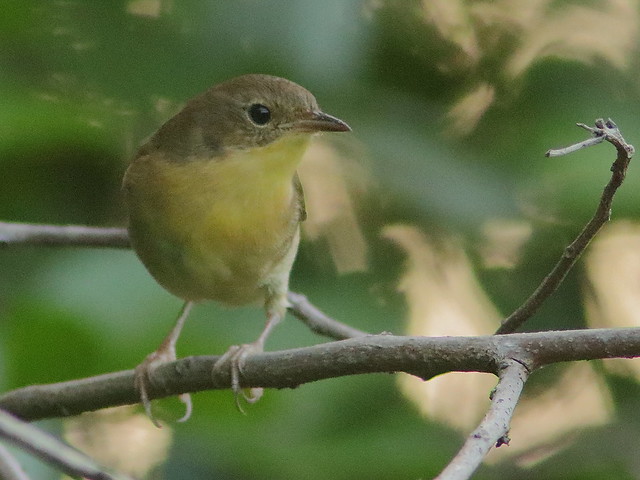
Black-and-White Warbler:

In the rookery (which has since been essentially abandoned), a Yellow-crowned Night-Heron roosted in a tree which would soon be cut down:

A tiny Bella or Rattlebox Tiger Moth rested on a blade of grass:

When is a goose not a goose and a duck is not a duck? Two gooselike members of the avian Order of Anseriformes (Ducks, Geese and Swans) enjoy rather uncertain positions as to where they fit into the classification scheme. Both bear some resemblance to each other and to the Shelducks, a group of large ducks which are smaller than geese. 

Male Muscovy Duck and Egyptian Goose (Drakes or Ganders, take your pick) posed nicely in our back yard, exhibiting rather similar characteristics of heavy bodies and thick goose-like necks. Both of these introduced exotic species are populating the urbanized areas of south Florida.

We visited our daughter's family in Illinois, our first return after selling our condo. Wasting no time, we headed to Nelson Lake, our favorite hot spot. In the prairie, Milkweed Bugs clustered on a seed pod of their host plant:


Fall flowers turned the fields to yellow:


A stately old oak at the edge of the golden prairie hosted Red-breasted Nuthatches which earned their nickname of "upside-down birds:"


I applied "oil painting" effects to this photo of a red barn and silo across the road from the preserve (click to enlarge):

Aging Tibetan Mastiff Agramonte and his buddy Casador lazed in our daughter's back yard:

By the end of the month we were back home in Florida, where a juvenile Green Heron provided evidence that at least some of the herons had nested successfully in the rookery:

It was a good month for flight shots, this of a Tricolored Heron...

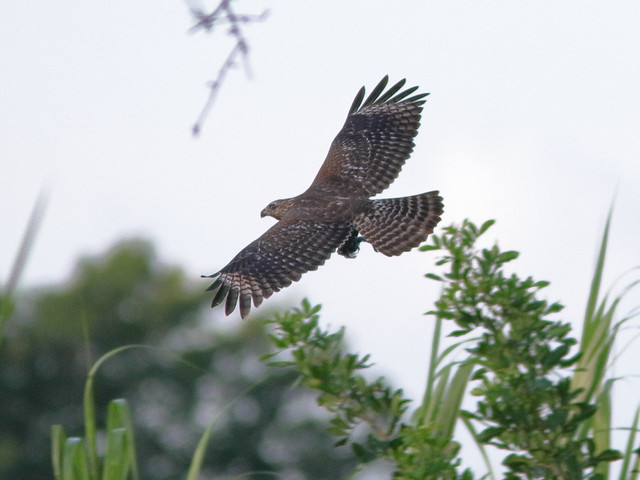
...a Red-shouldered Hawk carrying prey...
...Great Egrets...


...and a Killdeer:

A perky Ovenbird on September 24:

At sunrise on September 25, the Harvest Moon reflected on the still surface of the lake:

= = =  = = =  = = = =  = = = = =

Linking to:


Nature Thursday

Skywatch Friday

Weekend Reflections

Saturday's Critters

BirdD'Pot

Camera Critters

All Seasons

Wordless Wednesday (on Tuesday)

Natasha Musing

Our World Tuesday

________________________________________________

Please visit the links to all these posts to see some excellent photos on display
________________________________________________

Thursday, August 12, 2021

Silent sunrise

We usually set out into the local Wounded Wetlands preserve about an hour before sunrise. This provides an opportunity to hear (and sometimes see) nocturnal bird species such as owls and nightjars. 

For the first half hour it is nearly pitch dark unless the Moon is in an early phase. Flashlights are essential, if only to keep us from stumbling on the rocks or avoid stepping on a snake. Wildlife photography is essentially impossible without artificial light. 

Below the horizon, the sun progressively brightens the sky and its glare obscures the stars and all but the brightest planets. Depending upon the seasons (which affect the angle at which the sun approaches the horizon) "civil twilight," also known as the "crepuscular" period, begins when the sun is 6 degrees below the horizon and ends 20-30 minutes later at sunrise. The morning chorus of bird song usually builds up during this period and tapers off after sunrise. 

Now, many birds are undergoing the post-breeding molt. To save the energy needed to replenish their feathers, they are quiet and reclusive. For the past two to three weeks the morning chorus has dwindled into a few solo notes from...

...Northern Cardinals...

...Northern Mockingbirds...

...and Carolina Wrens:

One advantage of the early walks is that we are spared the heat of the sun. Heat exhaustion is a threat when, soon after sunrise, temperatures and humidity quickly become oppressive.

Another advantage is the opportunity to see some marvelous skies. I know that trying to interpret cloud formations can be a bit silly, but could this possibly be a swordsman ready to do battle with a monstrous dragon?

Persistence of Saharan dust in the atmosphere this past week enhanced the morning colors. Shadows of clouds on the eastern horizon created ever-changing interruptions of the crepuscular rays:

On the opposite horizon, the anticrepuscular rays filled the sky and converged over the Wet Prairie...

...and reflected on the lake:

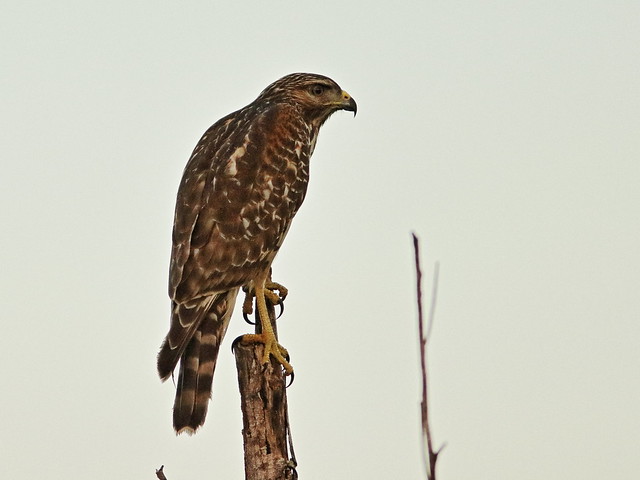
In the poor morning light, an immature Red-shouldered Hawk roosted next to the lake:

It took flight and landed on a flimsy branch atop a Pond Cypress:


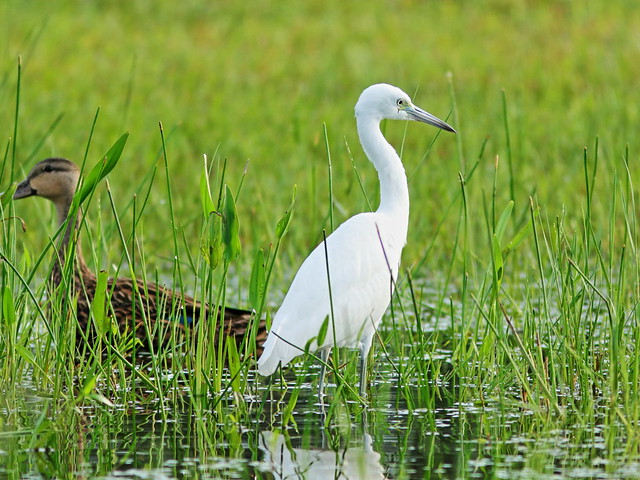
At nearby Chapel Trail preserve, an immature Little Blue Heron foraged with a Mottled Duck:


In our back yard early in the morning,  a Muscovy Duck loafed on the decoy which serves as a float for the intake of our lawn irrigation system:

An Anhinga entertained us by resting on the same decoy: 

Later, the Anhinga decided to bask on our patio. These are my iPhone photos, taken through the glass of the patio door:


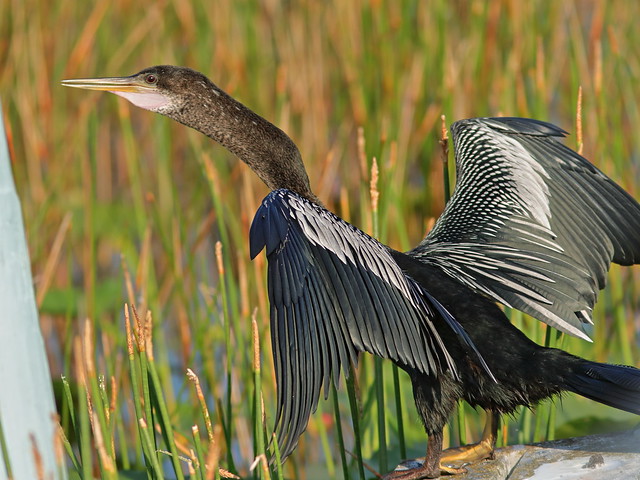
Since my DSLR camera cannot zoom, its viewfinder captured only the Anhinga's neck and head as it aired its wings. It was next to a Coontie which I had recently planted. I liked the aesthetics of the portrait as well as the symbolism. The Anhinga is a representative of the ancient Darter family whose fossil records date back 40-50 million years. The Coontie is a primitive Cycad which originated some 280 million years ago:

As to be expected, my visits to medical facilities increase with age, but they can provide photo opportunities for some interesting reflections:

That's Planet Jupiter, still visible high in the blue sky above the Cleveland Clinic in Weston, Florida:

The fountains turned on and spoiled the reflection:

= = =  = = =  = = = =  = = = = =

Linking to:


Skywatch Friday

Weekend Reflections

Saturday's Critters

BirdD'Pot

Camera Critters

All Seasons

Wordless Wednesday (on Tuesday)

Natasha Musing

Our World Tuesday

________________________________________________

Please visit the links to all these posts to see some excellent photos on display
________________________________________________

Thursday, July 29, 2021

Late July Potpourri #974

It has been another week of clear morning skies and early afternoon downpours, some of which cut short our walks. The bird species list rarely breaks 20, but even the common birds can provide interesting sightings.

An immature Red-shouldered Hawk roosted high on an abandoned telephone pole:

The next morning it selected a cross-timber for preening:


A Great Egret preened lakeside before sunrise, its white plumage contrasting with the reflected pink sky on tranquil waters:


A bit later, the morning rays added contrast and a nice reflection: 

A distant Bald Eagle coursed above the lake:

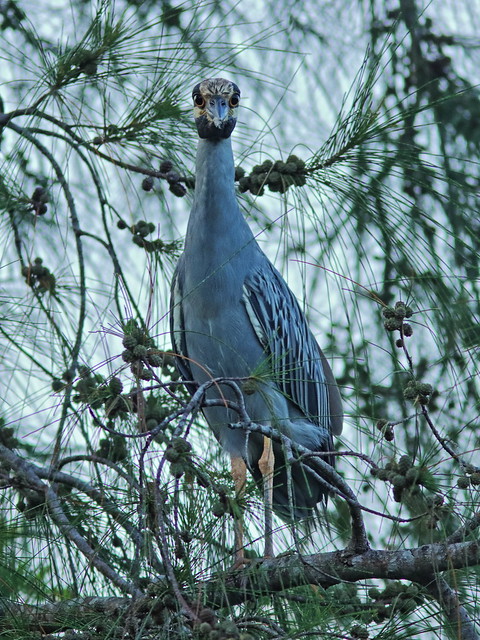
Early morning snaps suffer from underexposure. I could barely see this Yellow-crowned Night-Heron in the dark foliage but was surprised at the clarity of its image:

It turned to look straight at me. During breeding season its cap would have been white with a yellow tinge, but now it is streaked:


"Take me to your leader!"

At nearby Chapel Trail Nature Preserve, a perky juvenile Northern Cardinal perched on the boardwalk railing:

I am not sure whether it is a male or female. Young birds of both sexes somewhat resemble adult females, but their dark bills contrast with the bright red of their parents:

The post-breeding molt is in progress. This Anhinga revealed its motley tail feathers after it took flight. The central corrugated feather is fresh as compared to the worn ones about to be replaced:


This molting adult Northern Mockingbird's fresh tail feathers are emerging on top of the old worn ones:

This adult male Northern Cardinal also shows loss of feathers on his head, exposing his black facial skin:

To be kind to the birds when they are not in their best attire, I often back off to show their habitat. This male is harvesting the berries of a Trema tree:

Another juvenile cardinal chews on a the Trema fruit:

I was surprised to find a warbler, an American Redstart, also plucking the berries:

Redstarts are not commonly encountered here during midsummer, as they normally breed north of Florida. This one appears to be an adult female. It was the only one seen in our our County, of the three reported in all of south Florida during this month:

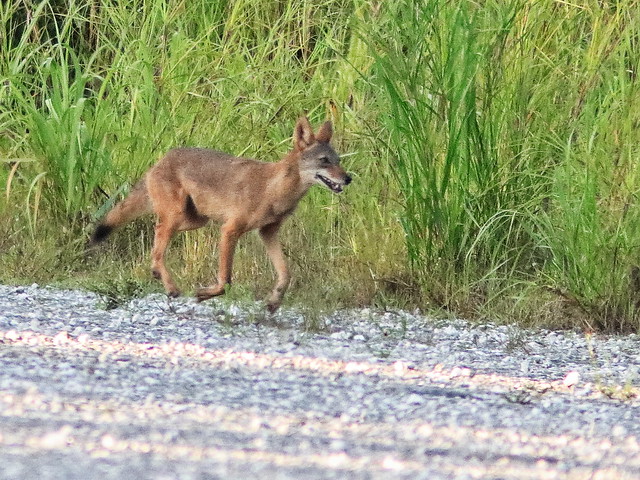
This week's biggest surprise was a Coyote crossing the gravel road in front of me. It was quite far away and the early morning light was not very intense, so my photos are soft:


I found a small patch of wild Poinsettia. The cultivated "Christmas Flowers" have an array of entirely red petal-like leaves (bracts) which surround the tiny yellow flowers:

Lingering Saharan dust continues to provide color at sunrise. The rising sun issues crepuscular solar rays...

...which converge as anti-crepuscular (anti-solar) rays over the Everglades to the west:

= = =  = = =  = = = =  = = = = =

Linking to:


Fences Around the World

Nature Thursday

Skywatch Friday

Weekend Reflections

Saturday's Critters

BirdD'Pot

Camera Critters

All Seasons

Wordless Wednesday (on Tuesday)

Natasha Musing

Our World Tuesday

________________________________________________

Please visit the links to all these posts to see some excellent photos on display
________________________________________________