Showing posts with label White-breasted Nuthatch. Show all posts

Saturday, October 4, 2014

Swifts by the swizillions

After coping with the heat, rain and humidity as we spent all of August and much of September in south Florida, it was so refreshing to feel the cool breezes and see the blue skies of northeastern Illinois.

We got our first hazy views of the Chicago skyline during our final approach to Midway Airport.

Chicago skyline from Midway approach 20140917

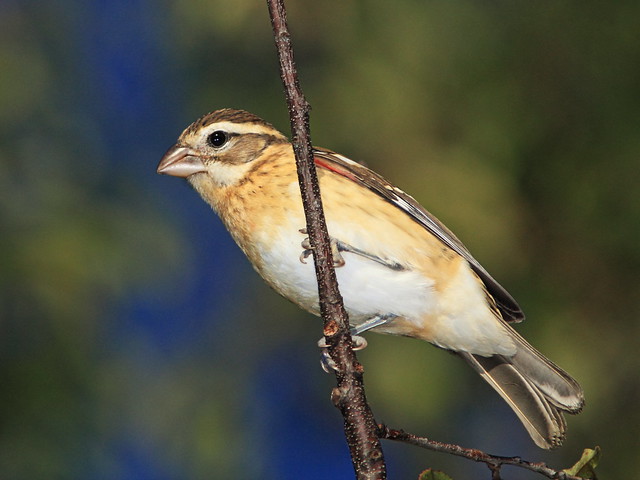
We were out early the first morning, visiting Nelson Lake/Dick Young Kane County Forest Preserve in Batavia, near our second home. Temperatures quickly rose from the high 40s (F) at sunrise, into the high 60s by 9:00 AM. A male Rose-breasted Grosbeak surprised us by singing its spring song and provided drop-dead views of its now-subdued fall plumage.

Rose-breasted Grosbeak fall male 20140923

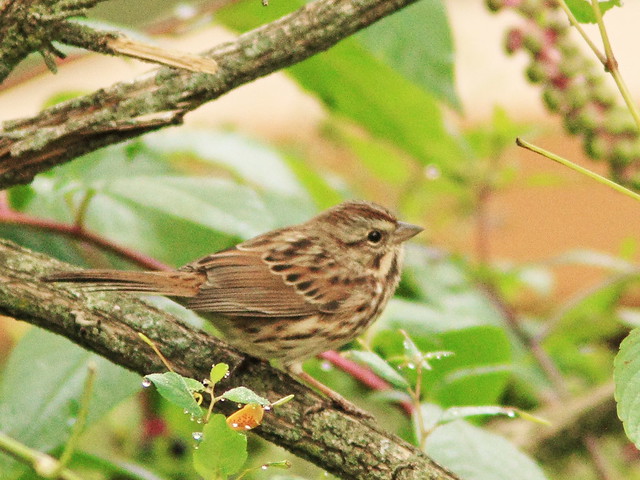
Song Sparrows are completely alien to south Florida:

Song Sparrow 2-20140918

Amid the sparrow flock was this White-throated Sparrow:

White-throated Sparrow 2-20140918

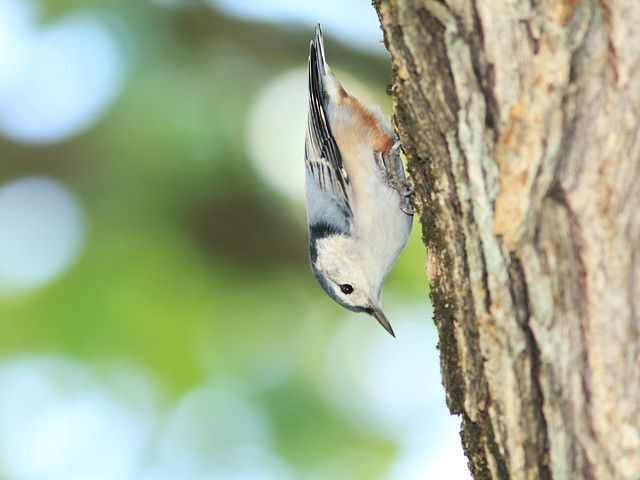
An upside-down White-breasted Nuthatch, another bird we never see in our Florida neighborhood, entertained us with its foraging antics:

White-breasted Nuthatch 3-20140919


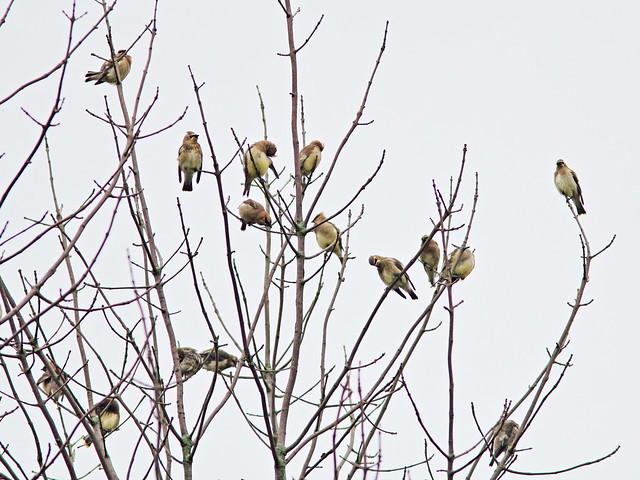
Cedar Waxwings abounded at Hawk's Bluff Park near our daughter's home in Batavia.

Cedar Waxwings 20140918

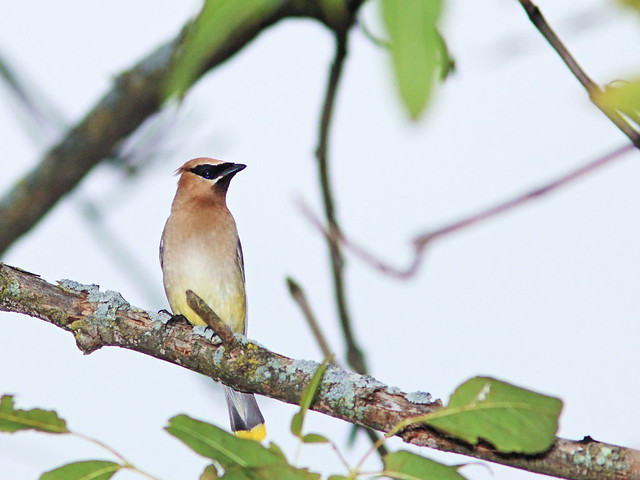
The adult waxwings are handsome, almost stately in appearance,...

Cedar Waxwing adult 20140925

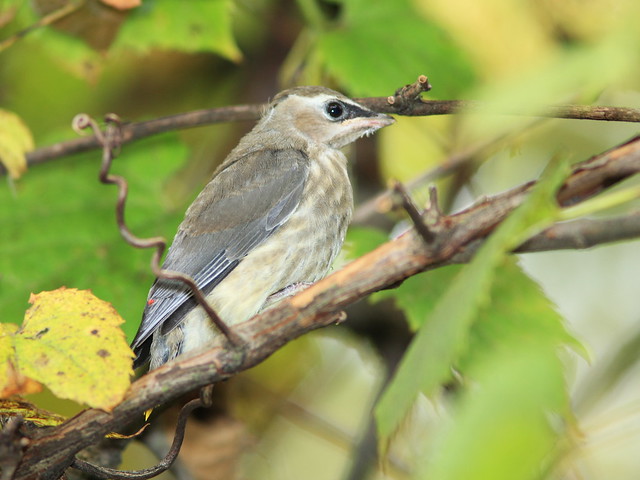
...but the youngsters have a ways to go before presenting themselves as ambassadors of the bird kingdom:

Cedar Waxwing juvenile 20140925

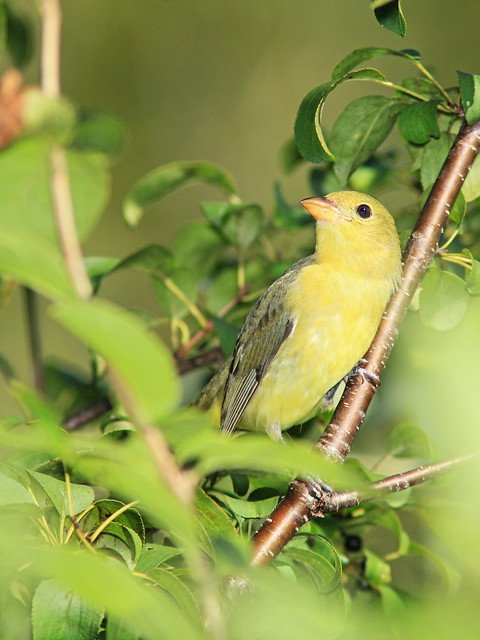
While I was watching the waxwings in a berry bush, a Scarlet Tanager suddenly popped out of the foliage.

Scarlet Tanager 2-20140921

At Lippold Park along the Fox River, a Great Egret, a Florida throwback, lofted from the shallows.

Great Egret in flight 20140918

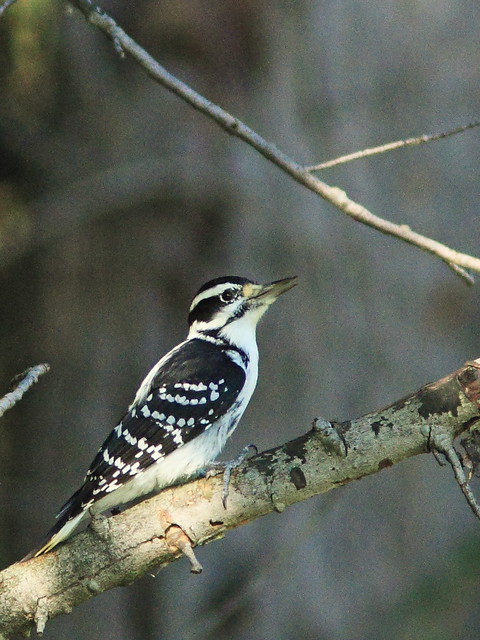
This Hairy Woodpecker is distinguished from the similar but smaller Downy Woodpecker by its proportionally longer bill and absence of black markings on its outer tail feathers.

 Hairy Woodpecker 2-20140926

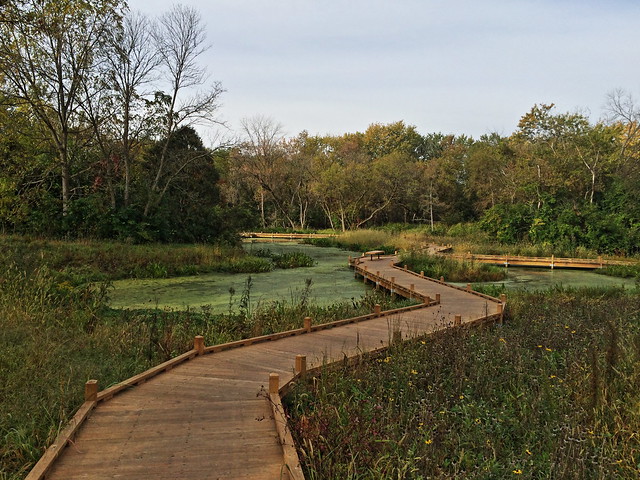
Last year we were very disappointed when the land around the secluded pond at Lippold Park was cleared of understory and the landscape was scraped and graded. The results turned out to be remarkably pleasing and hopefully will continue to be welcoming to wildlife and visitors alike.

We formerly had to slog through wetlands and Poison Ivy to get to the river bank, but now there is a boardwalk that borders the pond and branches off to the river's edge.

Lippold Park boardwalk 20140926

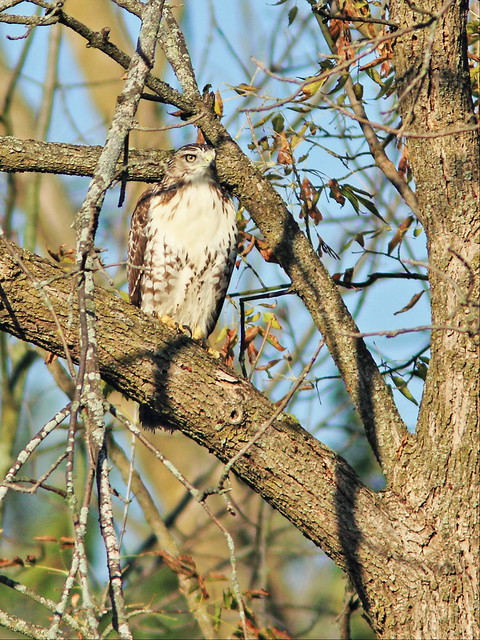
A Red-tailed Hawk watched us from the distance...

Red-tailed Hawk 20140926

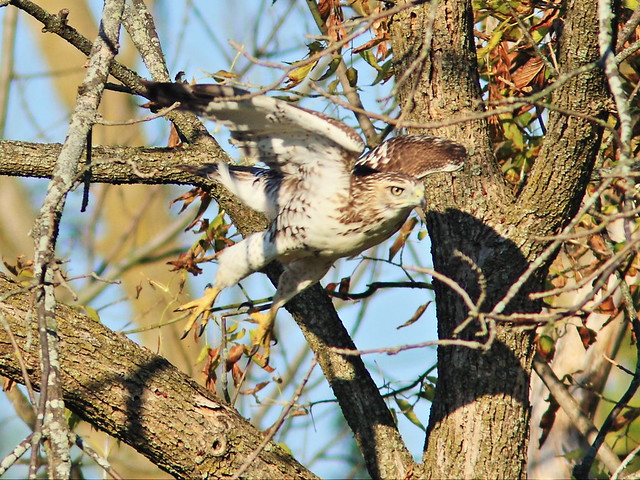
...then lofted into flight:

Red-tailed Hawk 3-20140926


I could go on and on, but will save more of my photos for another post as I must move on to the main subject, best understood by viewing this video which I prepared to memorialize the event. 

Of course we have all heard about a "gaggle" of geese, a "murder" of crows, a "murmuration" of starlings, and so forth, but now I can only describe the vortex that descended into this chimney as a "swizillion" of swifts.

If the video does not appear in the space below, please link to  Chimney Swifts of St Charles, Illinois. Best viewed in full screen mode. Enjoy!


Sunday, November 17, 2013

Missing the Rosy-Finches at Sandia Crest

Many birders were disappointed this past winter when the Sandia Crest House, located atop the Sandia Mountains in New Mexico, closed its doors. As related in Seeking our Signature Species, we started a bird feeding program there back in 1999. It attracted all three North American rosy-finch species. Each of the species (and the distinctive Hepburn's subspecies of the Gray-crowned Rosy-Finch) breed in separate ranges, often on mountaintops. 

Sandia Crest, just east of Albuquerque, is the only easily accessible site at which they all may be seen together. In September, the Crest House Restaurant and Gift Shop reopened under new ownership and management, with plans to stay open all winter.

After visiting our son and his family in Canyon, Texas, we drove to Albuquerque on Monday (November 4), and spent two nights there. Before getting into town we stopped at Sandia Crest to meet the new Manager, Nick Harada. As we started up the 14 miles to the Crest, we noted that the temperature was 55 degrees (F) at the base of Crest Road (about 7,000 ft elevation). The skies were clear and there was little wind, a perfect day.

Our first stop along the road was at Doc Long Picnic Area, where we heard the warbled song and brief whistled calls of a Townsend's Solitaire. This drab member of the thrush family breeds on high mountains throughout western North America. Northernmost populations from Alaska and Canada migrate south into the US and to lower elevations, supplementing the numbers of local birds during the winter. 

Townsend's Solitaire 20131104

On our way up we stopped at several pull-outs hoping to hear or see some birds such as crossbills or other winter finches. This is the view from 10K Trailhead, with smoke from a forest fire evident on the horizon to the north.

10K Trailhead with distant forest fire 20131104

Up at the top, at an altitude of over 10,600 feet, the temperature was 32 degrees! There had only been a dusting of snow the previous week, and no snow cover, so it was not surprising to find that the rosy-finches had not yet arrived. Typically, they fly in with the first real snow storm, which was expected to hit that night and continue into the next day.  This is the entry to Sandia Crest House Gift Shop and Restaurant.

Sandia Crest House entry 20131104

We were hungry after the 4 1/2 hour drive from Amarillo, so we had lunch at one of the tables next to the glass wall that overlooks the deck where the rosy-finches will soon visit the hanging feeder. We talked to the other workers and enjoyed Green Chile Cheeseburgers. The famous bowl of green chile is still on the menu. I feel confident that the staff will continue to be very birder-friendly, and I hope that visitors reciprocate by purchasing food and drinks as well as merchandise.

I created this 180 degree panoramic view of the interior of Crest House with my new iPhone. The kitchen is to the left and the west-facing deck is at the right. The two windows in the center background are on the east wall of the Gift Shop section of Crest House and they overlook a second feeder. It is easy to understand the popularity of this location, where birders can sit in comfort and tick off three new bird species that brave the harsh mountaintop winters.

Sandia Crest House panorama. NOV 4 2013

The deck provides a marvelous view of the City of Albuquerque a mile below.

Deck Feeder at Sandia Crest House 20131104

This is the southwest-facing view from the deck. Sandia Mountain courses away to the south (far left), and the Manzano Mountains are in the distance, behind the Manzanita foothills. These mountains are considered to be the southern extreme of the Rocky Mountain chain, all consisting of sedimentary rock uplifted by collision of tectonic plates. To the far right is  Mount Taylor (elevation 11,301 feet), the cone of an extinct volcano, 80 miles to the west, but visible on this clear day. 

Viewof Albuquerque from Crest House Deck 20131104

The feeders had been put up a few days previously and were hosting Steller's Jays, both Red-breasted and White-breasted Nuthatches, juncos, a Downy Woodpecker, and Mountain Chickadees. 

Steller's Jay on the deck feeder:

Steller's Jay 20131104

Red-breasted Nuthatches flew in and quickly removed one seed at a time, retiring to the trees to either eat or hide them:

Red-breasted Nuthatch 3-20131104

My photos were taken through the glass, so they are not of very good quality. This White-breasted Nuthatch seems to defy gravity as it strolls up the trunk of a tree.

White-breasted Nuthatch 20131104

The second feeder is positioned downhill, just to the southeast of the Crest House.

Sandia Crest House SE elevation 20131104

It is readily visible from the picture windows.

Steller's Jays 20131104

Although Nick had just started his job as Manager and had never before heard about the rosy-finches he was very interested in learning all he could about them and the other feeder birds. We reviewed pictures of the three rosy-finch species and the Hepburn's variant. 

That evening we had a very pleasant meeting and dinner with the Crest House owner, Andy Mayer. He has given a lot of thought as to how to make birders feel at home, and is supportive of the scientific and educational value of the banding program. The banding team is working out the details of how banding will be conducted. He  also plans to put up hummingbird feeders on the deck after the rosy-finches depart, which also should attract much interest from the general public. 

The weather indeed took a nasty turn the next day. When we set out at about 8:00 AM there was light rain and the temperature was 45 degrees in Albuquerque (5200 feet elevation). The Sandia Mountains were shrouded in clouds and the weather reports predicted that the snow that started there during the night would continue until around noon. We therefore decided to first visit Rio Grande Nature Center State Park in Albuquerque (more about that in a subsequent post). 

At about 11:00 AM we decided to venture up to Crest House for lunch. The sky was blue and the road was clear until we got near the ski area, at about 9,000 feet elevation. Clouds and blowing snow caused episodes of near white-out conditions. The road was snow-packed above Nine Mile Picnic Area, but we continued up in our rental Toyota Camry. At Crest House, the temperature was down to 24 degrees (F) with high winds. 

Sandia Crest House from upper parking lot 20131105

We could barely see the lower feeder from the picture window, and the hanging tray feeder on the deck was swinging wildly. The only birds we saw were Steller's Jays, White- and Red-breasted Nuthatches, Mountain Chickadees, ravens and a few juncos.  With those wonderful snow conditions we knew that the rosy-finches would be there on the heels of the storm. We were right! 

The next morning, at about the same time we were boarding the plane to return to Florida,  John and Thelma Dalmas of Nacogdoches, Tx saw 4 Black and 2 Gray-crowned Rosy-Finches at the feeder. Later in the day, Alan Mickelson, feeder program coordinator, went up to fill the feeders and saw a single Gray-crowned Rosy-Finch.

I must dig into my archives to find one of my photos, this of a Black Rosy-Finch at the deck feeder:

Black Rosy-Finch EDITED

From the window of our aircraft as we climbed over the Manzanos, we got our last view of Sandia Crest, poking up conspicuously in the distance.  It is nice that we at least have a pixelated photo of this season's rosy-finches. At this range, hundreds would fit into a single pixel! 

Sandia Crest and rosy-finches in distance 20131106

As soon as we arrived home I edited the Sandia Crest Birding FORUM and replaced this flag...


...with this one, announcing arrival of the finches!


Useful Links:


Directions to Sandia Crest House with notes about Health and Safety, Handicapped Access and birding in and around the Sandia Mountains

Sandia Crest House Restaurand and Gift Shop Web page (with menu)


Saturday, May 4, 2013

Catching up with migration in Illinois

We are back in Illinois and hoping to catch up with the northbound migrants that failed to visit our Florida neighborhood. Migration in southeastern Florida has been much quieter in spring than in the autumn, generally due to the prevailing southeasterly winds that steer migrants from Cuba towards the west coast and often allow them to continue non-stop over the Gulf of Mexico. We also departed Florida a bit ahead of the peak warbler migration.

Northern Illinois experienced record rainfall during the months of March and April. This broke the serious drought conditions that prevailed last year and caused massive crop failures. Now the farmers are concerned because their fields are too wet to permit planting of corn. Flooding and storms interfered with flight schedules, but we enjoyed fair skies on the first few days at our second home.

Suffering from "cabin fever," our granddaughters could not wait to get out on a "bird hike" with us, so we brought them to local Hawk's Bluff Park in Batavia on the morning after we arrived. As it turned out, model race cars and swing sets provided them with a much more interesting pastime, but it was great just being outside.

Cari 20130421

Graci with model race car 20130421

Graci with model race car 3-20130421

While Mary Lou supervised the children I broke away to capture this Red-tailed Hawk in flight.

Red-tailed Hawk 2-20130421

The calls of a White-breasted Nuthatch caught my attention.

White-breasted Nuthatch 2-20130421

A male Mallard lounged in a quiet corner of the creek.

Mallard COREL 20130424

American Robins were already building their nests.

American Robin 20130425

Daffodils were in bloom.

Daffodil COREL 20130424

Wake Robin (Trillium) buds were ready to open.

Wake Robin COREL 2-20130424

A stop at neighboring Jones Meadow Park was a disappointment. Flood waters had receded about three feet but still blocked the path and engulfed the woodlands.

Jones Meadow Park flooding 2-20130421

The next morning was a school day. It dawned bright, but windy and chilly (by Florida standards). Mary Lou and I headed for one of our favorite spots, Nelson Lake/Dick Young Kane County Forest Preserve in Batavia. We knew that we were a week or so ahead of the expected arrival of warblers, but we got great views of Ruby-crowned Kinglets.

Ruby-crowned Kinglet COREL 2-20130422

Ruby-crowned Kinglet COREL 20130422

We went on to visit Fabyan West Forest Preserve in Geneva, where we got to see the Great Horned Owl nestling that has attracted much attention. Here the owlet stares at an airplane as it passes overhead.

 Great Horned Owlet watching airplane20130422

One of the parent owls dozed high in a nearby tree.

Great Horned Owl COREL  20130424

A blue carpet of Scilla covered the floor of the open woodland.

Scilla blooming at Fabyan FP COREL  20130422

Several warblers foraged on the ground, probably because of the high winds. Among them was this Pine Warbler, usually found exploring the tips of pine trees.

Pine Warbler COREL 2-20130424

We later brought the girls over to see the owls. The chick flew from the nest that very night.

Great Horned Owlet 2-20130426

We capped off our first week in Illinois with visits to nearby Les Arends Preserve and Lippold Park, where numerous Tree Swallows flitted overhead. This one posed nicely, showing off its electric blue plumage.

Tree Swallow 20130425

Yellow-rumped Warblers are among the earliest and most numerous spring arrivals. They were everywhere.

Yellow-rumped Warbler 20130425

Arriving Sandhill Cranes flew high above.

Sandhill Cranes overhead 20130425

I caught this Yellow Warbler as it hover-gleaned in the junipers.

Yellow Warbler in flight 20130425

At Les Arends there were more Yellow-rumps hunting for insects on the lawns.

Yellow-rumped Warbler 3-20130427

Song Sparrows joined the warblers.

Song Sparrow 20130427

I could not resist this photo-op with a Black-capped Chickadee.

Black-capped Chickadee 20130427