This has become a habit of mine, to look back at photos I took three years ago. It may be boring to some, but it helps me to remember the good times past and anticipate the sights which may greet us this October as we venture out into Illinois parks and back to our south Florida Everglades remnant preserve, our "Wounded Wetland."
To add some interest to my quest, I will try to include some favorite memes-- wild critters (especially birds), skies, reflections, fences, signs of the season, and scenes which speak for themselves.
We spent the first three weeks of October, 2014 at our second home in NE Illinois, missing the best of south Florida's warbler migration but enjoying the clear weather and cool temperatures. (This year we plan to get back to Florida a week earlier to celebrate the Quinceañera of the daughter of our son-in-law's first cousin in Miami.)
Lippold Park, in Batavia, IL was adorned in fall colors:

We got to welcome some winter birds, many of which do not visit south Florida. Yellow-rumped warblers arrived early in the month. In Florida they are among the last to appear and signal the end of warbler migration:

White-throated Sparrows had arrived from northern breeding grounds:


White-crowned Sparrows visited our daughter's feeders and rested on the deck railing. This is an adult:

First-year White-crowned Sparrows have brown and dull gray rather than black and white head stripes:

Ruby-crowned Kinglets appeared. In Florida we may see one or two some winters:

White-breasted Nuthatches are Illinois residents and are seen all winter, but they do move erratically southward and may be replaced by migrants or wanderers from the north. Few make it into south Florida:

Black-capped Chickadees were abundant. This is another resident species which may wander about unexpectedly in some winters. A very similar relative, the Carolina Chickadee, ranges into central Florida:

Canada Geese were moving south. Note the similar but much smaller Cackling Geese in the foreground:

On October 22 we encountered our first flock of Purple Finches. This is a female:

After breeding season, American Goldfinches change from bright yellow into more somber garb:

Before departing for Florida we spent a long weekend of fun with our daughter and family at Sturgeon Bay in Door County, Wisconsin. It is located in far NE Wisconsin and straddles both sides of the inlet between Lake Michigan and Green Bay. Our lodge was on the waterfront and we enjoyed beautiful sunsets:

Sturgeon Bay Marina:

Beautiful split-rail fence at "The Farm" in Door County:

It was much colder up in Wisconsin:

October 26 found us back in Florida. We were out early the next morning and captured this Great Egret before sunrise as it lifted off:

While visiting Chapel Trail Nature Preserve I obtained this unusual photo of a pair of Purple (Gray-headed) Swamphens reflecting in the lake:

A Cattle Egret hunted for insects on a cow's back in the pasture next to Chapel Trail:

Sadly, on October 30 I saw our local female Bald Eagle "Joy" for the last time before she disappeared and was never seen again. She was sitting rather deep in the nest, rearranging sticks while her mate "Pride" stood by:
 = = = = = = = = = = = = = = =
Linking to Misty's CAMERA CRITTERS,
Linking to Eileen's SATURDAY'S CRITTERS,
Linking to FENCES AROUND THE WORLD by Gosia
Linking to SKYWATCH FRIDAY by Yogi, Sylvia and Sandy
Linking to WEEKEND REFLECTIONS by James
Linking to BirdD'Pot by Anni
Linking to Wild Bird Wednesday by Stewart
Linking to Wordless Wednesday (on Tuesday) by NC Sue
Linking to ALL SEASONS by Jesh
________________________________________________
Please visit the links to all these memes to see some excellent photos on display
________________________________________________
The Upper Midwest is dotted with depressions which collect water from rainfall and snowmelt. Varying in size, depth and weather conditions, some may dry up rather quickly while others may be relatively permanent. All serve as important foraging sites for waterfowl and the larger ones are major breeding sites, comprising "...one of the most important wetland regions in the world. The area is home to more than 50 percent of North American waterfowl." [Ref: Prairie Potholes US Environmental Protection Agency]
At Nelson Lake Marsh/Dick Young Kane County Forest Preserve near our second home in NE Illinois, there is a nice example of a pothole which holds water the year around, surrounded by marshes. Ducks, geese and Sandhill Cranes have raised their broods here. Red-winged Blackbirds, Marsh Wrens and Swamp Sparrows reside in the wetlands:
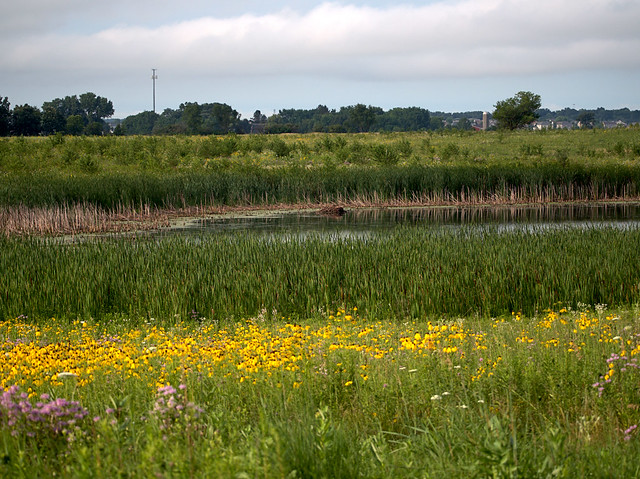
A Double-crested Cormorant perches on a Muskrat lodge:

Before the land around our condominium was developed, one small pothole served as a permanent residence for a family of Muskrats and attracted migrating geese, ducks and sandpipers.
The view from our front porch in May, 2011:
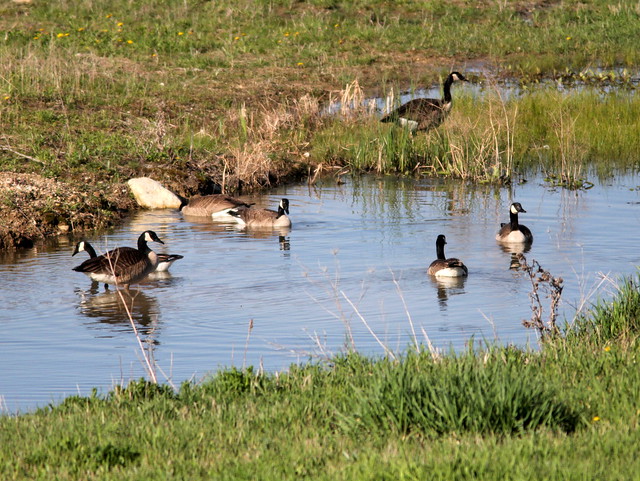
We were delighted when a Snow Goose showed up:

Among our breeding "yard birds" were Spotted Sandpipers (May, 2012):

Potholes were produced by the weight of glacial ice some 10,000 years ago. Many of the original potholes were filled and drained as areas were developed for agricultural or commercial purposes. Yet some remnants persist even in cultivated fields as evanescent shallow flood puddles ("fluddles") which attract migrating sandpipers and plovers. Other man-made retention ponds capture urban rainwater and serve as surrigate "potholes."
This past week our local Kane County Audubon Society sponsored a "ramble" to one such retention pond, on the grounds of the James O Breen Community Park in St. Charles.

August and September have been unusually dry, and water levels have decreased to the point of threatening the pond's fish population. Large carp are surfacing to gasp for air, to the delight of Ospreys. Mud flats along the shore have attracted large numbers of sandpipers.
Lesser Yellowlegs predominated:

I counted nine Stilt Sandpipers:

A small and short-legged Baird's Sandpiper foraged among the Killdeer:


Two beautiful Buff-breasted Sandpipers provided excellent views:

A Wilson's Snipe rested on the mudflat:

An immature Red-tailed Hawk oversaw the action from atop a goal post, but seemed to pose no threat:

The Community Park is part of a complex managed by the St Charles Park District which includes athletic fields, community vegetable gardens, an aquatic park, picnic areas and the Hickory Knolls Discovery Center with an adjacent natural area.
Community Gardens with idle pasture in foreground:

Autumn color at Hickory Knolls:

Nature trail:

= = = = = = = = = = = = = = =
Linking to Misty's CAMERA CRITTERS,
Linking to Eileen's SATURDAY'S CRITTERS,
Linking to FENCES AROUND THE WORLD by Gosia
Linking to SKYWATCH FRIDAY by Yogi, Sylvia and Sandy
Linking to WEEKEND REFLECTIONS by James
Linking to BirdD'Pot by Anni
Linking to Wild Bird Wednesday by Stewart
Linking to Wordless Wednesday (on Tuesday) by NC Sue
Linking to ALL SEASONS by Jesh
________________________________________________
Please visit the links to all these memes to see some excellent photos on display
________________________________________________