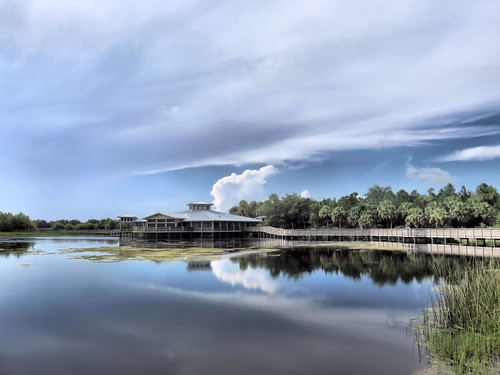
The Purple Gallinule is a Florida favorite. It was one of those species in my bird book whose picture looked so exotic and which, as a kid in New Jersey, I hoped one day to see. It took a while, but I finally set eyes on one in Avery Island, Louisiana, in 1967. Here in south Florida it is easy to find them in the right places, especially the settling ponds at water treatment plants such as Green Cay Wetlands in Boynton Beach:
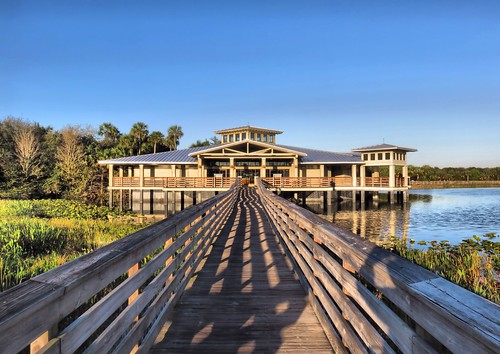
This is the nature center and beginning of the boardwalk at Green Cay:
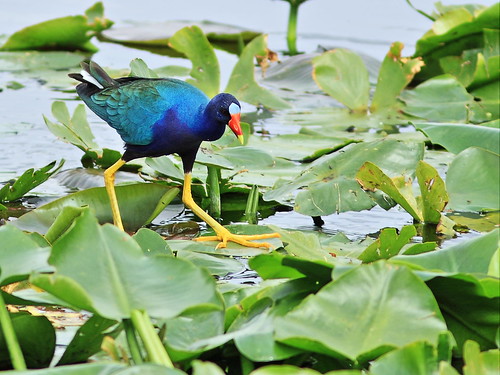
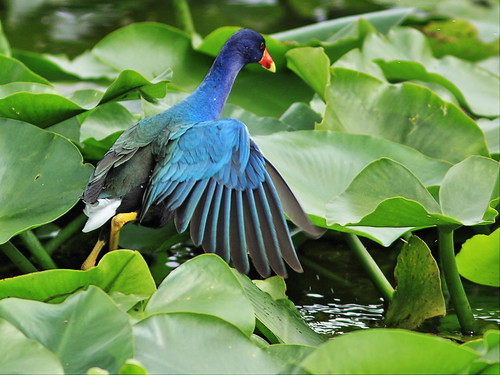
Peaceful Waters Park in Wellington is another such location. Here a Purple Gallinule shows off its long toes which allow it to walk across the floating vegetation:
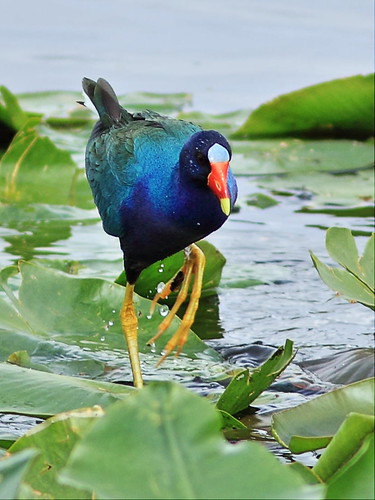
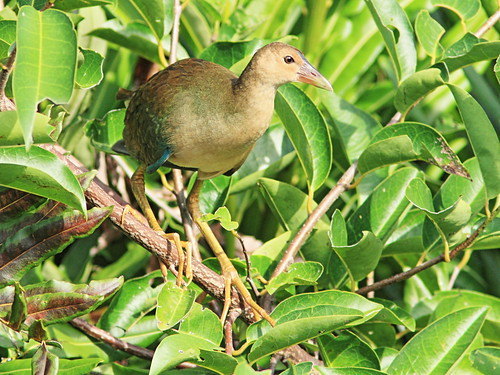
The juvenile can be rather drab. This one was at Loxahatchee National Wildlife Refuge in Palm Beach County:
The first time I saw this species in our neighborhood Wounded Wetlands was in January, 2015, when a pair showed up. I hoped the pair would breed, but they disappeared after only a week or so:
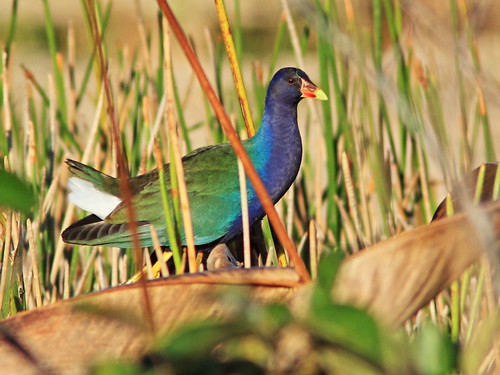
One year later, also in January, a single adult Purple Gallinule appeared in the same location. Try as I did, I could not find a second bird. It remained into March:
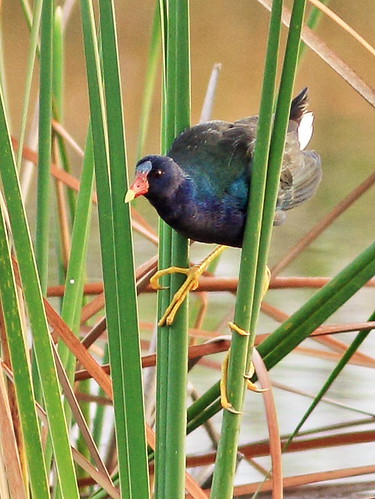
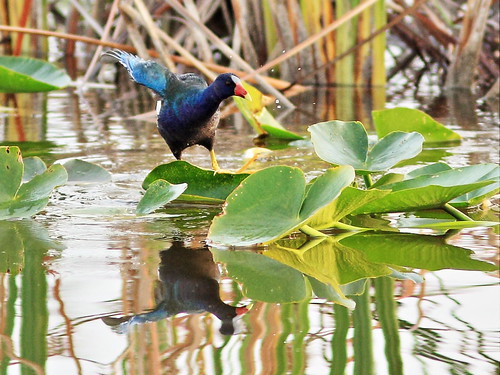
This December I saw a juvenile gallinule in the same local wetlands patch. The light was bad and it was rather secretive, so at first I was not sure of its identity. I patiently waited for it to come out into the open. It was eating the flowers and seed of Alligator Flag:
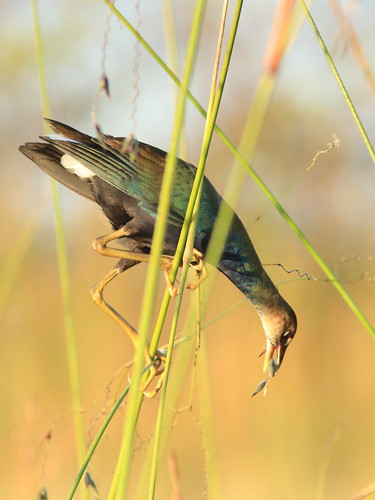
Alligator Flag must have its roots in water most of the time, so it is found on the edges of marshes and other persistent bodies of water. In the Everglades, this plant often signals the presence of an alligator hole.
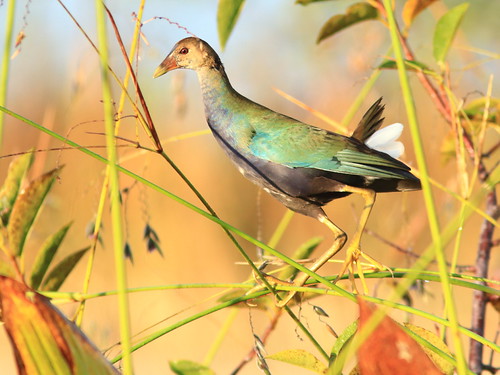
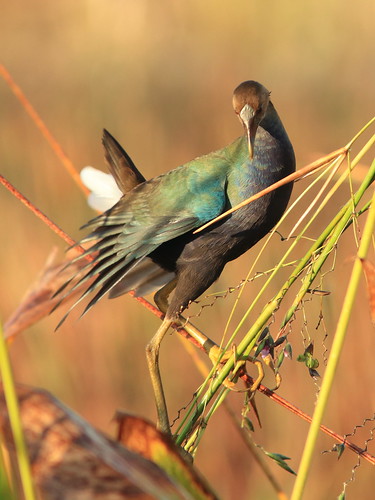
The tiny flowers of Alligator Flag rise high above on slender stems and the only way the bird can get up to them is to gather several stalks in each of its huge feet and take advantage of the construction principle of triangulation (the use of triangular shapes to give stability to structures such as buildings and towers-- the Eiffel Tower is a good example). In good light, the beauty of this immature Purple Gallinule is revealed. I love this striking pose:
 = = = = = = = = = = = = = = =
Linking to Misty's CAMERA CRITTERS,
Linking to Eileen's SATURDAY'S CRITTERS,
Linking to SKYWATCH FRIDAY by Yogi, Sylvia and Sandy
Linking to WEEKEND REFLECTIONS by James
Linking to BirdD'Pot by Anni
Linking to Our World Tuesday by Lady Fi
Linking to Wild Bird Wednesday by Stewart
Linking to Wordless Wednesday (on Tuesday) by NC Sue
Linking to ALL SEASONS by Jesh
________________________________________________
Please visit the links to all these memes to see some excellent photos on display
________________________________________________
Just as no two sunrises are ever alike, I never know what to expect any given morning on the Wounded Wetlands adjacent to our south Florida home--
The full Moon setting on February 3, 2017:

The Pine Bank, before Hurricane Irma, which struck on September 10, 2017


After Hurricane Irma, on November 8, 2017, the Pine Bank has a lower profile, as many of the tall Australian Pines have been blown down:

On November 5, 2017, in the pre-dawn I thought this heron had captured a large snake, but it was an amphiuma. I watched as it dispatched it and then swallowed it whole.
Two-toed amphiumas (Amphiuma means) can grow to lengths of 3 feet or more—one of the largest salamander species in the world. Two-toed amphiumas have tiny, nearly useless front and hind legs with two toes on each leg. Reference: Giant Salamanders of Florida


One never knows when there may be an opportunity to learn something new. I noticed that Palm Warblers were catching insects attracted to the sparse blossoms which towered above a patch of Alligator Flag.
This plant will flourish only when there is a constant supply of water. If its roots dry out for too long they will perish. In the Everglades, they signal the location of the water holes which are kept open through the dry season by alligators which created and maintained them over the years:


Their tiny but attractive flowers resemble those of the Bird of Paradise, a related plant (along with other members of the arrowroot family, which includes bananas and cannas).
Alligator Flag flowers invite bees and other pollinators to trigger an explosive "rat-trap" pollination mechanism which momentarily snaps down on the insect. In a split second the flower collects pollen brought in and deposits new pollen to be distributed. Having completed its task, the flower releases the visitor and prevents entry to new insects. For a more complete and scientific description, visit this link: The Alligator Flag is a Snappy Wildflower.
Although I am primarily looking for birds, I like to be surprised when mammals show up. I was trying to get a photo of a warbler when this Raccoon suddenly walked out on the path in front of me. I stood very still as he tried to get a better look at me. He walked almost up to my feet before I shood him:


Three young White-tailed deer, one a single-pronged spike-buck, stared at me from the end of the road:

Over the fence she goes!

On November 10 I found a Grasshopper Sparrow, only my third sighting here over the 10 years I have walked in this patch. This is not a rare species, but it is very small and secretive. It favors short grass such as we have along the gravel road. It persisted for three days in a spot on the right side just ahead:

Grasshopper Sparrow:


I was busy taking a photo of the Grasshopper Sparrow and ignored the cries of two egrets just to my left. When I looked up, this big healthy-looking male Bobcat was sitting there staring at me, about 20 paces away. The noisy egrets circled and flew low over the cat.
He stood up as I took this photo, then walked calmly away. I wondered whether he had tried to catch one of the egrets along the lake shore and they distracted him so much that he failed to notice me. Click on photo for larger view and more images:

He licked his chops, perhaps thinking about how tasty that pesky egret might have been:

He paid me little heed, making me feel like an invisible spectator to one of nature's wonders!


= = = = = = = = = = = = = = =
Linking to Misty's CAMERA CRITTERS,
Linking to Eileen's SATURDAY'S CRITTERS,
Linking to FENCES AROUND THE WORLD by Gosia
Linking to SKYWATCH FRIDAY by Yogi, Sylvia and Sandy
Linking to WEEKEND REFLECTIONS by James
Linking to BirdD'Pot by Anni
Linking to Wild Bird Wednesday by Stewart
Linking to Wordless Wednesday (on Tuesday) by NC Sue
Linking to ALL SEASONS by Jesh
________________________________________________
Please visit the links to all these memes to see some excellent photos on display
________________________________________________
Morning clouds reflect on the surface of the lake in the local wetlands:
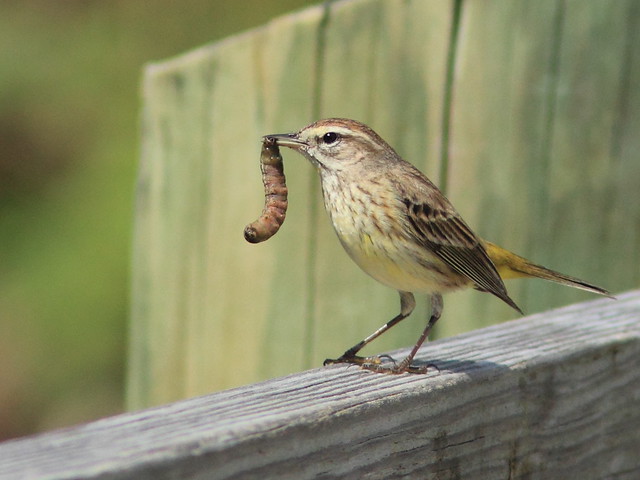
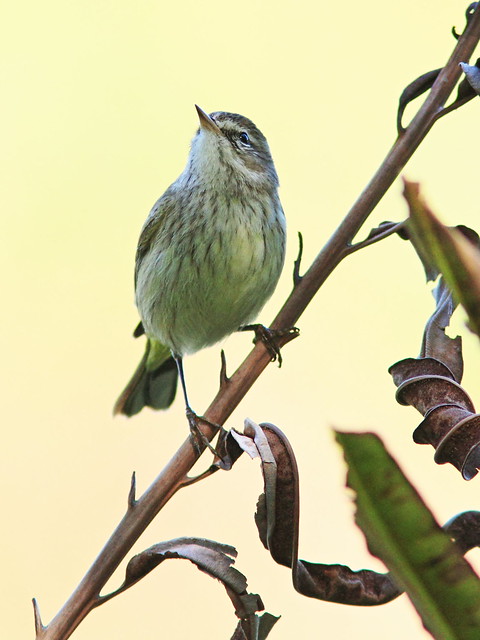
 The Palm Warbler is one of the most common bird species seen on residential lawns during Florida's winter. Our visitors belong to the drab western subspecies, which breed in central and western Canada and winter in Florida and the Caribbean.
The Palm Warbler's long legs are an adaptation to its habit of foraging on the ground:


This Palm Warbler has caught a very large grub:
 Another poses nicely for me:
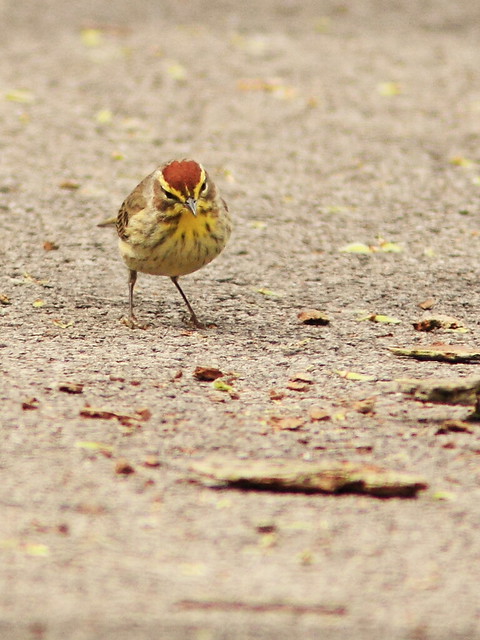
 In spring, its plumage brightens up...

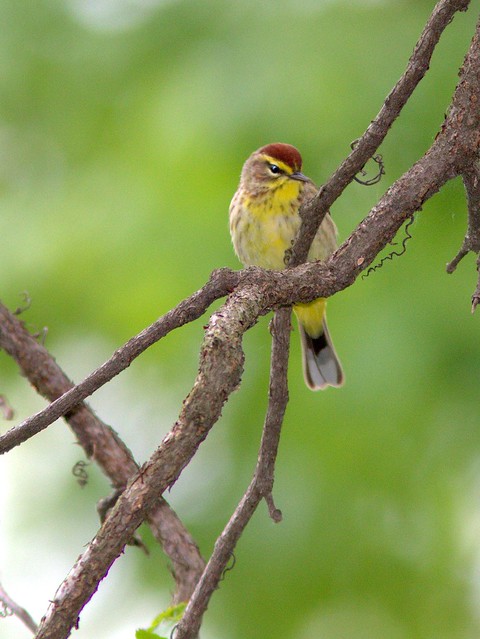
...but never reaches the intensity of this Eastern (Yellow) Palm Warbler subspecies which breeds in eastern Canada and crosses over to winter in Mexico by way of Texas (May 15, 2014 in Illinois):
This is another example of the eastern subspecies, also photographed in Illinois (May 1, 2012):
A group of small and active birds caught my attention as I was exploring the near shore of the lake in our local wetlands. Bright yellow at the base of their wagging tails identified them as Palm Warblers. Five or six were gathered on what looked like a collection of slender weeds. They were exploring inconspicuous red flowers that draped down from the tips of the stalks. This led me into a deeper inquiry about this behavior.

Enjoying the aesthetics of the scene, I took several photos. I learned that these flowers are very attractive to flying insects, drawing in the Palm Warblers.

The flowers sprang up from a clump of broad-leafed plants that I recognized as Alligator Flag:

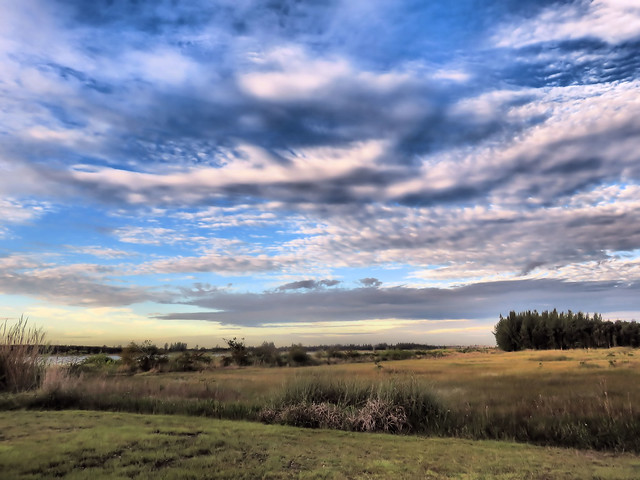
South Florida experiences a wet season (March-Oct) and a dry season (November-February). In response to seasonal variation in rainfall, vegetation in the Florida Everglades has evolved to take advantage of several micro-habitats. Almost all are related to the hydroperiod, or the average amount of time a plant stands in water over the year. Sawgrass, the predominant plant in the extensive marshes thrives in a hydroperiod of about 9 months. It can survive shallow flooding all year around, but will die if deeper water keeps oxygen from reaching its roots.
This was a stand of Sawgrass in our local wetlands back when the restoration area was actively managed by controlling water levels and removing exotic invasive plants. In the background is the skeleton of an ancient cypress that once stood in the historic Everglades. Sadly, now that this area is to be turned into a reservoir, all restoration efforts have been abandoned and this spot is now totally overrun by shrubs and trees.

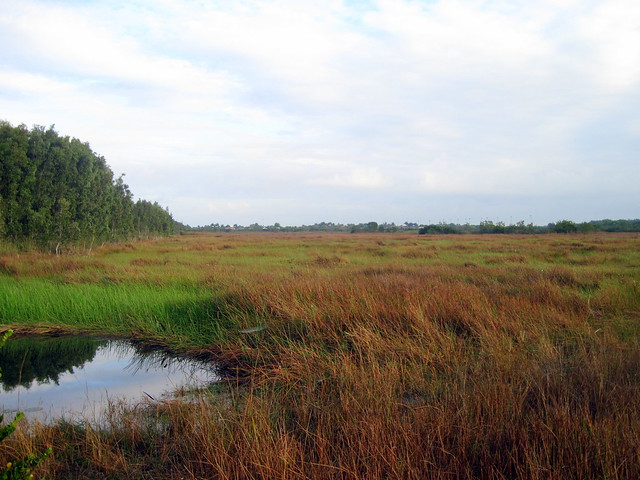
"Wet prairies" of grasses, rushes and sedges develop in slightly elevated areas where shallow water may cover the ground only about 3 to 7 months of the year. This is a fair example of a restored wet prairie, still actively managed, adjacent to the planned water impoundment:
Alligator Flag must be waterlogged all year round, so it is found in the deeper channels (sloughs or "slews") that cut through the marshes and prairies. American Alligators dig out ponds of open water which sustain mammals, birds, turtles, fish and other organisms all through the year, assuring these large reptiles with a reliable food source.
A bit to the north, an alligator has carved a circular pond in the wet prairie. Sedges are thriving at its margin:
An American Alligator basks next to its pond during the dry season:

Alligator Flag (Thalia geniculata) requires water all year, and is so named because its presence in the open Everglades suggests the presence of an alligator "hole." Its flowers are obviously attractive to flying insects which in turn attracted the small flock of foraging warblers.
I found a fascinating blog about Alligator Flag (Alligator Flag is a Snappy Wildflower)
which in some detail describes the "rat-trap pollination" that occurs when a bee enters the flower and triggers a mechanism which simultaneously collects pollen from the intruder and deposits its own pollen, as it forcibly ejects the insect, thus assuring cross-pollination and also closing the entrance to the flower. (Read the blog, as I have grossly oversimplified the process.)
My macro for the week is this White Peacock on the flower of a Balsam Pear:

= = = = = = = = = = = = = = =
Linking to Misty's CAMERA CRITTERS,
Linking to Eileen's SATURDAY'S CRITTERS,
Linking to GOOD FENCES by Tex (Theresa).
Linking to SKYWATCH FRIDAY by Yogi, Sylvia and Sandy
Linking to WEEKEND REFLECTIONS by James
Linking to BirdD'Pot by Anni
Linking to Wild Bird Wednesday by Stewart
Linking to I Heart Macro by Laura
________________________________________________
Please visit the links to all these memes to see some excellent photos on display
________________________________________________