Showing posts with label Cottonmouth Water Moccasin. Show all posts

Thursday, May 27, 2021

Missing my MDR of twenty species

Although I do not keep a running total of species seen as I enter them into the eBird app, I usually reach my Minimum Daily Requirement (MDR) of  20 without trying very hard. I just noticed that my last eight eBird checklists (since May 18) never got above 21 species: 20, 19, 19, 16, 20, 21, 13, 14. 

Warblers and vireos (even a couple of locally breeding species), egrets, Killdeer, and Common Nighthawks have been scarce or absent from the Wounded Wetlands. Some birds are less conspicuous because they are tending to nests and young. Cardinals and Carolina Wrens are singing less often or are silent, but doves and mockingbirds do fill the air with their songs. 

On one of those dull mornings this past week, standing vigil lakeside just after sunrise, I heard the call of a Green Heron. "Heard only" birds are accepted by eBird, but I tried unsuccessfully to find it-- until it walked out into the open:


A shaggy immature Great Blue Heron cast a reflection:

A Loggerhead Shrike hunted for grasshoppers from a low perch and a hungry youngster waited:


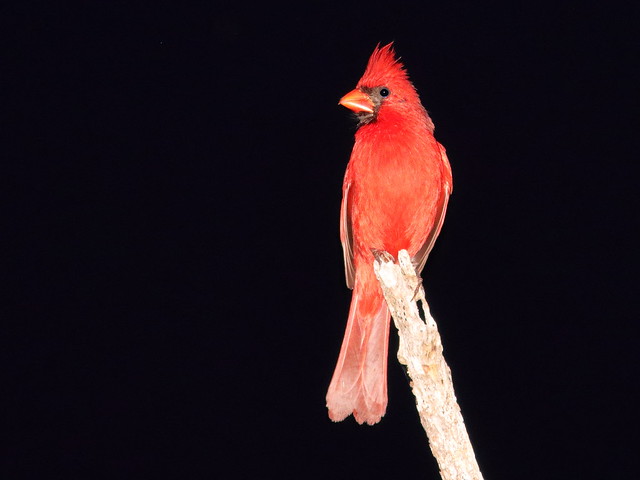
A singing Northern Cardinal was only visible with my flashlight:
An Osprey flew low overhead:

This adult Mourning Dove allowed a close approach:
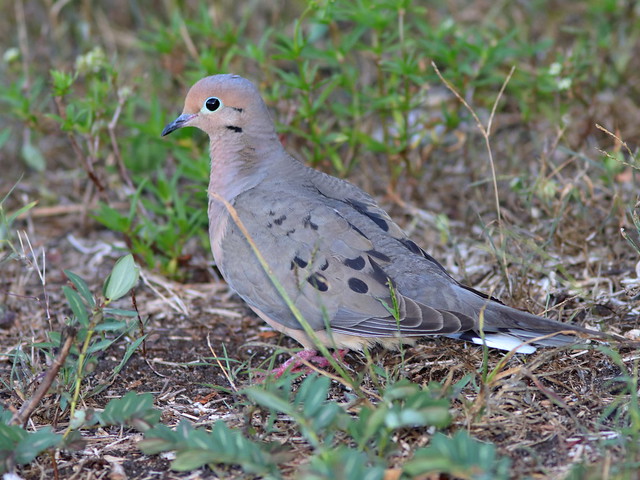
Nearby, an immature of its species eyed me with suspicion:

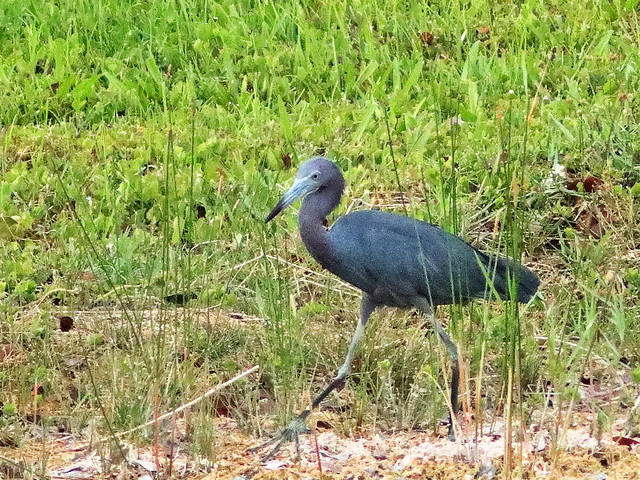
A Little Blue Heron foraged along the canal:
Overhead, Purple Martins dined on mosquitoes:   

Sunlight brought out the iridescence in the plumage of a male Boat-tailed Grackle:

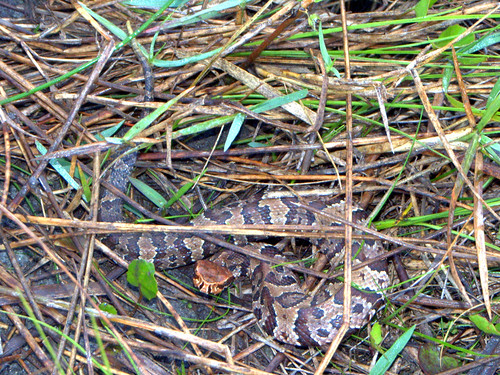
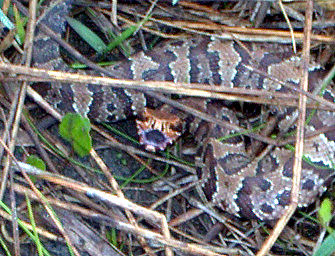
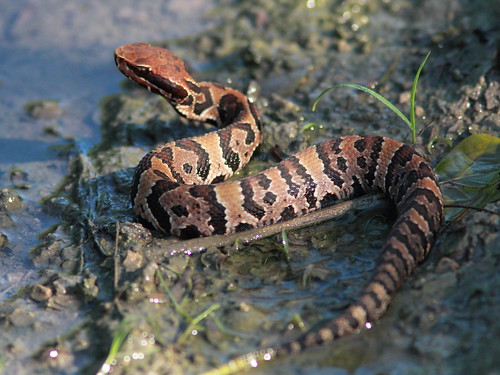
A venomous Cottonmouth Water Moccasin lounged near shore:
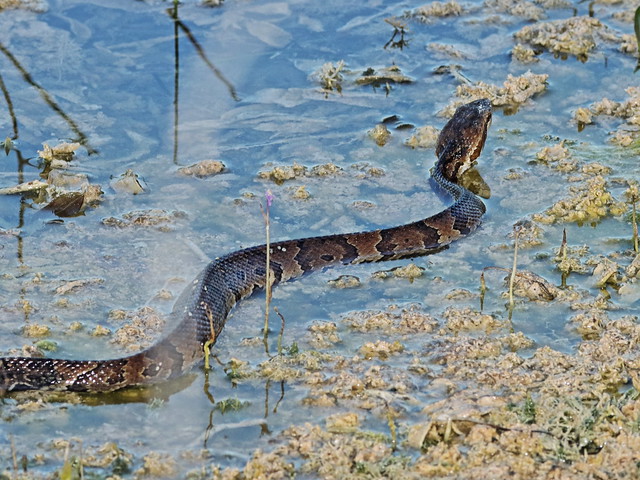
Close look at its black mask and slit pupil:

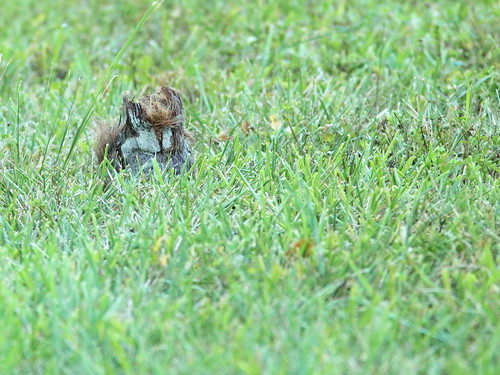
This curious Gray Squirrel was far from any trees and dashed off to find one as I approached:

At sunrise, a sunburst:

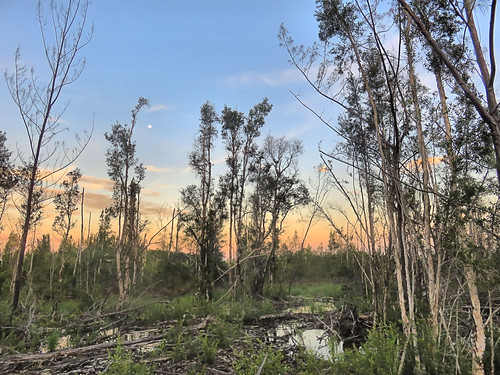
The sky was brightening up, but the Pine Bank had not yet been touched by the sun's rays:

UPDATE (MAY 26): Sad news about the youngest Bald Eaglet P Piney 27

The Audubon Center for Birds of Prey in Maitland, Florida released this statement about P Piney 27, the first eaglet to fall from the nest, at the age of about 5 weeks on April 18:

“The Audubon Center For Birds of Prey is saddened to report that the first eaglet rescued from the Pembroke Pines nest had to be humanely euthanized due to the severity of her injuries and lack of response to treatment. These difficult decisions are not made lightly and are discussed with a consulting vet and US Fish and Wildlife to determine what is best for the bird and their future quality of life. While this is not the outcome we all hoped for, we are grateful to those who watched this nest and helped rescue this young bird when her nest collapsed. The prognosis for the sibling who also has a wing fracture is still uncertain, but we are doing our best to give it every opportunity to heal and get a second chance at life. We appreciate your support and understanding.”

This was my first photo of P Piney 27, on March 18, exactly one month before he (we assumed a male because of its slower growth and passive behavior in the nest) fell from the damaged nest. He was probably a little over one week old at this time: 

This was my last photo of him with P Piney 26, his older and larger (presumed) sister in the nest, on April 7: 

= = =  = = =  = = = =  = = = = =

Linking to:


Skywatch Friday

Weekend Reflections

Saturday's Critters

Bird D'Pot

Camera Critters

All Seasons

Wordless Wednesday (on Tuesday)

Natasha Musing

Our World Tuesday

________________________________________________

Please visit the links to all these posts to see some excellent photos on display
________________________________________________

Thursday, November 28, 2019

A Bitter(n) lesson in the birding patch

An advantage of walking in the same old patch, day after day, is that you get to know so many features of the landscape-- the clump of leaves which resemble a roosting hawk, the shaggy stump which can be mistaken for a deer, the old woodpecker holes... You notice when there is something new-- a discarded soft drink can, a broken tree limb, fresh tracks or scat... 

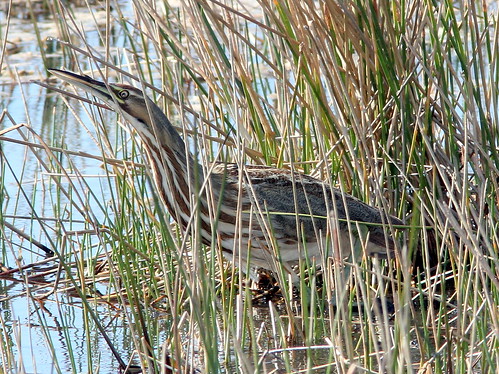
One morning I saw the unmistakable form of an American Bittern hiding in the sedges of the wet prairie:

American Bittern 20180104

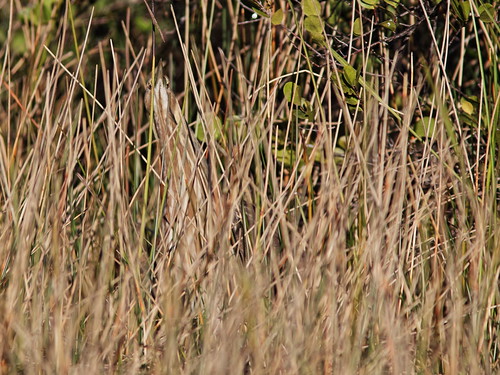
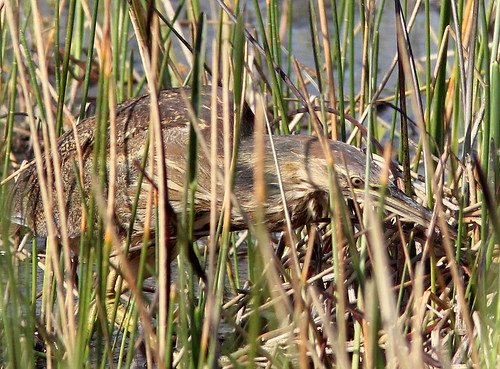
The next day, to my surprise, it was still hiding in nearly the same spot:

Fake Bittern 20180112

Not wishing to disturb it, I casually took its picture and walked on. However, an hour later the bittern was there again! Now look at the second photo more closely. This little clump of reeds  will not fool me again!

Another day a small mammal (or maybe an owl?), was out in the open, watching me. It looked exotic, resembling a cross between a fox and a squirrel:

Foxy Squirell NOT 20190930

I cautiously crept closer, and this is what I saw, a coconut!:

 Foxy Squirell NOT 2-20190930

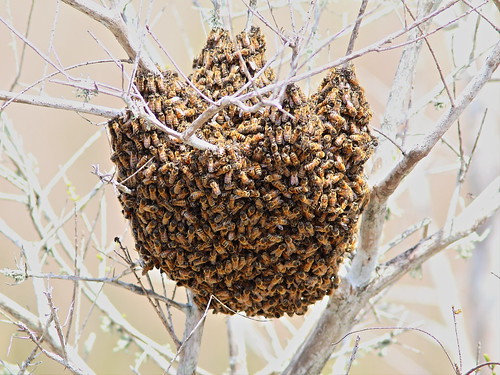
You are sensitive to changes in the soundscape-- the order in which various birds first call or sing in the morning and the seasonal variations in the mix and character of their sounds, the roar of flies crowded on the carcass of a dead animal or fresh scat, the hum of a swarm of bees:

Honeybee swarm 20140325

Your nose detects the opening of the flowers-- the sweet honeysuckle scent of Ligustrum, the strong camphor smell of Melaleuca flowers, the turpentine-like odor when you brush against the  Brazilian Pepper shrubs, the citrus smell of Lantana flowers which seems to be somewhat more or less pleasant depending upon their color...  As a kid I could detect the musky odor when the Garter Snakes emerged from their dens in early spring to gather in squirming copulatory masses, and the lemony sweetness of a colony of yellow Citronella ants in mid-summer (they smelled so good that I even tasted one-- to my surprise it was disgustingly bitter!).   

Honeybees and ants on fresh Ligustrum flowers:

Honeybees and ants on Ligustrum 20190814

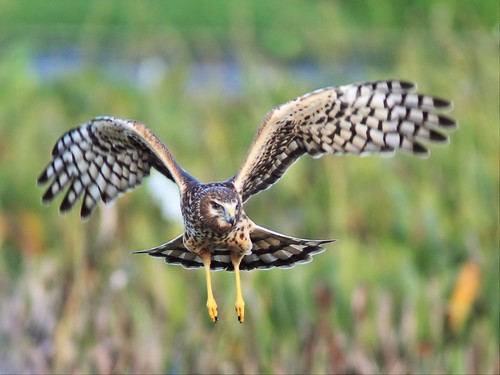
Northern Harriers use their acute vision and hearing to pinpoint prey hidden in the grass. They sweep back and forth over a grassy area almost as if they are following a planned GPS grid. They have been said to notice even minor changes in the areas they scan, implying they have excellent spatial memory. 

This reminds me of digital subtraction technology which superimposes two images separated by a time interval and subtracts all the identical overlapping background areas to display only objects which are new, moved or have changed. It is useful in aerial photography to allow the tax assessor to easily find alterations in structures which may modify their size or shape, in astronomy to detect new or moving heavenly bodies, for armed forces to discover recently placed weapons or fortifications, and in medicine, when using the same technique, serial digital X-rays or scans may track changes in blood vessels, the progression of tumors or healing of fractures. 

Northern Harrier:

Northern Harrier 5-20131210

Is the harrier's small brain capable of such a feat? In a certain sense, walking a patch resembles this phenomenon. Humans have the power to ignore the familiar-- the cracks in the sidewalk, cooking and tobacco odors at home, even the voice of a spouse! While I plead no contest to the latter, one winter morning I was guilty of not hearing the distinct calls of an American Robin in our local south Florida wetlands. Since it is a bird which I heard so often back in Illinois, my brain was slow to alert me to the fact that the bird was misplaced, as robins are infrequent and unpredictable visitors. Luckily I became aware and I even obtained photos.   

American Robin:

American Robin 02-10280217

Some of the changes in the landscape are unwelcome. These are often noted on Monday morning, after weekend trespassers on "wreckreational " vehicles (ATVs, ORVs, mud bikes, swamp buggies and jeeps) have violated the pristine areas of the preserve:

ATV damage to wet prairie 20180708

This is all that was left of my dark and shady sit-spot under the canopy of the "Fake Hammock" after trees were cut and bonfires roared, thanks to the ATV crowd. Since this photo was taken back in 2013, tall Phragmites grass has completely  invaded the sun-drenched spot:

Remains of fake hammock 2-200130329

Destruction in Fake Hammock 3-20120424

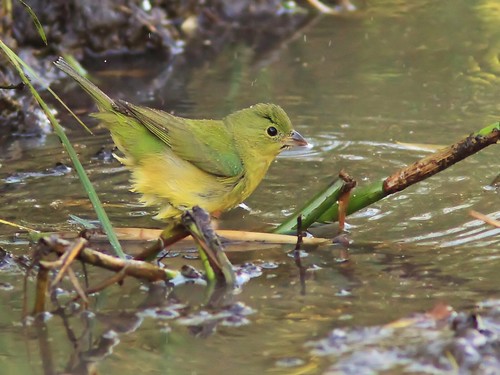
Sometimes ugly spots can be beautified, as when Painted Buntings bathe in fresh Mud Buggy tracks:

Painted Bunting bathing 2-20131222

Painted Bunting 2-20131222

A Killdeer forages at a muddy rut:

Killdeer 20111122

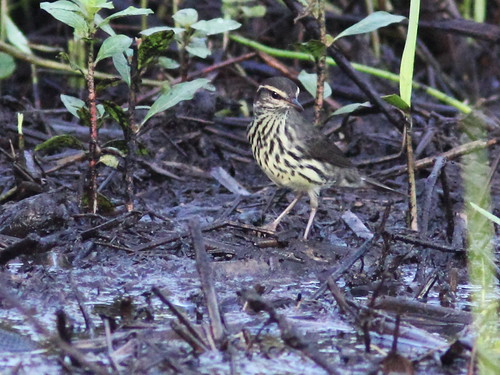
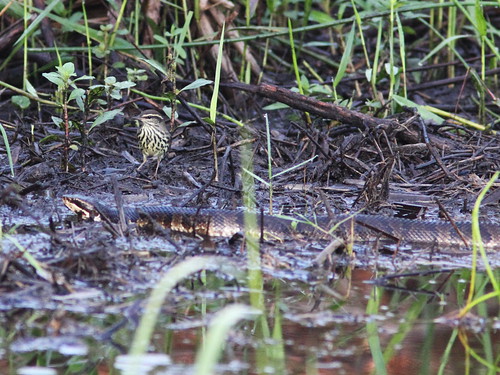
The antics of the partying off-road drivers can actually be welcomed when they practice doing "donuts" in the marsh. They create artificial "alligator holes" which retain water and attract wildlife, such as this Northern Waterthrush which is following a venomous Water Moccasin along the "shore" of just such a depression (Ophidiophobia warning):

Northern Waterthrush 20131008

Northern Waterthrush with Cottonmouth 06-20131008
  
Northern Waterthrush with Cottonmouth 09-20131008

Hurricane Irma struck in October, 2017. It decimated flowering plants and killed almost an entire generation of local butterflies, adults, larvae and eggs. Before the storm they flocked to the Lantana patch. At times one could not distinguish between flowers and butterflies:

Lakeside Lantana HDR 20150821

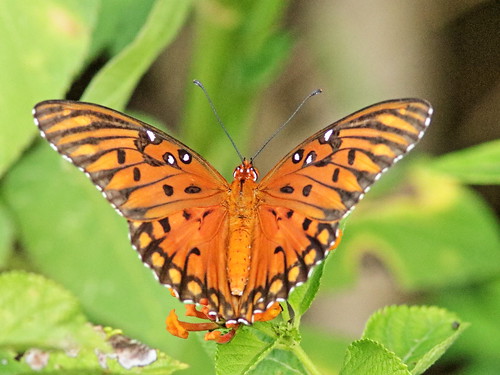
The Lantanas recovered slowly and some bloomed about  six months later, but  few butterflies visited. This past summer I could go a week without seeing more than one or two Gulf Fritillaries...

:Gulf Fririllary on Lantana 03-20191001

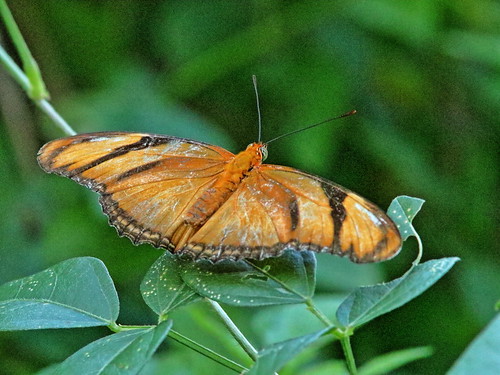
... or Julia heliconians. This was the first female Julia I saw in over a month (September 4, 2019):

Julia heliconian female 20190904

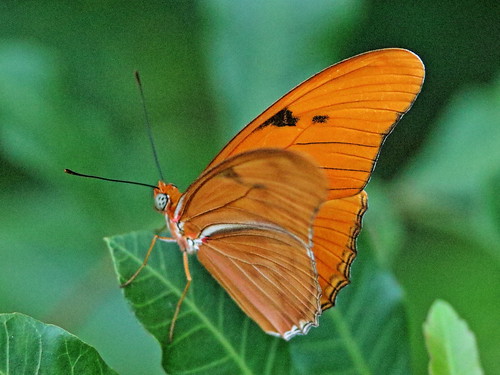
Julias are now becoming more common this is a male visiting the Lantanas on September 21, 2019: :

Julia heliconian male 01-20190921

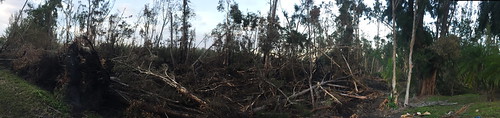
As if the fury of Hurricane Irma's wind were not enough, vandals set fire to wind-felled trees (February, 2018):

Fury of wind and fire 01-20180207

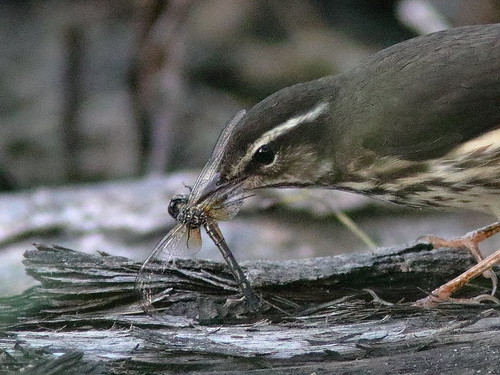
Paradoxically, the fire created a new but temporary habitat. The opening in the wetlands attracted prey for a Louisiana Waterthrush which remained there last autumn for an unprecedented three month stay as it probed among charred tree trunks and branches (October, 2018):

Louisiana Waterthrush 05-20181001

Louisiana Waterthrush 02-20181005

Louisiana Waterthrush 08-20181018

The fire improved sight distance, making it easier to see and photograph wildlife, such as this Gray Squirrel...

Gray Squirrel 01-20190902

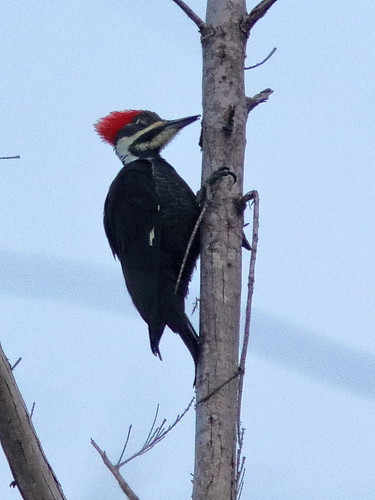
...and a  Pileated Woodpecker which  was  attracted to the dead and dying trees:

Pileated Woodpecker female 20181117

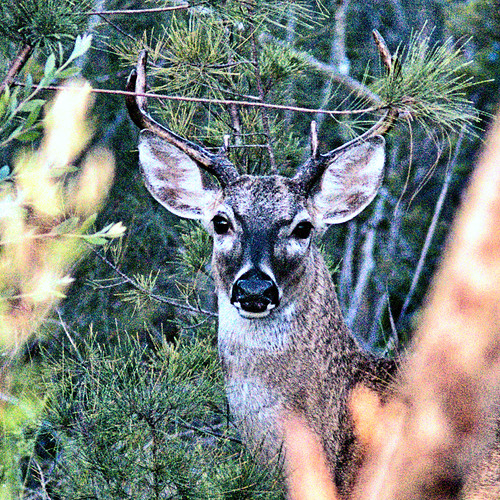
This White-tailed Deer buck failed to notice me as he entered the edge of the burned area:

White-tailed Deer buck portrait 06-20181022

The burned area is quickly recovering as invasive Melaleuca and Australian Pines sprout and flourish. Some have thrust up more than 15 feet during the two years since the  fire. This photo shows the area about one year later (August 28, 2018):

Sturgeon Moon over burn area 04-20180828

Here is the scene on October 24, 2019. Open water is already obscured by dense vegetation:

Burn area at sunrise 20191024 

= = =  = = =  = = = =  = = = = =

Linking to Misty's  CAMERA CRITTERS,

Linking to Eileen's SATURDAY'S CRITTERS,

Linking to SKYWATCH FRIDAY by Yogi, Sylvia and Sandy

Linking to WEEKEND REFLECTIONS by James

Linking to BirdD'Pot by Anni

Linking to Our World Tuesday by Lady Fi

Linking to Wild Bird Wednesday by Stewart

Linking to Wordless Wednesday (on Tuesday) by NC Sue

Linking to ALL SEASONS by Jesh
___________________________________________
Please visit the links to all these memes to see some excellent photos on display
________________________________________________

Thursday, March 22, 2018

Cryptic Critters


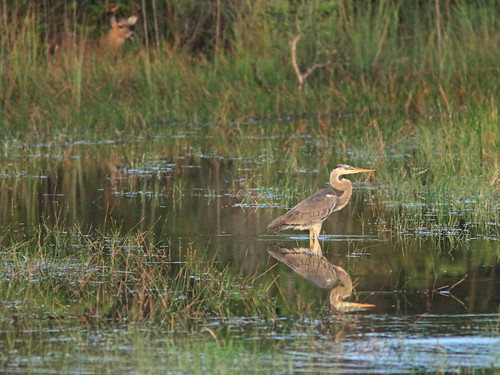
When I took this photo of a Great Blue Heron and its reflection, I did not know that a deer was watching from the seclusion of the wooded grove on the other side of the water:

 Deer photobombs heron 01-20140915

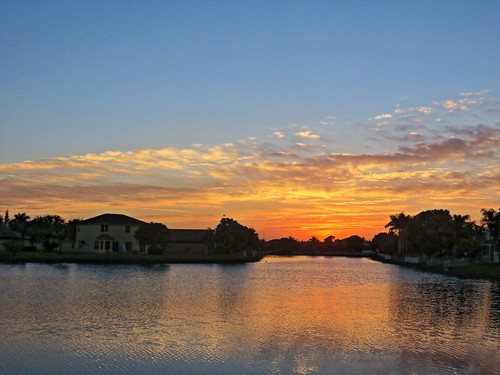
Sunrise from our back patio:

 Sunrise 20180308

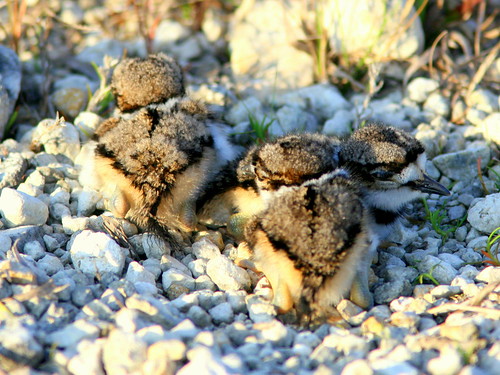
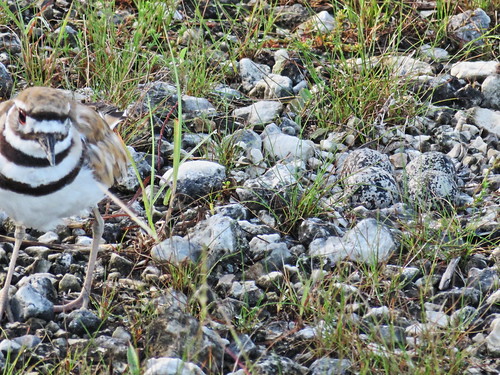
Early one morning, I almost stepped on these three newly hatched Killdeer chicks, huddled at the edge of the gravel track. I had unknowingly walked by their nest many times previously:

Three Kildeer Chicks 2-20090416

Killdeer eggs are also very hard to find. This courageous female stood defiantly in my way. At first I did not see the four eggs in the nest she was protecting, just to the right in this photo:

Killdeer at nest PowerShot 01-20170617

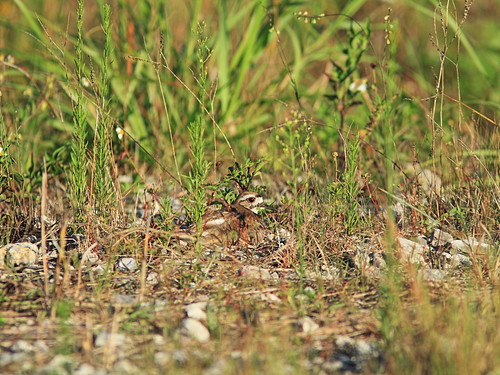
Another incubating Killdeer is nearly invisible:

Killdeer incubating 5-20160529

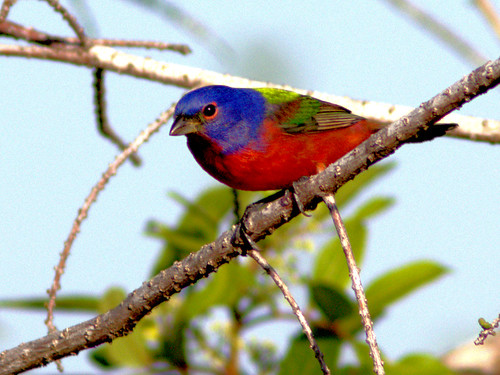
It's hard to believe that a male Painted Bunting might be included among the "Cryptic Critters" I have encountered: 


Painted Bunting 02-20170301

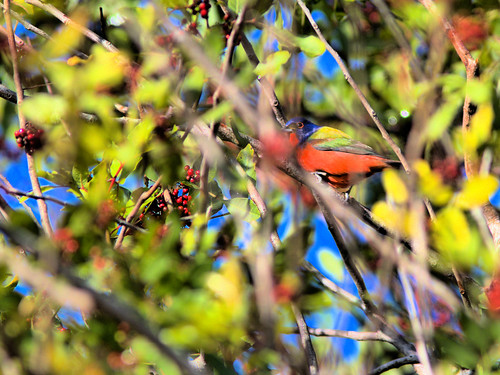
Yet, here he is in a Brazilian Pepper, almost overlooked against the green leaves, red berries and blue sky:

Painted Bunting male camo 20170130

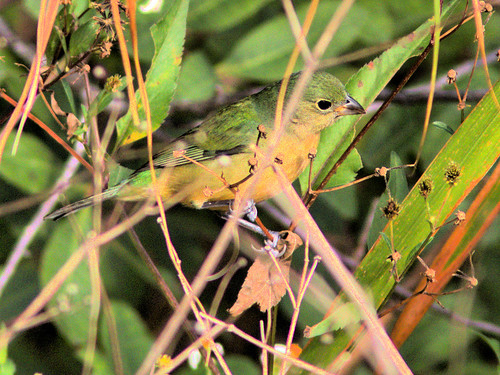
The bright green female Painted Bunting can sometimes be very hard to find among the leaves:

Painted Bunting female 02-20170219

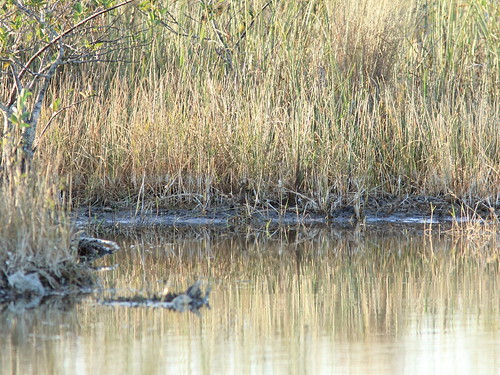
A Wilson's Snipe is very easy to overlook amid the grass and sedges. It is in the center of this photo at the edge of the water (click to enlarge):

Couldn't find the snipe 20121202

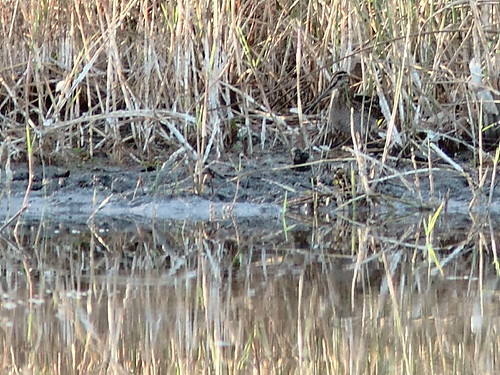
See it better in this crop of the above photo:

Wilson's Snipe found 20121202

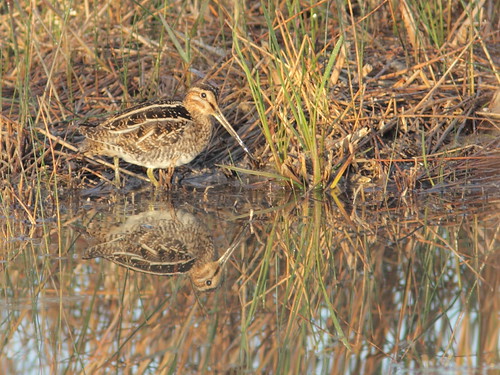
It is nice when one comes out into the open:

Wilson's Snipe 20130102

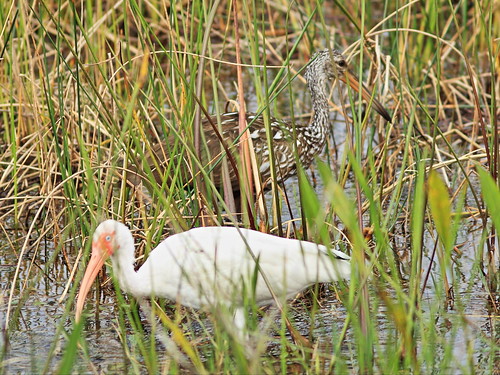
I almost did not see this Limpkin, standing right behind a White Ibis:

Limpkin and White Ibis 20160221

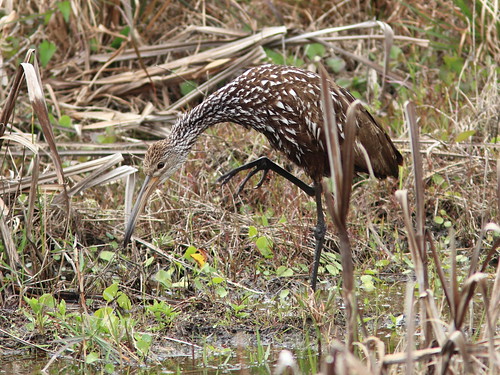
This is a clearer view of a Limpkin hunting for Apple Snails:

Limpkin hunting 20120219

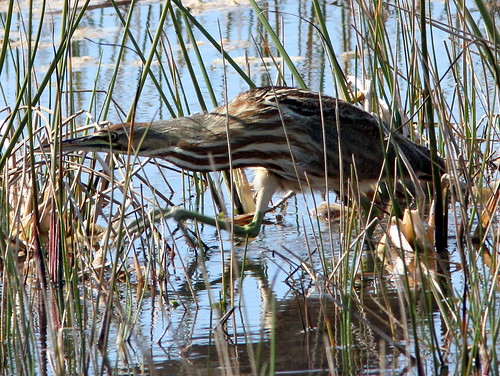
This American Bittern is watching me intently:

American Bittern 4-20180104

A study of stealth in slow motion, the bittern can disappear right before one's eyes:

Bittern stepping 20110123

American Bittern 3-20110123

American Bittern 20110323

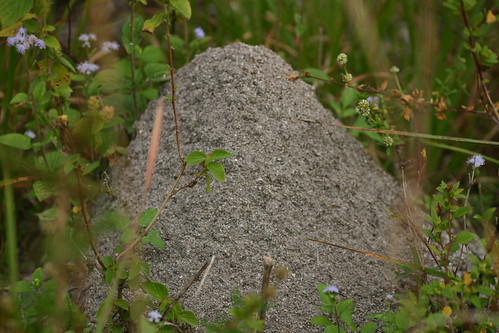
So, the lesson in all of this is to tread lightly and watch where you step. Fire ant nests are often not this easy to find:

FireAnthill

WARNING TO OPHIDIOPHOBIAS (I know who you are)-- DO NOT LOOK AT THE NEXT PHOTOS!

When birding in marshy areas I spend almost as much time looking down at my next footfall as looking up. I followed a little muddy deer trail and nearly stepped on something even more dangerous. I did not see it as I was taking photos of scenery and distant falcons. Then, as I turned to walk back to the main path, I saw something next to my foot which looked like a small yellow insect fluttering its wings-- an odd dragonfly or moth? No, as I bent down for a closer look I saw it was the vibrating yellow tail of a juvenile venomous Cottonmouth water moccasin .

It was in a defensive posture. When I moved, it opened its jaws wide and straight up. However the lining of its mouth was not white as is the case of adult Cottonmouths.


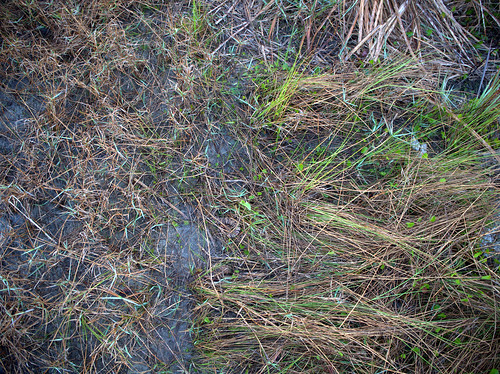
It was so well camouflaged that I could not see it in the viewfinder. The muddy foot path is on the left in this photo and I took several shots just to be sure one of them included the snake. It is on the right side of the path just beneath the very center of this picture (click to enlarge).

Cottonmouth Moccasin 02-20180214

Its yellow tail is near the upper left corner of this photo:

Cottonmouth Moccasin 01-20180214

It is only about 10-12 inches long. Here its mouth is partly open:

Cottonmouth Moccasin 03-20180214

Baby Cottonmouths are born alive. Unlike adults, they are colorfully banded and "...juveniles have bright-yellow tail tips that they use as a caudal lure to attract prey. They undulate the tail tip slowly back and forth to lure prey, such as frogs, within striking distance." Ref: LiveScience.com


Here is a better photo of a "Yellow-tail" which I took back in 2011. It was sitting out in the open in the middle of a muddy path:

Cottonmouth 20111001


= = =  = = =  = = = =  = = = = =

Linking to Misty's  CAMERA CRITTERS,

Linking to Eileen's SATURDAY'S CRITTERS,

Linking to SKYWATCH FRIDAY by Yogi, Sylvia and Sandy

Linking to WEEKEND REFLECTIONS by James

Linking to BirdD'Pot by Anni

Linking to Our World Tuesday by Lady Fi

Linking to Wild Bird Wednesday by Stewart

Linking to Wordless Wednesday (on Tuesday) by NC Sue

Linking to ALL SEASONS by Jesh

________________________________________________
Please visit the links to all these memes to see some excellent photos on display

________________________________________________