Showing posts with label Book Review. Show all posts

Sunday, August 16, 2015

Review: Backyard Guide to the Birds of North America

Our 11 year old Illinois granddaughter texted me from the Grand Canyon while her family was visiting Arizona. She attached a picture of a bird she correctly categorized as a titmouse.

After their trip we returned to our second home in Illinois and I asked Graciela how she knew about the titmouse.


She said she wanted to write a blog about her experience, as she did after her first visit to the Grand Canyon. Maybe she will get around to it despite all her other activities, but I pinned her down and interviewed her after she told me about this book she received as a gift from her parents.

Q. How did you know about the titmouse?

A. Because of a very helpful book called the Backyard Guide to Birds of North America.

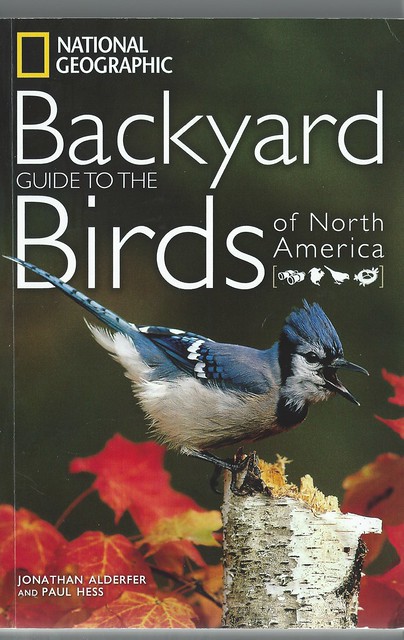
Backyard Birds Cover

Q. Isn't a backyard bird book about common birds like robins, starlings and pigeons?

A. No this isn't a simple book. It actually tells about many birds that you might never have heard of at all, like the Yellow-billed Cuckoo and even some types of hawks and vultures.

Q. I'm surprised! How many birds species does it describe?

A. There are 150 species of birds, all divided into different categories on 253 pages.

Q. Is it a field guide?

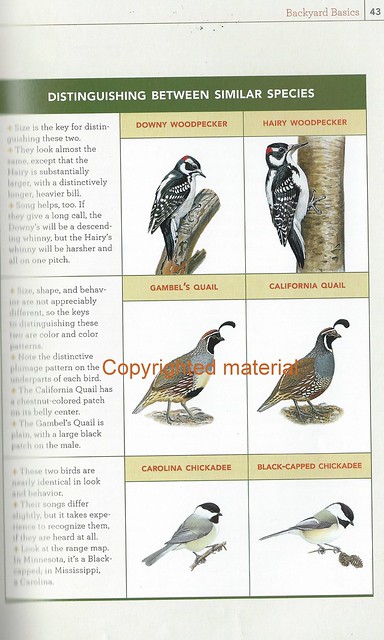
A. No, it is not a field guide because a field guide would list only certain things but this book includes basically everything. It does have hints about how to tell some birds apart, but that is not all.

Backyard Birds p43 similar birds

Q. So it is not just about identifying birds?

A. It not only identifies birds by telling what they look like and similar species, but also their call, range maps, what they eat and where you could find a nest. These things are not usually in a field guide. For example, the Northern Flicker takes up two whole pages. One page has the red-shafted flicker and the other has the yellow-shafted flicker, along with paintings and photographs of each, the males and females, showing them flying, even though they are both classified as the Northern Flicker.

Q. What else might distinguish it from a field guide?

A. There are special sections like those about bird feeders, creating a bird-friendly yard, types of bird houses, and when and where you can find birds in each season. In between the bird species you can find some pages that tell about interesting things like irruptions, caching food and finding it, how long do birds live, and how they change colors and so forth. There is a gallery of warblers.

Q. When you were in the Grand Canyon you wrote to me about seeing a titmouse. Did you see  it in your book?

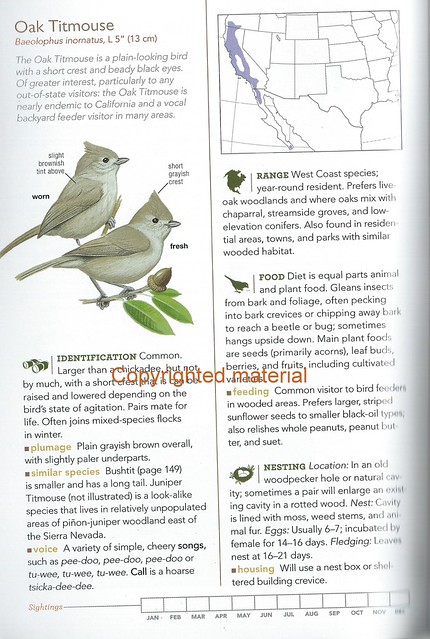
A. There are titmice in my book but it did not mention that certain species of titmous that I saw. It had the shape of a titmouse and looked like the Oak Titmouse. The book said that the Juniper Titmouse is a look-alike to the Oak Titmouse and you told me this is the titmouse species most likely found in the area of the Grand Canyon. The book shows where the Oak Titmouse lives, way out in California.

Backyard Birds p146 Oak Titmouse

Q. You mentioned an irruption. I guess you know what that means?

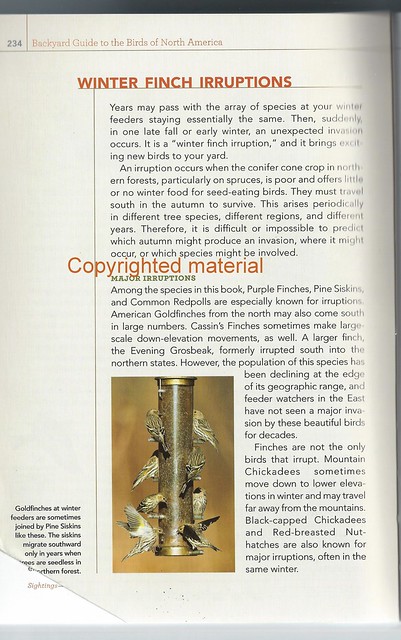
A. It is an event that happens occasionally around the fall or winter when all of a sudden a large number of birds from farther up north come to your feeders. Normally they are birds in the finch category.

Backyard Birds p234 irruptions

Q. That is pretty informative. It does not sound like purely a children's book. What ages is it directed to?

A. This book is good for anyone whether kid or adult. A child maybe down to even a seven year old child.

Thanks, Graci. With your permission I will post this as a book review in my blog, but I must give you all the credit, and thanks for asking me to use photos from my archives to illustrate it.


Here are some  photos of birds in Graciela's back yard. 

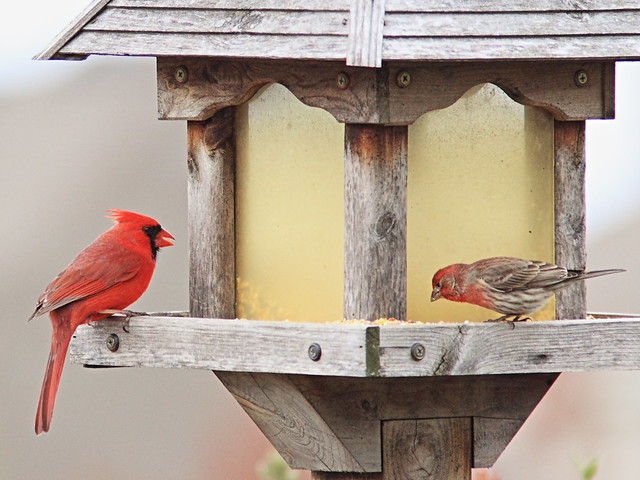
Males, Northern Cardinal and House Finch:

Northern Cardinal and House Finch 20150422

Common Grackle:

Common Grackle 20150422

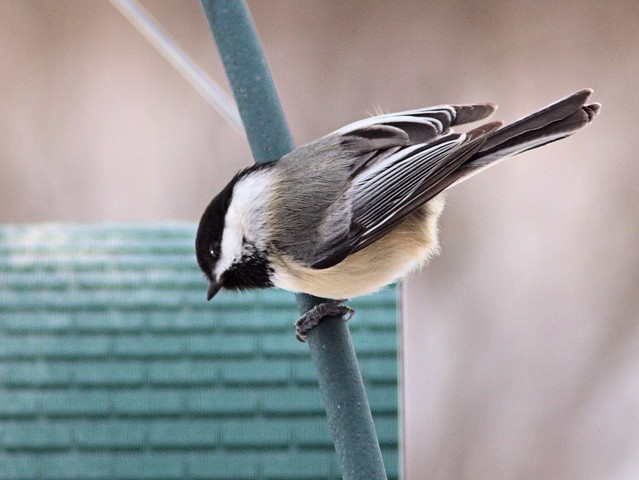
Black-capped Chickadee:

Black-capped Chickadee 2-20130305

Female House Sparrow:

House Sparrow 20120517

Chipping Sparrow:

Chipping Sparrow 4-20120509

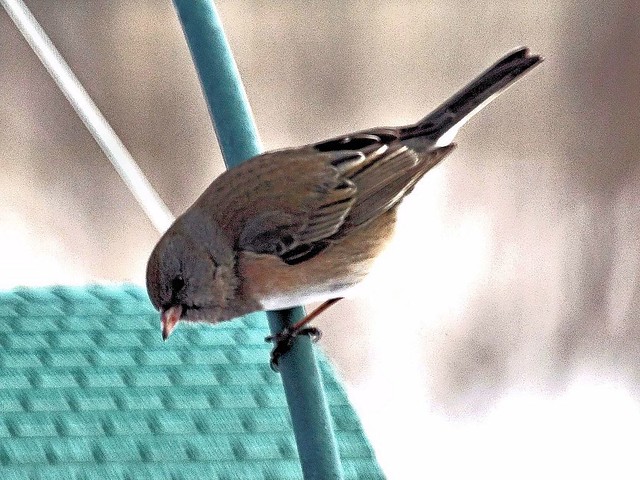
Dark-eyed Junco:

Dark-eyed Junco crop 20130223


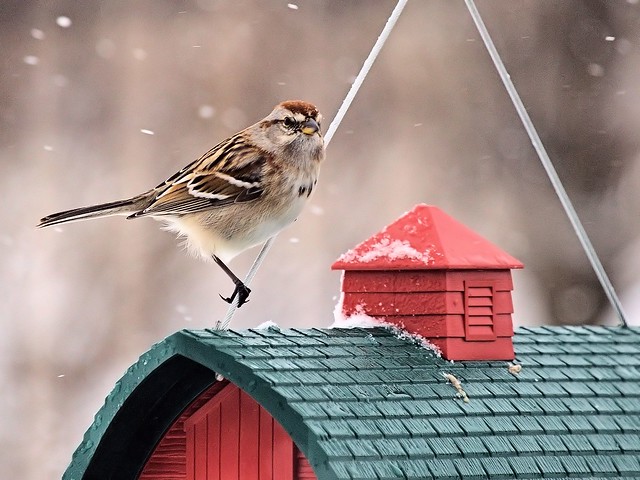
American Tree Sparrow:

American Tree Sparrow 2-20130227


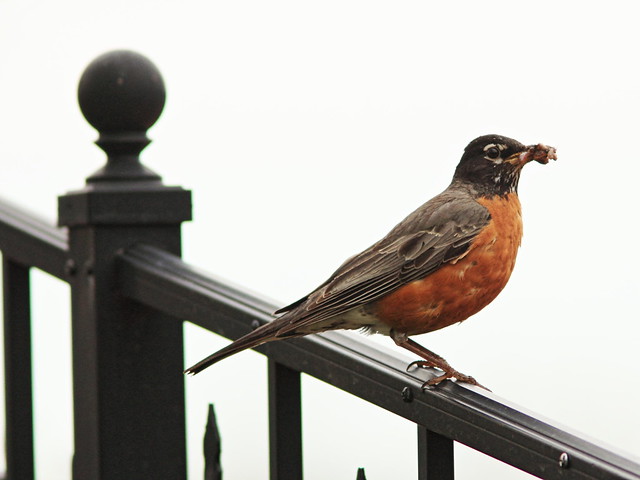
Male American Robin:

American Robin male 2-20140504


National Geographic Backyard Guide to the Birds of North America (National Geographic Backyard Guides) 

Paperback – March 15, 2011
by Jonathan Alderfer (Author), Paul Hess (Author)


AMAZON.COM -- $13.65

 - - - - - - -- - - - - - - - - - - -

Linking to Wild Bird Wednesday by Stewart and


Bird and Wildlife Book and App Reviews by Ken


________________________________________________

Saturday, December 13, 2014

A Blue Jay named Sammy

I can thank my dear late Father for opening my eyes to the beauty of the natural world. Not that Mom didn't help, putting up with my collections of snakes, frogs, toads, salamanders, turtles, white mice, hamsters and even praying mantises (I used to gather their egg cases and keep them inside all winter so that I could relocate them to our yard and watch them hatch in the spring-- but once I forgot then in the attic and this post A Buggy Rent House tells of the consequences). Mom never let me have a dog or cat, as we had the benefit of our grandparents' dogs next door. Ironically, as soon as the last of my four siblings left home she herself got her first dog! 

But back to Dad... A very nice neighbor, who knew of my interest in nature, gave him her entire set of Bedtime Story-Books (Boston, Little, Brown, and Company, 1915) by Thornton W. Burgess (1874-1965) just when I was at an age to best appreciate them. 

Dad would read the books to me at bedtime, and I fought sleep to hear the adventures of all the creatures of the Green Forest-- Danny Meadow Mouse, Peter Rabbit, Grandfather Frog, Reddy Fox, Prickly Porky the Porcupine, Jimmy Skunk, Billy Muskrat... I heard their stories over and over again, and even after I learned to read I asked Dad to read them to me. Later I would read them to my younger siblings, my children and, more recently, to my grandchildren. 

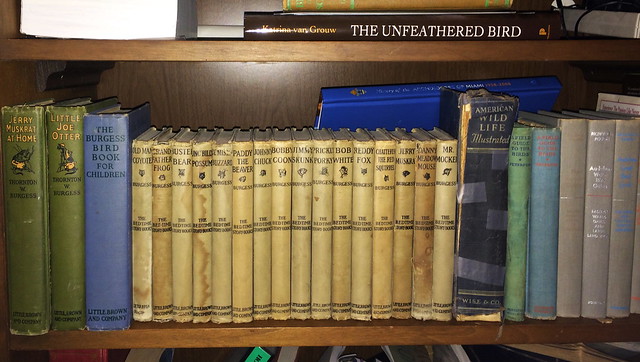
They were like new when we received them around 1938. My parents subsequently gave me three larger editions of Burgess's works (to the left in this photo):

Burgess Books 20141122

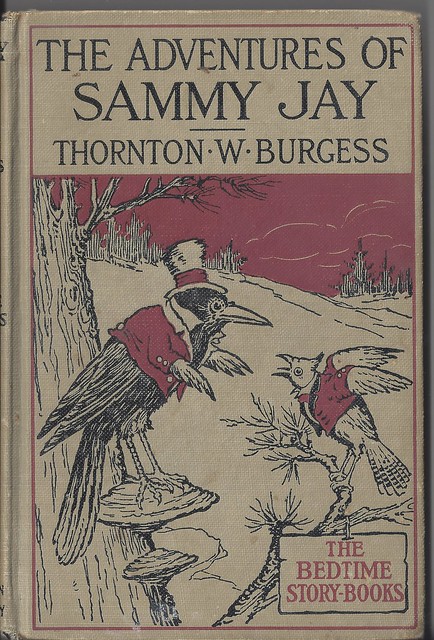
One of my favorite characters was Sammy Jay, a crafty and conniving creature who warned the other inhabitants of the Green Forest of danger, but more often loved playing tricks such as raiding their food stores or scaring them with false alarms. This book was one of the 170 books and 15,000 stories that Burgess would write in his lifetime. 

Burgess Book Sammy Jay

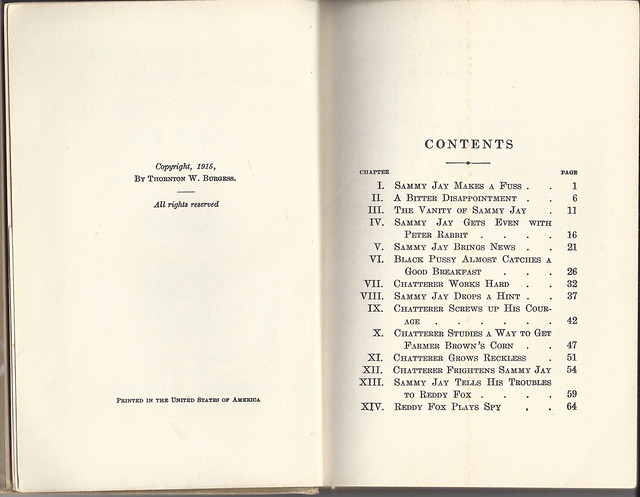
Burgess also wove many moral and ethical lessons into his simple prose. Dad (and later, I) would stop the narrative to reinforce them to the listener. 

Burgess Book Sammy Jay Contents

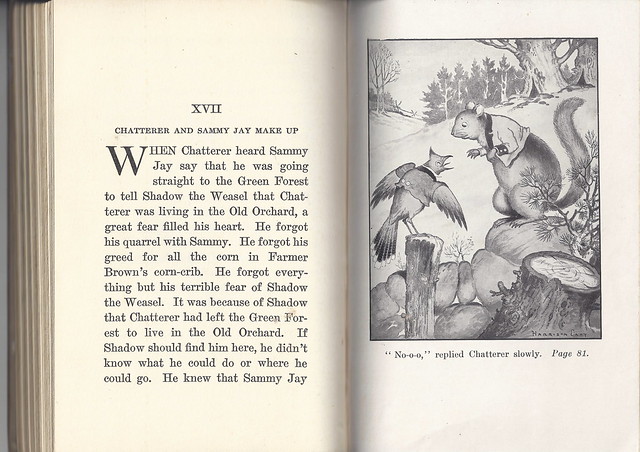
Here Sammy retaliates when Chatterer the Red Squirrel calls him a thief for stealing his acorns. After spying and finding that Chatterer took some corn from Farmer Brown's shed, Sammy then threatens to send Shadow the Weasel after him, frightening the poor squirrel into submission, asking, "Am I any more of a thief than you are?" Chatterer's answer:

Burgess Book Sammy Jay Illustration

Of all the colorful characters in the Burgess stories, I found it much easier to relate to Sammy Jay. Blue Jays were very conspicuous in my neighborhood. I remember finding one of their nests in a tree just outside an upstairs windows, and watching the progress of the young birds from helpless pink hatchlings to little short-tailed cartoon caricatures of their parents.

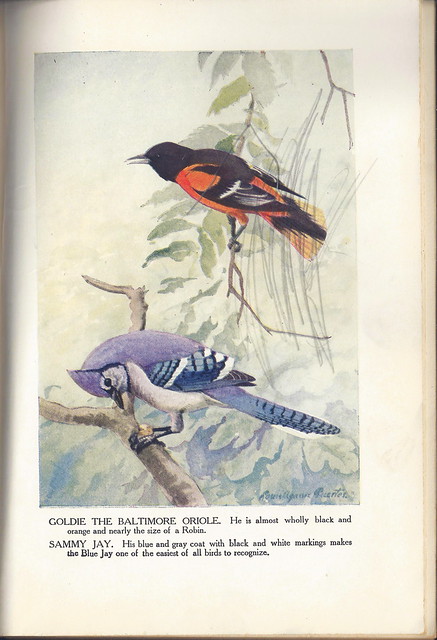
The Burgess Bird Book for Children (Boston, Little, Brown, and Company, 1919) expanded stories about the birds included in the Bedtime Story-Books, but they were illustrated much more realistically by the wonderful art of Louis Agassiz Fuertes (1974-1927).  Here I saw the real Sammy Jay as I grew to know him.

Burgess Bird Book Sammy Jay Illustration

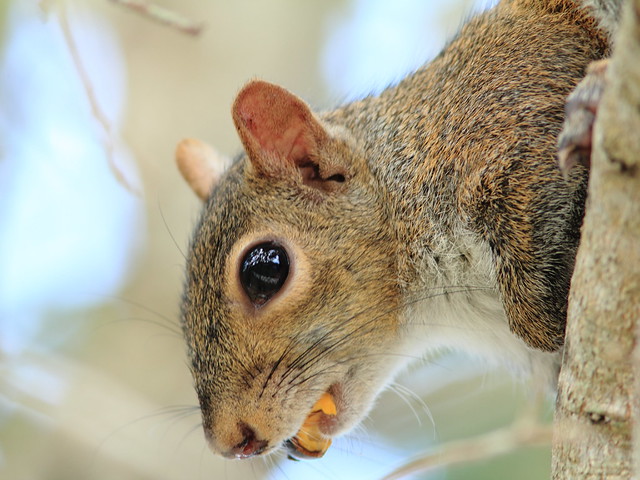
Indeed, I witnessed the animus between Blue Jays and squirrels, and remember seeing a jay follow a squirrel as it buried acorns in our lawn and unearthing them as soon as the squirrel departed. I have seen this drama repeated many times since. Survival trumps ethics in the real world of nature.

Gray Squirrel eating cocoplum 20121231

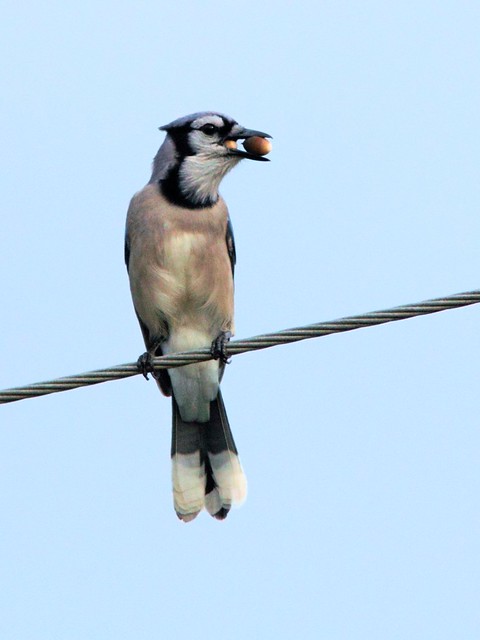
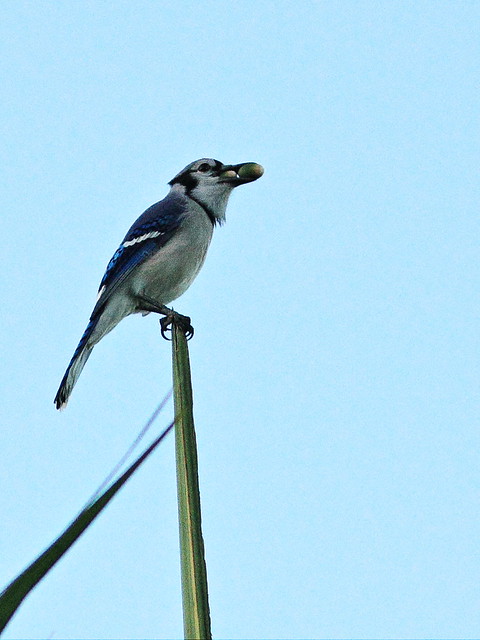
Blue Jays can carry as many as 5 acorns in their mouth and upper esophagus, their "gular pouch:"

Blue Jay 2-20121205

Blue Jay with acorns 20141028

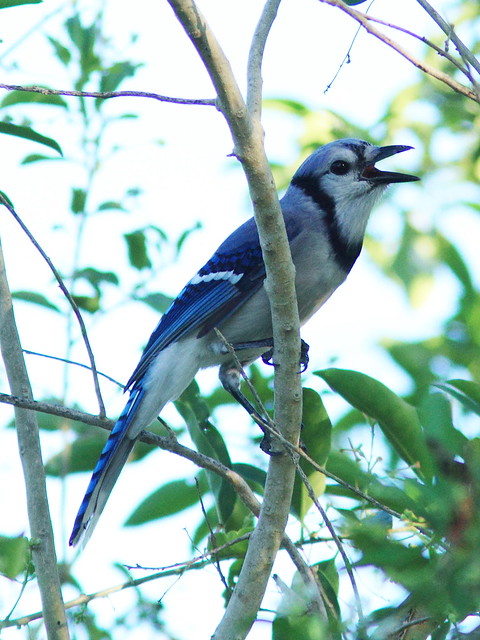
As a kid, I noticed that Blue Jays had a great variety of calls, running the gamut from a bell-like whistle to harsh screams. They are also good mimics. They could give an almost perfect imitation of a Red-tailed HawkInterestingly, here in Florida they commonly mimic the call of a Red-shouldered Hawk, a species that is very common here. I never heard one give this call back in New Jersey, where Red-shouldered Hawks had a more restricted range.

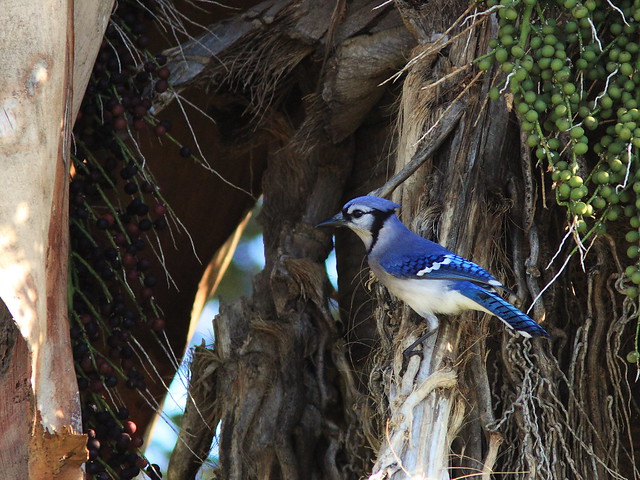
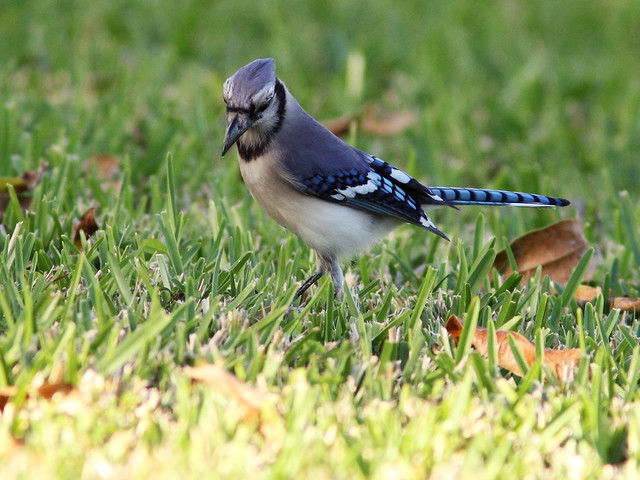
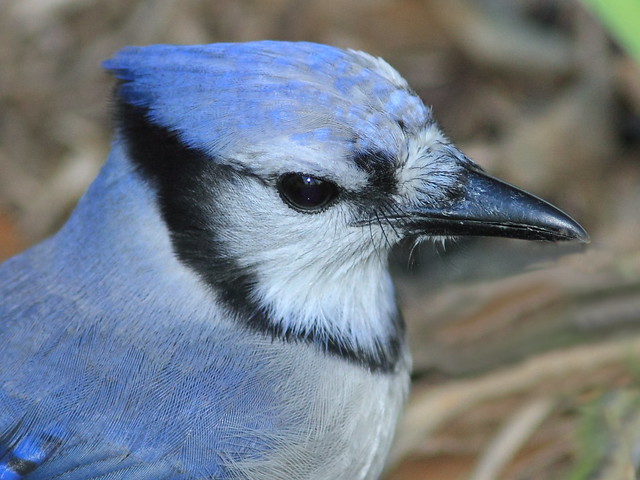
Common as they are, Blue Jays are nonetheless uncommonly beautiful:

Blue Jay on Royal Palm 20140127

Blue Jay 2-20130211

Blue Jay 20141118

Most activities in nature have some meaning, as wild creatures generally do not expend energy on something that does not have survival value. Many times I have found an owl or a hawk, or even an eagle simply by following the sound of a flock of excited Blue Jays. Presumably, they are alerting other birds of the presence of the predator, just as they do when I venture into their territory. 

Blue Jay 20130920

This makes me wonder why jays may become excited and call in a mob when no threat is evident. Perhaps I am just not seeing or appreciating the cause, and must speculate whether they are just wasting energy or perhaps conducting a "drill" to get to know their neighbors or to improve their ability to gather in times of danger.   

Blue Jay 20110131

Blue Jay portrait 2-20121021


More of my Blue Jay photos may be seen in this earlier post.

REPRINT OF "SAMMY JAY" may be available at this link


Sunday, October 6, 2013

The Unfeathered Bird: A Review and Reflections on a kink

One evening years ago, while we were eating a chicken dinner, our youngest daughter came up with an idea for her grammar school science fair project . "Let's save the bones and I can put them all together and make a skeleton."

This was much easier said than done. We collected the remains from dinner and afterwards picked away at the bones, ending up with a greasy mess. Neck vertebrae were a hopeless tangle of ligaments and windpipe. Cartilage stuck to the drumsticks. The wishbone had been broken (for good luck). 

I came up with a better idea, to slow-cook another chicken in a Crock Pot. We could make soup with the stock and expect the softened meat to fall off the bones. This worked fairly well. We cleaned the bones, washed them with detergent and let them dry out.

The difficult job was putting the bones back in proper order, but we accomplished this and secured the joints with globs of clear silicone adhesive. Mounted on a stand I made from clothes hanger wire, it was quite an impressive skeleton, despite the missing head and feet. The restored neck bones curved up nicely. Our daughter named the chicken "Ezekiel" of biblical dry bones fame. She didn't win the science fair, but her project got lots of attention. Ezekiel's skeleton survived for several more years as an adornment in her bedroom, until it broke apart.

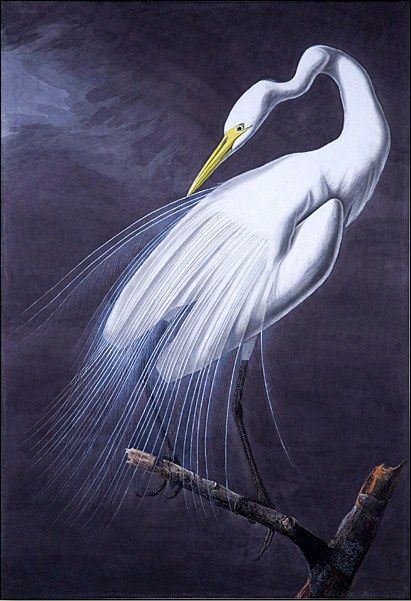
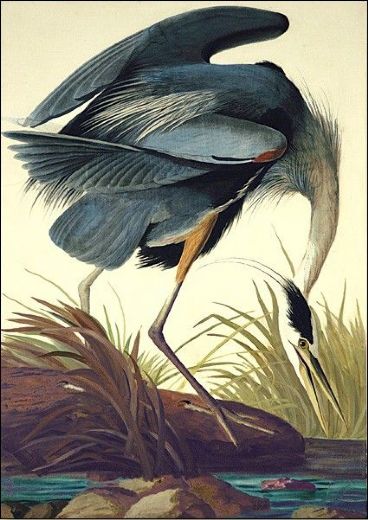
Given this experience, if I had worked on God's assembly line I would have provided the herons with a much more graceful neck. I don't know how you feel about this, but there must have been a mistake in its creation. I want an egret or heron's neck to form graceful curves, such as depicted by John James Audubon.


Instead, I see an ugly kink that interrupts the pleasant "S" curve in this Great Egret's neck. Why would it have a 90 degree zig-zag that constricts its spinal cord, or maybe even interferes with swallowing a  big fish? To Audubon's credit, his paintings are anatomically correct, as the kink is obscured by careful positioning of the birds' necks.

Great Egret Flying 20091129

There it is again, in this Great Blue Heron!

Great Blue Heron 20120101

My goodness, the Anhinga's neck takes a funny turn as well!

Anhinga 20090527

In nature, every structure serves a purpose. Sometimes the purpose is not very evident. It may be a remnant of some useful ancient mutation, important to survival during evolution of a species. 

Is the kink in a heron's neck similar to the human appendix, which seems unnecessary and superfluous, leaving us with a reminder, evidence of an evolutionary "blind alley" (pun intended)? Although seemingly of little use, the human appendix does serve an important immunologic function from early fetal development into young adulthood. 

Does that kink in the heron's neck possibly have some reason for being?

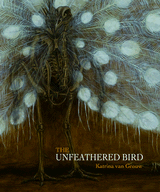
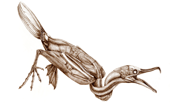
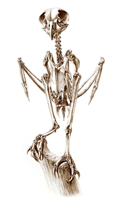
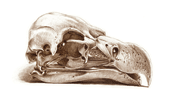
For the answer I turned to a book with an odd title: The Unfeathered Bird, by Katrina van Grouw (Princeton University Press). I leafed through it, expecting this book to be about birds in various stages of undress. Instead I found a dazzling array of drawings of the bony parts of many bird species. There are drawings of full skeletons as well as single bones or sets of vertebrae, ribs or limbs. Sometimes the muscular attachments or flight feathers are included, as are skulls, beaks and feet. The illustrations are not diagrams or outlines, but finely detailed and artfully executed.

The culmination of a twenty-five year project, The Unfeathered Bird is not simply about bones. It represents deep research into not only comparative anatomy, but also physiology, bird behavior,  body mechanics, taxonomy, paleontology and evolutionary biology.

The book consists of two major sections, Generic and Specific. The former, in about thirty pages, explores those features common to most birds and illustrates adaptive variances. As different as birds might appear, their skeletal and other internal features bear a certain sameness.

The concise text is not only extremely informative, but also makes for very enjoyable reading. A bird's trunk is a rigid and light weight airframe, which requires great mobility of the head and neck to permit preening and feeding. The hind limbs project underneath rather than outward as in reptiles, and must be strong to compensate for the lack of forelegs. Feet are adapted for specialized tasks such as running, grasping prey or food, climbing, digging, and swimming. Birds usually have four toes, but there may be only two (as in Ostriches), three (only two facing forward) in kingfishers, or even five in some domestic fowl.  The wings generally contain little muscle, relying on those of the breast, which provide the strong downstroke so essential for flight.

The Specific section addresses six major groups of birds that share similar anatomical characteristics, but they are not arranged in strict taxonomic order. 

For example, the chapter on "Accipiteres" includes hook-billed birds that eat the carcasses of other animals: vultures, birds of prey and owls. This approach provides the opportunity to explore particular adaptations. 

Vultures, facing an uncertain and sometimes scarce food supply, cannot waste energy. Their wings are specialized for soaring, which conserves energy and allows them to cover great distances. 

Diurnal raptors often have surprisingly small bodies under their bulky plumage and long tails. Rather than relying upon long distance flight and endurance, they often spend much time roosting or sailing and making high-speed forays after prey. Their broad breastbones and wide wishbones accommodate short, strong bursts of flight. 

Owls have comparatively low body weight that puts less load on their wings and permits nimble and stable flight even at low speeds. Owl bones are not the only focus of this section-- indeed the following reinforces my point that this is not a "book about bones." In easy prose the author discusses the wide gape of owls that permits them to swallow whole prey, and expanding the topic, mentions that owls regurgitate the indigestible parts of prey items as pellets: 

"Owl pellets are large enough to be studied with ease in the classroom or laboratory, giving a good indication of exactly what the bird ate for its last meal. So strongly associated are pellets with owls that many people don't realize that they are not exclusive to them-- virtually all meat-eating birds produce pellets, even small insectivorous species."

She reminded me of an American Kestrel I photographed (badly) as it appeared to be retching almost convulsively.  

Kestrel retching 20101118

Suddenly a pellet appeared in its mouth and dropped to the ground before I could snap another picture.

Kestrel disgorging pellet 20101118


Among the other groups are the "Picae," from parrots and kingfishers to woodpeckers and hummingbirds, all with sharp-edged bills and short legs, among other shared characteristics, "...anything that seemed too large or too unusual for the perching birds." 

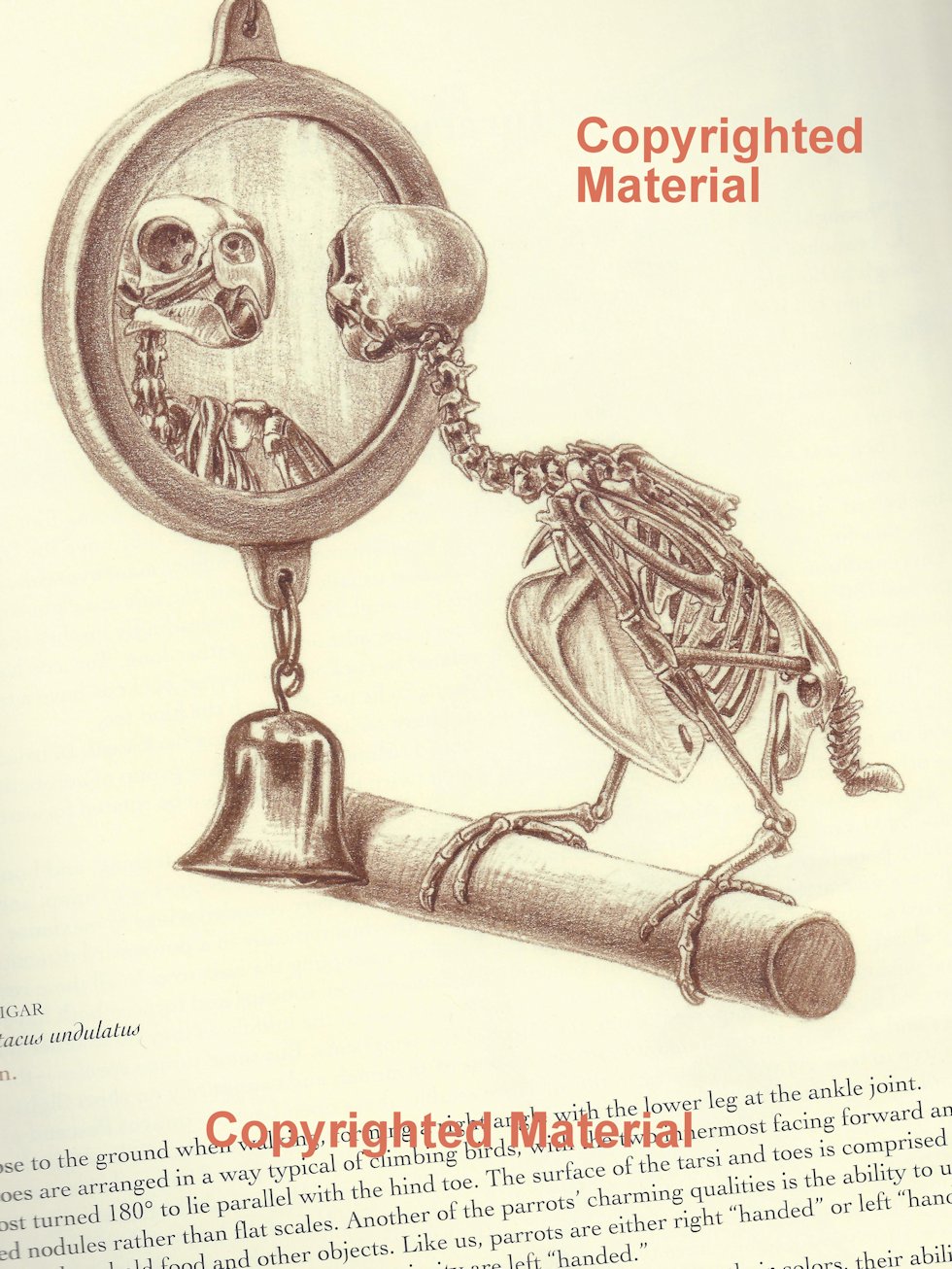
Humorous illustrations in this chapter include a macaw with its skin removed, chewing on a pencil, and a Budgerigar skeleton looking at itself in a mirror! 


Typically, Katrina van Grouw reveals her conservation concerns, here by calling attention to the decimation of some parrot species by the pet trade. Despite their engaging and gregarious personalities, captive parrots lead a dismal life: "More often than not the result is a pitifully bored and frustrated animal eking out a long and unhappy existence in the corner of an empty room."

Waterfowl such as ducks, geese, penguins, loons and grebes are grouped as "Anseres;" domestic chickens, gamebirds, ostriches and bustards are among the "Gallinae," while "Passeres" encompasses perching birds as well as pigeons, nightjars and swifts.

In view of my concern about the "kink" in herons' necks, I jumped to the chapter entitled "Grallae," as it includes herons in addition to flamingos, storks, ibises, spoonbills, cranes and rails. This succinct statement, typical of so many passages in The Unfeathered Bird, provided the needed clarification:

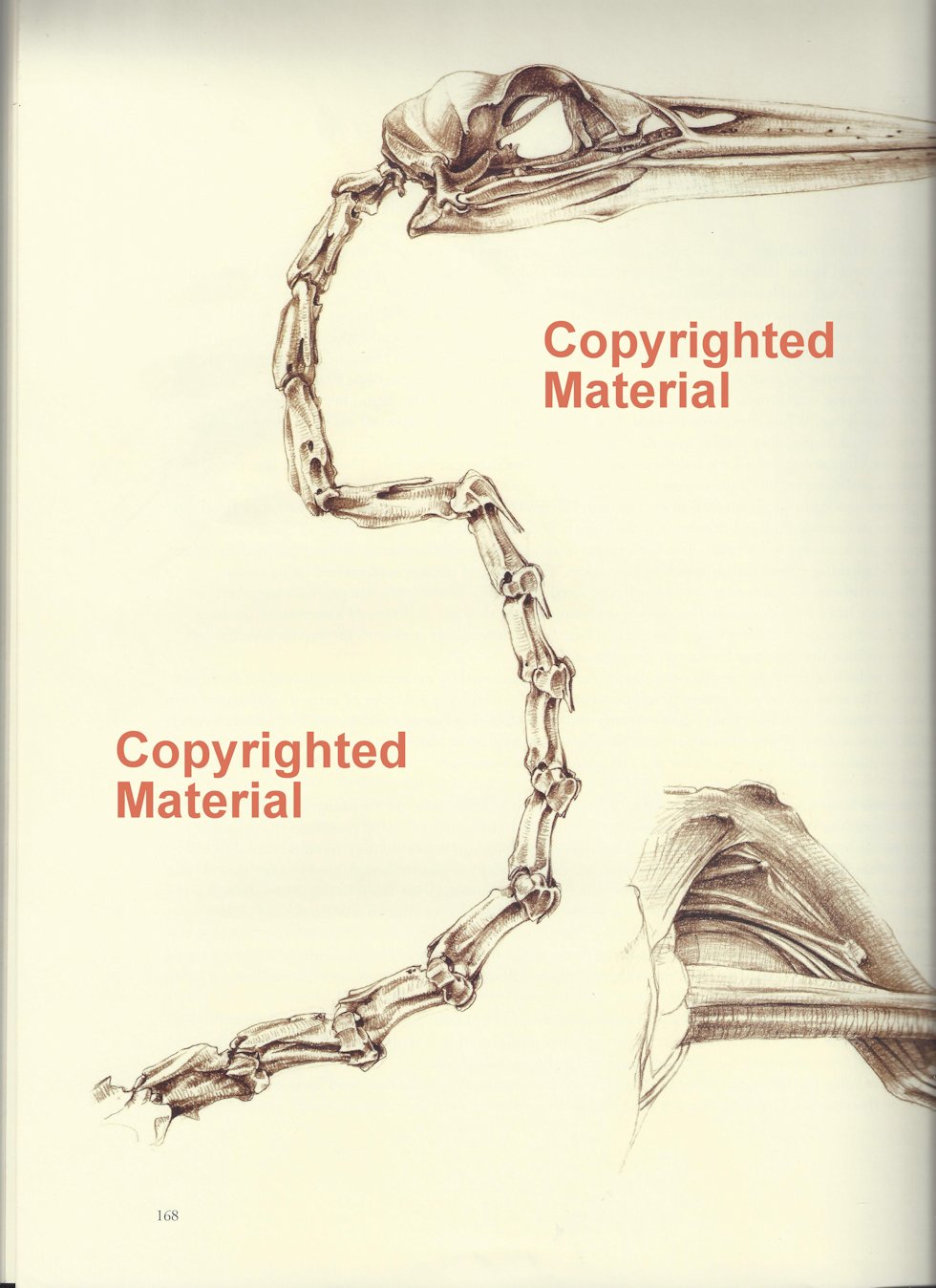
"Herons are built around the forward thrusting action of their dagger-like bill. Their neck, like the neck of cormorants and darters, has a permanent kink in it, the result of a single elongated vertebra that is attached to its neighbors at a right angle instead of end to end. In herons, however, this is the sixth vertebra from the skull, whereas in cormorants and darters it is the eighth, meaning that the kink in a heron's neck is slightly higher up the neck, closer to the head. The kink forms a sort of hinge mechanism, enabling the bird to lunge forward at lightning speed and astonishing precision."

The "errant" horizontal vertebra is beautifully shown in this drawing of the similar Grey Heron's neck bones:


This book is large and heavy, measuring 10 x 12 inches. It is a work of art to be enjoyed at the coffee table but also to serve as a unique and valuable reference.


The Unfeathered Bird
Katrina van Grouw

Cloth | 2013 | $49.95 / £34.95 | ISBN: 9780691151342
304 pp. | 10 x 12 | 385 duotones/color illus.
eBook | ISBN: 9781400844890 | Where to buy this ebook
Katrina van Grouw's Home Page


Small images linked from Princeton University Press

Sunday, September 29, 2013

The Warbler Guide: Review and Reflections

My first field guide was Chester A Reed's 1923 Bird Guide: Land Birds East of the Rockies. This pocket-sized book helped me discover the names of common dooryard birds through toddlerhood and beyond. Regrettably, I defaced the little book, recording my sightings by scrawling "SAW" in big block letters across every bird I identified. Recently I purchased a clean copy, which rekindled childhood memories.  

Three warbler species are particularly hard to identify in the fall, when young birds and females predominate. The spring males of these species are quite distinctive.  

The first of this "Treacherous Triad" is the Blackpoll.  Sole reliance on Reed's color rendering would have placed a bird watcher who encountered an immature bird at a great disadvantage. No warbler looks anything like the one in the upper right in his illustration, described as paler than the female which is "greenish above streaked with black." 

ReedBlackpoll - Copy

Next, in describing the Bay-breasted Warbler, Reed mentions that the female and immature may show "a trace of chestnut on the flanks."

ReedBay-breasted - Copy

In the case of the Pine Warbler, Reed's illustration of the "duller and grayer" female would have been of little help, even at close range.

 ReedPine Warbler

In pursuit of a Boy Scout Merit Badge, I started keeping a Life List in 1948, relying on my copy of Roger Tory Peterson's 1939 Revised and Enlarged First Edition of A Field Guide to the Birds, a gift from my mother a few years before. As I noted in an earlier blog, Roger Tory Peterson Centennialshe paid $2.75 for a used copy in 1942 (before my breakfast CheeriOats were renamed Cheerios). It would have cost $38.22 in today's economy, according to this Inflation Calculator, quite a sacrifice in those days. 

Peterson provided better descriptions and awakened my interest in warblers, but was not much more helpful in addressing the differences between the three problem species as usually seen during fall migration. 

For each of the "treacherous triad" the images of "autumn birds" had pointers which called attention to field marks. 
  • Blackpoll: "Olive-green above, two white wing bars, dingy yellow below, faintly streaked." 
  • Bay-breasted: Same description, except that it is "dingy buffy-yellow below," adding that it has yellow undertail coverts instead of white as in the Blackpoll. 
  • Pine: Similar to the other two, dull olive above, with a plain, unstreaked back and white undertail coverts.
The Peterson Field Guide greatly improved my ability to recognize male warblers in the spring. All the warbler species were depicted in only two color plates; this one illustrated the three similar species.

Peterson Warblers 1939

In his 1947 Second Revised and Enlarged Edition Field Guide, which I acquired about a year after I started my Life List, Peterson published this plate that depicted the "Confusing Fall Warblers." 

Peterson Warblers 1947

I wish he had not used that term "confusing." Although Peterson's intent was to sharpen the reader's birding skills, the illustrations had the opposite effect upon me, leaving me more perplexed than ever. Peterson's characterization simply legitimized my own confusion, especially in trying to distinguish the more common Blackpolls from Bay-breasted Warblers weaving about in the fall foliage! 

 Like most beginners, I learned useful ID tips from more experienced birders, but the "Confusing" three species were often cause for disagreements, even between the experts. I could sometimes separate the Pine Warblers from the other two. Autumn Blackpolls seemed to be more abundant than Bay-breasted, but too many of these went unidentified. Over the years, I came to call them simply "Baypolls."

To my rescue, some 65 years too late, Tom Stephenson and Scott Whittle's The Warbler Guide arrived on the birding scene. Before I received a copy, I expected it to be a rather slim publication. After all, the National Geographic Field Guide to the Birds of North America devotes a hefty 25 pages to the entire warbler tribe. Imagine my surprise to find that the massive Warbler Guide consists of 560 pages, packed with text, photographs and illustrations. 

The Warbler Guide cover

It arrived in time for our August through mid-September trip from Florida to our second home in NE Illinois. Before departing I read many of the 137 introductory pages. They dealt with such topics as warbler topography and what to notice about a warbler, including overall contrast and color, face and head patterns, size, shape, habitat, bill and leg color, breast, belly, back, rump, flanks, tail, wing and undertail coverts, aging and sexing, and seasonal and molt patterns. 

Although I skimmed over the rather technical (for me) discussion of sonograms, the section on how to listen to sonograms presented useful general information about patterns and qualities of warbler songs. 

Sixteen pages consist of about 80 thumbnail "quick finder" warbler illustrations on facing pages: side views, 45 degree views, under-views, faces, spring, fall and western regional comparative groupings, and finally unter-tail patterns. Toward the end of the book there is another "quick finder" for warblers in flight. This remarkable collection of photos and drawings, all sized proportionately and in full color, is worth the price of the book. I looked forward to applying what I learned during fall migration season in Illinois.

At the Fort Lauderdale airport, on our way to Illinois, our checked suitcase was two pounds overweight. I removed The Warbler Guide, thus reducing the weight by three pounds! Having cleared the luggage check-in without paying an extra tariff, I carried the book on the plane and immersed myself in the species accounts, jumping about, perusing those species I most expected (or hoped to see) during our stay in Illinois. 

Thanks to the Peterson plate, I had almost given up on the fall Pine-Blackpoll-Bay-breasted triad. Now, having read Stephenson and Whittle's book, I paid special attention to wing patterns and leg color.

The Warbler Guide, in a departure from traditional field guides, provides many species with more than one set of descriptions and illustrations. "Bright birds" and "drab birds" deserve separate four-page accounts, as if they were different "species."  

For example, the Bay-breasted Warbler has this second set of descriptions and comparisons for the "drab" form, particularly immatures, females and adult males in fall plumage.

Bay-breasted Warbler Drab

Bay-breasted Warbler Drab 2

This approach is very informative. One pearl that I harvested was to look for the high contrast black between the wing bars in the Bay-breasted, while the Blackpoll has more uniform dark olive wing coverts and flight feathers. 

With somewhat increased confidence, I headed out into the field. Migration was slow, but I caught sight of this warbler, definitely one of the "Treacherous Triad:"

Bay-breasted Warbler 2-20130910

Its streaked back ruled out Pine Warbler. Noting the dark primaries and unstreaked breast, I was quite confident that it was a Bay-breasted Warbler. It confirmed my impression by moving up to provide a better view of its buffy flanks, and the definite darker area between the white wing bars:

Bay-breasted Warbler 20130910

One of those "Baypolls" showed a rather pronounced eye-ring and streaked yellowish-olive breast and flanks. Its wings are more uniformly dark, and its legs are light colored, not black. I identified it as a Blackpoll:

Blackpoll Warbler 20130905

Another Blackpoll, with distinct yellow feet:

Blackpoll 20130906

Buffy undertail coverts and breast reveal this as a Bay-breasted Warbler:

Bay-breasted Warbler 20130911

Fall warblering is fun and challenging, but how much easier in the spring, when the warblers match my childhood mental images...

Bay-breasted male (Illinois, May, 2009):

Bay-breasted Warbler 20090502

Male Blackpoll (Illinois, April, 2011):

Blackpoll Warbler male 20110414

Pine Warbler (March, 2011, South Florida):

Pine Warbler 3-20110311

Not a field guide to fit into one's pocket, and not a cocktail table adornment, this is a book to be visited time and time again... at my age, perhaps even more frequently than for most. It exhaustively illustrates the fine points of warbler identification, whether by size, shape, color, habits or vocalizations, and is a worthy addition to the library of any serious students of birds.


Product Details