Showing posts with label Caspian Tern. Show all posts

Thursday, November 11, 2021

Back yard visions and decisions

Even though my condition prevents me from traveling far and wide, I do keep an eye on our back yard lake. Two very similar birds appeared together on November 2.

They represent our two largest tern species...

The Caspian Tern is largest and has a massive bright red bill. Its dark cap extends through the eyes into the forehead. Usually the tip of its bill is black, but apparently not on this specimen:


The dark cap of the streamlined Royal Tern generally does not extend in front of its eyes. Its longer tail is deeply forked and its bill is slender and more orange than red:


This female Anhinga believes she "owns" a spot at the edge of our lawn. The morning sun and prevailing easterly wind helps dry her extended wings:

Threatened by my approach, she inflated her gular pouch:
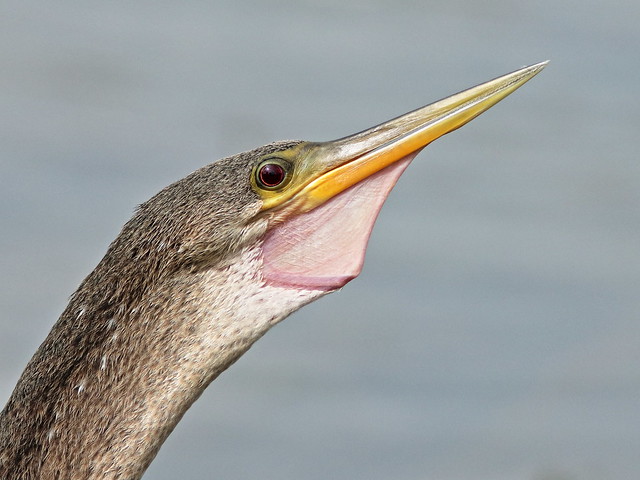
A Great Egret was so nearby that it was necessary to rotate the camera for a portrait exposure:

When the egret extended its neck I had to back away and process the image uncropped:

A Tricolored Heron rested at lakeshore:

Across the lake, another Great Egret hunted intently:


An Osprey passed overhead:


An angry red sunrise on November 2:


Today marks the fourth week since my surgery. The primary cancer in the cecum had not penetrated the colon and there was no evidence of local or lymph node spread. However, there were two small metastatic nodules in my liver. One was removed completely. The other was entirely ablated (cooked) with microwave energy. 

The minimally invasive laparoscopic colon and liver surgeries were done in sequence by two surgical teams and each took about 2 hours. I feel very good right now and undergoing tests to determine whether any hidden metastases may be secreting tumor DNA into my bloodstream. 

At my age (86) the possible benefits of chemotherapy are uncertain. It seems to be a choice between quality versus prolongation of life. Decisions are complicated by  the fact that we are in the middle of selling our Florida home and moving to Connecticut. 

= = =  = = =  = = = =  = = = = =

Linking to:


Garden Affair

Nature Thursday

Skywatch Friday

Weekend Reflections

Saturday's Critters

BirdD'Pot

Camera Critters

All Seasons

Wordless Wednesday (on Tuesday)

Natasha Musing

Our World Tuesday

________________________________________________

Please visit the links to all these posts to see some excellent photos on display
________________________________________________
Thursday, April 28, 2016

Crops & Clips: Parting shots from Florida

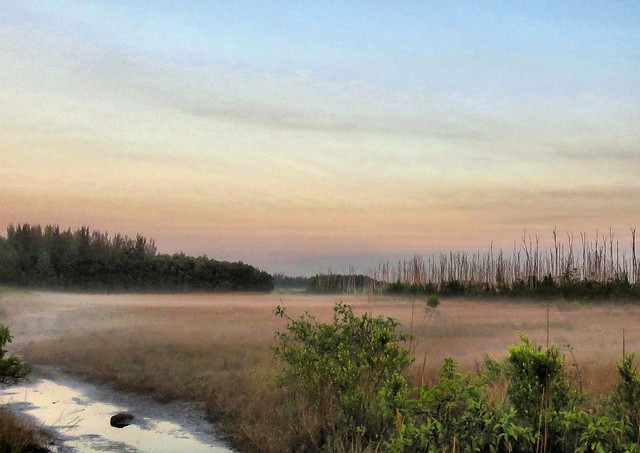
Fog over the wet prairie on the morning of April 13:

Fog over wet prairie HDR 20160413

Before we departed Florida for our second home in Illinois, we were pleased to see receding water levels in our local wetlands. High water dilutes the prey upon which both sight feeders (such as herons and egrets) and tactile feeders (storks and ibises) depend. There have been widespread nesting failures of these species this season, as they do not breed if food is scarce. 

Conversely, low water also discourages breeding because the birds benefit if their nest trees are in standing water. This deters terrestrial predators and encourages alligators which not only protect the nests but are rewarded when young birds fall into the water. Optimal breeding time usually begins around November and finishes before spring rains once again flood the wetlands.

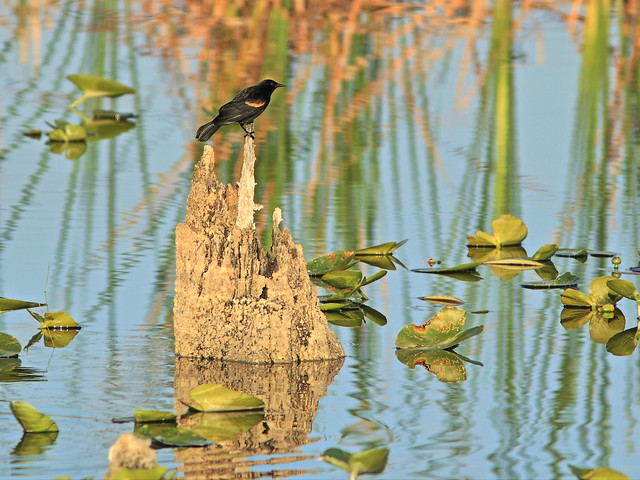
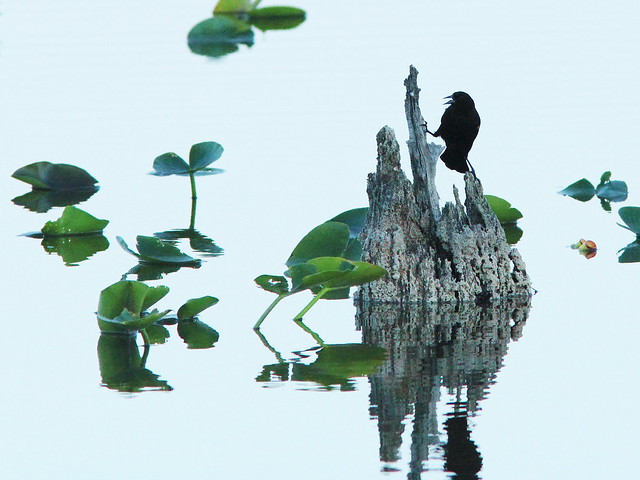
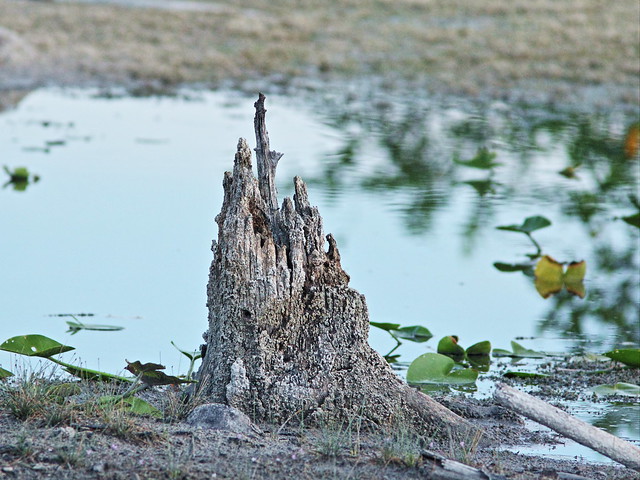
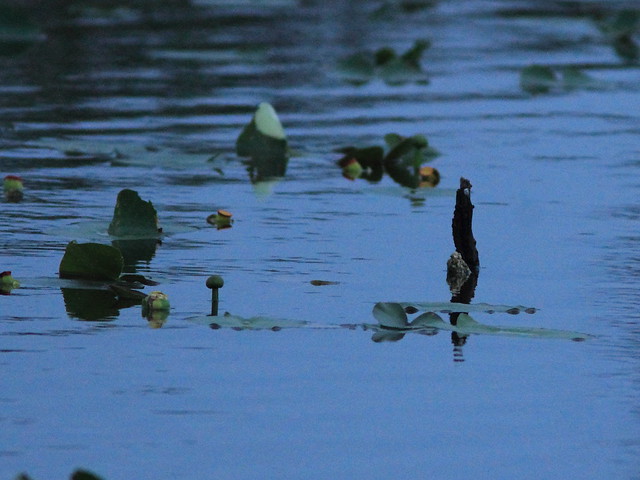
An old cypress stump, which I call the "Enchanted Island," provides a convenient gauge of the depth of the water near the shore of the lake in our birding patch. By late winter it normally would be sitting on a mud flat.

In March, 2015 the water level was a bit above average because of late winter rains:

Red-winged Blackbird reflection 2-20150301

An unusually dry summer followed, and it was high and dry by July, 2015:

Enchanted Island stump landlocked 20150724

Then the record-setting winter rains came, and by December, 2015, only the top of its spire appeared above about 3 feet of water:

Enchanted Island at high water 20151207

Here it was on April 12, 2016:

Red-winged Blackbird on Enchanted Island 20160412

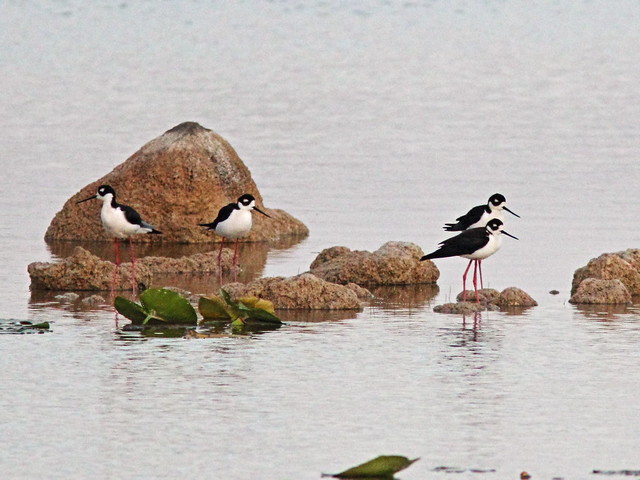
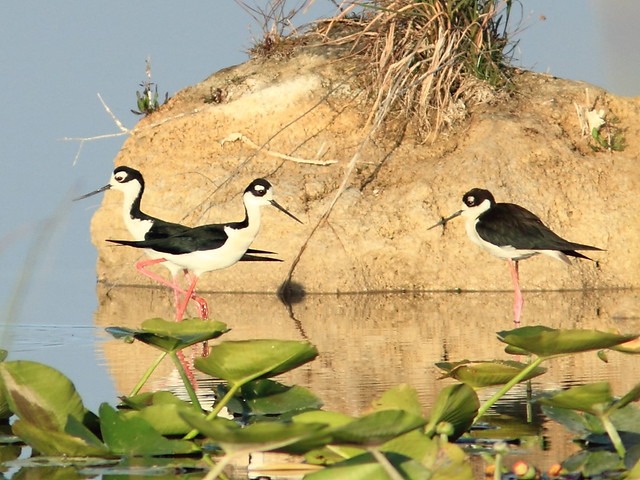
The newly created shallows now have attracted waders, including several Black-necked Stilts: 

Black-necked Stilts 3-20160411

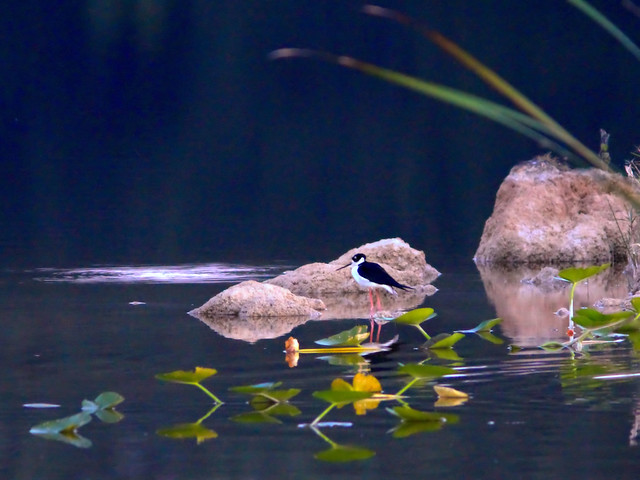
One arrived early on April 12. I first saw it during the "blue hour" before sunrise. My photo was very dark, so I nudged it to life by overlaying a series of lighter exposures from the original RAW image::

Black-necked Stilt before sunrise HDR  20160412

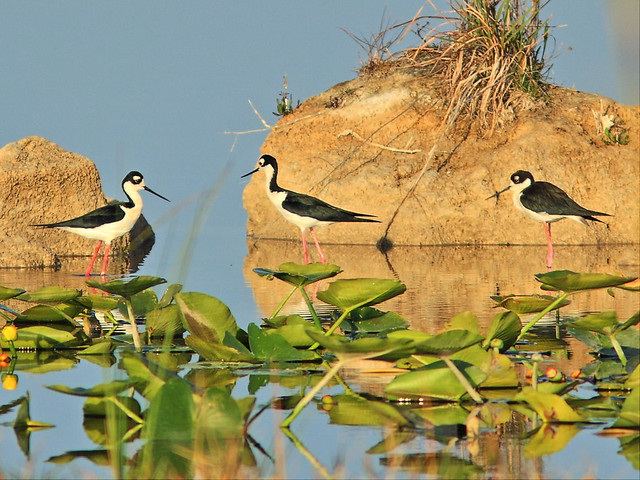
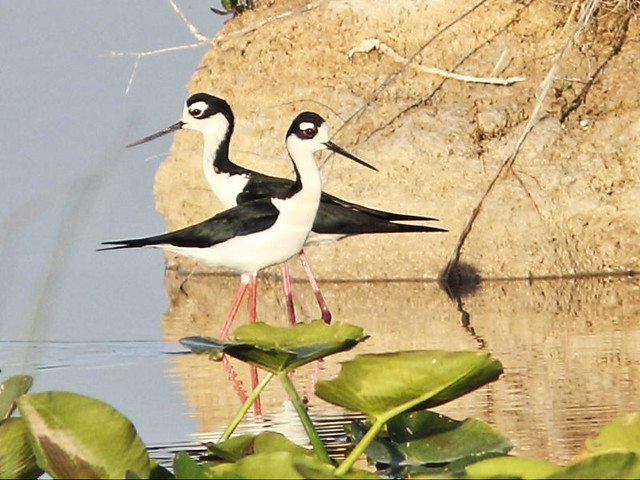
A bit later, while the sun was still low, a flock of five stilts foraged in the shallows:

Black-necked Stilts 3-20160412

Black-necked Stilts 6-20160412

Black-necked Stilts 5-20160412

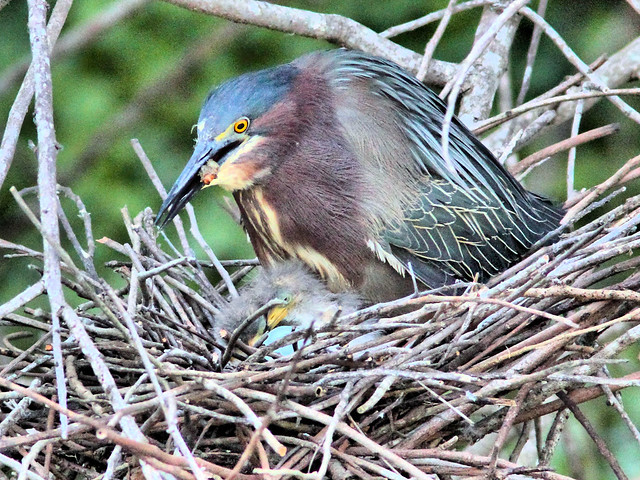
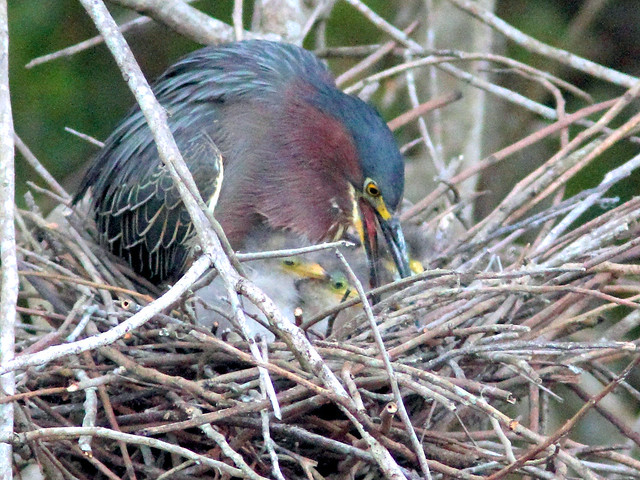
The eggs in a Green Heron nest, which I had been observing for about two weeks, began hatching during my last couple of days in Florida. At first (on April 13) I saw four chicks and one unhatched egg. In this photo the parent is feeding them regurgitated fish particles. The egg is a beautiful blue color:

Green Heron 17-5 with hatchlings HDR 05-20160413

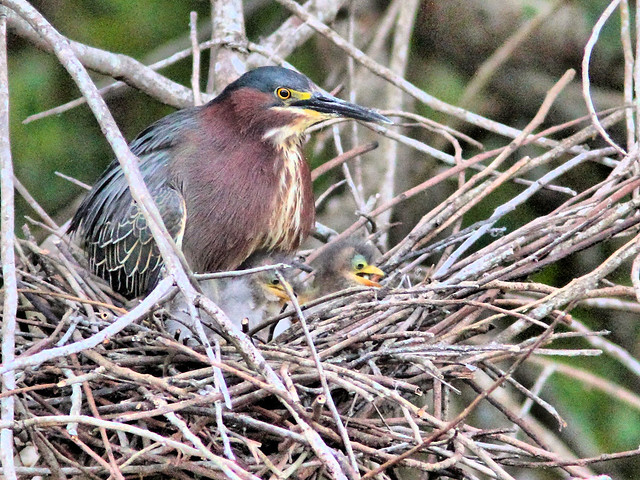
The next day I counted five hatchlings:

Green Heron with nestlings HDR 06- 20160414

Green Heron feeding nestlings HDR  05- 20160414

The nest is in plain sight over the water of a canal in the bare branches of an herbicide-treated tree and is exposed to the elements and predators. About 6 feet away and deeper amid the dead branches, a second pair was tending a nest still containing eggs. I am anxious about their safety. 

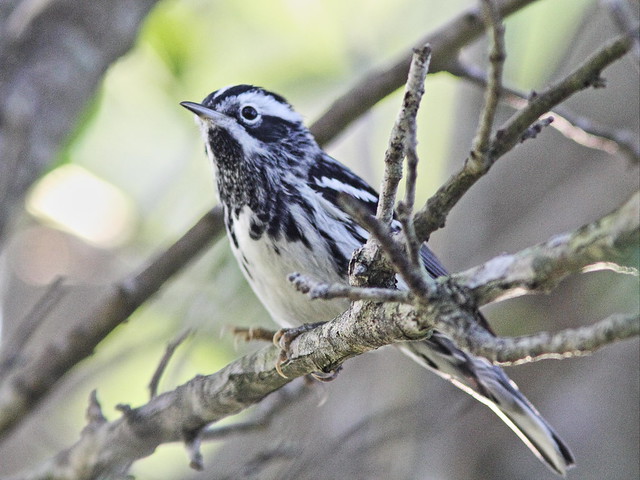
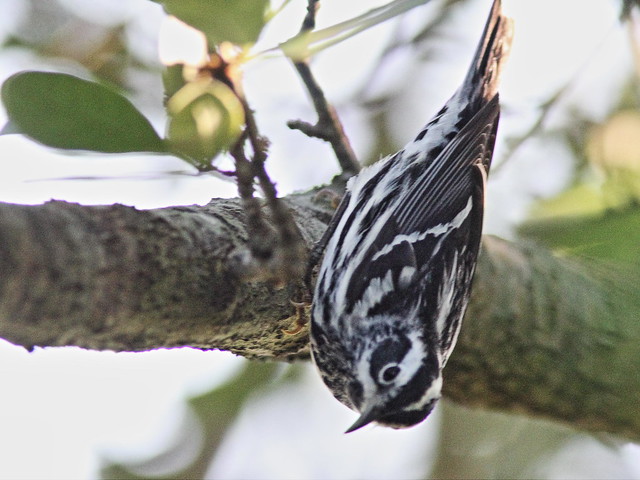
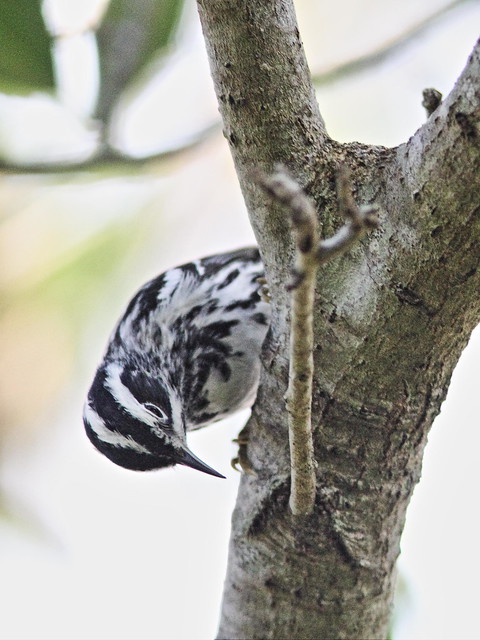
Migrating warblers, including this acrobatic Black-and-White Warbler, started arriving just before our departure:

Black-and-White Warbler 04-20160414

Black-and-White Warbler 08-20160414

Black-and-White Warbler 06-20160414

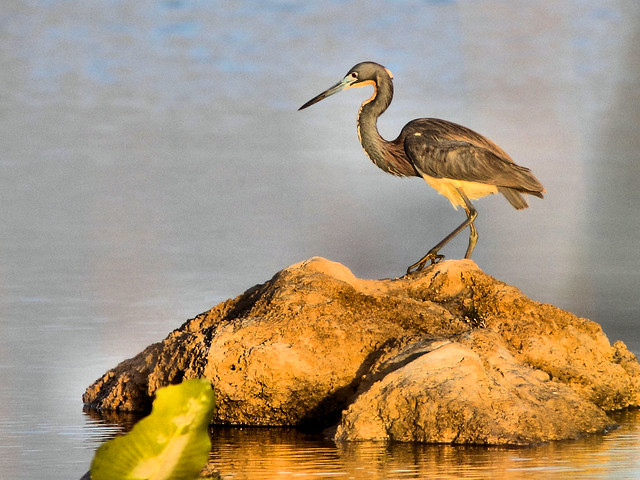
Other notable sightings provided nice "parting shots," including a Tricolored Heron in dawn's glow

Tricolored Heron HDR 2-20160411

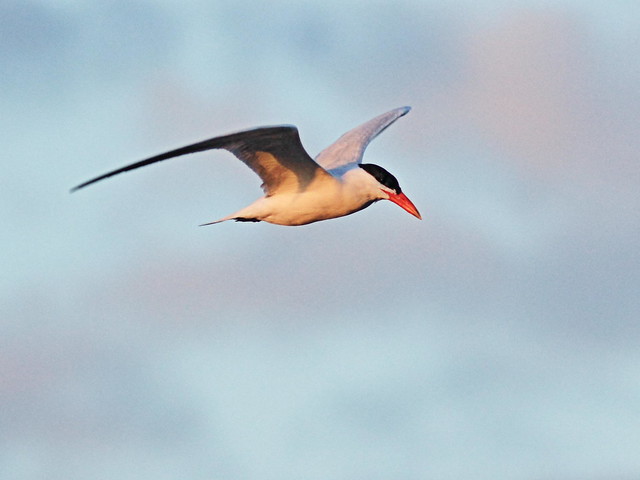
The first Caspian Tern of the season flew over the lake:

Caspian Tern 20160410

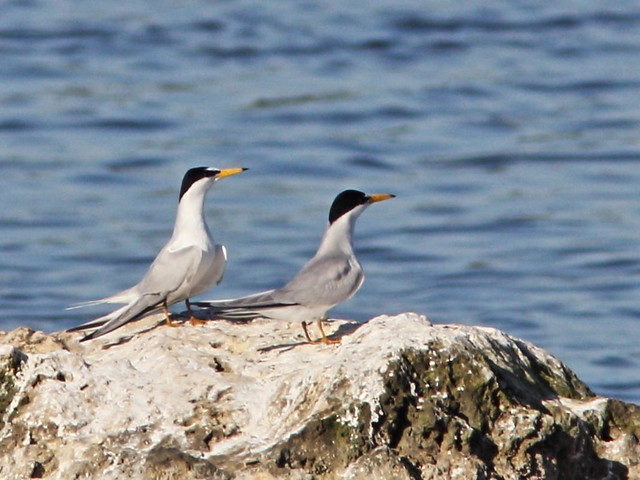
Least Terns also appeared on the lake, a sure sign that spring had arrived:

Least Tern 04-20160408

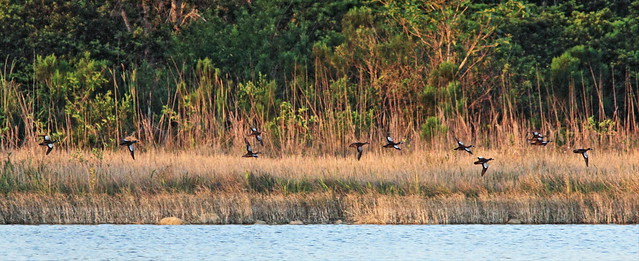
A flock of migrating Blue-winged Teal flew along the opposite shore (click on photo for enlarged view):

Blue-winged Teal header 20160410

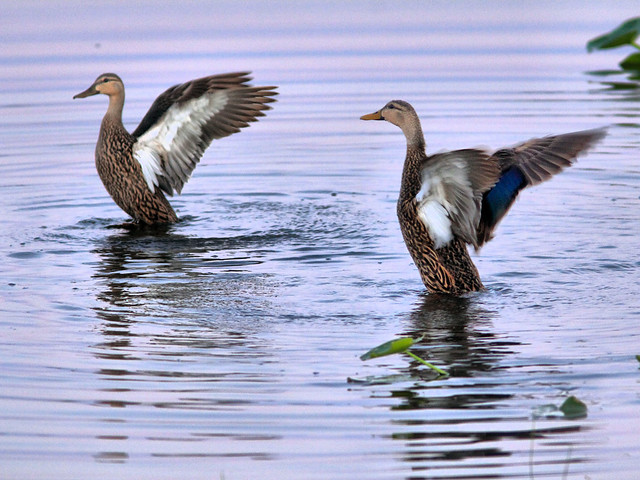
A pair of Mottled Ducks exercised their wings:

Mottled Ducks HDR 3-20160412

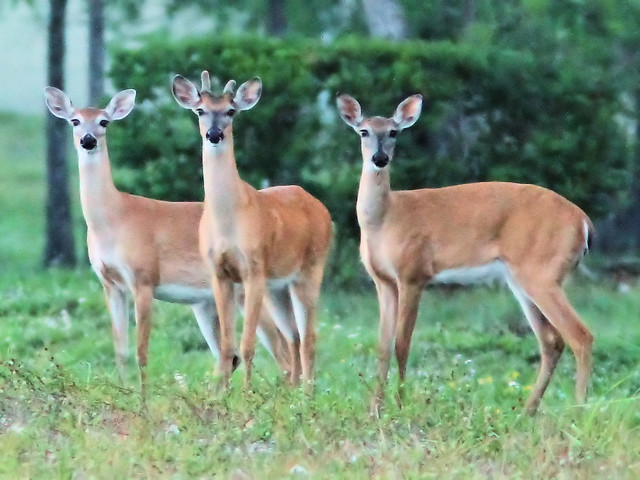
Sightings of the mammalian kind included these White-tailed Deer. The buck's antlers were in very early velvet stage, and one of the does appeared to be pregnant:

White-tailed Deer 3-20160412

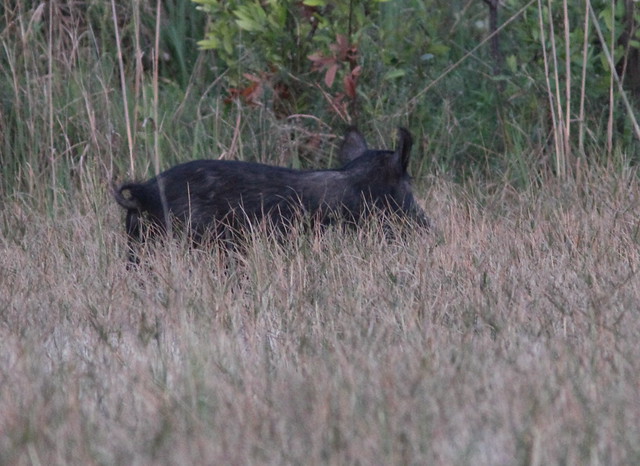
I got quite a fright very early one morning as I nosed through some brush to get a photo of the wet prairie. Suddenly I saw a large black creature not too far away. It was too dark for me to photograph or even make out its shape so I watched for a while as it moved slowly along the edge of the high grass. 

Then I remembered that decreasing the exposure compensation permitted the camera to focus better in the dark. The prolonged exposure time also caused a blurred photo as I was not using a tripod, but it was good enough for me to recognize the creature as a large wild pig-- the first I have seen here over the ten years I have been walking the patch [This photo was taken a few minutes later, at Exposure Compensation Minus 1, ISO 3200  at 1/25 second]:

EC Minus 1 ISO 3200 Tv 1 25th sec

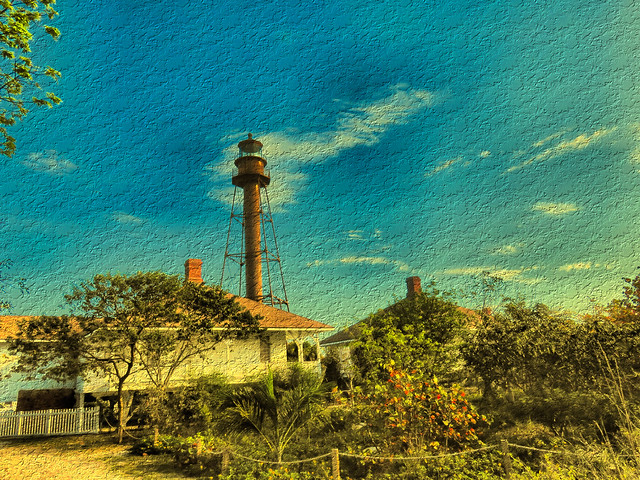
Looking for a fence picture for Tex's Good Fences meme, I found this one, of the lighthouse on the point at Sanibel Island on the Florida Gulf Coast. This was taken just after Easter, when we spent a few delightful days there with our Illinois granddaughters and family. It is processed as an antique oil painting:

Lighthouse Point Sanibel OLD OIL 20160329

GOOD NEWS! IMPORTANT UPDATE to my April 14 post "Bald Eagles hatch second brood-- BUT...

Remarkably, one observer provided a photo of two eaglets on the nest five days after another photographer witnessed (on April 11) what she interpreted as the smaller/younger of the two being killed. She saw and documented a struggle between both siblings. Her photo clearly showed what appeared to be the lifeless form of the smaller one sprawled over the rim of the nest. Here is a link to her photo:  

The subsequent observer wrote: "At 09:15 today [April 16] I saw and photographed both eaglets. They were both alive, and moving throughout the nest and doing well. Mom was also in the nest..." His photo showing the two may be viewed here at this link.

At first I wondered whether the "dead" eaglet may have been a third and even younger nestling, but what I now think that this represented a defensive instinct which protected the weaker sibling from further attack. 

I have seen this kind of behavior in small birds when a hawk suddenly appears. Usually the birds scatter into protective shrubbery and remain perfectly still. If surprised out in the open they may "freeze" in place as long as the threat is present. 

As a kid I often helped my grandfather catch chickens which roamed in our adjacent backyards. If I cornered one by extending my hands in front of it (almost like a hawk swooping down) it would suddenly become motionless, crouching low. I could pick it up and even turn it on its back without it trying to escape.  See "How to Hypnotize a Chicken" in the The Old Farmer's Almanac at this LINK.

= = =  = = =  = = = =  = = = = =

Linking to Misty's  CAMERA CRITTERS,

Linking to Eileen's SATURDAY'S CRITTERS,

Linking to GOOD FENCES by Tex (Theresa). 

Linking to SKYWATCH FRIDAY by Yogi, Sylvia and Sandy

Linking to WEEKEND REFLECTIONS by James

Linking to BirdD'Pot by Anni

Linking to Wild Bird Wednesday by Stewart

________________________________________________
Please visit the links to all these memes to see some excellent photos on display


________________________________________________
Sunday, August 25, 2013

Waiting for fall migrants

We are now at our second home in NE Illinois, enjoying a respite from south Florida's heat and humidity. We wasted no time getting out on crisp and cool mornings, but found that this time of year is not ideal for birding. Local resident species are undergoing a post-breeding molt. With few exceptions, they are conserving energy and hiding out. 

Some may already be heading south. To our distress, we found no Bobolinks or Dickcissels in the prairies of local preserves. We looked for Henslow's and Grasshopper Sparrows but found none. We hope to catch the front end of fall songbird migration before returning to Florida.

A ragged Field Sparrow suddenly perched on a flower stalk.

Field Sparrow molting 20130812

American Goldfinches provided most of the action, singing and rollicking all around. They have waited for the thistles and milkweed to go to seed and furnish the down for nests and seeds for nestlings.

American Goldfinch 20130812

I came across a female goldfinch sitting tight on an unusually deep-looking nest not far off the path. You must look closely to even see her.

American Goldfinch on nest 20130812

This Song Sparrow was waiting for us to move away before flying down to feed a nestling.

Song Sparrow 20130812

Seven Caspian Terns rested on the shore of a small retention pond near our home. Note that the second from the right has a leg band, and that the next one to the left has a shorter and paler bill and mottled plumage that identifies it as an immature bird. 

Caspian Terns-- one is banded 20130812

Caspian Tern in flight 20130812

Lippold Park, along the east bank of the Fox River, was more productive. We hoped to see some early warblers, to no avail. Black-capped Chickadees foraged in the large oak trees.

Black-capped Chickadee 20130814

A male Northern Cardinal peered at us through the understory.

Northern Cardinal 3-20130814

Indigo Buntings sang and did their best to hide among the leaves.

Indigo Bunting 2-20130814

When one did come out into the open, the strong light made it difficult to capture its deep blue plumage against the sky.

Indigo Bunting 20130814

A Solitary Sandpiper probed the mud flats along the river.

Solitary Sandpiper 2-20130814

An Osprey coursed over the river...

Osprey 20130814

...followed by an adult Bald Eagle.

Bald Eagle 20130814

One morning a male American Kestrel roosted on a street light next to our condo. Despite my "pishing" and squeaking  I could not get it to look my way!

American Kestrel 20130812