This continues my monthly retrospective on past experiences, memories from three years ago. I will continue to search the archives for photos which represent a few selected themes: Living CRITTERS of all kinds, beautiful SKIES and REFLECTIONS, as well as MACRO images and GOOD FENCES. I have met this challenge for the past 15 months in a row, so let's see how far I must travel into the month of April, 2013 to achieve my goal!
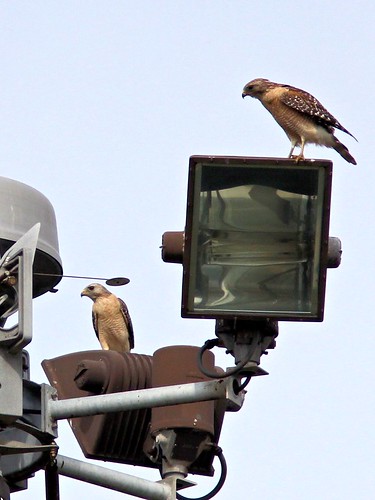
I started the month out right, while observing the local Bald Eagle nest, as a pair of Red-shouldered Hawks landed atop a light standard along the road (April 1, 2013):
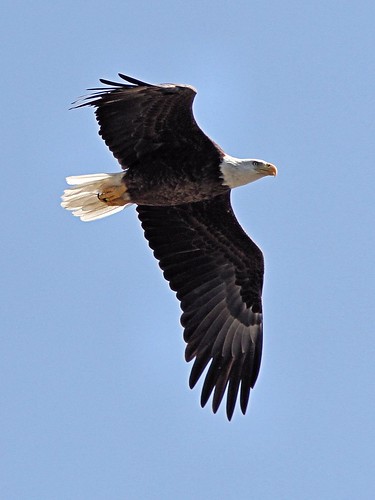
The next morning the female eagle provided a nice fly-by photo opportunity:
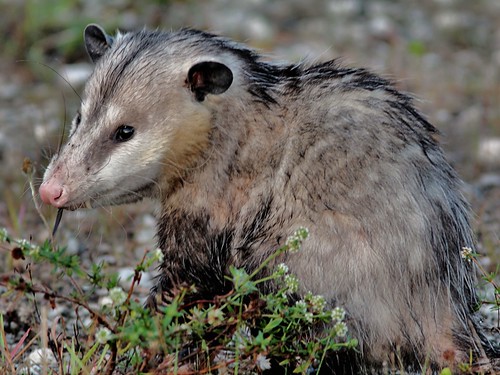
A not-very-handsome "critter" was reluctant to get out of our path on April 8. This Opossum had not quite finished eating a rat which had been killed by the mowers, as its tail still protruded from its mouth:
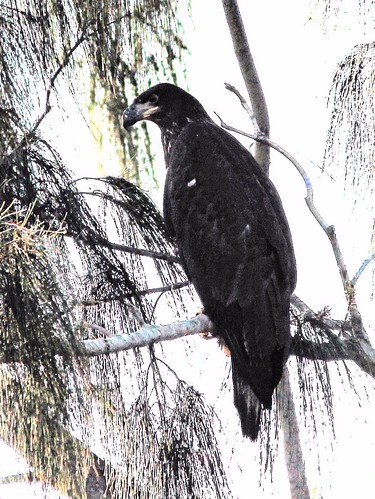
The juvenile Bald Eagle was still returning to the nest to be fed:
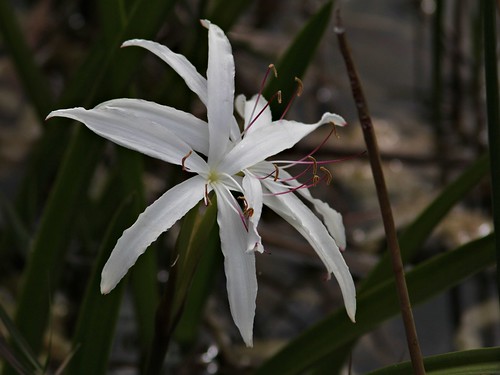
A Marsh Lily provided a nice macro study:
On April 14 we visited a ranch in Hendry County to the north, where Barred Owls had a nest, ...

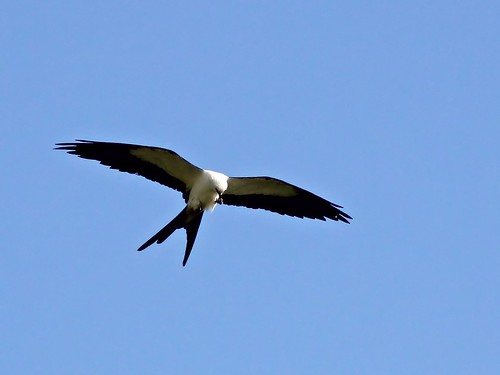
...a Swllow-tailed Kite flew overhead...
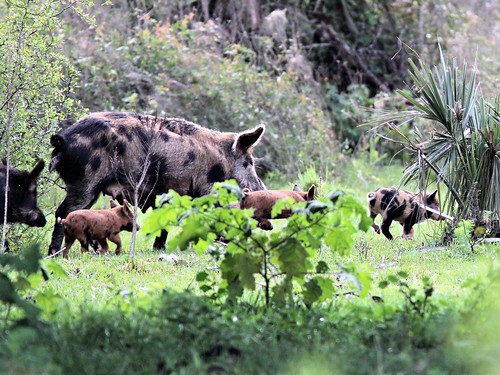
...and a wild sow shepherded her piglets:
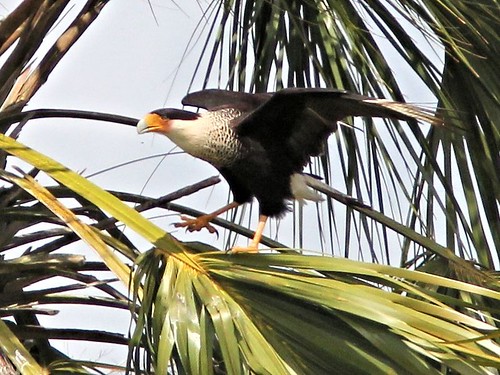
At the ranch we also saw a Crested Caracara,...
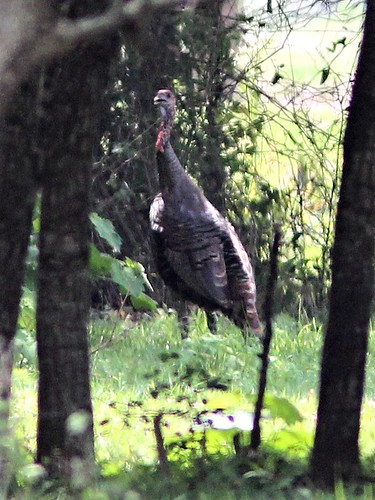
...Wild Turkeys,...
...Burrowing Owls,...

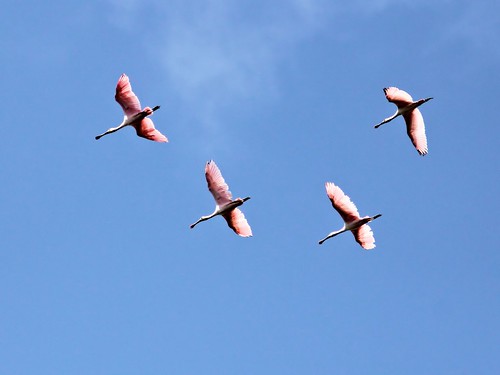
...and Roseate Spoonbills:
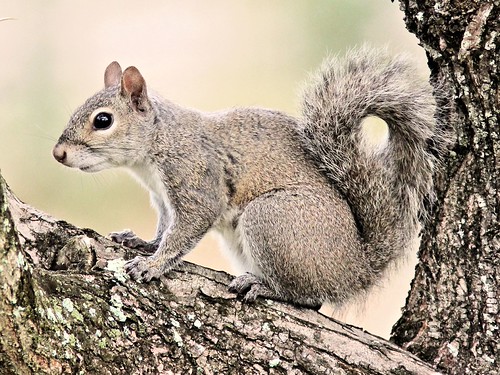
So far, we have seen a plethora of "critters," but I could not pass by this Gray Squirrel in our front yard:
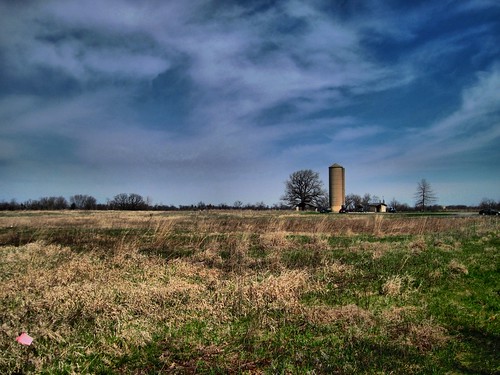
Thanks to the breezes which produce ripples on our Florida lakes, we are halfway through the month without a single nice reflection. Now we return to Illinois, to find a restless sky over the entrance to Nelson lake Forest Preserve, ...
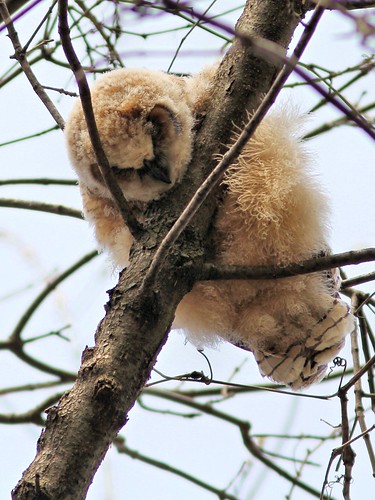
 ...and on April 29 find a fledgling Great Horned Owl in a local park...
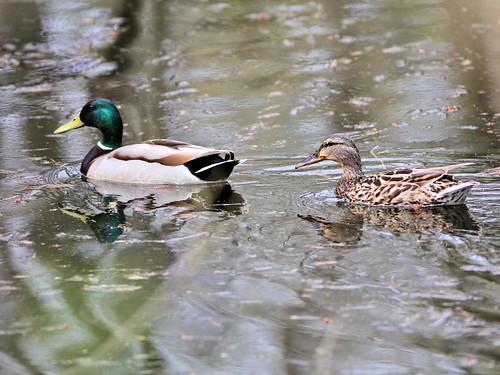
...as well as a weak excuse for the reflection of a dabbling pair of Mallards:
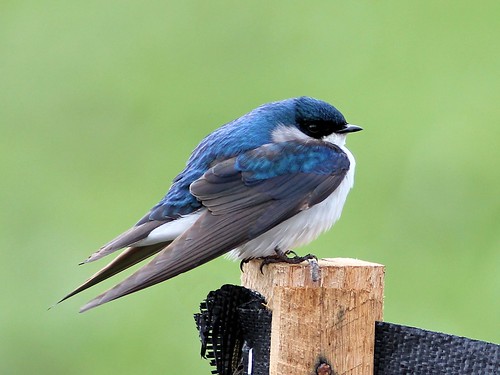
Still no fences, unless Theresa allows me to count this poor imitation of one in a construction zone, with a Tree Swallow beautifying its post:
If you squint while looking as the flood water recedes in Jones Meadow Park, you may see another fence in the distance:

On April 28, another macro-- a White Trout Lily:

On the last day of the month, a Northern Waterthrush cast its true reflection in a brook, but can you see either? (click to enlarge)
You may have been following the adventures of the two captive-reared juvenile Whooping Cranes that visited our local patch. They were among the six that were allowed to find their own way south from Wisconsin. Part of the International Crane Foundation's "Direct Autumn Release" experiment, they were not assisted by the "Operation Migration" ultralight aircraft. This year their journey was fraught with danger.
Five of the six departed from Horicon National Wildlife Refuge on the last day of October, 2012 and flew 1200 miles to Clay County, Florida in only six days. Only two days later, on November 8, the flock of 5 was tracked by satellite to Everglades National Park at the southern tip of Florida. The next day they had doubled back nearly 100 miles north to a ranch in Hendry County, Florida. The sixth crane finally migrated from Wisconsin with a flock of Sandhill Cranes in late November and on December 9 had settled down for the winter in Volusia County, Florida.
Three of the five cranes remained in Hendry County, but on December 22, two cranes (a female nicknamed Tussock and a male called Cypress) relocated to the wetlands adjacent to our home in Broward County, about 50 miles to the southeast. Unfortunately, two of the three remaining Hendry County cranes expired on the ranch during late December or early January. As related in an earlier post Tussock suffered an injured foot and had to be captured. After a week of treatment at Disney Animal Kingdom, she was released in Tennessee on February 9 to join a group of other Whooping and Sandhill Cranes. Cypress was subsequently captured on February 10 and released to rejoin the surviving crane "Fireweed" on the J-Seven Ranch in Hendry County.
The ranch owners invited several of us who had provided ground observations in Broward County to come up and see "our" crane, but before we got up there, we were disappointed to hear that Cypress migrated north in late February or early March. For a time Fireweed was also presumed to have died, as his satellite signal constantly pointed to one spot, and ground searches were not successful. Rhonda Roff and Margaret England from the Hendry-Glades Audubon Society joined four of us from South Broward Audubon. Minutes after we enjoyed coffee with John and Gretchen Ward, owners of J-Seven, we received a call that announced, to our great surprise, Fireweed had turned up on a neighboring ranch, Devil's Garden Bird Park (DGBP).
Doug and Catherine Zipperer, owners of DGBP, invited us all to come over. We headed there immediately.

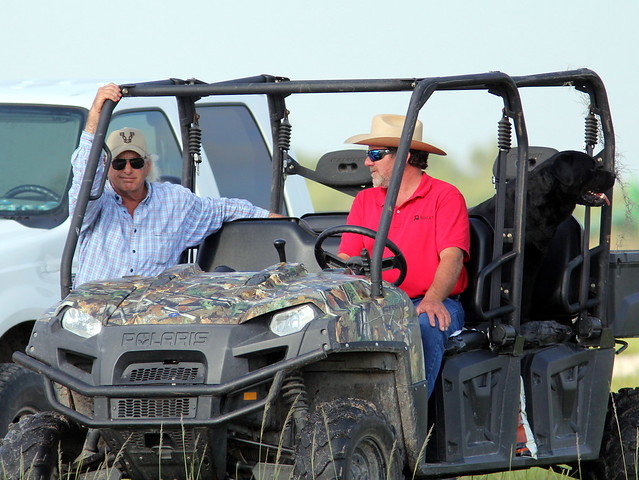
Neighboring ranchers John Ward and Doug Zipperer chatted as we scoped out the first overgrown pasture.

Devil's Garden Bird Park provides guided custom birding tours for the public, but the Zipperers extended us the courtesy of lending us an extra Ranger all-terrain vehicle so that we could travel cross-country if necessary.
 Fireweed was readily located, foraging with a flock of Sandhill Cranes near the entrance road.


A Crested Caracara posed on a fence post.

Many Eastern Meadowlarks sang in the prairie.

Red-shouldered Hawks were conspicuously present.

As we approached a beautiful native Cabbage Palm-Live Oak Hammock, Swallow-tailed Kites wheeled overhead.

Inside the hammock, a pair of Barred Owls flew towards us, most likely because their newly-fledged young were hidden deeper in the trees. We did not advance, but watched the owls as they called "Who cooks for you?".

We returned to J-Seven, where John Ward guided us on a tour of wonderfully varied habitats. Two newly-fledged Bald Eagles flew up in front of us.

A little while later they returned to their nest to feed.

An adult eagle flew high overhead.

In a well-concealed nest, two Red-shouldered Hawk chicks waited to be fed.


Several pairs of Burrowing Owls nested in berms on the grazing land.


Glossy Ibises foraged in the wet prairies.

In the wetlands, we had magnificent views of Roseate Spoonbills.


A flock of Wild Turkeys scurried in the tree groves.

A wild sow hurried away with her piglets as we approached.

Caracaras nested in the top of a Cabbage Palm.


We really worked up an appetite, and Gretchen spread out a delicious lunch for us in the chickee. Their hospitality was overwhelmingly warm! From left to right, Barry Heimlich, John Ward, Gretchen Ward, Helen Harringer, John Abbott, Margaret England, and Rhonda Roff.