Showing posts with label Gulf Fritillary. Show all posts

Thursday, April 2, 2020

Crops & Clips: Flashback to April, 2017

A new month begins, prodding me to get out of my COVID-19 pandemic-induced funk and start looking through my photos from three years ago. I will try to find images which depict favorite memes: critters of all kinds, flowers, fences, reflections and skyscapes as well as photos which speak for themselves. We remained in Florida the entire month, but did spend a week on the west (Gulf) coast with our visiting Illinois family. 

The month of April started off with a handsome male Northern Cardinal on a Pond Cypress which is just sprouting new leaves...

Northern Cardinal in Pond Cypress 5-20170401

...a male Black-and-White Warbler...

Black-and White Warbler 02-20170401

...a male Prairie Warbler...

Prairie Warbler 01-20170401

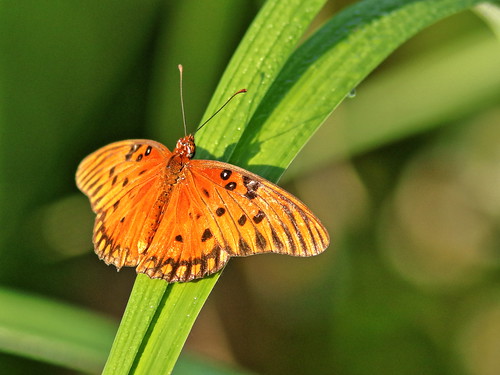
...and a male Gulf Fritillary. The "male" theme was accidental as they represented the first four creatures I photographed on April 1, 2017. In the case of the butterfly, only the males possess a series of pheromone-secreting androconia, visible as transverse (ladder-like) striations on six veins on each of its fore-wings. (You may need to enlarge this image to see them):

Gulf Fritillary 20170401

Great Crested Flycatcher:

Great Crested Flycatcher 06-20170403

Northern Mockingbird:

Northern Mockingbird 03-20170403

Green Heron:

Green Heron 3-20170405

In the rookery, a pair of Green Herons shared a tender moment with their first egg, on April 9:

Green Herons tender moment position 6 2-20170409

Our daughter and family visited from Illinois. Our granddaughters went out with MaryLou to view the Bald Eagle nest:

Eagle watchers 3-20170414

We spent Easter vacation on Sanibel Island on Florida's Gulf Coast, where we watched an Osprey eat a fish:

Osprey 3-20170418

At Ding Darling National Wildlife Preserve, a Reddish Egret hunted, energetically dashing to and fro:

Reddish Egret 05-20170418

Reddish Egret 03-20170418

Reddish Egret 04-20170418

On the beach, a Willet displayed its distinctive wing markings:

Willet 3-20170418

A Ruddy Turnstone probed in the sand:

Ruddy Turnstone 02-20170418

A Royal Tern flew along the water's edge:

Royal Tern 02-20170418

Dunes at Bowman's Beach on Sanibel island:

Dunes at Bowman's Beach 02-20170418

A Tiki Hut on the boardwalk at Bowman's Beach:

Bowman's Beach chickee on boardwalk 08-20170418

Marsh Rabbit at Bowman's Beach:

Marsh Rabbit 3-20170418

Back home, at the local nest, the two eaglets were climbing on the branches and would soon fly freely:

Bald Eagle two eaglets 20170425

Common NIghthawks had returned to breed:

Common Nighthawk in flight 20170427

Carolina Wrens had been present all year, but were singing much more vigorously in early Spring:

Carolina Wren 03-20170427

A notably tortuous neck on this Tricolored heron:

Tricolored Heron 3-20170422

Solitary Sandpiper and reflection:

Solitary Sandpiper 03-20170421

A Bunting eating the "Shepherd's Nettles" seeds of Bidens alba on April 21. It is probably an immature Painted Bunting, as its back has a greenish cast, but... 

Bunting in Bidens alba 02-20170421

... it appeared to have some blue feathers on its breast, suggesting it may be an immature Indigo Bunting. (This was probably an aberration due to the color temperature of the processed image). Both species usually migrate north before the end of April:

Bunting in Bidens alba 03-20170421

A Mottled Duck and Black-necked Stilt:

Mottled Duck and Black-necked Stilt 03-20170421

Sunrise as seen from our back patio...

Sunrise over the cove 20170422

...and our front yard:

Sunrise at mi casa 20170422
= = =  = = =  = = = =  = = = = =

Linking to:

Fences Around the World

Skywatch Friday

Weekend Reflections

Saturday's Critters

BirdD'Pot

Camera Critters

All Seasons

Wordless Wednesday (on Tuesday)

Our World Tuesday

Wild Bird Wednesday
________________________________________________

Please visit the links to all these posts to see some excellent photos on display

________________________________________________

Thursday, August 22, 2019

Common Ground-Dove

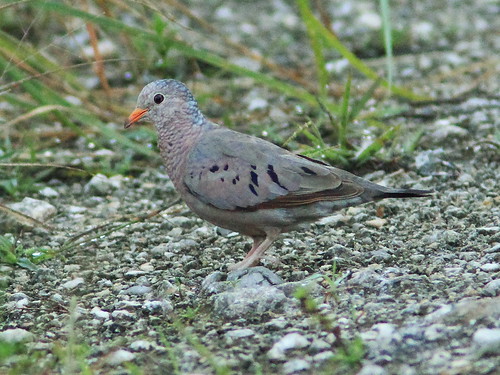
The Common Ground-Dove is an easy species for us to overlook during our morning walks in the Wounded Wetlands. Only about 6 1/2 inches (17 cm) long and drab in appearance, it does not gather in flocks which are so characteristic of other members of its family of pigeons and doves. Instead, it forages quietly in the grass or at the edges of woodlands, flying away low before being approached too closely.

It has a sprightly scientific name, Columbina passerina, which could be danced to a Macarena or a salsa tune and translates as "tiny dove sparrow." 

Common Ground-Dove 20170309

We usually see them in pairs or with one or two of their offspring. Indeed, they are said to mate for life. Its major population is in the tropics, but it ranges into the extreme southern USA, including all of Florida and parts of the other Gulf States, southern California, southwestern Arizona as well as much of Mexico, Central and South America.

Common Ground-Doves 3-20170314

Common Ground-Doves 2-20131004

Common Ground-Doves 20130531
 
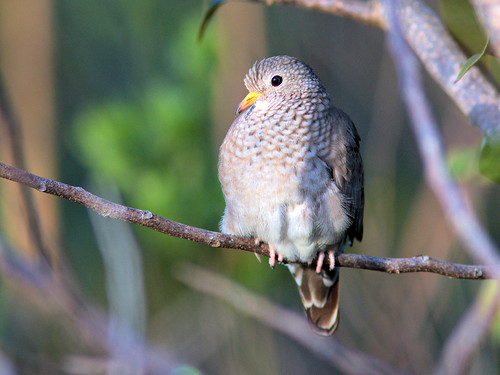
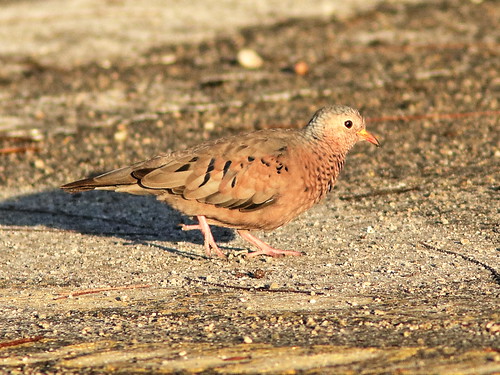
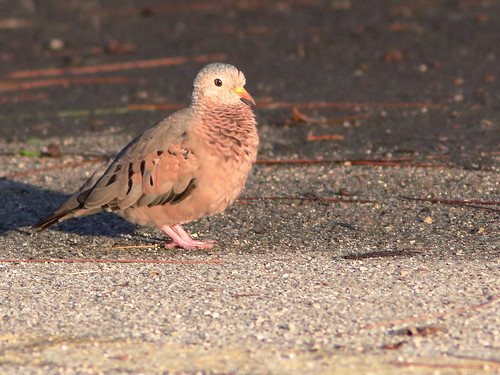
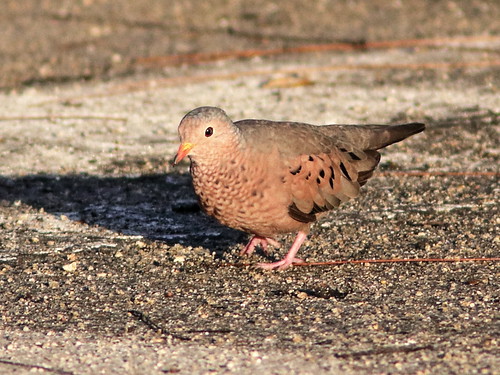
A brown bird with a lighter grayish head, the Common Ground-Dove's plumage has a scaly appearance, especially on its neck, breast and undersides. The similar but slightly larger Ruddy Ground-Dove wanders north of Mexico and sometimes breeds in southwestern US.

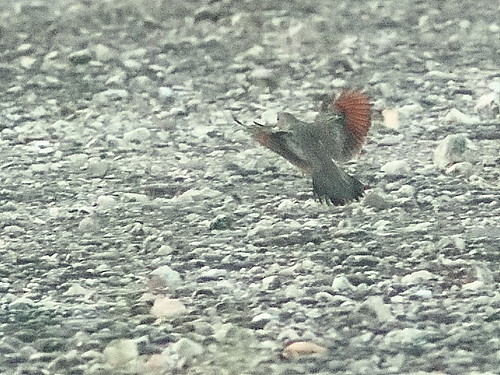
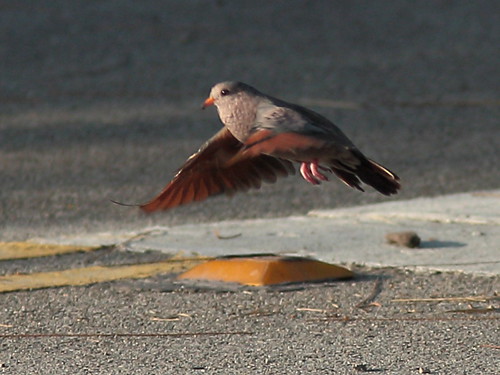
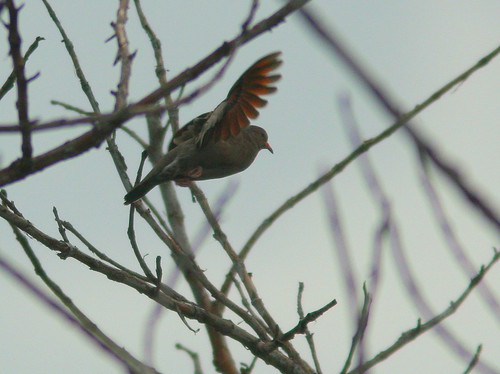
The Common Ground-Dove's song is also unassuming, a repetitive and monotonous soft "woot, woot, woot..." Yet it has a strikingly brilliant plumage feature--  bright reddish brown primary wing feathers and underwing linings, which only show when the bird bursts into flight.

I have only captured a few (very poor) views of a Common Ground-Dove in flight:

Common Ground_Dove in flight 01-20190815

Common Ground-Dove in flight 20120731

Common Ground Dove 20100209

Common Ground-Dove in flight 03-20130531

Common Ground-Doves 20121005

Adult female Common Ground-Dove:

Common Ground-Dove 3-20170311

The male is more brightly colored, with pink highlights on its neck, breast and crown, and bluish gray crown and nape of his neck:

Common Ground-Dove 20130805

I encountered this male up fairly close and in bright sunlight:

Common Ground-Dove 01-20190811

Common Ground-Dove 02-20190811

Common Ground-Dove 06-20190811

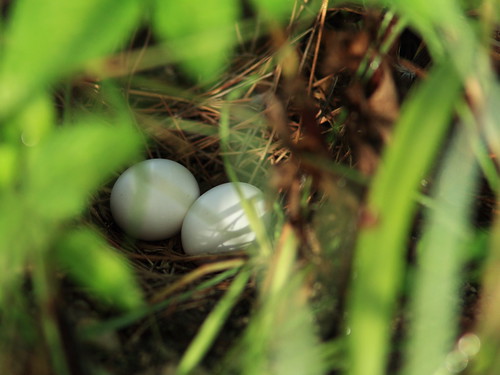
By accident, I discovered an active Common Ground-Dove nest on August 17, 2014, the first ever reported in Broward County. While I was walking along the side of the gravel road, a dove flew up out of the grass just to my side. The flimsy nest contained two white eggs, barely visible the vegetation. (Photos from the roadway with telephoto lens):

Nest of Common Ground-Dove 20140817

Common Ground-Dove nest 20140817

This is the female which had been sitting on the nest:

Common Ground-Dove 20140817

 During the next several days I checked the nest without disturbing it and the eggs remained intact. This was the nest on August 22:

Common Ground-Dove nest 20140822

However, ten days after I had located the nest, the landscapers came through and mowed all along the side of the road (August 27, 2014):

Common Ground-Dove nest site 20140927

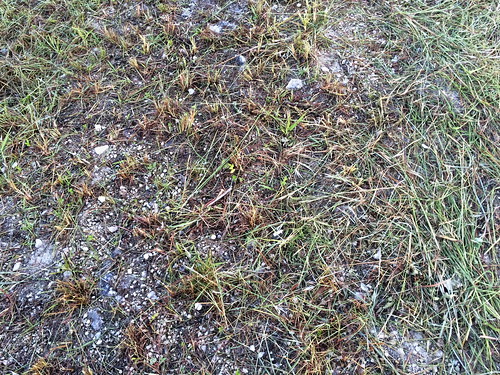
They left no sign of the nest structure or remains of the eggs:

Common Ground-Dove nest site 2-20140827

An encouraging sign-- Two years later, on August 19, 2016, a pair was tending to two fledgling young (to the left), along the same roadside weed patch:

Common Ground-Doves 20160819

This is one of my favorite photos of a Common Ground-Dove. It seems such a peaceful setting:

Common Ground-Dove HDR 20160311

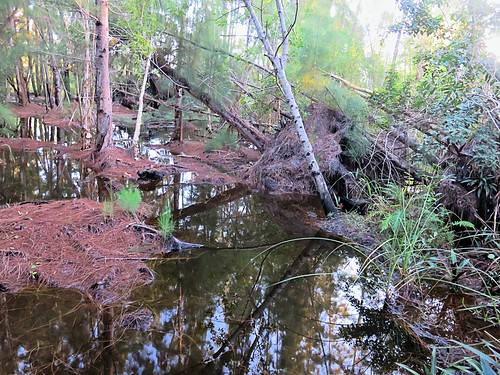
Trees felled by Hurricane Irma almost two years ago reflect chaotic beauty in the wetlands, now flooded after our area's wettest July ever:

Flooded windfall area 20190807

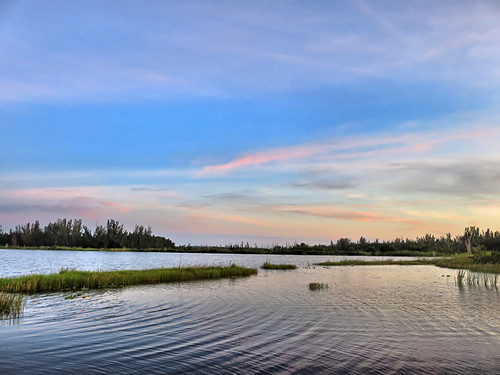
On August 8 it was 80 degrees F (26.6 C) just after sunrise. A westerly breeze, so welcome, stirred the surface of the lake:

Westerly breeze at sunrise 20190811

An adult Bald Eagle often passes over just around sunrise, flying from the nearby nest tree to forage in the large lake to the southeast:

Bald Eagle 20190808

Butterflies are still scarce. I have not seen any Monarchs for several weeks. A Gulf Fritillary rested on a grass stem:

Gulf Fritillary 20190811

This is the view to the south along the large canal on a fair morning. The Wounded Wetlands are on the right (west) side, opposite "civilization"  (August 14):

196th Ave Canal 20190814


= = =  = = =  = = = =  = = = = =

Linking to Misty's  CAMERA CRITTERS,

Linking to Eileen's SATURDAY'S CRITTERS,

Linking to SKYWATCH FRIDAY by Yogi, Sylvia and Sandy

Linking to WEEKEND REFLECTIONS by James

Linking to BirdD'Pot by Anni

Linking to Our World Tuesday by Lady Fi

Linking to Wild Bird Wednesday by Stewart

Linking to Wordless Wednesday (on Tuesday) by NC Sue

Linking to ALL SEASONS by Jesh

 Linking to Fences Around the World by Gosia

________________________________________________
Please visit the links to all these memes to see some excellent photos on display

________________________________________________