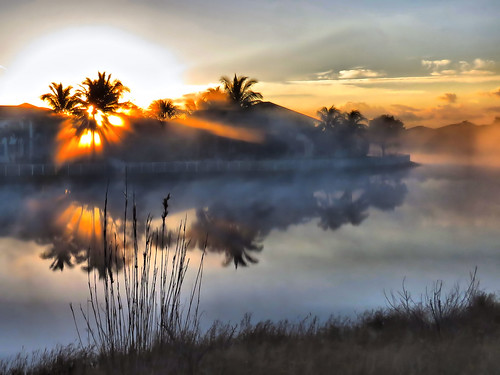
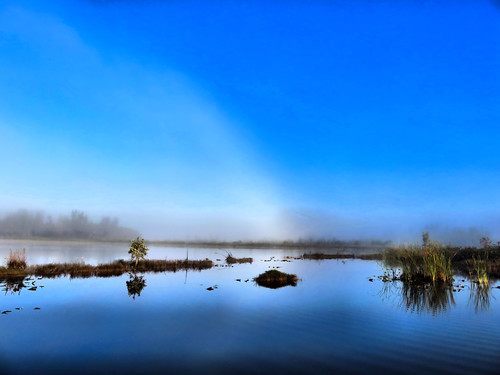
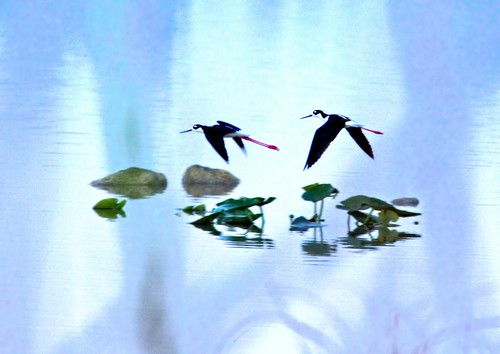
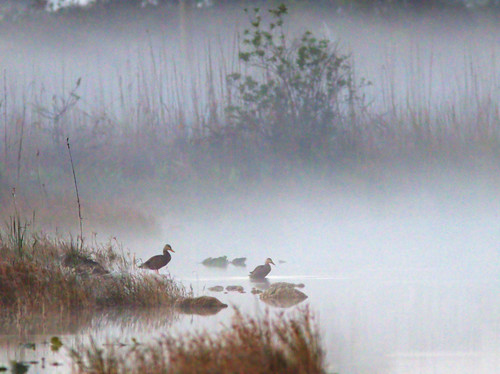
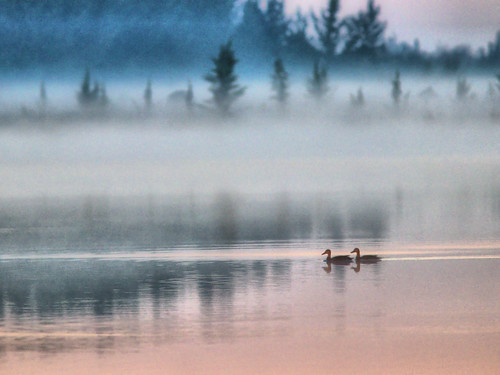
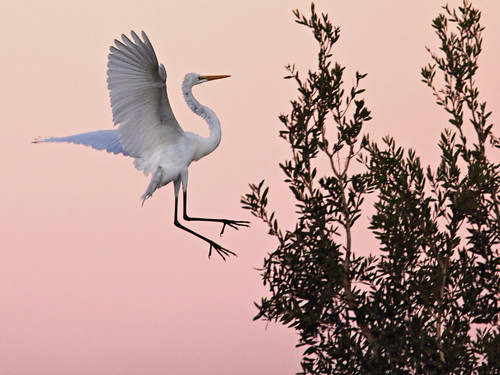
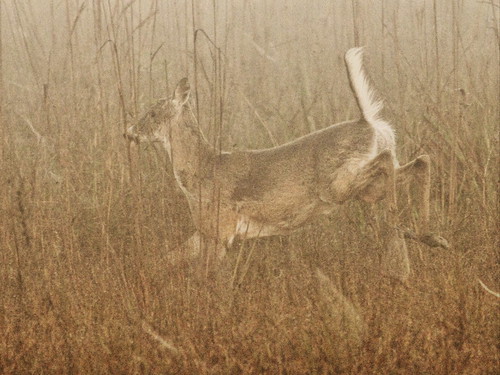
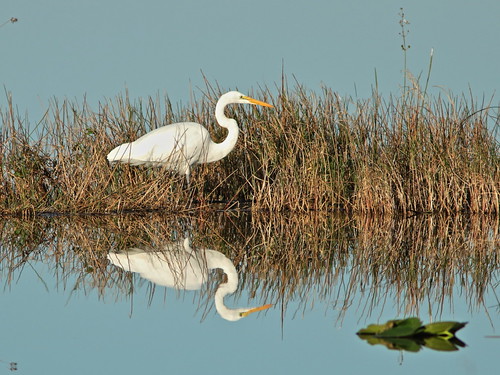
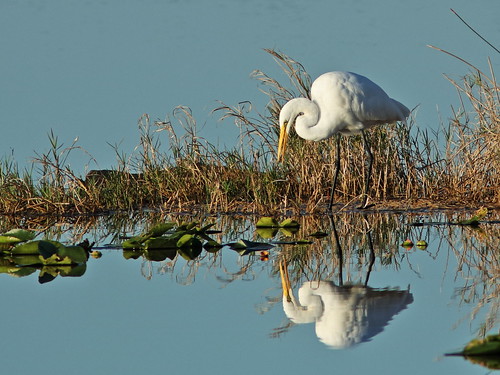
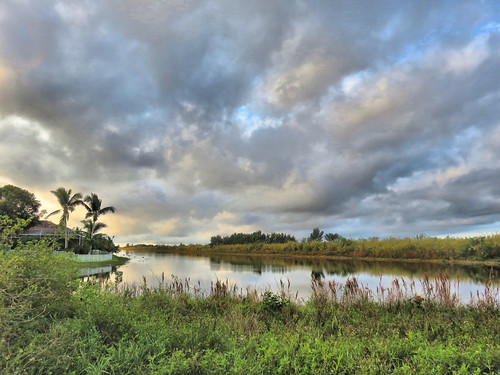
A colorful sunrise is reflected over the wetlands on December 27, 2014:

Now back to those eagles. You may remember that we have been following a local pair of Bald Eagles since they were "discovered" back in 2007. It was the first active nest to be recorded in Broward County, Florida in over 40 years. This was well before DDT was abolished after being recognized as a major contributor to the disastrous decline of the species.
The eagles attracted much attention from local residents, many of whom had no idea that this iconic species even resided in Florida, which now has over 1,500 nesting pairs. Over seven breeding seasons, ground observers documented that this pair produced at least 18 eaglets, of which only 4 failed to fledge. Facebook followers named the pair "Pride and Joy."
Tragically, Joy disappeared after October 30, 2014, and Pride was left alone. He often flew in circles above the nest, possibly to attract a mate, and continued to rearrange nesting materials:

All this changed on December 7, 2014, when an observer called me to say that she was quite certain she saw one eagle on the nest and immediately saw a second roosting nearby. She called again about 25 minutes later to report that an adult female was roosting near the nest and the male (Pride) was in the nest. I rushed over and got there at about 5:00 PM. A small crowd was already gathering in response to her Facebook alert.

The female was now roosting in the nest tree above and to the left (east) of the male in the nest. The male (Pride) kept looking up at her.
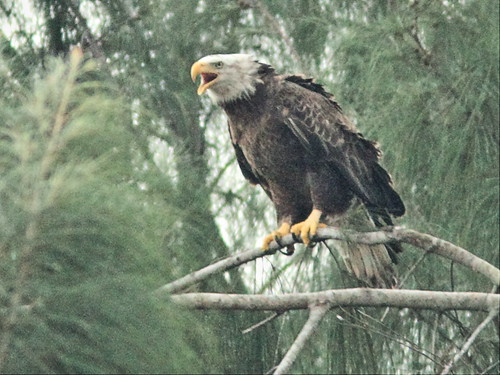
As is evident in this photo, the female eagle retains dark feathers in her head and tail. She is a young bird, probably about 3 1/2 years old. Usually a Bald Eagle's head turns pure white when it attains "fifth year" plumage after about 4 years of age:

Pride then took flight and landed next to the female and briefly attempted copulation after the female assumed a receptive posture.
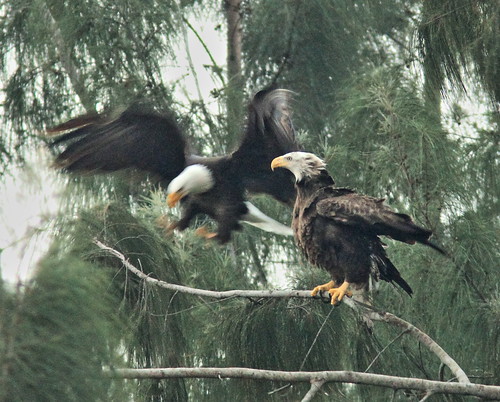
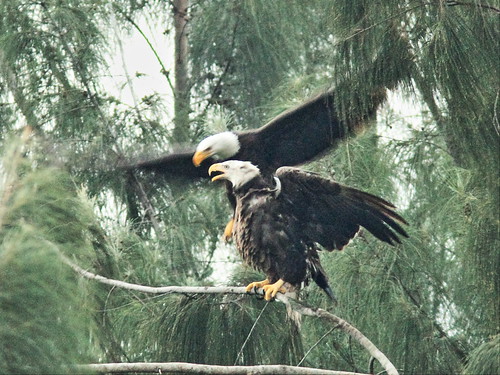
Soon both took flight (the female chasing the male) and circled the nest, over the wooded area and Pines Boulevard. Pride is noticeably smaller:

The new female may weigh 20 percent more than the male and has a greater wing span:

The male then roosted at the top of a pine just to the west of the nest and the female disappeared behind the nest. During the remainder of the month, more courtship was observed but the new female seemed never to have "broody" instincts. She rarely sat in the nest despite Pride's many attempts to lure her into it by bringing in food.
We assumed that she was simply not yet old enough to raise a family but were very encouraged to see that a pair bond was being established between Pride and "Jewel," as she came to be named. (To be continued next month...)
The month was not all about eagles, although their images occupied a large share of the 603 photos which I processed during December. Our back yard saw some action as a Wood Stork and a Great Egret hunted together. Each may have benefited from the association because of their different foraging strategies.
The Wood Stork is a tactile feeder which stirs the water with its foot and waits for prey to wander within the grasp of its open jaws. The egret hunts by sight and may help to locate prey concentrations. Fish stirred up by the stork may serve as food for the egret.
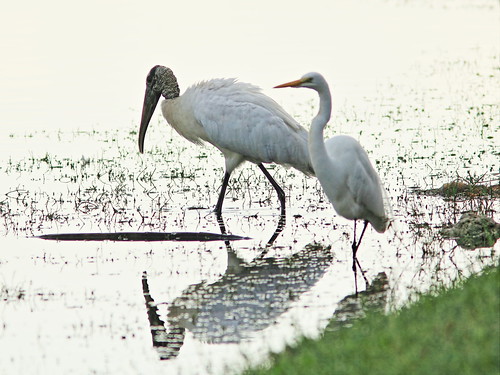
Here is a nice size comparison:

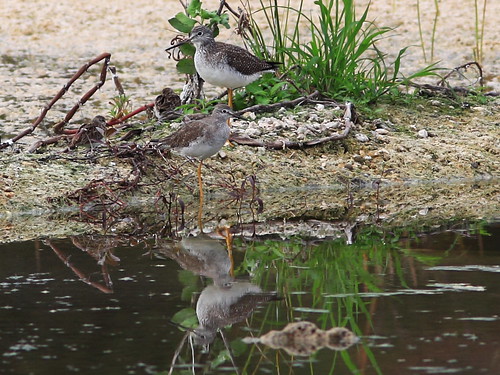
A small pond just off a busy roadway provided another comparison, between two large sandpipers, a Greater and a Lesser Yellowlegs. In this photo the greater size and bill length of the Greater (to the left) and the Lesser Yellowlegs species (dozing to the right) are evident. Six much smaller Lesser Sandpipers (which also have yellow legs) are resting in their midst.
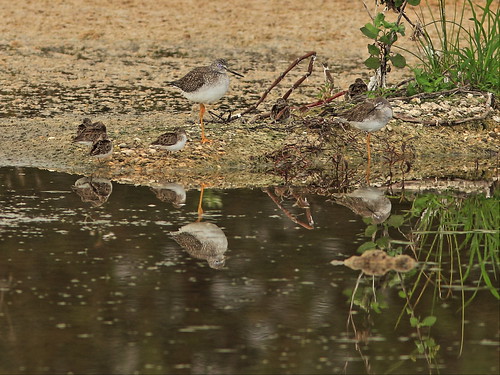
This photo illustrates that the longer bill of the Greater Yellowlegs is slightly upturned:
An exotic Purple (Gray-headed) Swamphen at nearby Chapel Trail preserve:

Also at Chapel Trail, a Mourning Dove rests on a fence:

Looking back on the eventful month, I realize that this was one of the last times we had flocks of Wood Storks on our lake. They since have abandoned their huge rookeries in the southern Everglades because of unfavorable climate and persistent high water levels which disperse their prey.
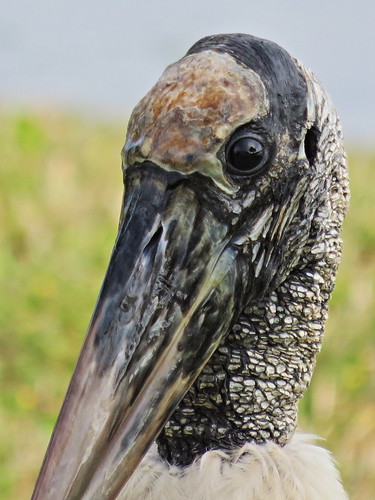
Usually they would have been raising their young at this time of year. One stork seemed to be particularly stressed. Oddly, it appeared on our back patio and acted abnormally tame. Had someone been feeding it?
The stork is looking into our back window (click for larger image):

Better views through the window:
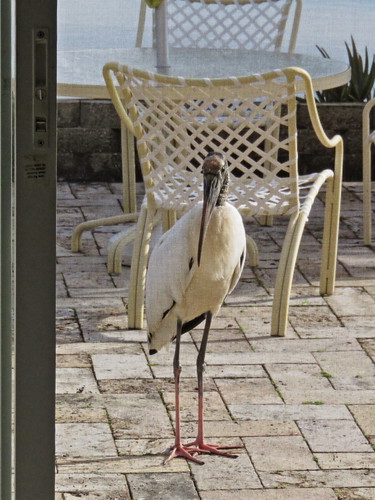
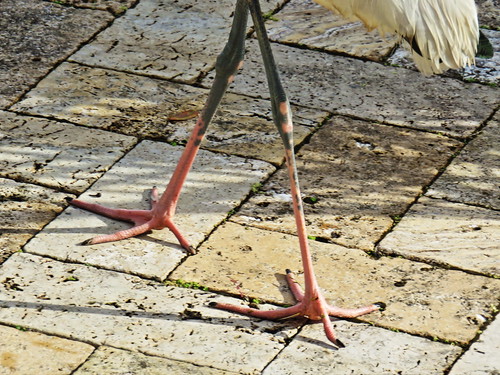
Its pink feet are an adaptation which makes them more visible as it agitates the water to frighten prey into the grasp of its bill:
= = = = = = = = = = = = = = =
Linking to Misty's CAMERA CRITTERS,
Linking to Eileen's SATURDAY'S CRITTERS,
Linking to FENCES AROUND THE WORLD by Gosia
Linking to WEEKEND REFLECTIONS by James
Linking to BirdD'Pot by Anni
Linking to Wild Bird Wednesday by Stewart
Linking to Wordless Wednesday (on Tuesday) by NC Sue
Linking to ALL SEASONS by Jesh
________________________________________________
Please visit the links to all these memes to see some excellent photos on display
________________________________________________