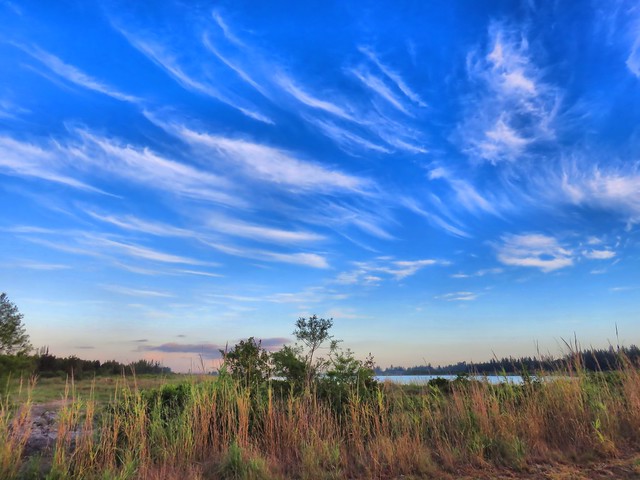
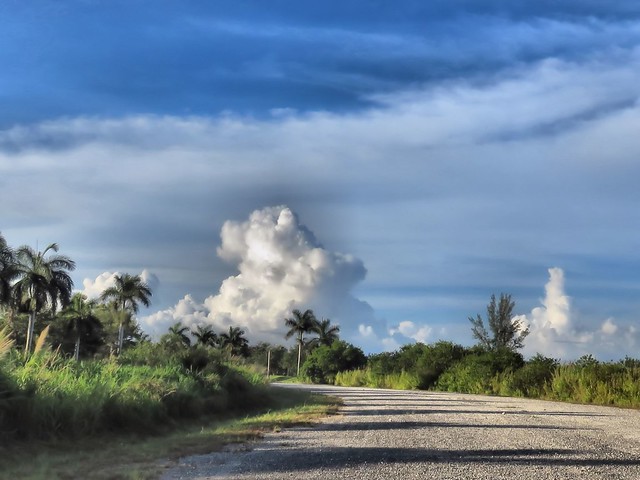
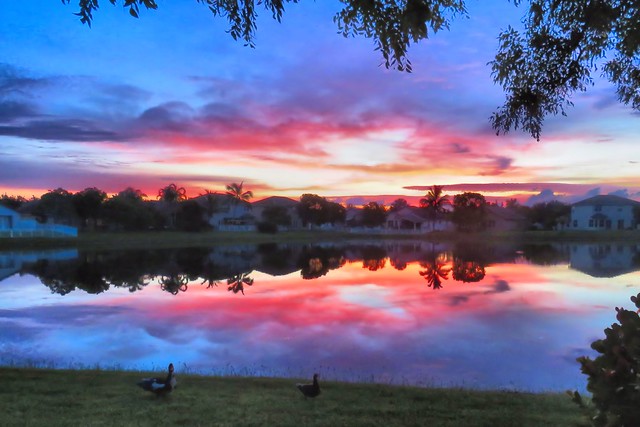
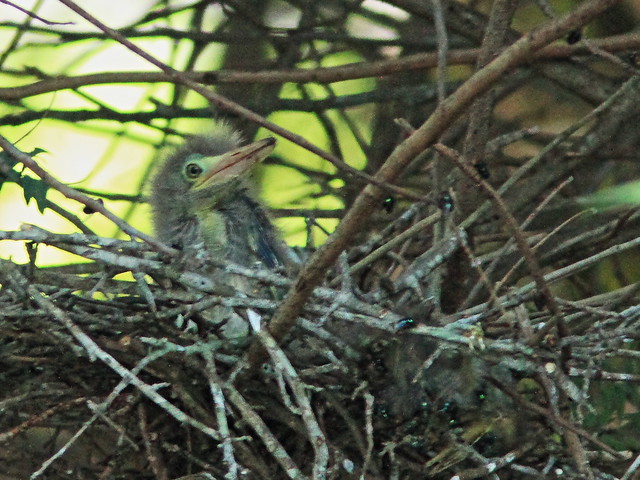
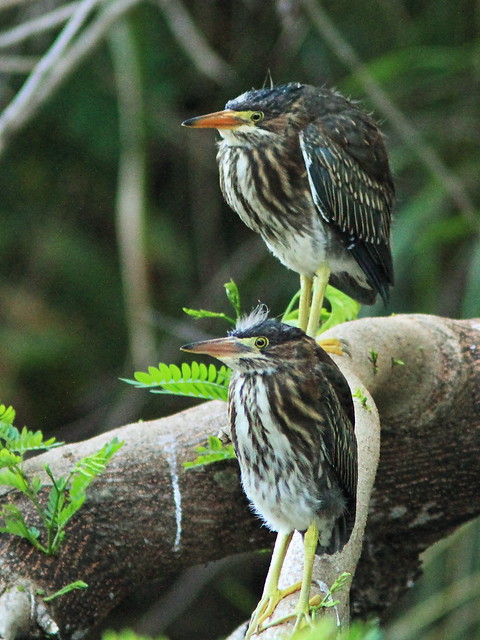
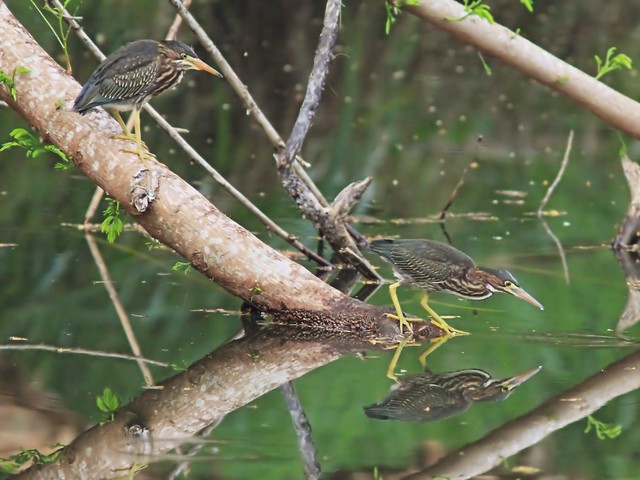
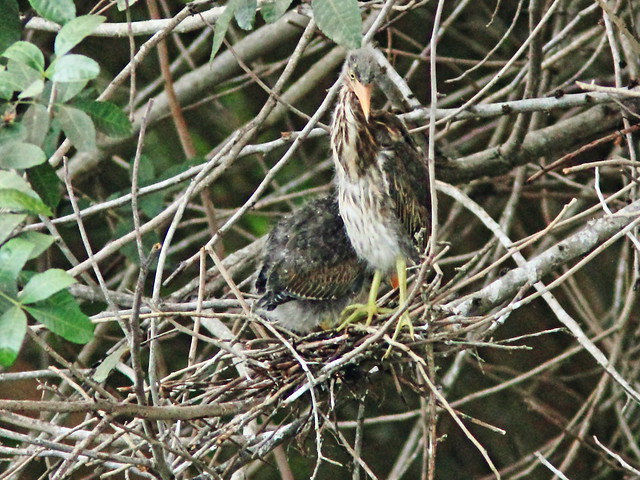
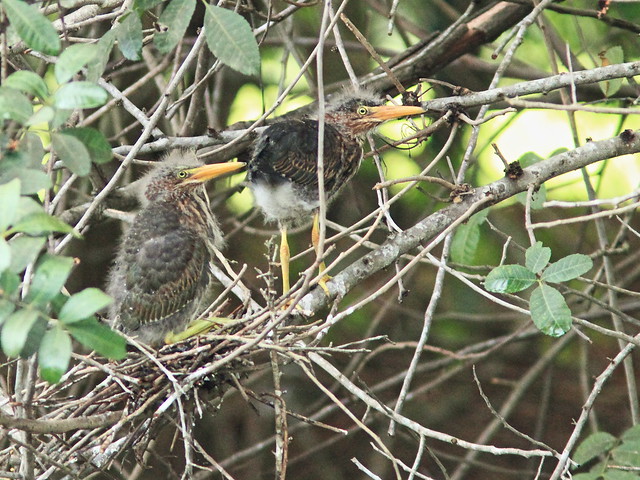
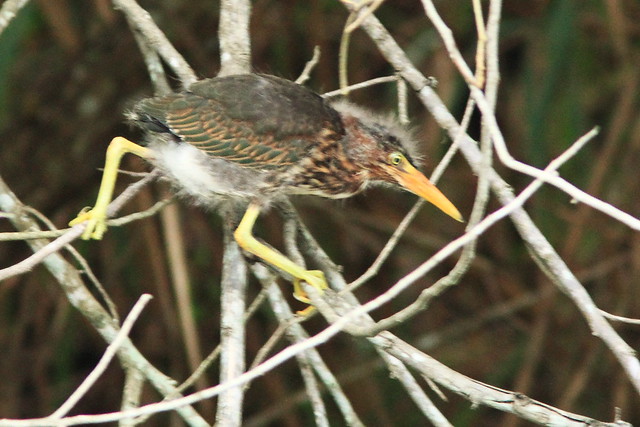
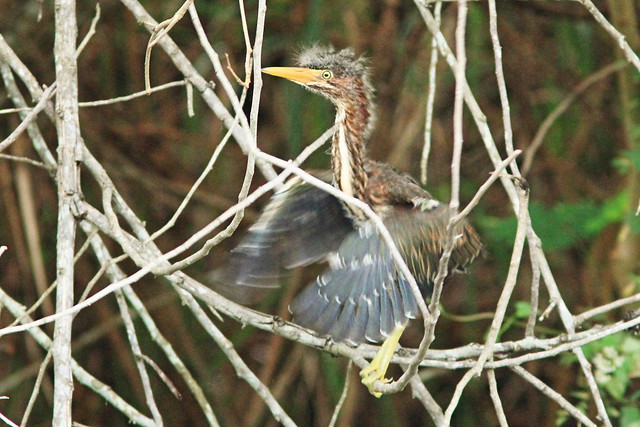
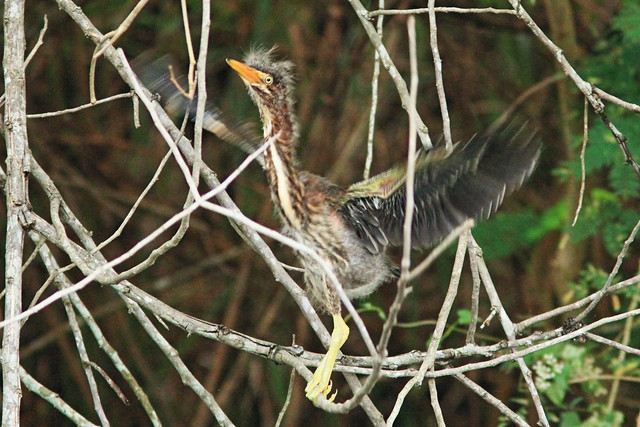
With so much to do before running off to Canada I have accumulated an unprocessed backlog of Florida photos. As I write this, Summer Solstice is two weeks away, but south Florida has already settled into the rainy season pattern of sporadic showers and frequent afternoon rainstorms. Cirrus clouds over the wetlands herald a change in the weather: A morning walk is cut short by the appearance of looming cumulus clouds: This is the view from our back patio on May 6. "Red in the morning, sailors take warning:" Although the variety of birds in late spring has decreased, there have been interesting developments in the devastated heron rookery. The Yellow-crowned Night-Herons, of which at least 8 pairs nested there last year, did not return. However, it was populated by at least three pairs of Green Herons, almost the same number as have bred there before. Somehow they accommodated to the dead and dying trees that border the herbicide-treated canal. Perhaps their smaller size and less inclination to build their nests directly over the water worked in their favor. I found two of their nests, both out in the open and fully exposed to the elements and predators. As reported in my last post, I discovered the first on May 25. It was located very near or perhaps on the site occupied by a Yellow-crowned Night-Heron (cataloged as herbicide treated location #6.1). It held single nestling, not old enough for its first flight: Two days later, that nestling is still present, and I find two older fledglings roosting on a tree limb. Their flight feathers are nearly fully developed but their caps are adorned with tufts of natal down: This tree limb had broken off and fallen into the canal. It serves as a convenient fishing platform for the juvenile herons. One casts its reflection in the still water: Although I could not find the older nest, I was surprised when movement in the foliage directed my attention to another Green Heron nest (herbicide treated location 7.5) . This flimsy nest contains two very active youngsters, perhaps a few days older than the one in the first nest: One of the nestlings is particularly adventuresome, walking about in the dead branches that surround the nest: It tests its wings vigorously, with feet clinging fast to a branch:
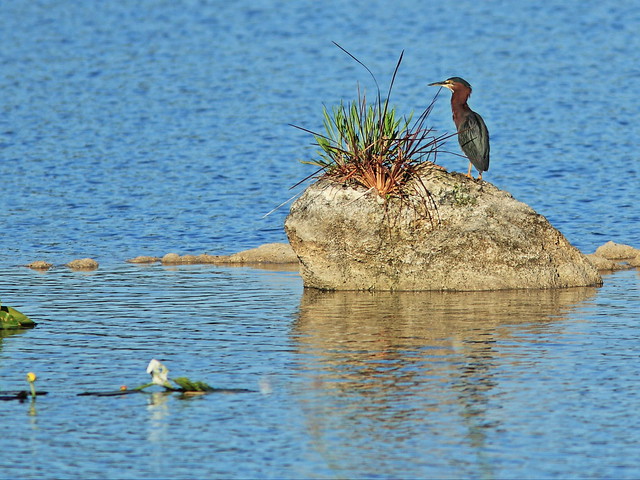
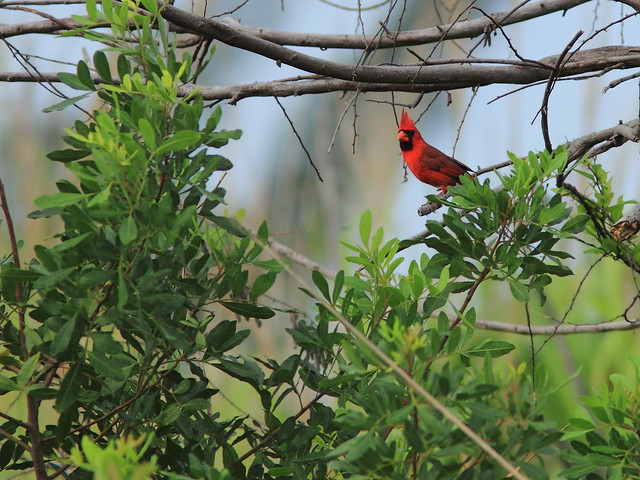
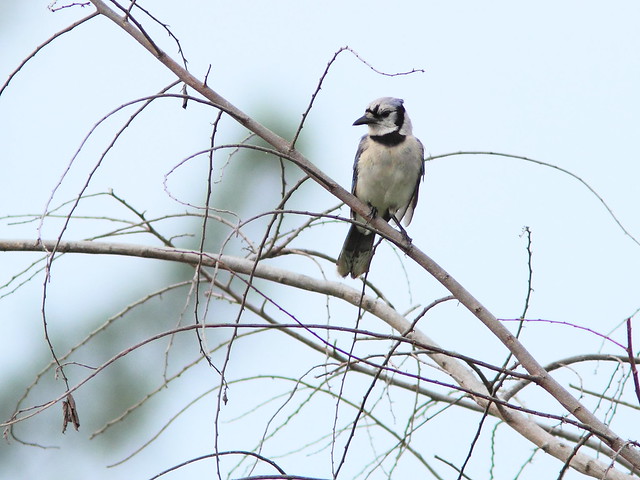
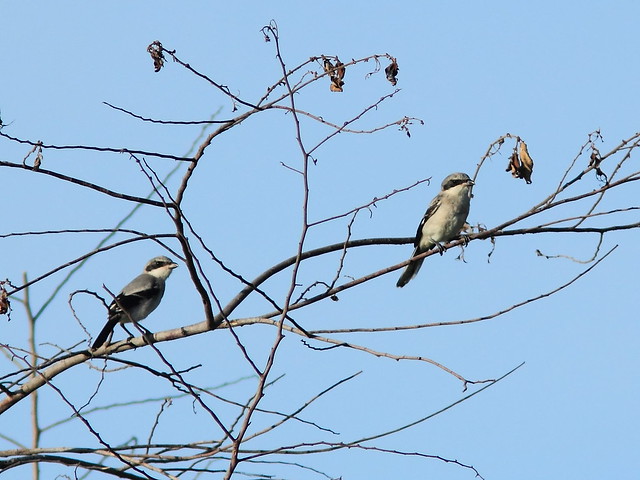
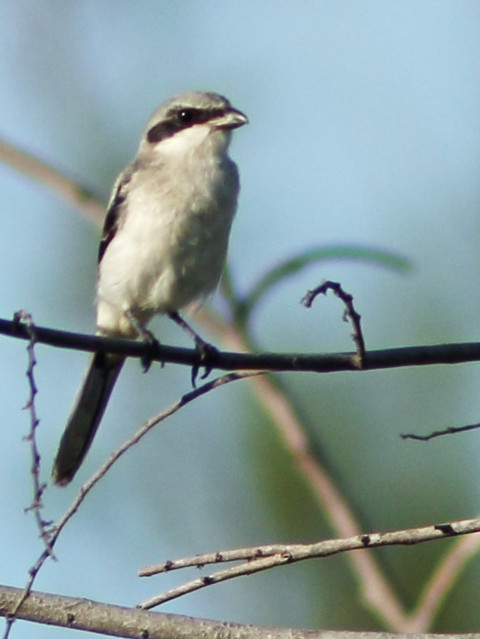
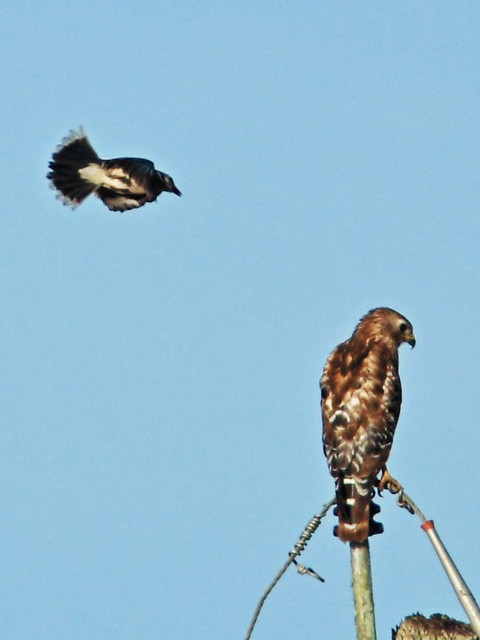
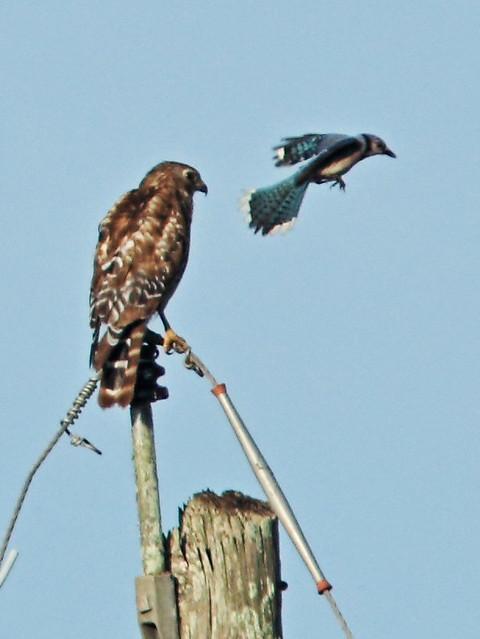
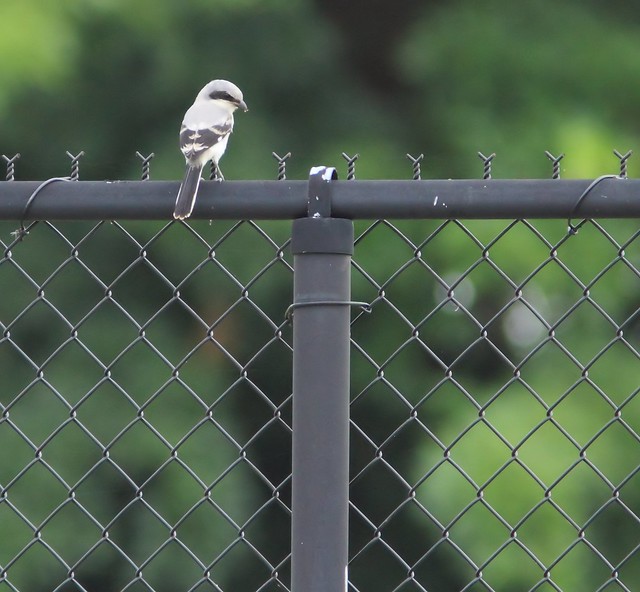
On the wetlands lake, one of the adults rests on a rock: Some of the most common birds are uncommonly beautiful. I like to include them in their habitat instead of always trying for "field guide" photos. This Northern Cardinal really stands out when framed in greenery: A Blue Jay takes a typically high perch in a leafless tree along the path, its color complementing the somber sky: Nearby, two juvenile Loggerhead Shrikes wait to be fed... ...as one of the adults looks on: A Blue Jay harasses a Red-shouldered Hawk: At nearby Chapel Trail Nature Preserve, another Loggerhead Shrike perches on a chain link fence...
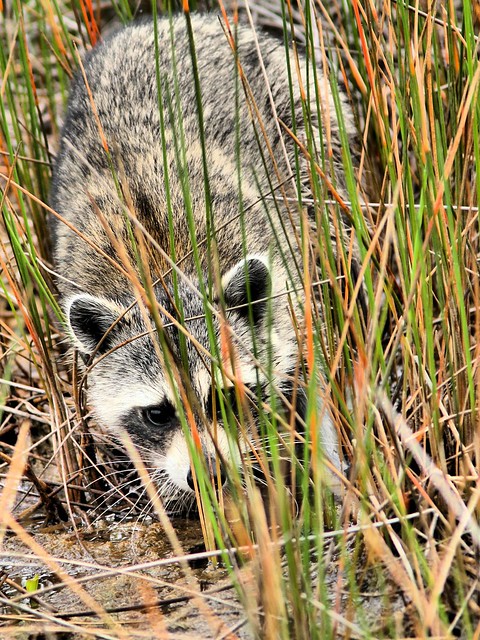
...and an oversize Raccoon thinks it is hidden in the rushes:
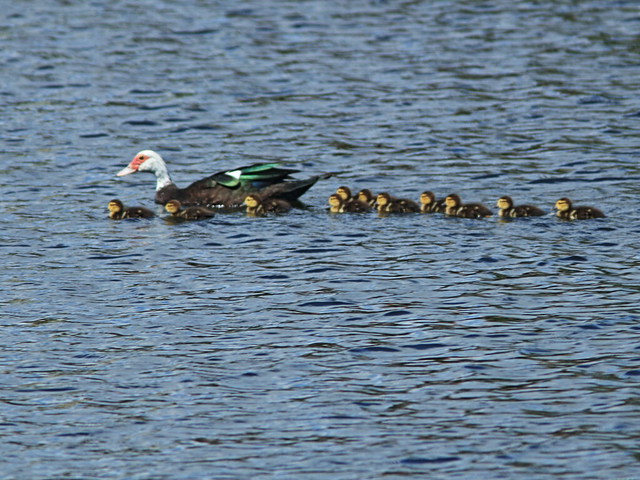
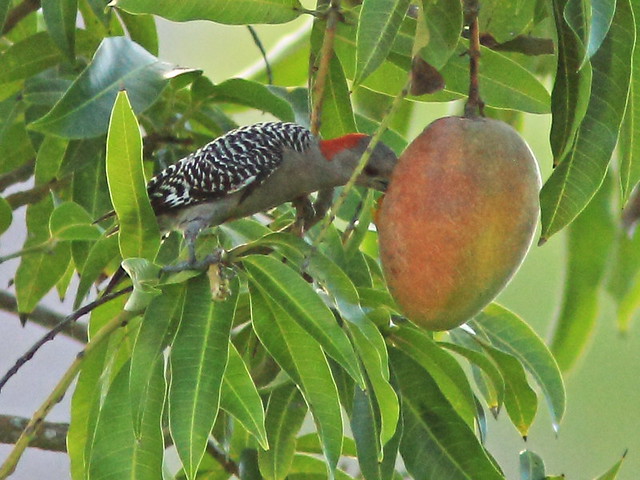
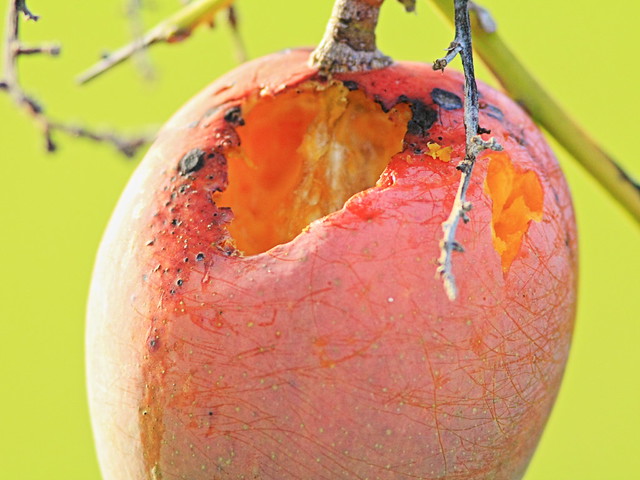
On the home front, a Muscovy Duck leads her 11 ducklings across our lake: A Red-bellied Woodpecker enjoys one of our last Mangoes of the season. Our two small trees borne over 100 pounds of fruit, most harvested by our neighbor (with our permission) while we were away in Illinois:
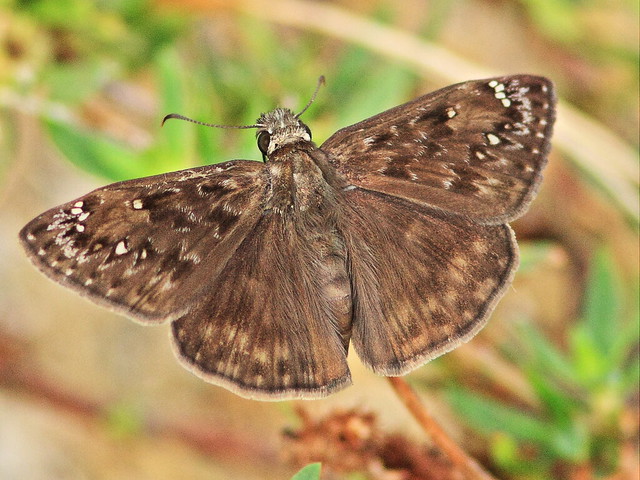
A small butterfly attracts my attention. It is almost black below and has an interesting pattern of wing markings. It is a Horace's Duskywing:
This is a "robo post," but I will get back to you as soon as I get back to a desktop. Since I will be on the road, I may not be able to post my theme photos to these favorite memes, but please visit the links to see many beautiful images on display:
The arrival of spring in our Florida neighborhood was almost a non-event. There was no burst of floral color, and the dry mild weather changed only gradually into the summer pattern of afternoon showers. Spring migration here, 18 miles inland from the ocean, had not been spectacular.
Thunderheads creeping in from the coastline blocked the morning sun:
The parallel rays of the sun appear to widen as they pass overhead, and then converge at a vanishing point on the horizon opposite the sunrise. This gives the illusion of a second (false) sunrise. A breeze ripples the surface, softening my hoped-for mirrored effect:
As spring approached, changes in abundance of land birds had been mostly gradual. Among the more common winter residents, Blue-gray Gnatcatchers and Painted Buntings disappeared by the end of February, Belted Kingfishers lingered into mid-March, and American Kestrels, House Wrens, Palm Warbler and Gray Catbird numbers decreased unevenly into mid-April.
The Carolina Wrens, permanent residents, had abruptly stopped singing in mid-April, probably because they resolved their territorial boundaries and were suddenly occupied with raising their families. Their morning songs resumed in early June.
Before we departed for Illinois on April 18, the Common Ground Doves were paired up and cooing their love songs. They favored two grassy spots along the road where I hoped they would nest:
We had also flushed a pair of Common Nighthawks from the grass, near where we found their eggs in past years:
At the lake, two similar sandpipers of different species provided a nice comparison of their identifying characteristics. A Solitary Sandpiper was on the left, while a slightly smaller Spotted Sandpiper posed next to it. Note that the Solitary has a conspicuous eye ring while the Spotted has a white brow line. The latter also shows how the white of its chest extends up in front of its shoulder. Both of these features are more helpful in the fall and winter, when the Spotted Sandpiper loses its spots:
After spending an enjoyable (but cold, wet and windy) six weeks in Illinois, we returned to Florida on May 24 to find midsummer-type weather. On our first morning we got out before sunrise to walk into our local wetlands. Offshore storms created a colorful sky as we exited the gates (and fence) of our subdivision:
I was disappointed to see that the grassy shoulders of the gravel road into the wetlands had been freshly mowed. This time of year the nighthawks and ground-doves should be sitting on eggs or tending to newly hatched broods. That little blue dot on the road is Mary Lou, now about 1/4 mile ahead of me on the way to the heron rookery.
A Common Nighthawk rose up from the edge of the road. If it had eggs or young they almost certainly were destroyed by the grass cutters. Perhaps it will try to nest after all:
Ground-doves persisted along the path near their old nesting area:
A Killdeer ran across in front of me and fell to the ground as if injured, attempting to distract my attention away from its nest site:
The Killdeer spread its bright orange tail feathers and uttered a shrill call, encouraging me to follow it away from its eggs or young:
A White-winged Dove looked on:
A male Northern Flicker alighted in a small tree next to the path:
A bad photo, but this illustrates why the eastern subspecies is called "Yellow-shafted" Flicker, as opposed to the Red-shafted form in the western US:
At the rookery, I found only one nest, that of a Green Heron. It contained one nestling:
There were at least two pairs of Green Herons present, but I initially failed to locate any other nests. One adult, in breeding plumage kept vigil nearby:
Two days later I returned and discovered that another pair had already successfully raised at least these two fledglings:
The little nestling was now exploring the branches around its home. I watched from a secluded spot for about a half hour, hoping to see a feeding, but had no success and gave up. Just as I was leaving the area an adult flew directly to the nest, but by then I was too far away to get any photos of the event.
I liked the way the back-lighting turned the baby heron's fuzz into a halo: On the way home, I saw a Great Egret roosting on a rock in the lake. I had to sneak up through the high grass to get a photo, but it saw me and immediately took flight:
Butterflies were about, including this male Julia... ...and a Zebra heliconian, Florida's State Butterfly: There were decent reflections on the lake the next morning, with a still wind under an unsettled sky, in this view from the back patio of our home: A better view of the entrance to our subdivision, on the way back home:
Today is our 55th Wedding Anniversary and Mary Lou and I plan to be taking an extended trip, which will limit our access to the Internet. I do appreciate your visits and will do my best to visit all of your posts, but I may be a bit slow in catching up for the next couple of weeks.
Linking to SKYWATCH FRIDAY by Yogi, Sylvia and Sandy Linking to WEEKEND REFLECTIONS by James Linking to BirdD'Pot by Anni Linking to Wild Bird Wednesday by Stewart Linking to I Heart Macro by Laura
________________________________________________
Please visit the links to all these memes to see some excellent photos on display
________________________________________________