Showing posts with label Spotted Sandpiper. Show all posts

Wednesday, September 8, 2021

Avian Red-eye special

Scores of Florida Trema trees* in our local Wounded Wetlands were destroyed by Hurricane Irma back in October, 2017. Nearly all the taller ones were either felled or stripped of their leaves. Most went on to die within a year. Those remaining were mostly saplings which flowered but did not bear the fruit which is so attractive to wildlife. Tremas normally produce abundant berries just in time for autumn migration. This year, some of them have matured and been very productive.

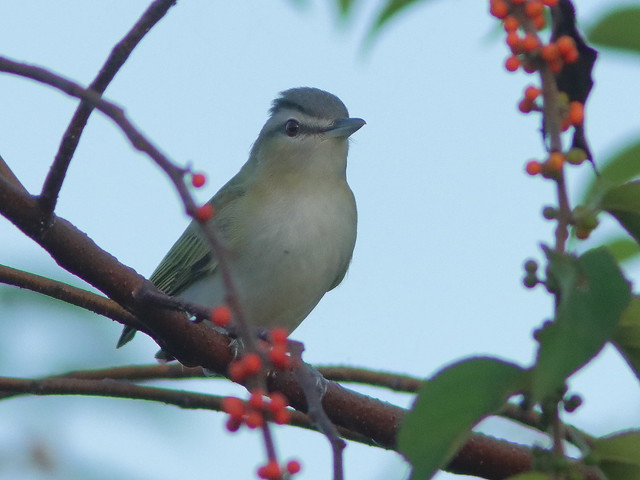
Southbound Red-eyed Vireos usually arrive ahead of most of the other songbirds, often by mid-August and become quite common by early September. On the first day of September, a half hour after sunrise, a flock of five were eating the Trema berries: 


Three days later, just after sunrise, lighting conditions were poor. I did not carry my flash unit, but the vireos provided some nice views as they harvested the fruit:


A male Northern Cardinal joined in the feast. His tail feathers were molting::


I wondered why one of my favorite warbler spots was so quiet. Blue Jays were calling from hidden perches in the area. Then this Cooper's Hawk flew in from an adjacent tree. This species is a "true hawk" ( Accipiter) with compact body, short wings and long tail suited for chasing smaller birds through the branches:


The hawk took off, but patrolled the area and returned several times:

Spotted Sandpipers are returning. In spring and summer they have spotted breasts, like this "early bird" on July 11:

Adults like this one photographed on September 3, have clear breasts in fall and winter:

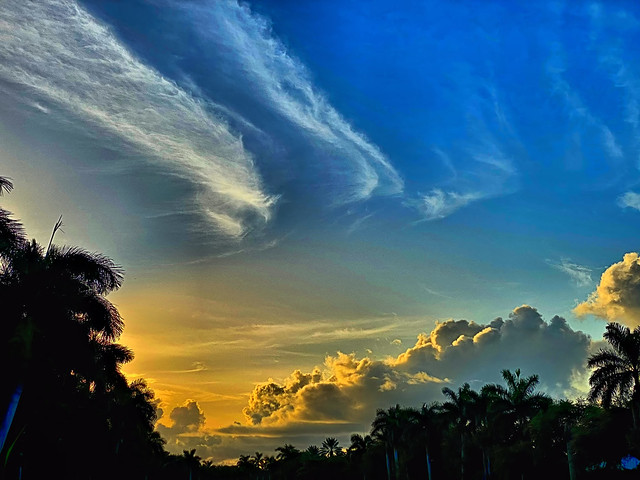
African dust lingered in the atmosphere just before sunrise on August 31, showcasing the dark shadows cast by cloud tops over the Atlantic Ocean. I followed the emerging solar (crepuscular) beams...

...across the southern horizon. Though straight as an arrow, they seemed to curve down opposite the Sun...
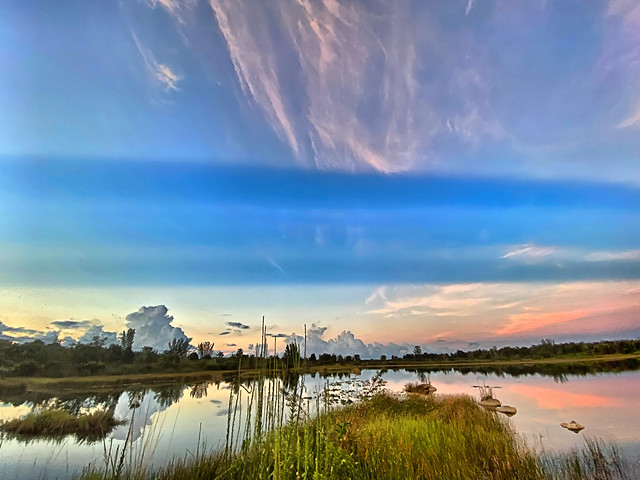
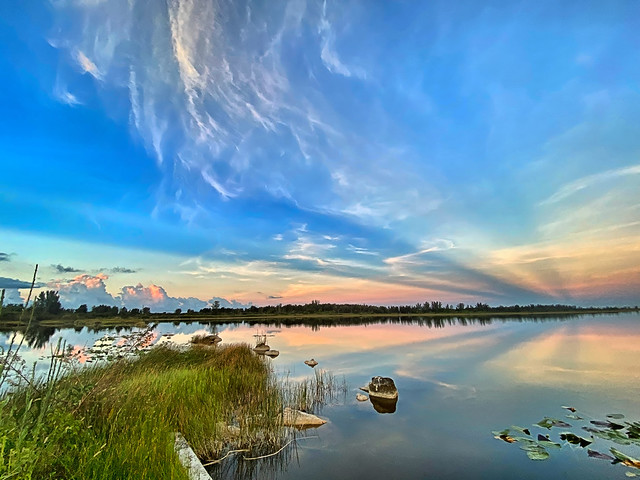
...appearing to cluster with other cloud shadows as an anti-solar (anticrepuscular) mirrored "sunrise:"

*Florida Trema (Trema micrantha) is a shrub or small tree up to 10 m tall. It is grouped with Hackberry and Hemp in Tree Family CANNABACEAE.  Leaves are egg-shaped, up to 9 cm long, green on top but covered with white, woolly pubescence underneath. Flowers are greenish-white. Fruits are yellow to bright reddish-orange, up to 4 mm in diameter.

REF: https://www.southfloridatrees.org/?page_id=530

= = =  = = =  = = = =  = = = = =

Linking to:


Skywatch Friday

Weekend Reflections

Saturday's Critters

BirdD'Pot

Camera Critters

All Seasons

Wordless Wednesday (on Tuesday)

Natasha Musing

Our World Tuesday

________________________________________________

Please visit the links to all these posts to see some excellent photos on display
________________________________________________
Thursday, April 29, 2021

Eaglets down

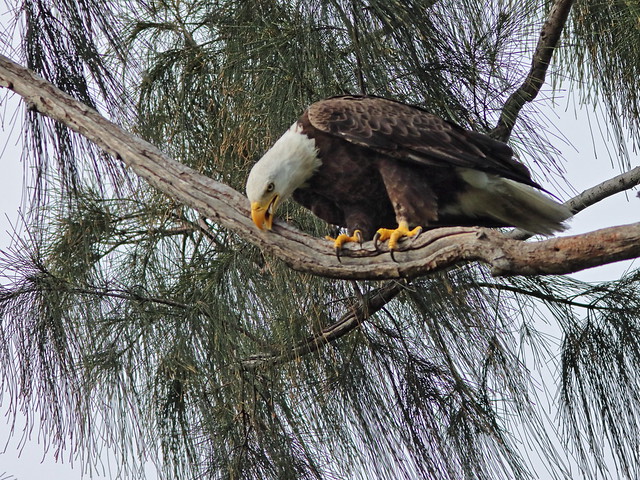
The local Bald Eagles' new nest containing two 5 week old eaglets was damaged by a severe thunderstorm on Sunday, April 11. The next morning a portion of the right (west) side of the nest had fallen. A week later, while I was away in Illinois, on April 19, the nest split into two pieces which fell a few feet down from its original spot in the "V" formed by two large branches of the tall Australian Pine. (Note important UPDATE at the end of this post).

The smaller eaglet of the two fell to the ground and was rescued. It suffered minor injuries but is doing well at the Pelican Harbor Seabird Station rehabilitation facility in Miami. The older eaglet (presumably a female based upon its size) is active and healthy, occupying the lower remnant of the nest, behind and just to the left of the main trunk. It was hatched around  March 5 or 6th, so she is 57 days or nearly 8 weeks old. Normal fledging age is about 10-13 weeks of age. At this nest site, fledging of the first eaglet occurred as early as 68 and as late as 86 days after hatching. (average 76.5 days with a median of 73 days). 

This part of the nest appears to be supported by smaller branches and some of the long sticks from the original nest. We watched as it was being fed a large fish carried in by the female parent. I only was able to capture a few poor photos of the eaglet, as it was mostly hidden by the debris from the nest. 

I arrived at the nest yesterday ( Wednesday) at about 8:15 AM and found the adult female (Jewel) roosting in the usual spot in the tall pine just east of the nest tree.


Almost immediately, the male (Pride) flew in and fed the eaglet, which called out incessantly. The eaglet is out of sight in this view, hidden by the left half of the remnant nest: 

Jewel then flew off and things were quiet until about 9:50 AM, when she arrived from the north carrying a large fish.


She fed the eaglet which was rather precariously perched below her on the very edge of the sloping lowest portion of the left nest fragment. The eaglet's tail and wing feathers extend to the left beyond most of the nest structure, and her head can be seen as she crouched down, next to the tree trunk:


The eaglet stood up as the female parent tended to her:

In Illinois I lost two days worth of bird photos when I uploaded my photos and got a message that the files could not be opened, then that my SD card was corrupt. Did get out one final day and will review those photos later, but I missed some very nice views of kinglets and terns.

Back home in Florida I did get out one morning and found two Spotted Sandpipers, one of which posed nicely:


When they took flight I shot rather blindly and all bu two of my series were nothing but blurs. Two frames made up fo the loss:


A Killdeer was also very cooperative:


The day-old Full Pink Moon was setting late, but it reflected in the calm before sunrise:

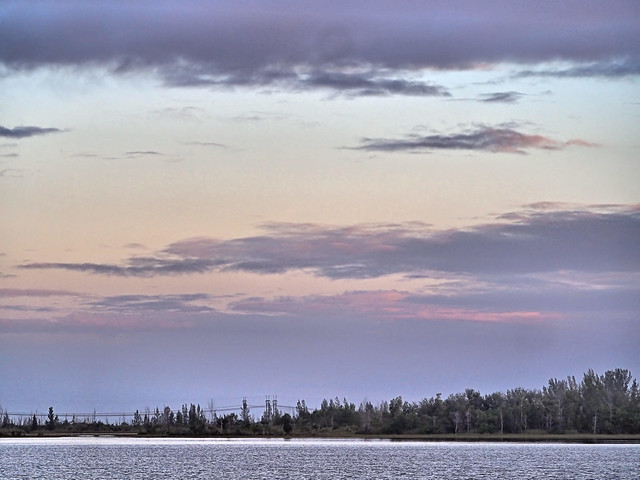
The view to tne north before sunrise:

BULLETIN (Wednesday, April 28): The remaining eaglet has not been seen all day and the adults are not around. No calls are heard to suggest a fallen eaglet. Wildlife rescue is now searching for a possibly downed eaglet. 

UPDATE (late Wednesday): The area in the vicinity of the nest was searched and the eaglet was not found. It is not capable of flight. Searchers found two burrows in higher areas near the eagle nest tree with large openings suggestive of Coyote or fox dens. Raccoons also scavenge the area under an eagle nest for prey remains. Rodents also may be attracted as are predatory Bobcats. There were high winds yesterday evening which may have whipped the nest tree. As I had mentioned above, the remaining eaglet appeared to occupy in a very vulnerable spot in the nest remnant. 

I do not wish to create false expectations, but there is a glimmer of hope worth considering---

At this point it is presumed that the eaglet has not survived. She did have considerable development of flight feathers, as evidences in the photo which shows them trailing out over the left edge of the nest, but I could not document their length in any of the hundreds of photos I took of the nest the day before she disappeared. Could we have miscalculated her age? She occasionally flapped wings but did not venture out on branches ("branching"), which usually occurs about 6-7 days before first flight.

Based upon the female starting to sit continuously deep in the nest, we presumed that the first egg was laid around February 1 and projected a hatch date of March 7 or 8. Jessee suspected she was incubating as early as January 20, but the female continued gathering and arranging sticks through the end of January. 

A problem with this nest has been the difficulty in closely observing the female during incubation. She appeared to change her position, raising up as if tenting an new chick at the end of January or beginning of February. How accurate were our ground observations? In the past we have noted less activity around the nest after only a single eaglet fledged. A single feeding location is most efficient if there are multiple eaglets.

Nest watchers will continue to observe the behavior of the adults and listen for any calls from an eaglet, though there is not much optimism about her survival.  

= = =  = = =  = = = =  = = = = =

Linking to:


Skywatch Friday

Weekend Reflections

Saturday's Critters

BirdD'Pot

Camera Critters

All Seasons

Wordless Wednesday (on Tuesday)

Natasha Musing

Our World Tuesday

________________________________________________

Please visit the links to all these posts to see some excellent photos on display
________________________________________________


Thursday, August 13, 2020

August: A soggy start

As Tropical Storm Isaias was tracing an uncertain path towards Florida, our morning walks were often interrupted by the threat of rain. Heavy clouds sometimes added to the mood, if not to the technical perfection, of my photographs. Further, I could not operate my usual camera because I did something that was... well, not too smart. 

These photos of a Great Egret, a butterfly and threatening skies may well be the dying "last gasps" of my trusty DSLR camera, taken on July 29, before thunderstorms moved in to shorten our walk:

Great Egret 03-20200729

Great Egret 02-20200729

White Peacock:

White Peacock 02-20200729

Morning Clouds 2-20200729

While cementing a loose rubber surround on the mode dial of my Canon 80D, I took care to dispense the adhesive in tiny quantities on a paper clip. However, a larger bit of the CrazyGlue dripped unexpectedly on the knob and bonded it (and the camera's on-off switch) to the camera body. An internet search revealed that acetone might loosen the glue, but I worried that it would turn to gum and solvent might find its way into the camera's vital mechanisms. 

I called Canon repair and the representative said they could fix it, for an estimated price, subject to increase depending upon what other damage they might encounter. After paying the estimate I shipped the camera to Virginia, which happened to be on the projected path of Isaias.

My back-up camera is a mirrorless Olympus E-M10 Mkii with a 75 to 300 mm zoom lens. It had come in handy for traveling, but as a "KISS" (keep it simple, stupid) kind of guy, I found its settings menus to be terribly complicated and easy to forget. Actually, it served me quite well, even before sunrise when a Spotted Sandpiper was back-lit by reflections:

Spotted Sandpiper 20200730

Although it is rather soft, this photo of a Little Blue Heron conveyed a morning mood:

Little Blue Heron 20200730
     
Mourning Doves against the eastern sky were just short of silhouettes:

Mourning Doves 01-20200730

A little bit of blue sky helped me out with this Loggerhead Shrike:

Loggerhead Shrike 2-20200801

A lazy American Alligator watched from just offshore as the rising sun caught his eye:

American Alligator 02-202007730

American Alligator 01-202007730

The restricted range of the zoom lens system of the Olympus was not appropriate for landscape photos, but I tried a few, one of a somber western sky as the sun rose behind clouds...

Somber sunrise 20200801

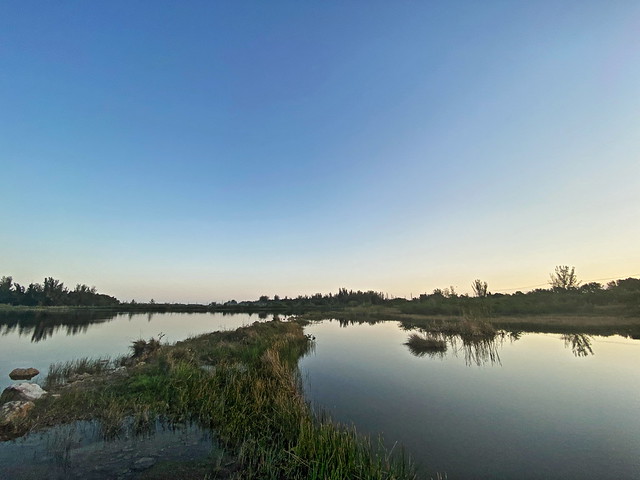
...and this, from my early morning vantage point overlooking the south wet prairie:

 South wet prairie 20200801

These are the cloud tops to the south just before sunrise on July 31:

Clouds at Sunrise 20200730

Fast-moving bands of heavy rain and high winds preceded Hurricane Isaias on the morning of August 1. I made it to home as the wind picked up but just before the rain started: 

Storm band approaching 02-20200801 

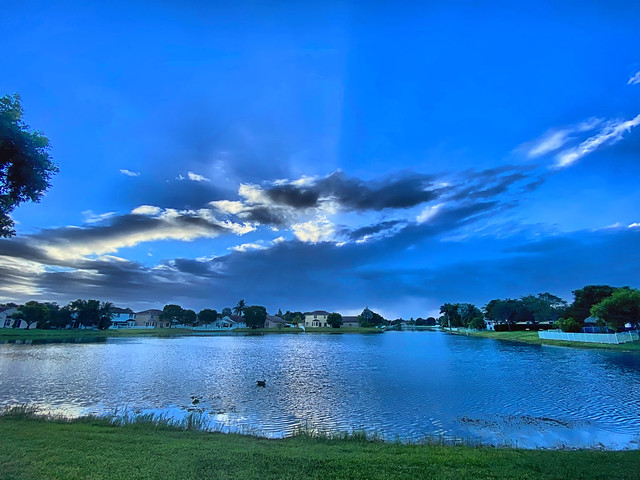
The view from our back yard:

Storm band approaching 03-20200801


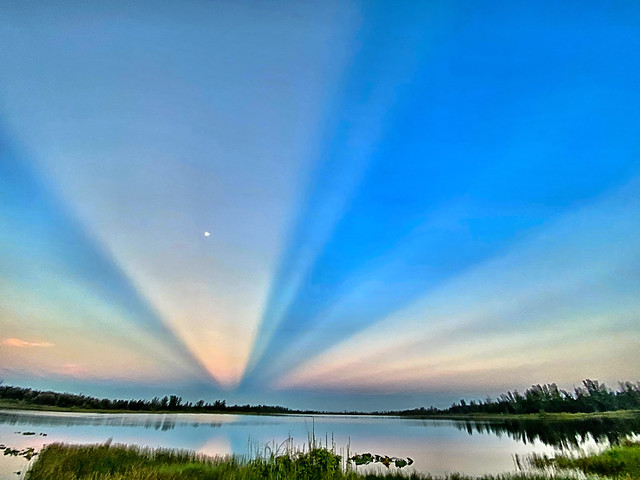
On the morning of August 6, out in the wetlands, I used my iPhone 11 Pro Max to capture images of the converging array of anti-solar (anticrepuscular) rays opposite the sunrise. The nearly-full Moon was part of the picture.  The Sun is about 5 minutes below the ENE horizon, so the Earth casts a curved shadow just under the vanishing point of the rays. 

Conditions must be just right-- (1) A clear sky to transmit the solar rays all the way from the Sun to the opposite horizon (2) Atmospheric conditions which reflect  light to illuminate the rays, such as moisture droplets, smoke or dust  (3) Storm clouds offshore and low in front of the sun to create shadows which break up the sun's solar (crepuscular) light.   

Anti-solar rays 03-20200806

Anti-solar rays 02-20200806


Isaias weakened and we experienced little more than a breeze and a few light showers. However it regained hurricane strength and pummeled the northeastern coastal area. In the meantime, my camera was delayed for more than a week because of the effects of the storm on Newport News, the home of the Canon Repair Center.  

So, I rationalized that putting more money into my heavily-used 3 1/2 year old camera would not be a sensible option. (Notice that I did not say "reasoned," meaning that I drew my conclusion after considering all the evidence, but rather "rationalized," starting with the conclusion and fitting in the supporting facts!). My new baby is the next one up in the EOS progression, a Canon 90D. Can't wait to try it out!


= = =  = = =  = = = =  = = = = =

Linking to:

Skywatch Friday

Weekend Reflections

Saturday's Critters

BirdD'Pot

Camera Critters

All Seasons

Wordless Wednesday (on Tuesday)

Natasha Musing

Our World Tuesday


________________________________________________

Please visit the links to all these posts to see some excellent photos on display
________________________________________________