Thursday, February 28, 2019

A small heron rookery

The heron rookery in our local south Florida "Wounded Wetlands" is now smaller than ever. 

In May, 2011 a neighbor wrote to me while we were in Illinois, reporting that he found a nesting colony of 5-6 pairs of Yellow-crowned Night-Herons in "our" local birding patch. They were in a corner I never had investigated. 

Without his help I would not have found them, as they were very well concealed in trees along a storm-water canal. Two of the nests had adults incubating eggs or brooding small chicks. We also found three immature Green Herons with their parents near another nest. 

Over the years we have seen the nests of up to 8 pairs of Yellow-crowned Night-Herons and 3-5 pairs of Green Herons. A pair of Black-crowned Night Herons raised at least one chick but concealed their nest very effectively.

Hurricane Irma struck on September 7, 2017, and drastically changed the little rookery. Although the storm hit after breeding season, it pushed many of the nest trees and shrubs into the canal. Last spring I found only one Yellow-crowned Night-Heron nest. 

The regional authority which maintains the drainage canals periodically treats the stream-side vegetation with herbicides, but more had to be done to keep the waterway open. I learned of their plans and alerted them to the existence of the rookery. 

They came in with chainsaws and cleaned out fallen trees and shrubs which amounted to about one third of the rookery, but did leave more than half of the vegetation undisturbed. However, they cut down several of the larger trees which extended over the water and clear-cut one large area of thick brush, sites of nests during previous years.

This winter up to 6 Yellow-crowned Night-Herons have visited, but only five were present this week, three males, one female, and a probable first year immature bird in drab plumage. Adults' plumage brightens up and their legs change color from black to yellow and then to bright red as breeding season advances. Both sexes grow head (occipital) and upper back (scapular) plumes, and their crowns turn from streaky white to clear yellow. The plumes of the males are noticeably longer.

On February 25 I arrived at the rookery about 20 minutes before sunrise. There was light fog and it was still too dark for photos, but I observed a pair engaged in a courtship ritual. I obtained this image at about 15 minutes before sunrise. The male is on the left. Note his longer head plumes:

Yellow-crowned Night-Heron courtship 063838AM 20190225

This sequence shows his display, which takes place in less than a second.

He stands up very straight, bill raised:

Yellow-crowned Night-Heron courtship 065110 AM 20190225

Yellow-crowned Night-Heron courtship 065131AM 20190225

He extends his scapular plumes:

Yellow-crowned Night-Heron courtship 065132AM 20190225

Wings are pointed up and he bows deeply:

Yellow-crowned Night-Heron courtship 065134AM 20190225

Yellow-crowned Night-Heron courtship 065135AM 20190225

Suddenly, he reacts to the presence of the second male as it flies by. Now the display is intended as a threat:

Yellow-crowned Night-Heron aggressive display 01-20190226

The next morning the pair was actively engaged in building a nest. There was a bit of ceremony each time the male brought in a stick. The female grasped and seemed to inspect each offering before the male placed it on the nest platform: 

Yellow-crowned Night-Herons at nest 02-20190227

Yellow-crowned Night-Herons at nest 03-20190227

Yellow-crowned Night-Herons at nest 04-20190227

The male almost ignored my presence and flew across the canal to pick up a stick. He was so close to me that I could not fit all of him in my viewfinder:

Yellow-crowned Night-Heron male hunting for sticks 20190226

Here the male displays as he arrives with a stick:

Yellow-crowned Night-Herons at nest 06-20190227

Yellow-crowned Night-Herons at nest 07-20190227

Yellow-crowned Night-Herons at nest 091-20190227

Video slide show of display:


These photos document the changes in the rookery--

View to north end on April 22, 2012:

196th Ave Canal looking NE 20120422

Rookery on March 21, 2014:

Rookery 20140321

View to south after Hurricane Irma, October 26, 2017:

Rookery damage 20171026

After about a third of the rookery was clear-cut, November 27, 2018:

Heron rookery clear cut area 20181127

The waning crescent Snow Moon had a rendezvous with the Planet Jupiter on the morning of February 27. Jupiter and some of its moons may be visible at the bottom of this frame:

Snow Moon and Jupiter moons 2-20190227

Full Snow Moon setting just before sunrise on February 20:

Snow Moon 08-20190219


= = =  = = =  = = = =  = = = = =

Linking to Misty's  CAMERA CRITTERS,

Linking to Eileen's SATURDAY'S CRITTERS,

Linking to SKYWATCH FRIDAY by Yogi, Sylvia and Sandy

Linking to WEEKEND REFLECTIONS by James

Linking to BirdD'Pot by Anni

Linking to Our World Tuesday by Lady Fi

Linking to Wild Bird Wednesday by Stewart

Linking to Wordless Wednesday (on Tuesday) by NC Sue

Linking to ALL SEASONS by Jesh

 ________________________________________________


Please visit the links to all these memes to see some excellent photos on display
Thursday, February 21, 2019

Crops & Clips: Mid-February clicks

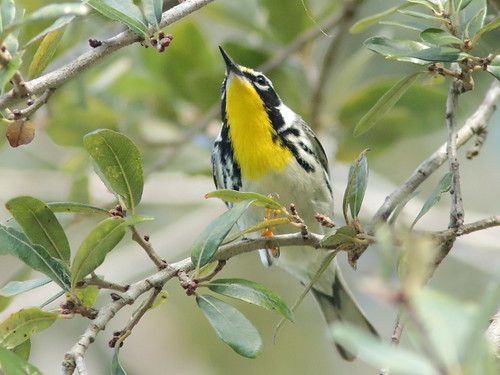
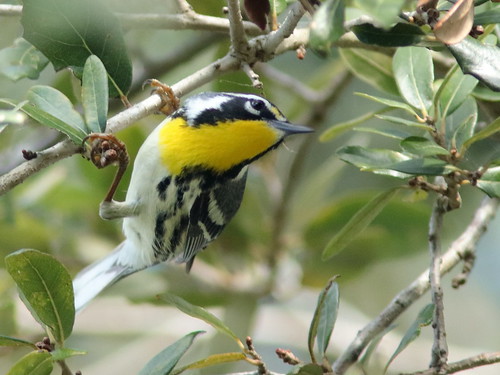
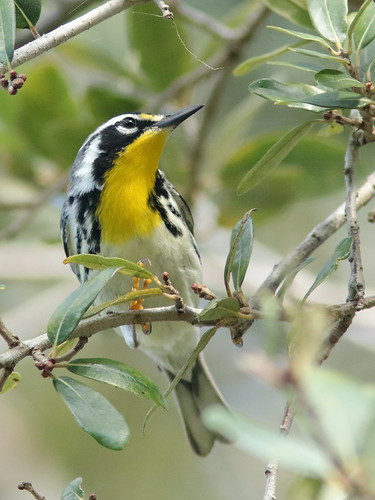
One of my favorite winter birds here in south Florida is the Yellow-throated Warbler. Their breeding range has expanded from the southeastern US into the northeast and north central states. I have seen and photographed them in NE Illinois.

Although they nest down into central Florida, they are rarely seen south of Lake Okeechobee during spring and early summer. They winter in Florida, the Caribbean and along the Gulf of Mexico coast down into Central America

Their foraging habits make Yellow-throated Warblers difficult to observe and photograph, as they creep along the outer limbs in the treetops. On February 17 I followed two of these beautiful birds as they moved along three Live Oak trees. I took over a hundred photos, nearly all of which provided partial views, poorly exposed against the bright sky. In a stroke of good luck, one of them decided to forage for a few seconds in full sun on the near side of the third tree.

Yellow-throated Warbler 01-20190217

Yellow-throated Warbler 02-20190217

Yellow-throated Warbler 04-20190217

Yellow-throated Warbler 08-20190217

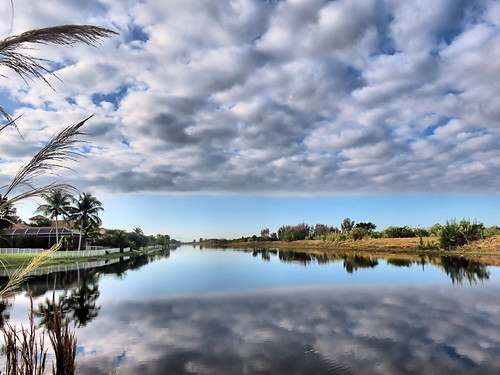
On the morning of February 17, an unusual cloud formation reflected on the still surface of the lake, providing a sort of shadow box picture frame for this view of the opposite shore:

View to northwest 20190217

Later that morning, as I was walking home, I saw the same effect over the canal which separates our subdivision from the wetlands preserve:

195th AV Canal View to south 20190217

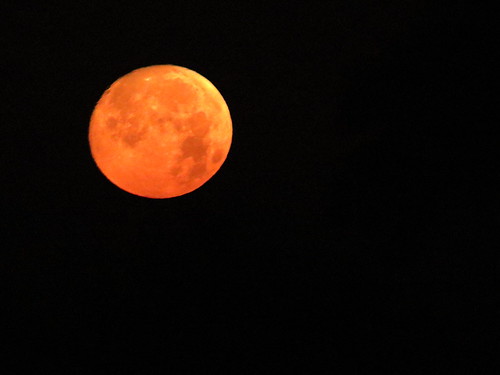
The full Snow Moon was setting as we entered the Wounded Wetlands, nearly an hour before sunrise on February 18:

Snow Moon 20190218

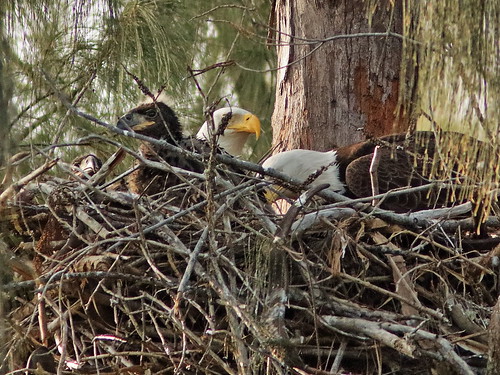
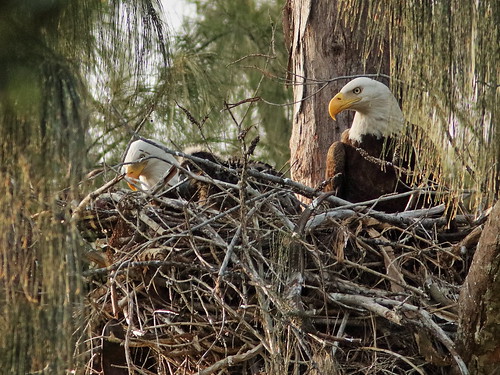
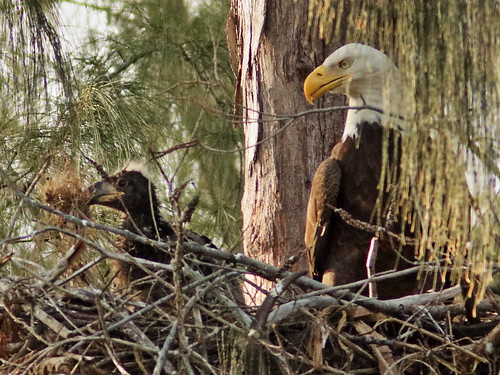
Our local pair of Bald Eagles have two eaglets, now just over 5 weeks old. They provided me with my first photo of the entire family together on the nest. Mom and Dad (Pride and Jewel) and P Piney 21 and 22:

Bald Eagle 0843AM 20190216 9731

Bald Eagle 0843AM 2019 0216 9736

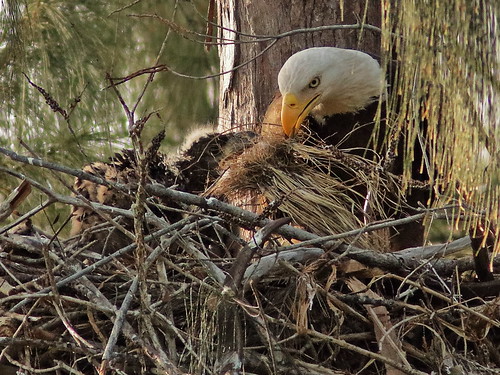
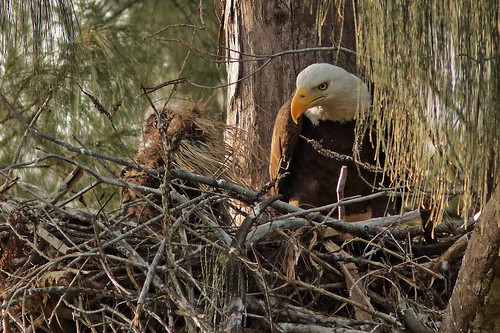
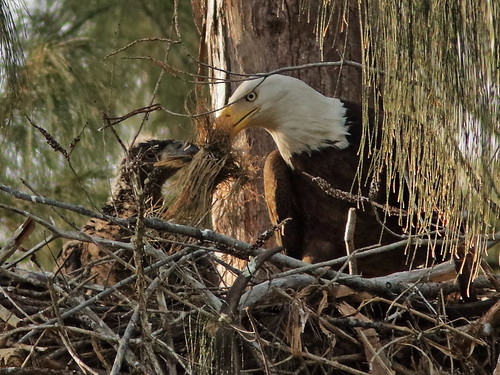
After their chicks hatch, the eagles often add to the soft lining of the nest. They bring in fresh grass and leaves. Some say this helps deter parasites. Indeed, they carried in some pods from the Flamboyant tree (AKA Royal Poinciana) which, like many other legumes (such as Lima Beans which are poisonous if not cooked) contain toxic substances and cyanide. I think they are also covering up some of the debris in the nest, "sweeping the dirt under the rug."

We observed a rather humorous interaction. Pride was rearranging some nest lining materials and the younger eaglet, perhaps thinking it was a tasty morsel,  grasped a clump of sod from his beak.

Bald Eagle 0844AM 20190216 9742

Bald Eagle 0845AM 20190216 9743

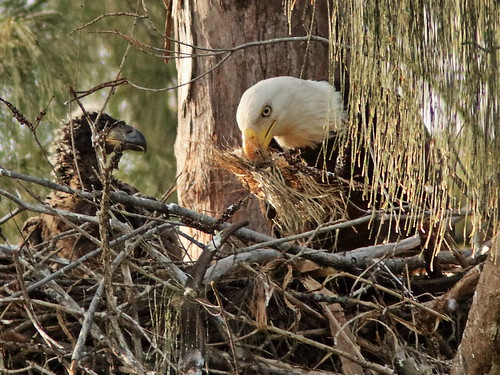
Pride watched as the eaglet carried it away to the left side of the nest.

Bald Eagle 0847AM 20190216 9747

Bald Eagle 0848AM 20190216 9750

Pride tugged on the sod and retrieved it and finally replaced it on the floor of the nest.

Bald Eagle 0849AM 20190216 9753

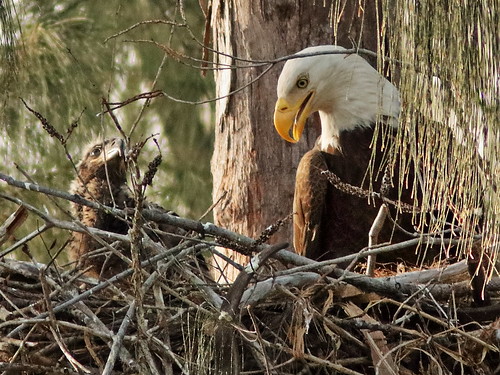
He then turned towards the eaglet as if to admonish it:

Bald Eagle 0850AM 20190216 9758

Ever alert, Pride flew up above the nest to drive off an intruding eagle. We could hear it in the trees behind and to the right but never saw it. Perhaps it was one of their progeny from a previous season, or a wandering adult:

Bald Eagle 0855AM 20190216 9821

We are seeing dreadfully few Monarch butterflies this winter. Most of the south Florida population is non-migratory. This one is sipping nectar from Bidens Alba:

Monarch on Bidens alba 20190218

= = =  = = =  = = = =  = = = = =

Linking to Misty's  CAMERA CRITTERS,

Linking to Eileen's SATURDAY'S CRITTERS,

Linking to SKYWATCH FRIDAY by Yogi, Sylvia and Sandy

Linking to WEEKEND REFLECTIONS by James

Linking to BirdD'Pot by Anni

Linking to Our World Tuesday by Lady Fi

Linking to Wild Bird Wednesday by Stewart

Linking to Wordless Wednesday (on Tuesday) by NC Sue

Linking to ALL SEASONS by Jesh

 Linking to Fences Around the World by Gosia

________________________________________________