Thursday, July 9, 2020

Crops & Clips: Early summer clicks

For the past two weeks we have had record and near-record heat and humidiity almost every day. Heat index "feels like" temperatures often reached into the low 100's F (~38-40 C). 

As usual, MaryLou and I walked out about 45-50 minutes before sunrise to avoid enduring full sunlight. This practice has limited my ability to capture decent photos. For several mornings, dust blown over from the Sahara Desert tinted the morning skies an amber color. Fog over the lake added to the challenge.

Great Egret:

Great Egret in fog COREL 20200630  

Green Heron foraging in semi-darkness:

Green Heron 01-20200628

The pair of Eastern Screech-Owls stayed up late and I was again able to get images in natural light just around sunrise. This one seemed to be indifferent to my presence:

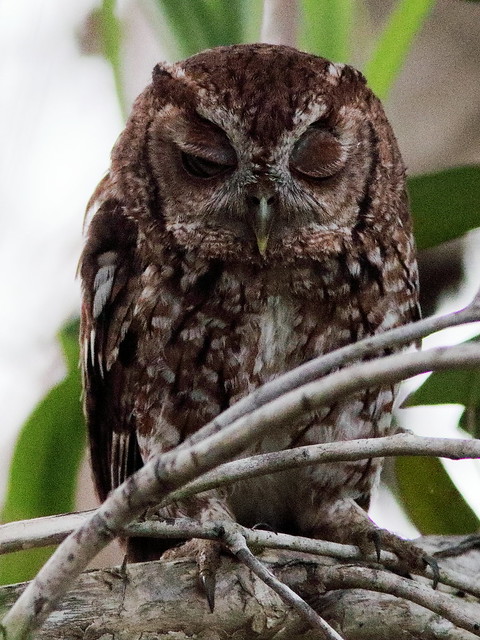
Eastern Screech-Owl 06-20200628

Eastern Screech-Owl 05-20200628

The plumage of a juvenile Mourning Dove had a textured "scaly" appearance due to the white edges on its wing coverts:

Mourning Dove juvenile 01-20200629

An adult Mourning Dove rested on a resident's fence:

Mourning Dove on fence 20200705

An advantage of going out early is that we pay more attention to celestial bodies. Venus has been climbing higher in the eastern sky. It shines brightly on July 1:
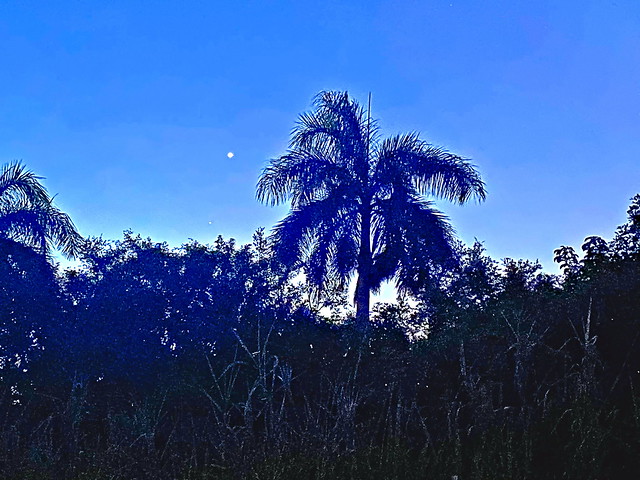
Venus 35 min before sunrise 01-20200701

Every four weeks, we hope to see the full moon set over the lake. The "Buck Moon" is so named because it is said to occur when the deer develop velvet-covered antlers.

The sky was cloudy on July 5 when we walked out, hoping to view the Moonset:
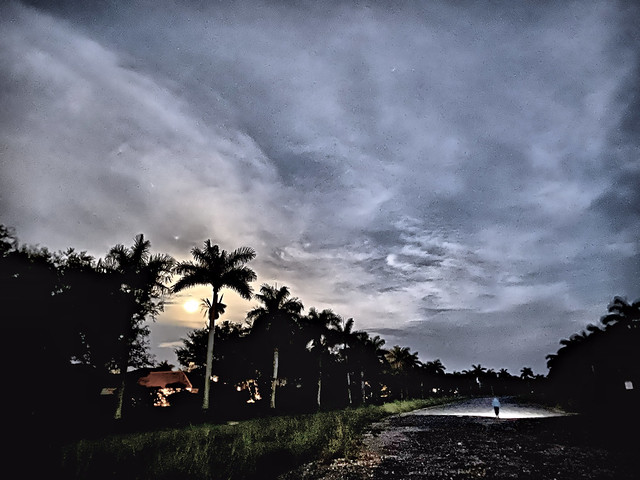
Buck Moon setting 0554AM 20200705

However, this was our last look as the Moon disappeared, almost an hour before setting:

Buck Moon setting 0611 AM 20200705

Appropriately, on July 5, this young White-tailed Buck showed his emerging velvet antlers:

White-tail spike buck in velvet 02-20200704

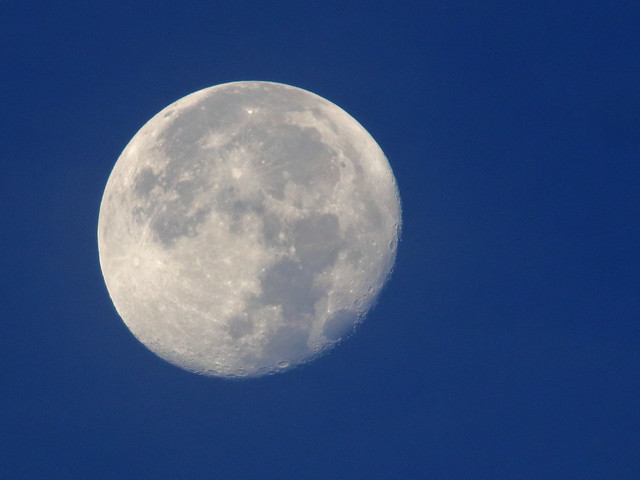
The next morning the Buck Moon was one day old in a hazy sky:

Buck Moon 1 day old 20200706

 It was 2 days old on July 7:


Buck Moon 2 days old 20200707


The first two mornings after a full Moon provide opportunities for superimposed images. I have found it impossible to get both a bird and the Moon in clear focus. This female Boat-tailed Grackle posed long enough for me to get a few shots:

Boat-tailed Grackle and Buck Moon COREL 05-20200706 

For the past two weeks, while walking out along the grassy edge of the gravel road, we startled a Killdeer which flew up in the dark and called excitedly. We assumed that it had a nest nearby in the grass. 

One morning the Killdeer confronted me as I walked towards it, fluffing up its feathers and refusing to fly from a spot out on the open path. (I almost said "her," but the Killdeer pair exchanges incubating duties. The male is more likely to spend the night on the eggs than the female). 

I trained my flashlight on it and snapped a poor photo. To my surprise, an egg protruded out from underneath the bird:

Killdeer on nest 01-20200627 

On the way back, the Killdeer flew off as soon as it saw me. Without getting too close, I could see that the nest held four eggs:
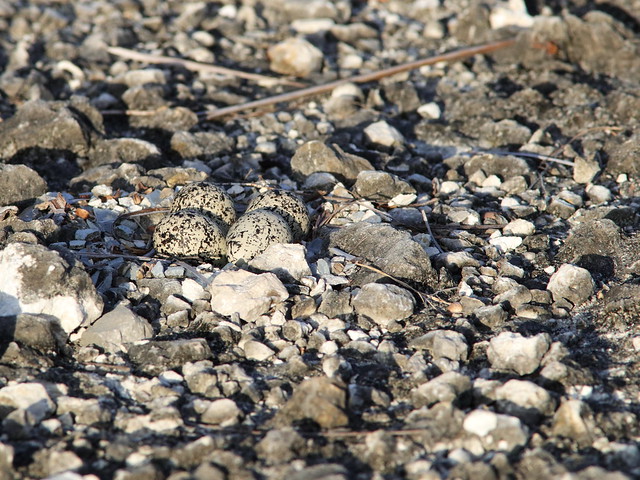

Killdeer nest 20200702

The "nest" is actually a slight depression surrounded by many small whitish objects-- pebbles, shells, even pottery chips which are added continuously all during the ~25 day incubation period. They form an irregular pattern which may help conceal the nest:

Killdeer nest 01-20200628

Yesterday morning (July 8) as I walked in I avoided the nest area as usual and checked it on my way home. It is out in the open, away from the grassy area. Even in good light it is hard to find the nest and I use visual clues such as lining up the trunks of certain trees when I am standing on a particular stone which is directly across the road from the nest. 

I was surprised to find it contained three babies, three egg shells and one apparently intact egg. One of the chicks had just hatched and was still wet.  "Where's Waldo?" Can you see the nest with its chicks and eggs? (Look for it before reading the answer under the photo -- click to enlarge):  

Killdeer chicks and egg 05-20200708

See the three chicks and one unhatched egg in the upper left quarter of the above photo, just to the left of the biggest white stone? 

Even when viewed closer up, the nest and its contents blend in with the surroundings:

Killdeer chicks and egg 03-20200708

One chick is on left of the intact egg and two are on the right. Hard to see the third chick, which is still wet. It has either hatched or is in the process. Its head and part of its eye are visible behind the head of the older "dry" chick:

Killdeer chicks and egg 04-20200708

This is the vacant Killdeer nest on the morning of July 9th. Quite a remarkable collection of small whitish objects:
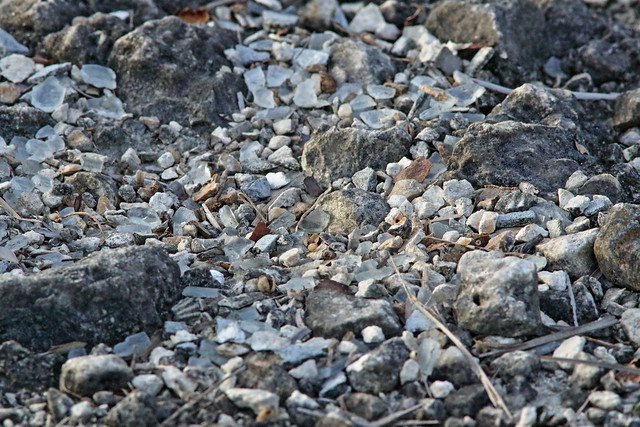
Killdeer nest 20200709

Adult Killdeer (July 1):

Killdeer 3-20200701

Afternoon thunderstorms often cooled us down a bit. This one, on July 7, blocked the rising sun but stayed out over the ocean:

Storm brewing 3-20200707

I exercised my "creative license" to get both subjects in sharp focus in this composite (aka "Fake") image :

Bald Eagle Buck Moon composite 20200706


= = =  = = =  = = = =  = = = = =

Linking to:

Fences Around the World

Skywatch Friday

Weekend Reflections

Saturday's Critters

BirdD'Pot

Camera Critters

All Seasons

Wordless Wednesday (on Tuesday)

Natasha Musing

Our World Tuesday


________________________________________________

Please visit the links to all these posts to see some excellent photos on display
_______________________________________________

Thursday, July 2, 2020

Crops & Clips: Flashback to July, 2017

At the beginning of each month I enjoy looking back at photos from three years previously, to refresh old memories and perhaps anticipate what beauty awaits this year. Especially, I look for favorite dreams, memes and themes-- critters of all kinds (especially birds and butterflies), flowers, clouds, skies, reflections, fences... and images which speak for themselves. This month's harvest makes me miss our summers in Illinois (or anywhere besides being locked down at home).

We spent the entire month of July at our (then) second home in northeastern Illinois. We watched our favorite grassland birds, and mourned the continuing loss of  their habitat. A family of Sandhill Cranes climbed on a pile of dirt where their prairie home was being converted into a housing complex. An unruly blackbird added to their discomfort, but only the colt paid attention to the attacker:

Sandhill Crane adults and colt 20170702 

A Lark Sparrow perched on a sign advertising a home site. These birds had not been verified as nesting in Kane County until MaryLou first sighted them and we saw their fledgling. Later the nest was discovered and photographed by others. This entire area was staked out for development:

 Lark Sparrow 02-20170707

Documentation photo of young Lark Sparrow being fed by parent:

Lark Sparrow juvenile and adult 01-20170710

Lark Sparrow juvenile fed by adult SHARP 04-20170710

We visited Nelson Lake preserve as often as possible. This is a path through the prairie:

Nelson Lake north entrance 20170727

Wildflowers were abundant. These are Purple Coneflowers:

Purple Coneflowers 20170711

That's MaryLou beyond the mass of wildflowers:

Wildflowers and MaryLou 20170714

Cedar Waxwing on a sapling in the prairie at Nelson Lake preserve:

Cedar Waxwing 20170707

The diminutive Henslow's Sparrow finds refuge here, where controlled burns are rotated to provide its exacting habitat needs. It usually nests two years after a fire, in the layer of dry grass which is packed down by the second winter's snow. They have greenish heads and are tiny and elusive:

Henslow's Sparrow 02-20170725

Henslow's Sparrow portrait 094-20170725

Other small sparrows which nest more widely at Nelson's Lake are the Grasshopper Sparrow...

Grasshopper Sparrow 02-20170724

...Savannah Sparrow...

Savannah Sparrow 04-20170723

...and the rather plain-looking Field Sparrow which has a pink bill:

 Field Sparrow 01-20170709

Dickcissels were abundant. This pair were tending a nest and the female was waiting for me to depart before delivering a meal for their chick:

Dickcissel male and female 02-20170702

Male Dickcissel:

Dickcissel 02-20170714

American Goldfinches brightened the scene:

American Goldfinch 02-20170709

American Goldfinch 08-20170728

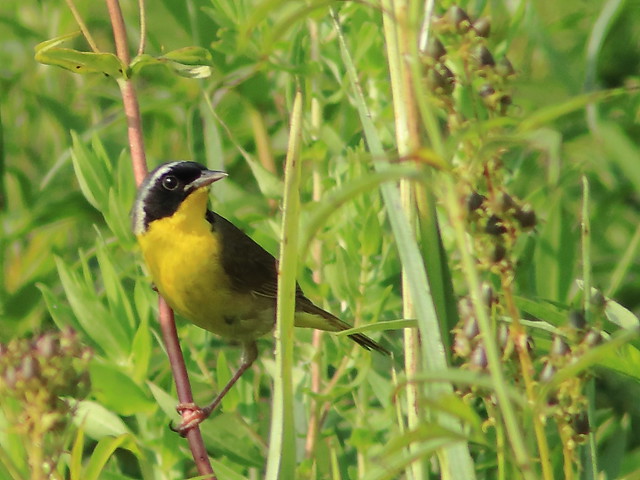
Common Yellowthroats sang along the trail:

Common Yellowthroat 04-20170727

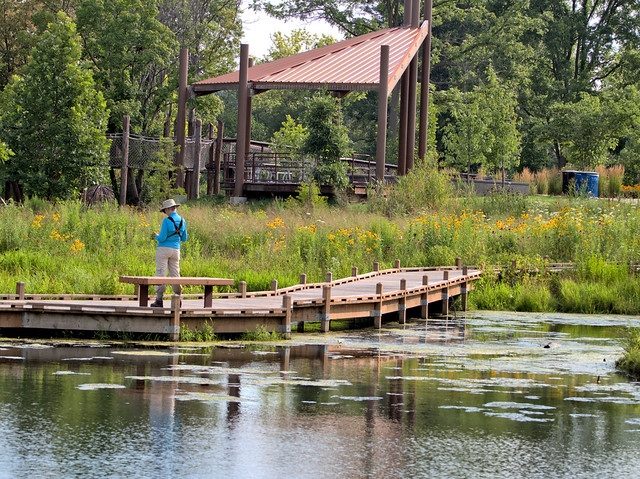
The boardwalk and pavilion at Lippold Park:

Lippold Park pavillion 20170728

Mallards preening:

Mallards 20170711

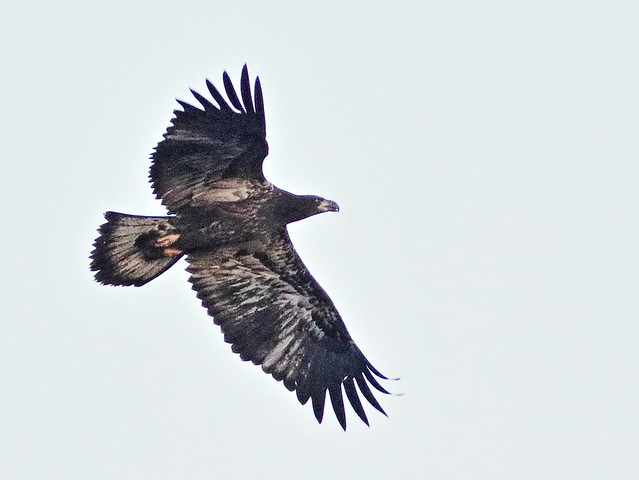
We checked the Bald Eagle nest near our condo. The two juveniles had fledged, and one flew by:

Bald Eagle juvenile 02-20170701

One of the parents stood guard:

Bald Eagle 05-20170701

Fox River floodplain:

Fox River flood plain 03-20170724

Common Buckeye butterfly:

Common Buckeye butterfly 20170721

American Lady butterfly:

American Lady NOT Painted Lady butterfly 02-20170724

A Painted Lady "attacked" me:

Painted Lady butterfly 05-20170725

Agramonte, our Granddaughters' beloved Tibetan Mastiff, now 13 1/2 years old, is not doing well this year. He can barely climb the stairs. The girls hold out hope but must face the fact that he is failing. Three years ago he was sleeping on the cool floor as usual:

Agramonte 20170730


= = =  = = =  = = = =  = = = = =

Linking to:

Fences Around the World

Skywatch Friday

Weekend Reflections

Saturday's Critters

BirdD'Pot

Camera Critters

All Seasons

Wordless Wednesday (on Tuesday)

Our World Tuesday


________________________________________________

Please visit the links to all these posts to see some excellent photos on display
________________________________________________