Showing posts with label Eastern Screech-Owl. Show all posts

Thursday, May 20, 2021

Early morning birding Lagniappe

The excitement of spring migration and the drama surrounding the successful rescue of both the eaglets has subsided, but routine morning walks sometimes offer a little something extra.

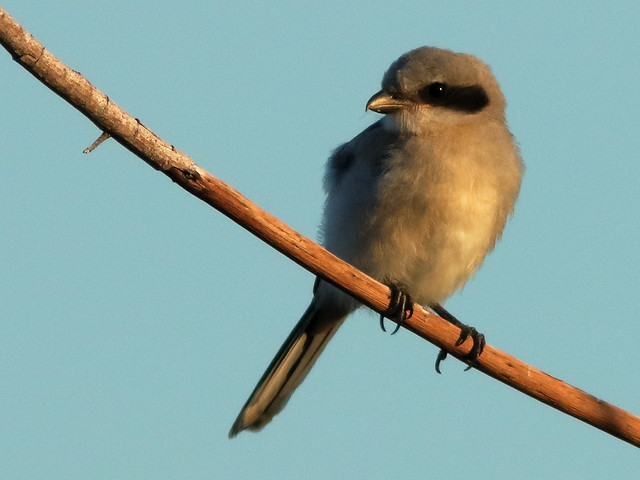
An adult Loggerhead Shrike caught a dragonfly and fed it to a youngster:

The cute baby shrike:
A Red-winged Blackbird attacked a Fish Crow:

An Eastern Screech-Owl settled close by and posed nicely:

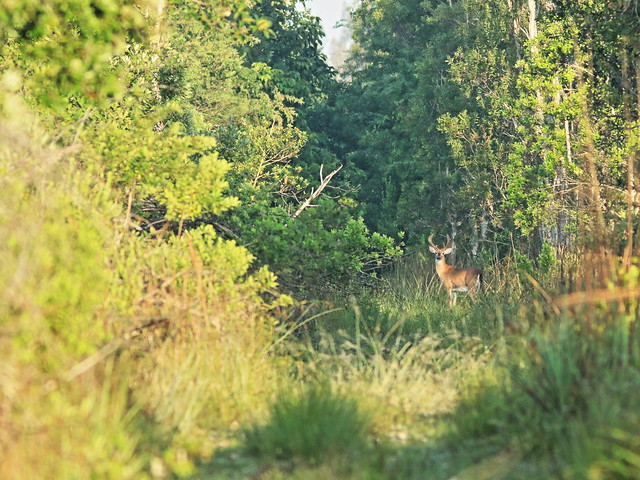
Out on the Bar Ditch Trail, a White-tailed buck with antlers in velvet watched me as I walked along at sunrise:

More than 50 White Ibises flew over in a loose "V" formation:

A Green Heron crouched low in the ditch as I passed by. If it had not moved a bit, I would never have seen it:

Common Ground Doves have been uncommon and even missing the past couple of months, but three suddenly showed up this week. Only one male posed for a photo:

Least Terns usually arrived in early April, courted and then brought their young to our lake, but none appeared this year. Many of the urban terns nest on flat gravel roofs such as that on the supermarket about a mile away. These roofs last about 30 years and many are being replaced with more modern technology involving insulated panels and an impermeable membrane, not friendly to the terns (as well as nighthawks, Killdeer and gulls)  This week I was surprised to briefly see my first and only Least Tern:

A Black-necked Stilt lingered at nearby Chapel Trail preserve:

A female Northern Cardinal carried sticks to a hidden nest:

A Tricolored Heron foraged at the edge of the lake in our back yard. They usually are very shy, but this one provided some nice views:

Water levels in the wetland lake have reached the season's low and the water is receding from the lakeside marsh. This photo was taken ten minutes before sunrise:
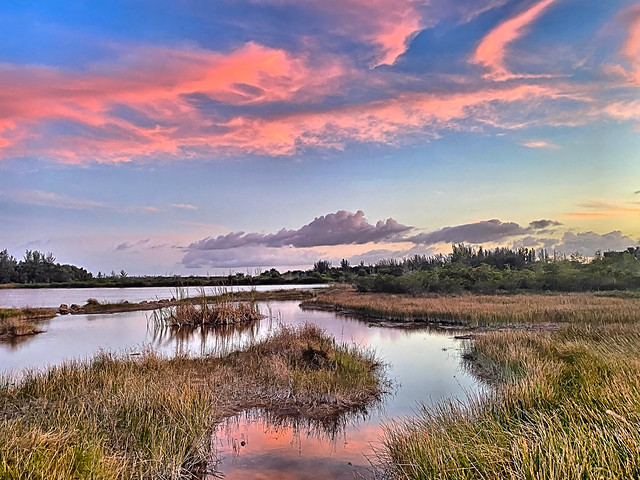
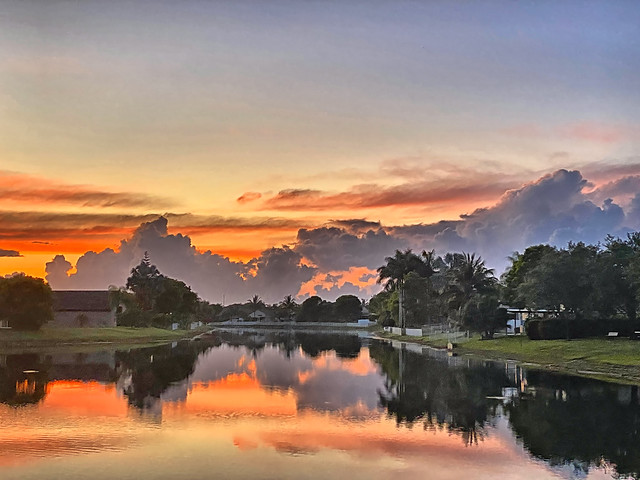
At sunrise, the sheltered water behind an old levee reflects a colorful sky:
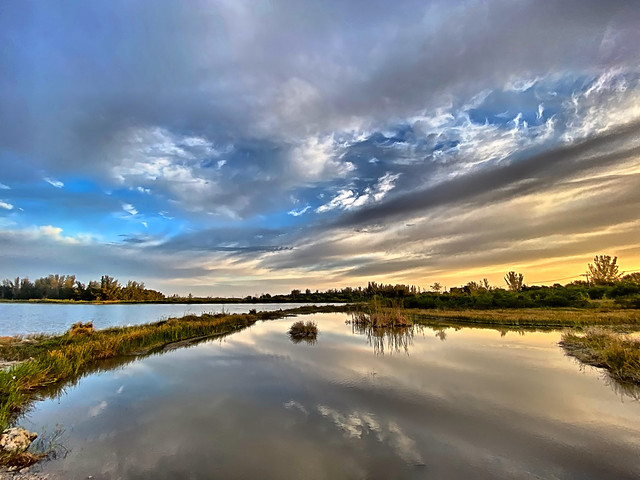
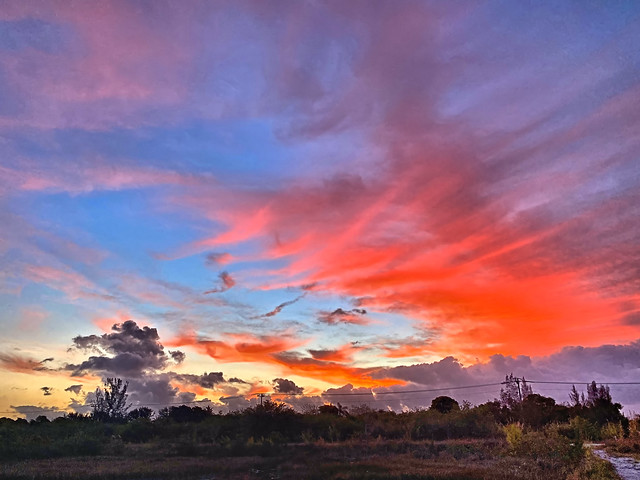
The rainy season is starting early. The official start of hurricane season his being moved earlier, to May 15 instead of June 1.  On May 18, the sun rose behind storms moving in from The Bahamas:


Our children started school when we lived in New Orleans and learned about "Lagniappe"---  

A lagniappe (lan-Yap) is an old Louisiana tradition, especially in the French Quarter of New Orleans... The word lagniappe might be applied to any unexpected bonus that comes with something else. For example, if you bought a car and found a 50 dollar bill in the trunk, it would be a lagniappe (Wikipedia).

= = =  = = =  = = = =  = = = = =

Linking to:


Skywatch Friday

Weekend Reflections

Saturday's Critters

BirdD'Pot

Camera Critters

All Seasons

Wordless Wednesday (on Tuesday)

Natasha Musing

Our World Tuesday

________________________________________________

Please visit the links to all these posts to see some excellent photos on display
________________________________________________

Thursday, May 13, 2021

Second Eaglet Rescued - The value of having many eyes on the eagles #963

This is a follow-up to the events described in my earlier post: EAGLETS DOWN

After the failure of the rescue crew to locate the second downed eagle on Wednesday, April 28, our hopes were dashed. We watched for the adults and listened for any eaglet calls. Volunteers heard no sound of an eaglet during multiple visits on Thursday and Friday. Then, late on Saturday) afternoon, May 1, Richard stopped by on his bicycle and heard a call which he recorded and then confirmed as indeed the cry of an eaglet. Phil notified Florida Fish and Wildlife Conservation Commission (FWC) and arranged to meet an officer at the nest in the morning.

I arrived at the eagle nest on Sunday morning at 6:50 AM, just after sunrise. At first all was quiet, but at about 7:10 AM there were the distinct calls of an eaglet from an area very close to the sidewalk and a short distance east of the nest tree. With other watchers, we heard over a dozen eaglet cries before the arrival of FWC, at about 8:15 AM.

Phil and the FWC Officer entered the woodland and searched through the tangle of fallen trees for over two hours. Probably because the eaglet was startled by the presence of the rescuers, it fell silent, calling only about twice but never near enough for Phil and the Officer to determine its location. Then at about 10:45 AM they finally felt that, because of the  nearly impenetrable undergrowth and tangle of fallen trees left by Hurricane Irma, it was necessary to suspend the search.

The FWC Officer was just preparing to depart when Richard looked into a break in the foliage and said he could see the eaglet! I waved down the Officer just as he was departing. It was amazing because I found it almost impossible to see the eaglet in the dark and dense forest floor. Richard did his best to point it out, saying, "Look for its yellow feet." That did it and I got partial views of the eaglet standing tall on a fallen log, only about 20 yards from our position at the edge of the woodlands. 


We watched as the Officer, carrying a large net, got within a yard or so from the eaglet. It suddenly ran into a hole between the limbs of the fallen tree. It was crouched down and quite inaccessible. Phil and his wife Mary joined the FWS Officer in trying to access the eaglet. They brought some fish, in case it might entice the hungry bird to come out into the open.

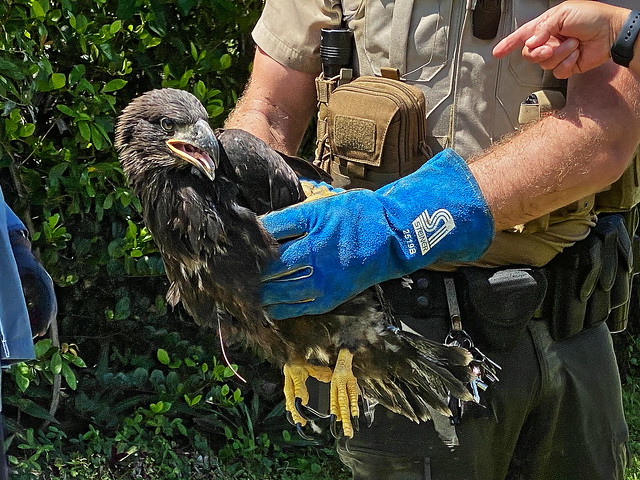
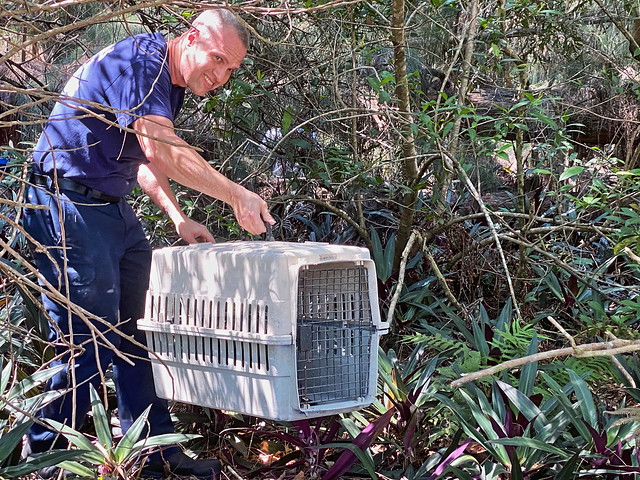
Pembroke Pines Fire & Rescue then arrived with longer poles and a chain saw. The latter was not needed as the eaglet responded to gentle probing by moving to a spot where is was finally captured. 


It was brought to a local wildlife rehabilitation facility for examination and treatment as necessary. Except for mild anemia and hookworm infestation, it was hungry but uninjured. 

Kudos to volunteers Phil and Mary for being part of the exhausting search effort. Richard was doubly a hero for this eaglet. By hearing and reporting its presence the night before, he renewed the search. To top it off, it was Richard who spotted the eaglet just before the search would have again been suspended.

As we were listening for the eaglet to betray its presence, an Eastern Screech-Owl looked out of its nest from a woodpecker hole in a dead palm tree in front of the abandoned nest. The adult appeared first:

Then, a downy juvenile peered out:


The eagles have kept me so busy that I got behind in processing my photos. After losing a couple of days worth of pictures from our visit to Illinois, we did get out one day to local parks. I also clicked a few shots while relaxing on our daughter's back deck. Here are some backyard birds framed by the bars of their iron fence.

Northern Cardinal:


Red-winged Blackbird:

Brown-headed Cowbird at their feeder:

Back yard male House Finch singing:


At nearby Jones Meadow Park, a pair of Canada Geese tended to five goslings:


A demure Field Sparrow at Nelson Lake:

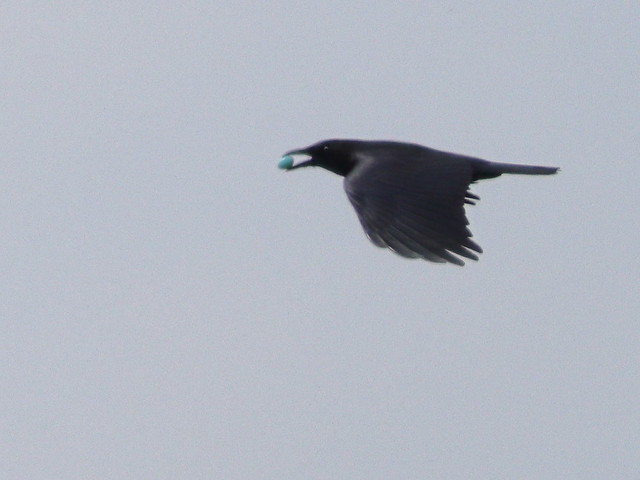
An American Crow carried a stolen robin's egg:

At home in Florida, view from the back patio before sunrise on May 11:

A fish disturbed the surface of the lake:


Later, on our morning walk, I found last year's antler of a young buck, the first I have ever found:


Near where I found the antler, a young white-tailed buck in velvet walked out into the open and stared at me from a distance. Could this have been the one who donated the antler?:


= = =  = = =  = = = =  = = = = =

Linking to:

Fences Around the World

Nature Thursday

Skywatch Friday

Weekend Reflections

Saturday's Critters

BirdD'Pot

Camera Critters

All Seasons

Wordless Wednesday (on Tuesday)

Natasha Musing

Our World Tuesday

________________________________________________

Please visit the links to all these posts to see some excellent photos on display
________________________________________________

Thursday, September 10, 2020

Beauty is in the eye of the Barn Owl

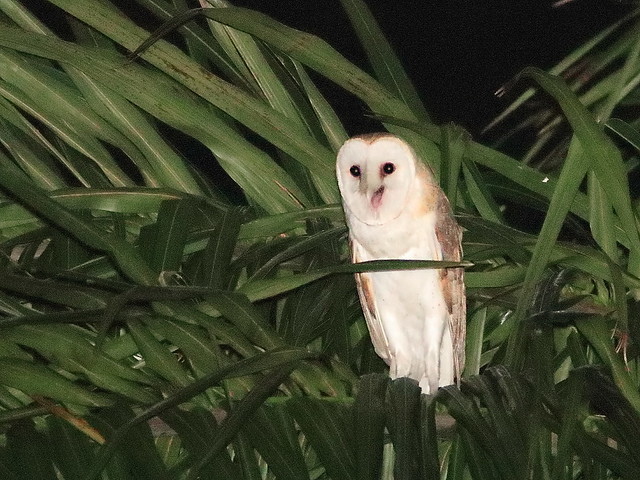
I first encountered a Barn Owl in our local wetlands preserve in 2015, when I saw one on the top of a dead Royal Palm along the gravel entry path. That tree was subsequently removed and replaced by another which also died.  

According to Cornell University's global eBird database, this species has never before been reported to breed anywhere in southern Broward County. The nearest historical sightings occurred in undeveloped areas in Miami-Dade County about 4 miles / 6.4 kilometers to the south.and in Broward County 10.5 miles / 17 kilometers to the north. I never saw another until I photographed one in flight near this location in February, 2019.

Since then they have been present consistently. These are earlier photos:

Barn Owl 02-20200408

Barn Owl 03-20200408

Here is the topless palm tree in an undeveloped spot where I first saw a Barn Owl, in August, 2015:

Palm trunk Barn Owl roost 20150811

Although I never saw them again until 2019, I was encouraged when I found this wing feather in October, 2018, very close to the old tree:

Barn Owl wing feather 20181009

I suspected that they may have been nesting on the top of another Royal Palm behind a home across the gravel road. This tree had also died and lost its foliage. I heard and recorded a young owl nearby only a few weeks ago (Link to eBird checklist)

This species nests all year round. This week there were two Barn Owls occupying the top of this second tree, too dark for my camera, so here is the daytime view (along with our neighbor's  regulation-compliant fence):


Barn Owl nest tree 01-20200830

Our homeowners association contracts with landscapers to maintain the area along the berm where the nest tree is located.  Many people cannot stand the sight of an old dead tree and I feared they may be planning to remove and replace it with a more "fitting" representative of our refined community. The Barn Owl does not see it this way.

Therefore, I worked with the homeowners association on a plan to to protect the nest tree. A pair of Barn Owls and their brood can eat as many as 3,000 rodents in a single nesting season, so they are much more efficient than a pest control company. While they are protected by the Federal Migratory Bird Treaty Act and they are the least numerous among Florida's 5 owl species, they are not threatened or endangered. 

Happy to say that my mobility and energy have vastly improved since starting on Prednisone. MaryLou and I have been out about an hour before sunrise almost every morning. We arranged for Juan, a fellow birder to meet us on the way in and he was treated to seeing both Barn Owls as they emerged from the palm trunk and flew overhead, their pure white undersides reflecting the glare of our flashlights.

As we were observing the Barn Owls we heard an Eastern Screech-Owl calling nearby. Juan located it and I obtained poor photos with the help of his flashlight:

Eastern Screech-Owl 01-20200829

Eastern Screech-Owl 03-20200829

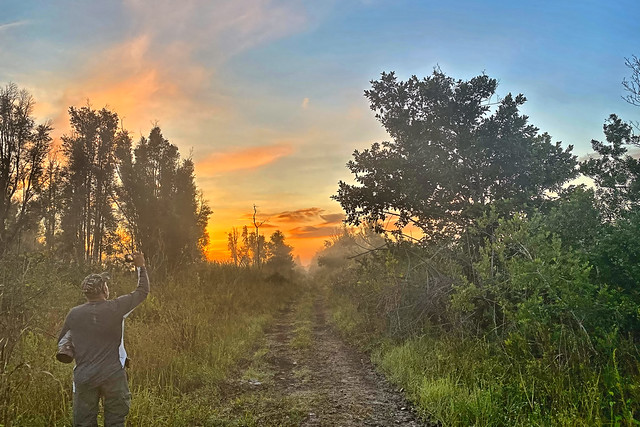
That day I logged over 10,000 steps for the first time in almost a month as we trekked into a more primitive area of the preserve on the Bar Ditch Trail. As we walked westward, Juan turned around to capture the rising sun:

Sunrise captured by Juan 20200829

Were it not for the sound of airplanes and distant traffic, we could have been lost, deep in the wilderness:

Bar Ditch Trail 05-20200829

A motley molting Blue Jay was missing his splendid head-dress:

Blue Jay molting 01-20200829

Later we spotted one almost completely feathered:

Blue Jay 20200825

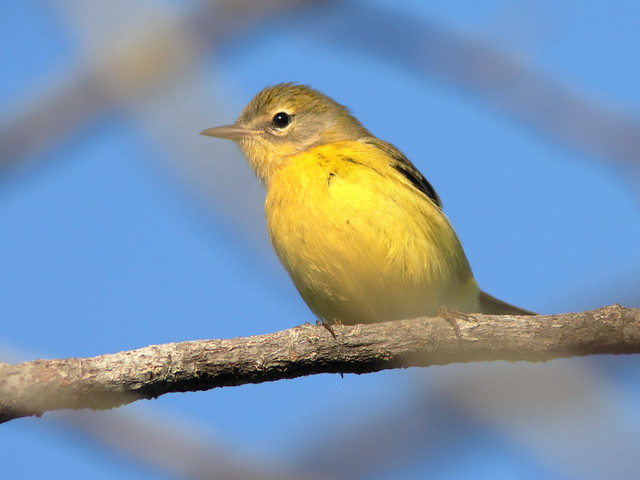
A female Prairie Warbler appeared against the blue sky:

Prairie Warbler 03-20200829

The male Prairie Warbler was partially obscured in the brush:

Prairie Warbler 02-20200829

Blue-gray Gnatcatchers flitted about actively:

Blue-gray Gnatcatcher 01-20200826

Northern Cardinals were numerous, a male...

Northern Cardinal 08-20200526

...and female posed for photos:

Northern Cardinal female  04-20200526

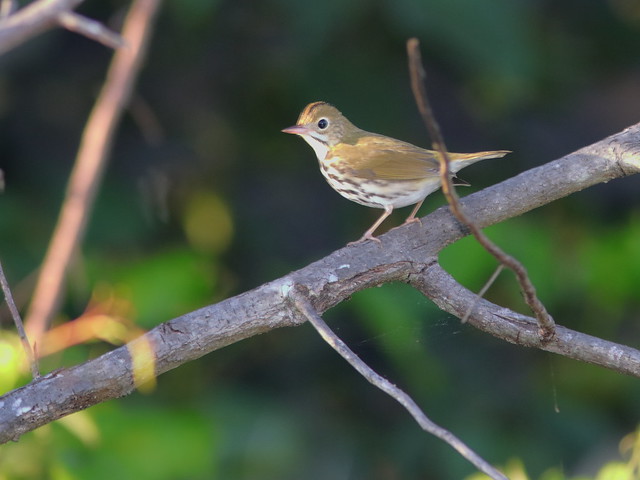
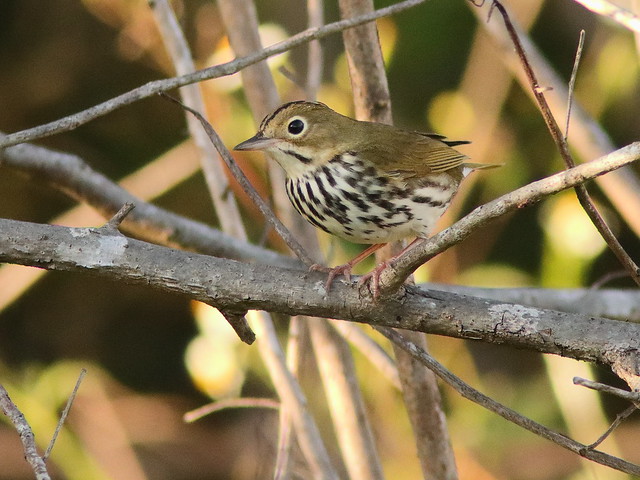
An Ovenbird appeared briefly:

Ovenbird 02-20200826

Ovenbird 01-20200826

There were fresh Bobcat tracks...

Bobcat print 01-20200826

...Raccoon hand-prints...

Raccoon prints 29299826

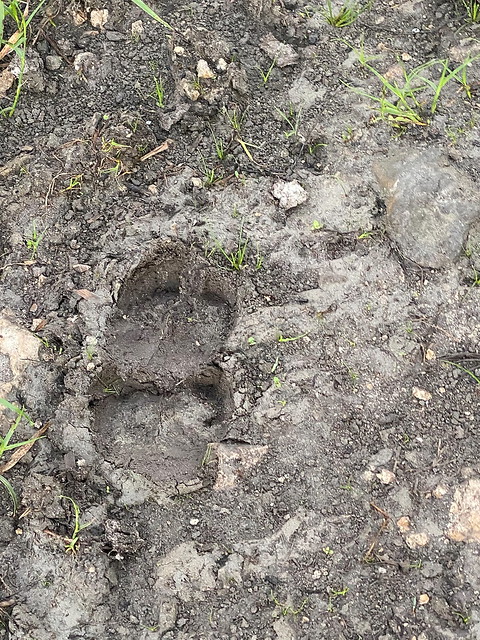
...and evidence of a large feral hog:

Feral hog print 20200826

A White-tailed Deer with deformed antlers stepped out into the path in front of us:

White-taled Deer one-horn buck 01-20200826

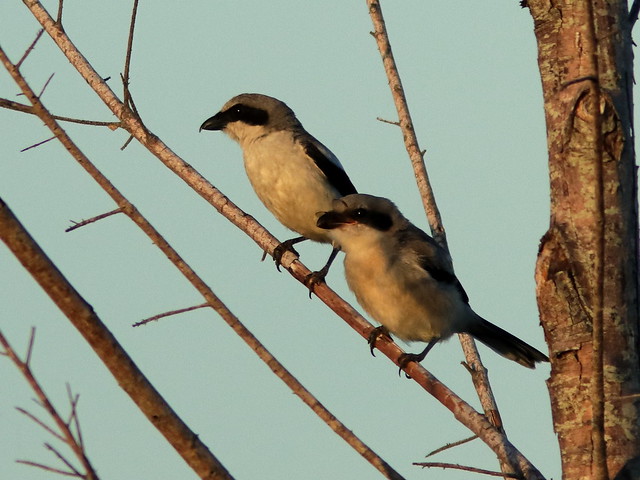
A pair of Loggerhead Shrikes rested together in a treetop:

Loggerhead Shrikes 2-20200825

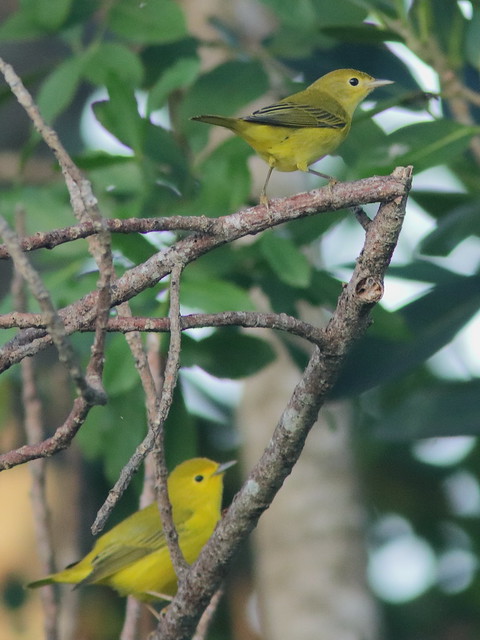
Two Yellow Warblers were passing through, southbound:

Yellow Warblers 01-20200818

Yellow Warbler 09-20200818

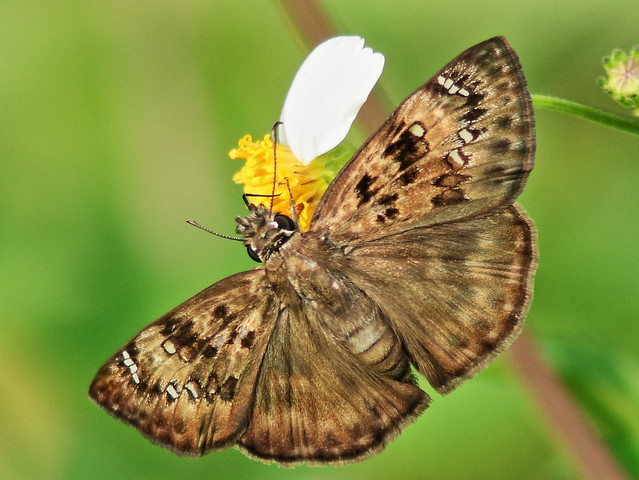
Among the insects, a richly patterned Horace's Duskywing...

Horace's Duskywing - Erynnis horatius 02-20200820

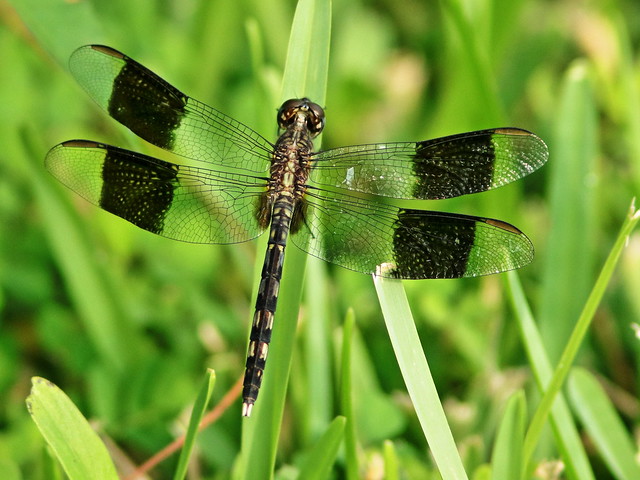
...and a Band-winged Dragonlet (Erythrodyplax umbrata):

Dragonfly 01-202008120

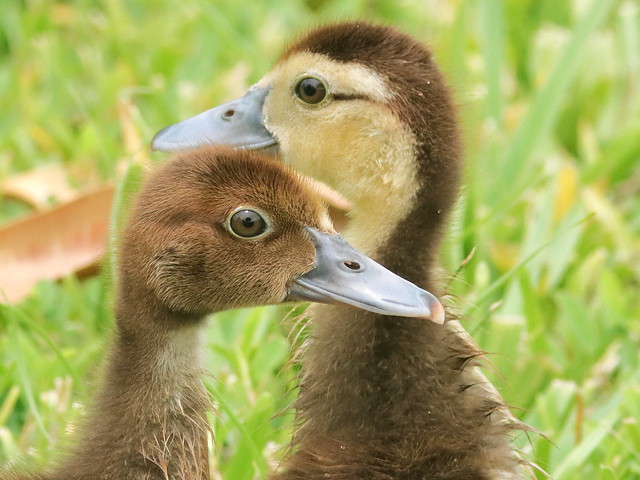
Back home and in seclusion, we enjoyed a visit from the mamma Muscovy Duck, who hatched out 15 ducklings in our back yard. She now was guarding the last four survivors of her brood. Turtles, bass, cats, herons and hawks are not kind to baby ducks:

Muscovy ducklings 02-20200819

Muscovy ducklings 03-20200819

Muscovy ducklings 04-20200819

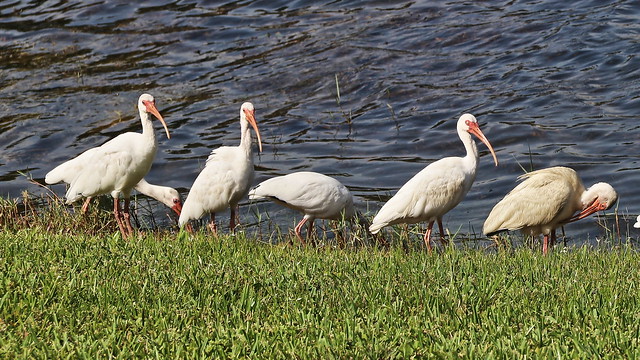
White Ibises gathered along the shore:

White Ibises 02-20200525

Opposite to the sunrise, the anti-solar rays reflected on dust blown in from the Sahara Desert and the shadows of clouds intersected over the Everglades:

Before sunrise 03-20200830

Morning sun touched the south wet prairie:

South wet prairie 20200831

Great Egret in morning light:

Great Egret 06-20200830

The egret cast a meager reflection on the breeze-dimpled lake surface:

Great Egret 05-20200830


= = =  = = =  = = = =  = = = = =

Linking to:

Fences Around the World

Skywatch Friday

Weekend Reflections

Saturday's Critters

BirdD'Pot

Camera Critters

All Seasons

Wordless Wednesday (on Tuesday)

Natasha Musing

Our World Tuesday


________________________________________________
Please visit the links to all these posts to see some excellent photos on display

________________________________________________