When I am out in the Wounded Wetlands of western Broward County, Florida, I do not have high expectations that some rare bird will suddenly brighten my day.
Actually, working a "patch" might seem boring, yet I have recorded ("officially" per eBird) 171 bird species here since I started regularly posting trip reports in October, 2009. All but a handful were also photographed on-site. A number of species were seen rarely or sometimes only once.
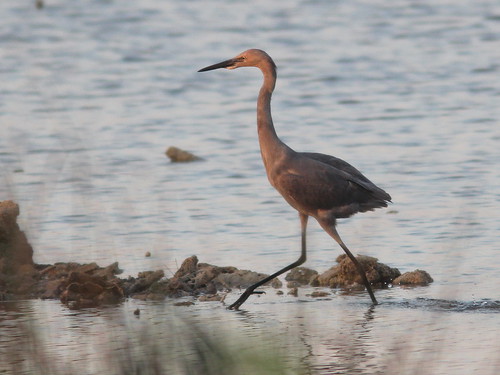
An immature Reddish Egret appeared in the spring of 2011 and remained for only two weeks. This species prefers brackish estuaries and rarely wanders inland:
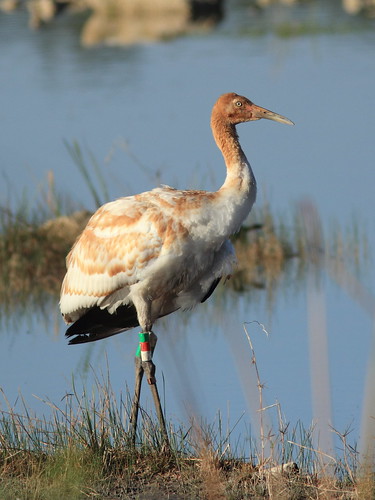
Another "one-off" species was actually represented by two captive-reared juvenile Whooping Cranes from Wisconsin which overshot their normal wintering grounds in northern Florida:
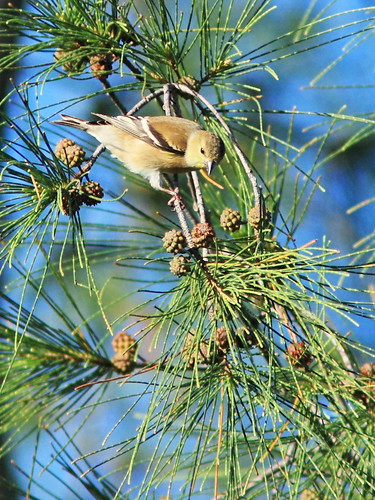
A flock of 15 American Goldfinches, a species which winters in south Florida irregularly, arrived once on December 9, 2015 and departed the same day:
To date I have submitted a total of 1,307 eBird checklists, of which 860 have been from my local patch, a hotspot officially known as the West Miramar Water Conservation Area (WCA). My eBird West Miramar WCA Life List
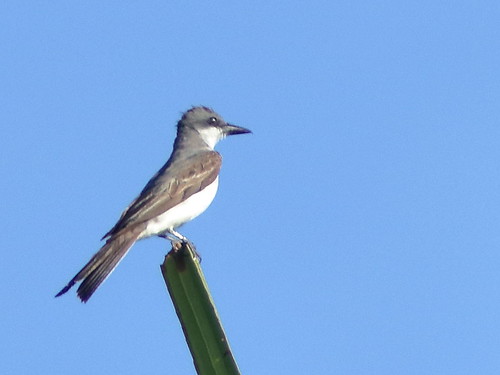
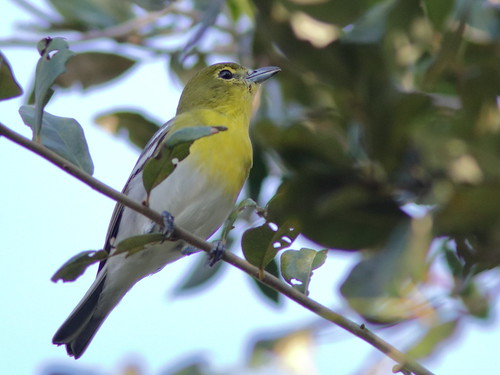
New additions to the list have decreased over time. I had seen a total of 80 species by the end of 2010, added 27 more in 2011, 13 in 2012, 14 in 2013. 8 in 2014, 15 in 2015, 6 in 2016, 3 in 2017, and only four species (Gray Kingbird, Royal Tern, Chipping Sparrow and Yellow-throated Vireo) this year to date. ADDENDUM (December 13) Only an hour after posting this I added a fifth new species at 6:30 AM, when we heard an Eastern Whip-poor-will calling just as we started our walk!
Am I succumbing to the Law of Diminishing Returns? Is the "gain not worth the pain?" Time to quit and stop wasting energy?
Gray Kingbird (August 23, 2018):
Yellow-throated Vireo (November 23, 2018):
 If my walks were only about counting birds I might certainly get bored. More importantly, they are a time to observe and enjoy the beauty and mystery of nature.
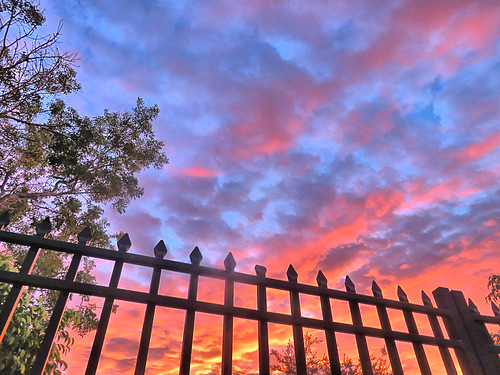
No two sunrises are alike... Pink clouds and fog on November 25, 2018:
If my walks were only about counting birds I might certainly get bored. More importantly, they are a time to observe and enjoy the beauty and mystery of nature.
No two sunrises are alike... Pink clouds and fog on November 25, 2018:
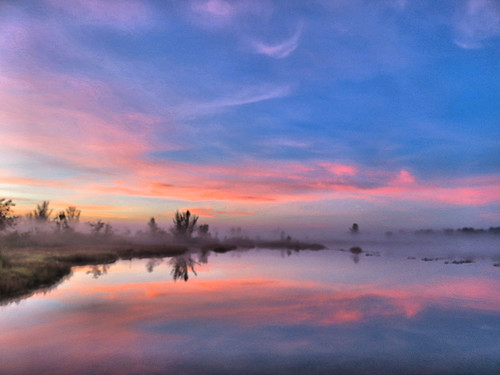 An unsettled sky a half hour before sunrise on December 5, 2018:
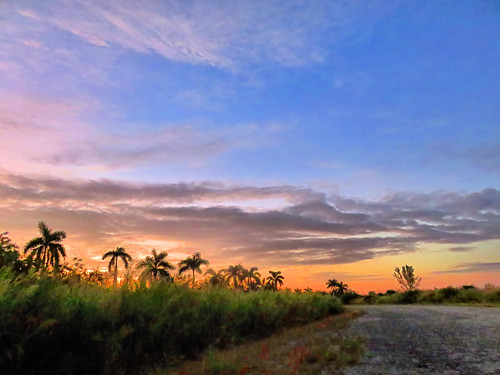 Sun rising behind the east gate to our patch (November 29, 2018):
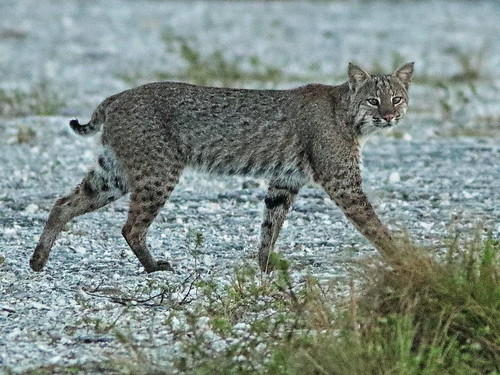
 Behaviors are interesting and sometimes unexpected. There is the thrill of the sudden appearance of a Bobcat, deer or even a Coyote...
Male Bobcat on November 19, 2018:
Behaviors are interesting and sometimes unexpected. There is the thrill of the sudden appearance of a Bobcat, deer or even a Coyote...
Male Bobcat on November 19, 2018:
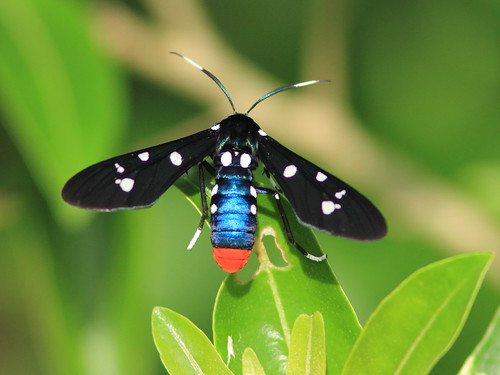
 ...and of finding beauty in the commonplace and the smallest of things.
Who would have known that there is a moth which resembles a wasp? Polka-Dot Wasp Moth-Syntomeida epilais:
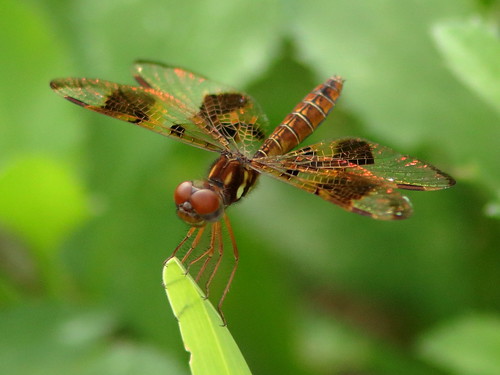
The smallest of our dragonflies also imitates a wasp, waving its wings slowly in a very menacing manner. Eastern Amberwing - Perithemis tenera:
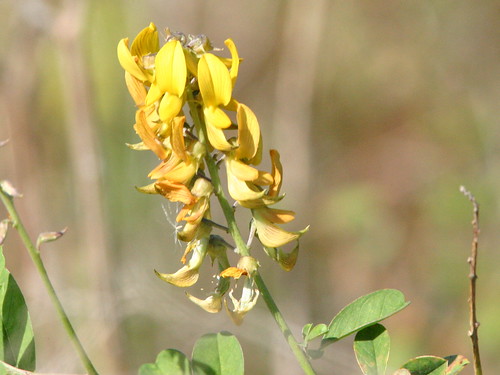
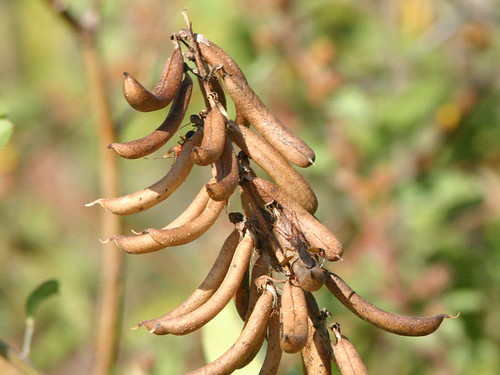
I bumped into a wild pea plant with seed pods which rattled with a sound like pebbles rolling in a paper cup. I learned that is is quite poisonous. Flowers and fruit of Smooth Rattlebox, Crotalaria pallida:
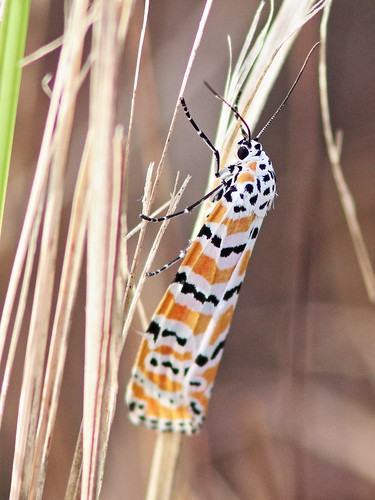
Later I found an unusually beautiful red patterned moth which requires that same plant to host its larvae, which themselves are protected by the noxious substances they ingest. Bella or Rattlebox Tiger Moth -Utetheisa bella:
 I admire the delicate beauty of the flowers of the Bent Alligator Flag, a plant related to members of the Arrowroot family: bananas, cannas and the Bird of Paradise. Their zig-zag stems reach up as high as 8 feet.
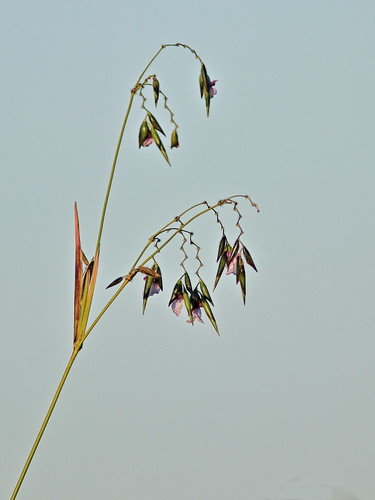
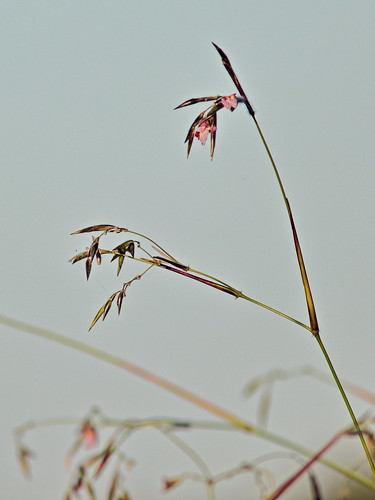 Tiny insects are lured to their blossoms and are momentarily trapped and dabbed with pollen before being released so they may cross-fertilize other flowers.
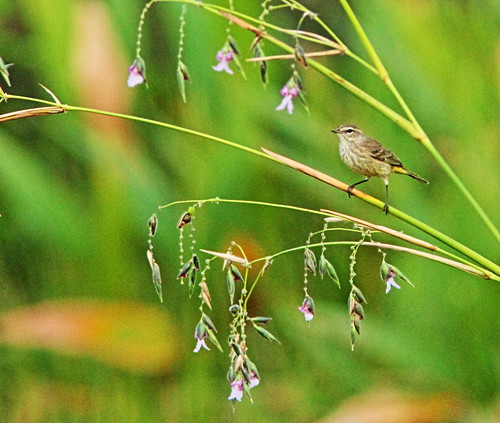
The insects attract Palm Warblers:
 Purple Gallinules eat the flowers and seeds:
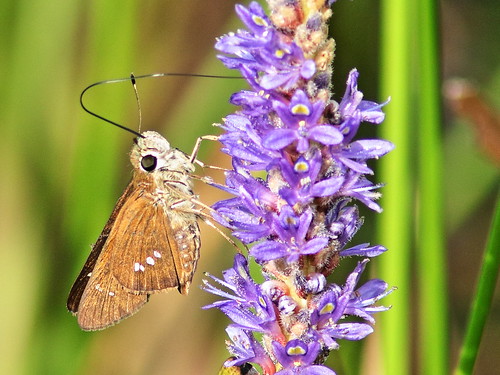
 I learned that this plant serves as host to a particular butterfly species, the Brazilian Skipper, whose leaf-rolling caterpillars also inflict great damage to cultivated cannas and other members of the Arrowroot family:
 = = = = = = = = = = = = = = =
Linking to Misty's CAMERA CRITTERS,
Linking to Eileen's SATURDAY'S CRITTERS,
Linking to SKYWATCH FRIDAY by Yogi, Sylvia and Sandy
Linking to WEEKEND REFLECTIONS by James
Linking to BirdD'Pot by Anni
Linking to Our World Tuesday by Lady Fi
Linking to Wild Bird Wednesday by Stewart
Linking to Wordless Wednesday (on Tuesday) by NC Sue
Linking to ALL SEASONS by Jesh
Linking to Fences Around the World by Gosia
________________________________________________
Please visit the links to all these memes to see some excellent photos on display
________________________________________________
Since I will be traveling this week, I quickly compiled some recent images from our daily early morning walks.
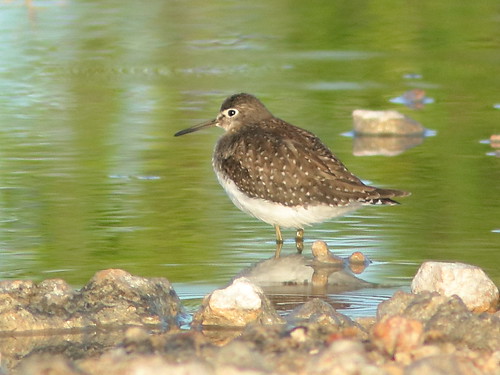
The first Solitary Sandpiper of the fall migration season appeared at the lake shore on August 28:
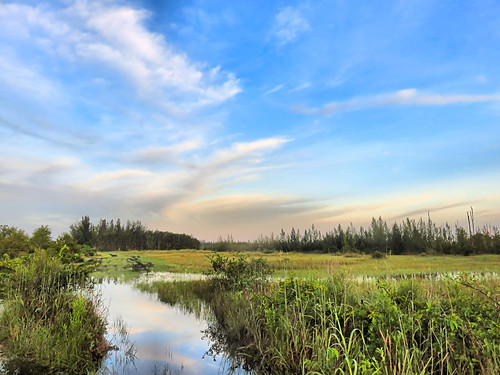
Frequent rains have raised the water level in the lake, discouraging the waders which prefer to explore the now-inundated mud flats along the shore. It has flooded into the wet prairie...
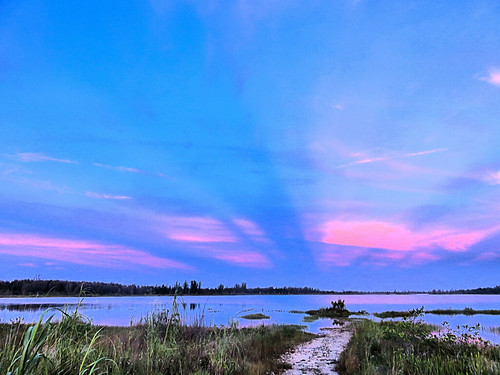
...and turned the "peninsula" into an "archipelago:"
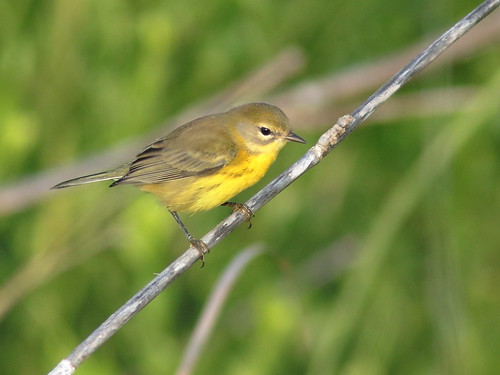
Among the other fall arrivals was this female Prairie Warbler:
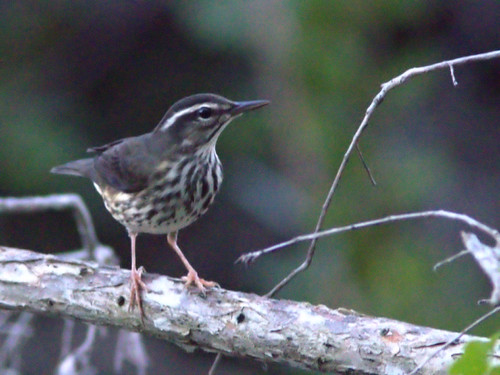
Another warbler, a less colorful Louisiana Waterthrush, was present for over a month:
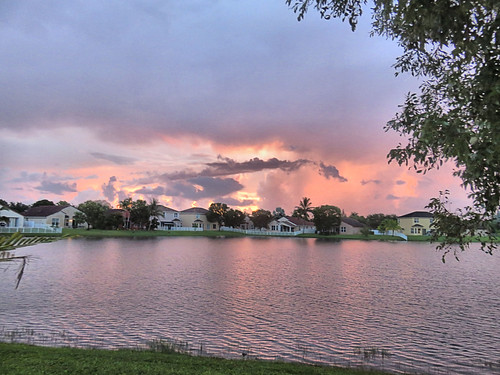
We canceled our walk one morning becaues of this view from our back patio. Storms were approaching from the east a half hour before sunrise:
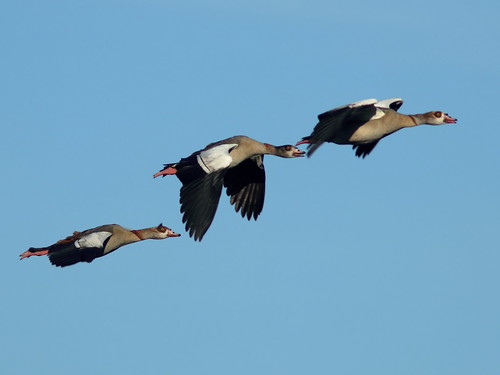
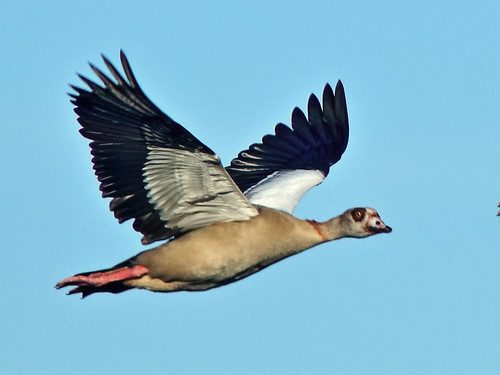
Part of a flock of six Egyptian Geese flying over the Wounded Wetlands:
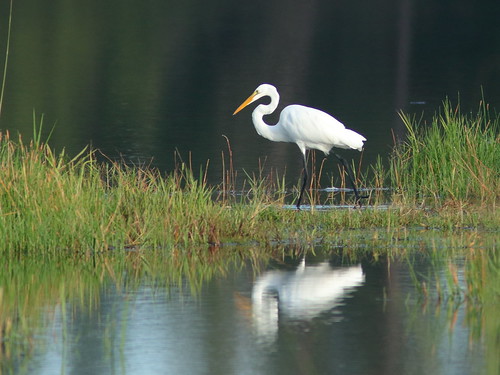
Calm winds and still waters provided nice reflections of this Great Egret:
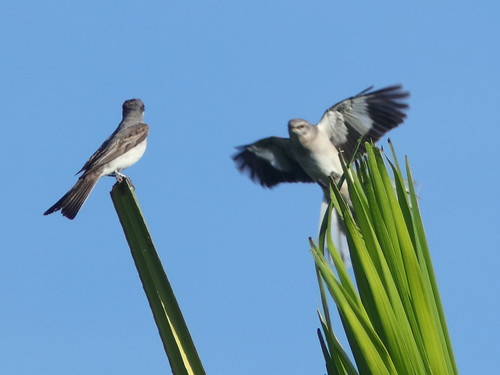
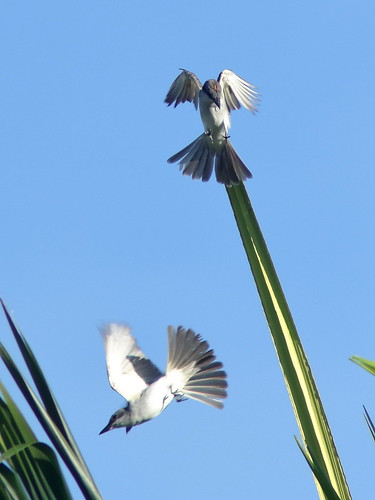
Although not an unusual sighting along the coast, these two Gray Kingbirds were the first I have ever seen in our local patch. They were engaged in a game of "king of the palm spire," competing for the highest roost along the path:
The kingbird ignores a Northern Mockingbird which also covets the perch:
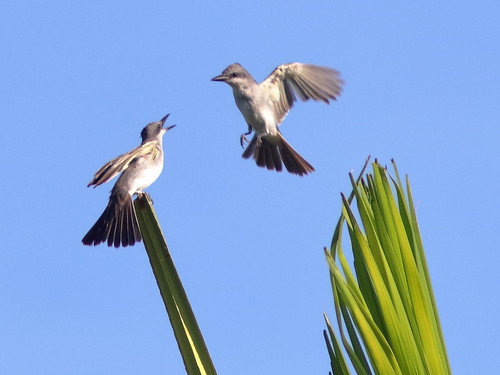
Another challenger arrives, a second Gray Kingbird:
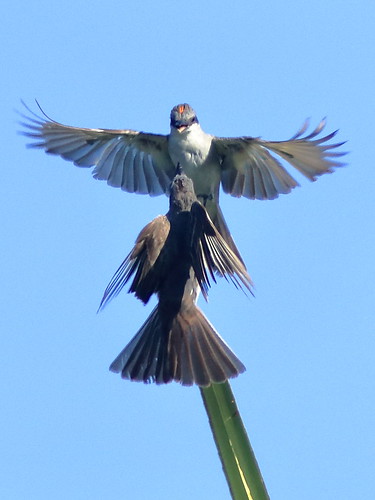
The confrontation (note the red crest of the attacker, usually hidden):
The king of the spire retreats, and a new victor occupies it:
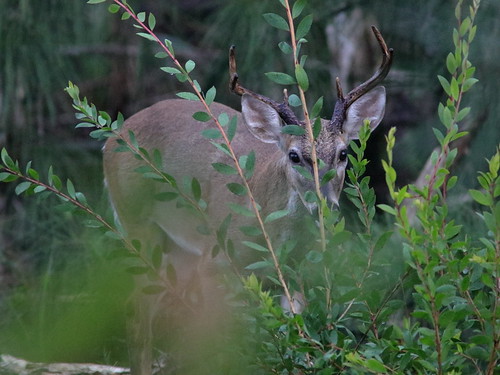
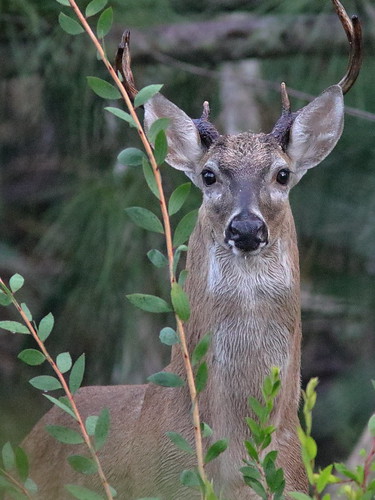
While I was photographing the waterthrush around sunrise, a White-tailed buck wandered in, unaware of my presence:
When I raised my camera, he bolted off:
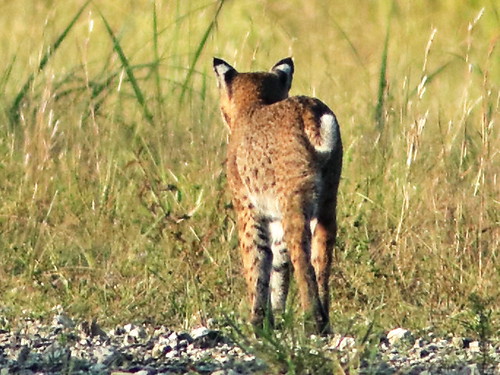
One day as I was walking back home, a female Bobcat strolled across the gravel road, saw me...
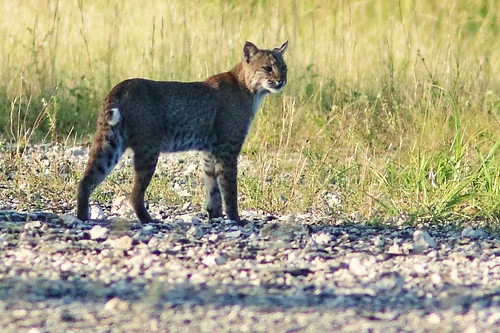
...and calmly retreated into the brush:
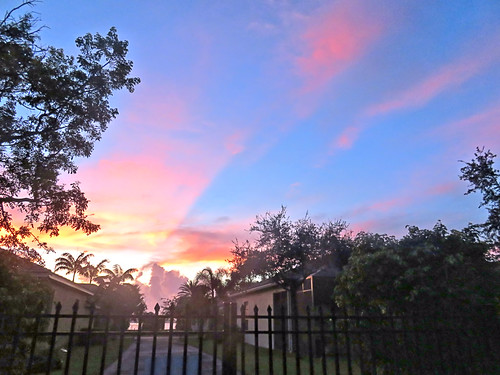
The path to the back gate of an adjacent subdivision is oriented exactly east-west. It serves as a convenient "sundial." The sun rises directly over the middle spire of the fence on the mornings of the equinoxes. It is gradually moving down from the left (north) to signal the beginning of autumn:
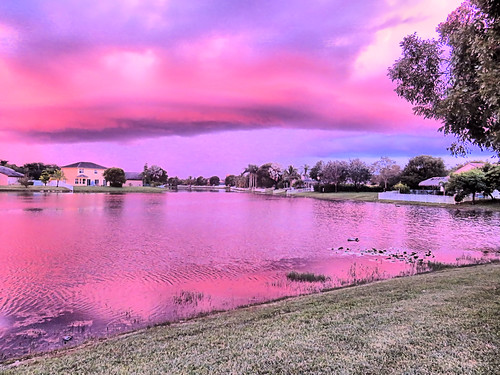
One evening the rays of the setting sun reflected on the clouds over our lake, seeming to turn the water blood red:
 A view of three cruise ships docked at Port Everglades as we departed:

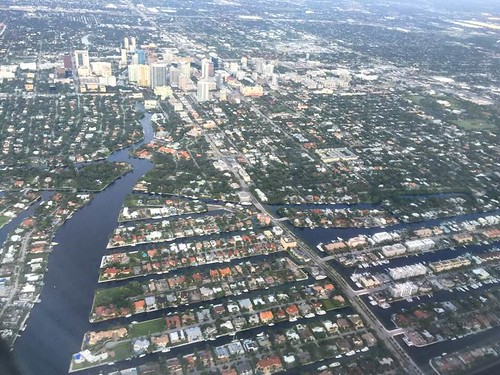
Downtown Fort Lauderdale:
 ________________________________________________
= = = = = = = = = = = = = = =
Linking to Misty's CAMERA CRITTERS,
Linking to Eileen's SATURDAY'S CRITTERS,
Linking to SKYWATCH FRIDAY by Yogi, Sylvia and Sandy
Linking to WEEKEND REFLECTIONS by James
Linking to BirdD'Pot by Anni
Linking to Our World Tuesday by Lady Fi
Linking to Wild Bird Wednesday by Stewart
Linking to Wordless Wednesday (on Tuesday) by NC Sue
Linking to ALL SEASONS by Jesh
Linking to Fences Around the World by Gosia
________________________________________________
Please visit the links to all these memes to see some excellent photos on display
________________________________________________
The weather in south Florida was particularly hot and humid this August. Normally we would have been at our second home in Illinois, where the temperature has not gone over 90 degrees (F) for over a month. However, our trip to Alaska and other conflicts changed our normal pattern. Some mornings we have found it nearly impossible to brave the mosquito swarms that appear when the prevailing winds blow in from the Everglades to our west. Yet, the past couple of weeks did provide some birding surprises.
We already described the first surprise, the appearance of the first "Great White Heron" subspecies of the Great Blue Heron on our lake. It continued to show up over a 9 day period, but as of this writing has not returned.
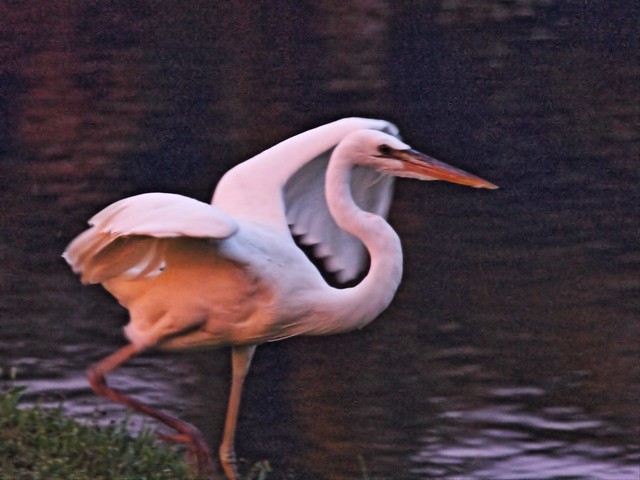
One evening the Great White Heron tarried in our back yard until a half hour after sunset. We thought it might spend the night. These photos, taken through the back patio window, are of poor quality but they capture the evening light and some nice poses as the heron engaged in some last-minute foraging along the lake margin.
.
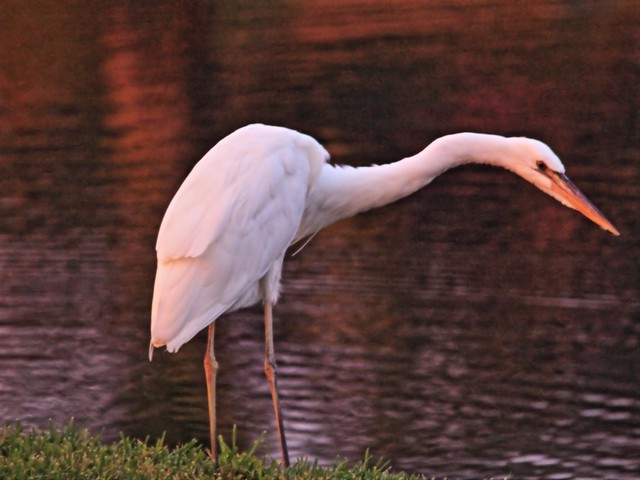
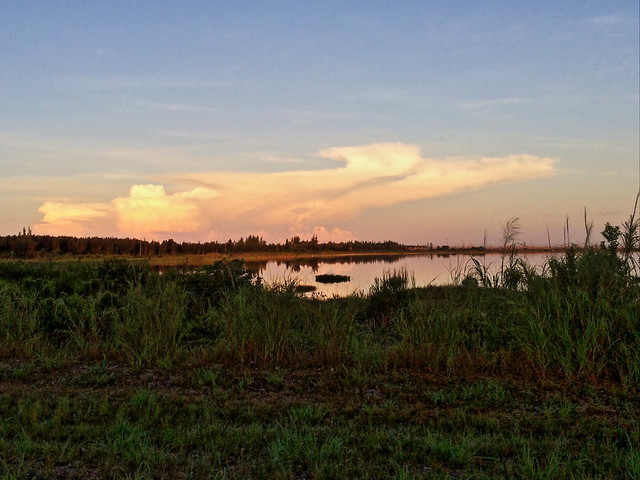
In mid-month the winds started moving in from the north, and we had several rain-free (and almost mosquito-free) mornings, allowing us to resume the habit of taking our mile walk on the gravel road into the wetlands next to our home. As usual, Mary Lou got way up ahead of me as I stopped to click a few sunrise shots.
The water level of Harbour Lake mitigation area was high, discouraging and dispersing waders.
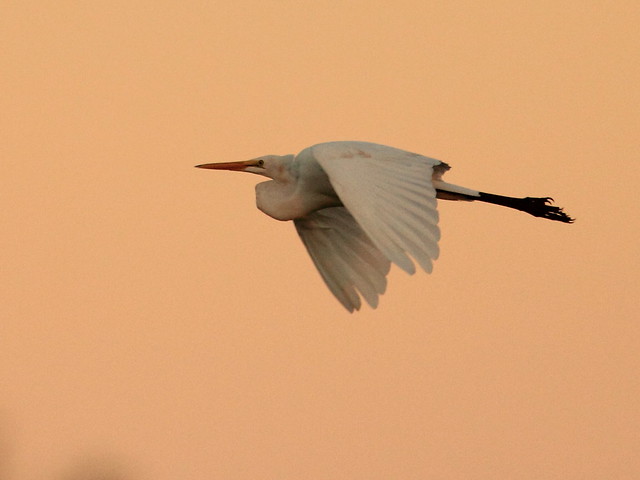
A Great Egret flew overhead.
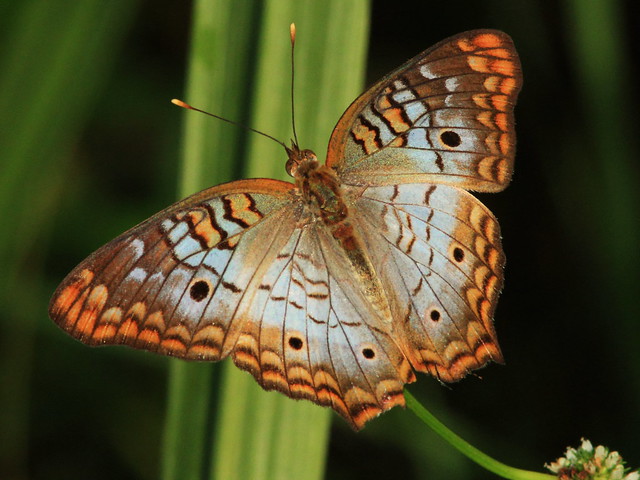
Butterflies were still dormant, soaking up the first rays before taking off, making them easy subjects. This is an almost perfect specimen of a White Peacock:
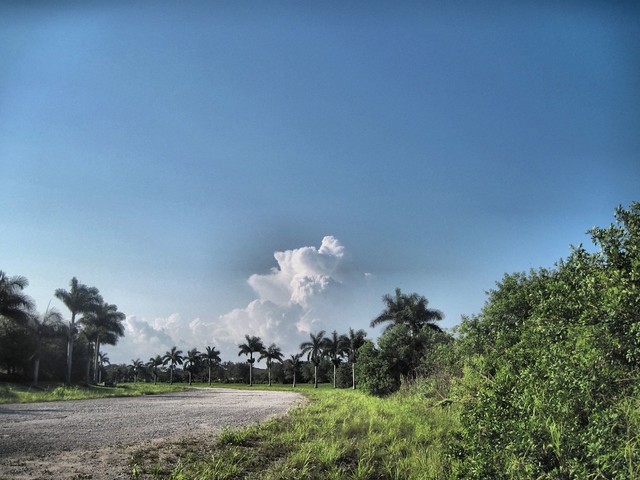
Construction of this roadway began about 12 years ago. It was designed as a 4 lane divided parkway, to connect our neighborhood (which is now isolated by the protected wetlands to the west) with points to the north and US-27, about 2 miles west of our home. Presently we must drive an extra 5 miles east, north and finally west just to access the highway. Problems in acquiring a small portion of the right-of-way and the economic downturn in 2008 delayed the project indefinitely, to our joy. Once completed it will forever change the character of the wild lands it invades.
As I ambled along the path on the edge of the gravel road, a small bird burst up from the roadside grass,only about 2 yards away, near this point on the right side of the road.
It was a female Common Ground-Dove, which retreated to the branches of a nearby tree.

I suspected that the bird had been tending a nest and I had surprised her. Not wanting to cause alarm, I made note of the location and continued walking along the road. On the way back I gave the area a wider berth, but kept a close eye on the spot from which the bird had flown. As I passed by it flew up once again.
The next morning I decided to find the nest. Keeping on the opposite side of the road, I slowly moved to within about 5 yards of the location, when my shadow startled the bird into flight. Using my telephoto lens, I scrutinized the immediate surroundings and spotted the nest, which held two very round white eggs.
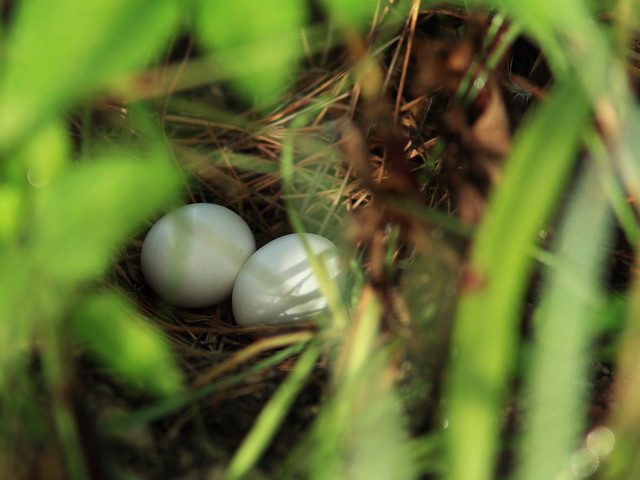
The nest, no more than a flimsy platform of grass stems, was well-concealed, on the ground at the base of a broad-leafed weed among the foot-high grasses. There has never been any doubt that this species breeds locally, but according to the Breeding Bird Survey coordinator, it was the first documented finding of a Common Ground-Dove nest in Broward County.
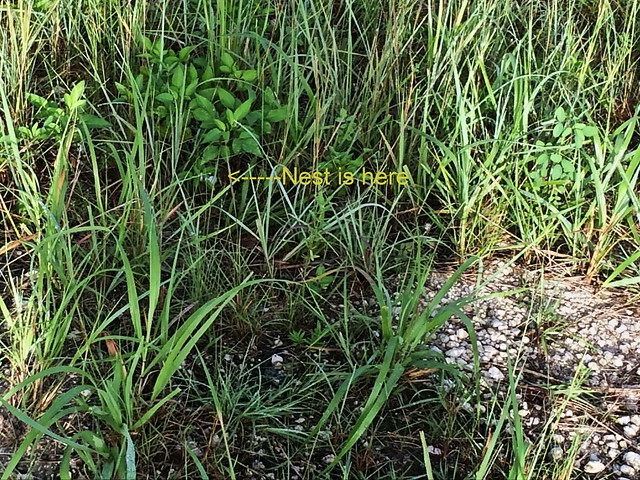
Although this path is commonly used by hikers, dog walkers and cyclists, I took care not to use it and also not to back-track my steps to its vicinity, but rather take my photos and continue along. I monitored the nest daily for the next nine days, hoping to note the day of hatching and possibly follow the development of the hatchlings. They are born blind and helpless but grow rapidly and are flight-ready at about 11 days of age.
Unfortunately, the landscapers began their task of "beautifying" the roadway. Their mowers had stopped only several yards short of the nest site, but when I checked the nest the next day it was empty. I believe that scavengers such as Opossums or Raccoons were attracted by the availability of rodents and snakes killed by the mowers, and they happened across the nest. It mattered little, because later that day the "landscrapers" finished their job, cutting the vegetation down to the bare ground and leaving no trace of the nest.
Following this disappointing outcome, I was heartened by a third "good thing." On a brief visit to nearby Chapel Trail Nature Preserve, we found a newly-arrived flock of over a dozen migrating Eastern Kingbirds. Among them were several first-year birds with brown backs and dark face and heads. Adults are all black above. The younger birds somewhat resemble the Gray Kingbird, but are smaller and have shorter bills. Gray Kingbirds are usually found in coastal areas, and we are 18 miles west of the Atlantic Ocean.

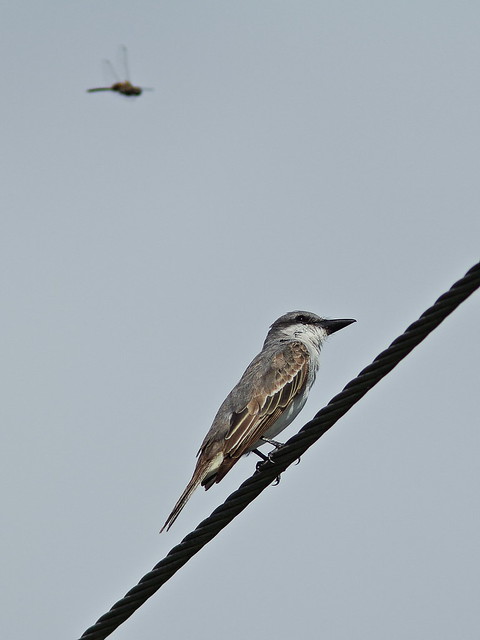
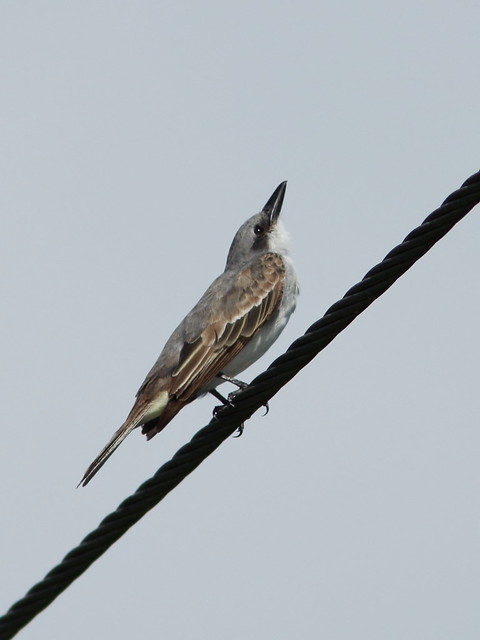
On our way home from Chapel Trail we stopped at a rain puddle in front of a school. It sometimes yielded waders, as I reported earlier in Life in a Puddle, but we found none. Exiting the driveway we had to wait for traffic, and I looked up and saw this bird on a wire directly overhead. Compare its bill size with that of the Eastern Kingbird, and note its black mask.

It was the first Gray Kingbird I have ever found in the western suburbs of Broward County, Florida. When I checked the eBird data I learned there had been only three reported sightings of this species in the County's inland corridor west of I-75 and east of US-27 during the past 10 years.
It eyed a passing dragonfly, but decided not to chase it.