Showing posts with label Rock Pigeon. Show all posts

Thursday, October 28, 2021

My Patch list # 1-10

My health condition now (hopefully temporarily) prevents me from straying very far from home. Therefore I will take advantage of my forced leisure to reflect on the birds I have seen since moving from New Mexico to south Florida. This list only includes bird species seen in our back yard and the preserve adjacent to our home, the West Miramar Water Conservation Area in Broward County, Florida (AKA "Wounded Wetlands"). 

We moved to Florida in 2004, but I only started to report sightings on eBird late in 2008. I did not take up photography until 2008 and deemed two of my earlier sightings important enough to report retroactively. I  picked out a representative photo of each species, not necessarily the first one taken, but always one among many from the Wounded Wetlands. My checklist includes a total of 185 species to date for this location, most of which I eventually photographed here. 

# 1. American Flamingo, 12 Jul 2005

I was fishing in our back yard lake when I looked up in amazement as a flock of four long-legged, crooked-billed flamingos coursed from south to north right over in front of me. I was not sure at the time that this was a most unusual sighting, indeed the first flock reported locally in several years. I saw four again over the lake the next evening, flying almost the same course. 

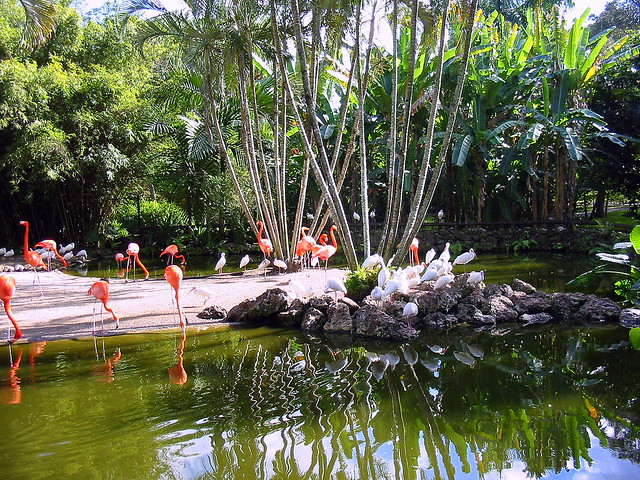
Flamingos once roamed extensively over South Florida, but in recent years the only reliable sightings were of a flock at the southern tip of the peninsula at Snake Bight. Inquiries about all known captive flamingos confirmed that none had escaped. Here is a photo of those in the nearest flock, confined in Flamingo Gardens:
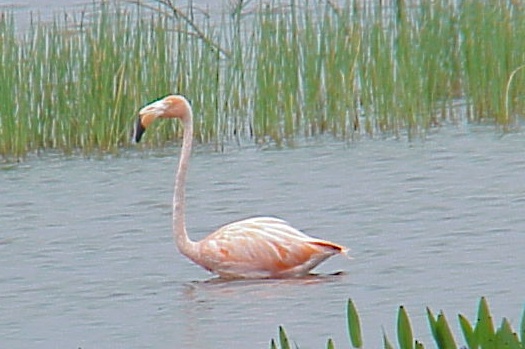
I put the word out on the Internet and others discovered them, a flock of "seven or eight or up to twenty" foraging in a wetland preserve adjacent to the north end of my Patch. I was not carrying a camera, but David Tringo, a neighbor, took this photo and kindly permitted me to publish it: 

# 2. Savannah Sparrow, 26 Dec 2008. This is a photo of one in November, 2018:

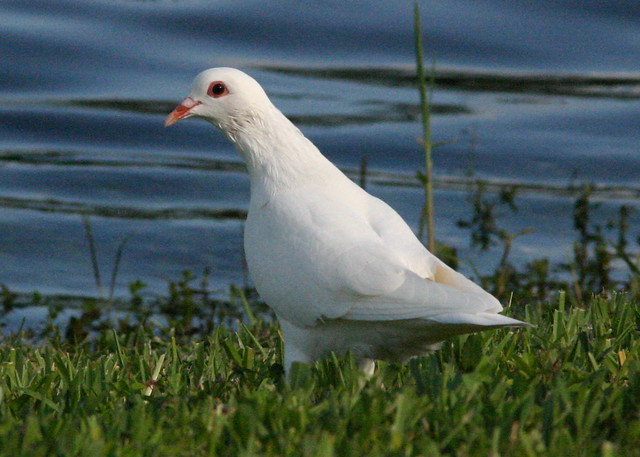
# 3. Rock Pigeon, 23 Oct 2009. That day I photographed a feral albino specimen, very likely an escapee from a wedding celebration or peace demonstration:

# 4. White-winged Dove, 23 Oct 2009. This one was looking for nesting materials on our driveway:

# 5. Mourning Dove. 23 Oct 2009. 

# 6. Killdeer, 23 Oct 2009

# 7. Anhinga, 23 Oct 2009

# 8. Double-crested Cormorant, 23 Oct 2009

# 9. Great Blue Heron, 23 Oct 2009

# 10. Great Egret, 23 Oct 2009

Our walks usually started out about an hour before sunrise, to take advantage of the cooler temperatures and listen to the owls and nightjars. The peninsula in the wetlands lake provided a wide open view over the Everglades to the west.   An advantage to being a stay-at-home birder is that I can see the sunrise on the eastern horizon, which is obscured by the trees out in the wetlands. 

The morning after I got home from the hospital this was the view of sunrise from our back patio:

A flock of White Ibises foraged on the lawn of a home across the lake:
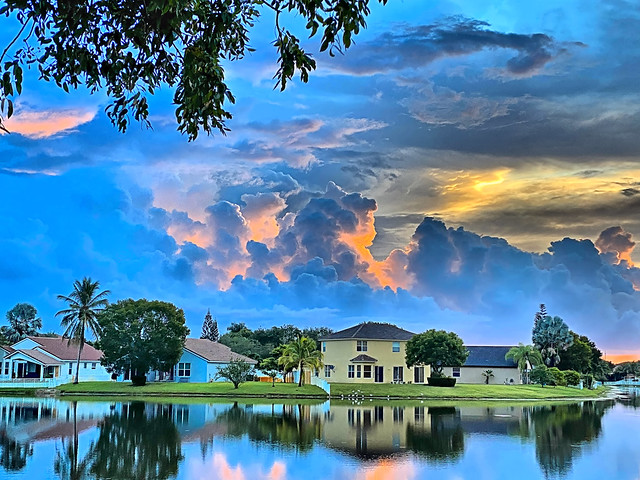
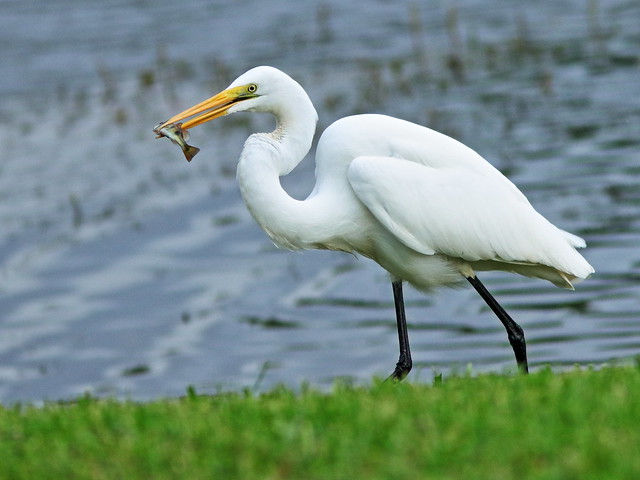
Later in the day the overcast sky provided a shadow-less view of a Great Egret, which hurried along our lawn. It appeared to be intently watching a prey item along the shore:

It plunged and came up with a small Peacock Bass:



= = =  = = =  = = = =  = = = = =

Linking to:


Garden Affair


Skywatch Friday

Weekend Reflections

Saturday's Critters

BirdD'Pot

Camera Critters

All Seasons

Wordless Wednesday (on Tuesday)

Natasha Musing

Our World Tuesday

________________________________________________

Please visit the links to all these posts to see some excellent photos on display
________________________________________________

Wednesday, December 24, 2014

Crops & Clips: Doves

My weekly potpourri gathered from the archives features... meme themes featuring 

CRITTERS: Doves!

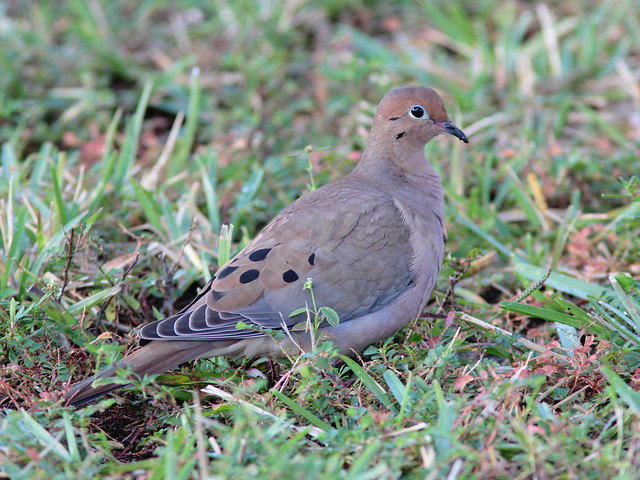
The Mourning Dove is an abundant breeding resident of all 48 lower states and parts of southern Canada. Avidly hunted, the biomass of Mourning Doves harvested each year is said to exceed that of all other game birds combined. The US Fish & Wildlife Service estimated their US population to be 274 million in 2003, and that 14.5 million were taken by hunters that year. 

Mourning Doves DPP Processed 20130322

Mourning Dove 20111211

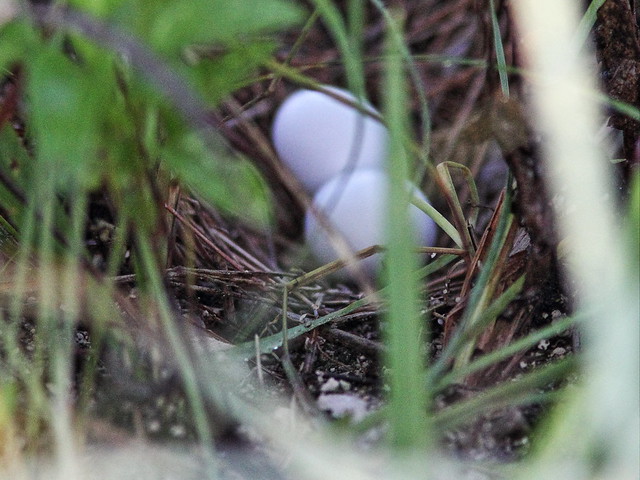
The Common Ground-Dove is fairly restricted to the southern third of the continental 48 states, with scattered reports of sightings up the coasts and into the Great Lakes area. I found its nest with two eggs near our south Florida home this fall. Although it is known to be an established breeding bird here, it was the first such finding in Broward County. 

Common Ground-Dove 20120325

Unfortunately the eggs and its well-concealed ground nest were destroyed, probably by a flash flood along the side of the road where they were located.


Common Ground-Dove nest 20140822


Until about the 1980s, the White-winged Dove's US range was restricted to the far southern reaches of states along the US-Mexico border. Since then it has spread into most of the southern states, with Increasing numbers being reported as far north as southern Canada. 

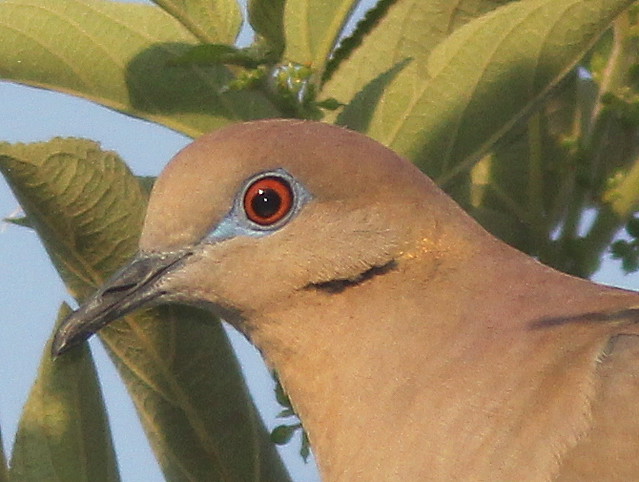
Eye of the dove 20110410


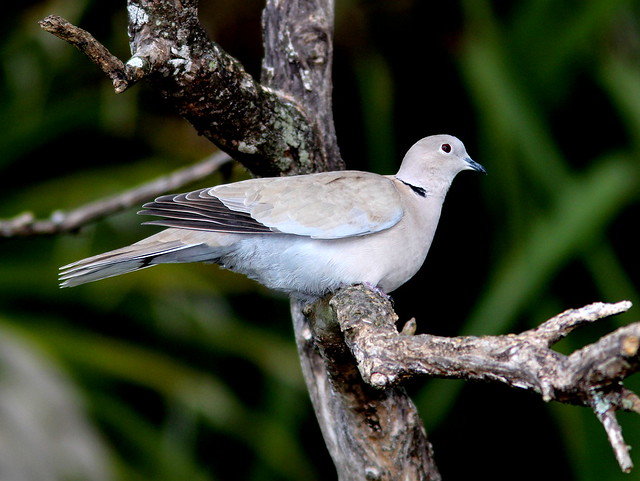
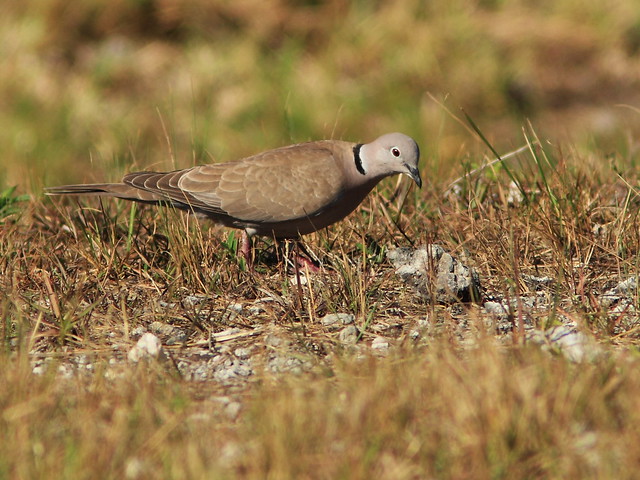
The Eurasian Collared-Dove ranges all over Europe, Asia and into the Middle East and North Africa. It was introduced into the Bahamas only forty years ago and now has spread over nearly the entire continental US and even into Canada. Most Eurasian Collared-Doves appear rather dark, as this individual:

Eurasian Collard-Dove 20140410

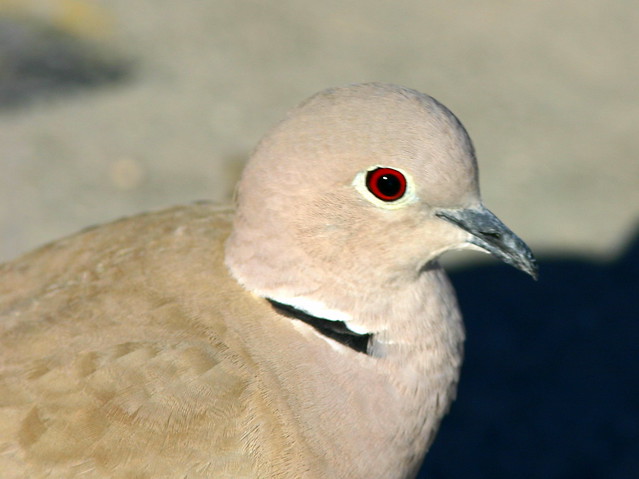
The Eurasian Collared-Dove below is particularly light in color. Its darker under-tail coverts help distinguish it from the smaller African Collared-Dove (also called Ringed Turtle-dove, common in captivity and sometimes released at weddings and other celebrations but rarely seen in the wild).

Eurasian Collared-Dove 20090109

This collared-dove is almost white, and appears to have white under-tail coverts and strongly  contrasting black flight feathers, possibly descended from hybrids with domesticated African Collared-Doves. Note the limited black base of its middle tail feathers:

Eurasian Collared-dove 20110220


The Rock Dove was renamed Rock Pigeon in 2002 to conform with that used by the British Ornithologists' Union. True, their common name in the US was simply  "pigeon." This Rock Pigeon displays a plumage pattern close to that of the original European stock:

Rock Pigeon 20081017

We see Rock Pigeons in many shades, from pure white...

White Rock Pigeon 20081017

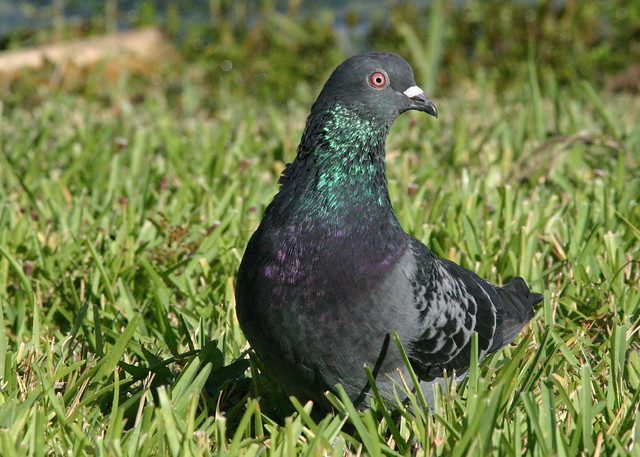
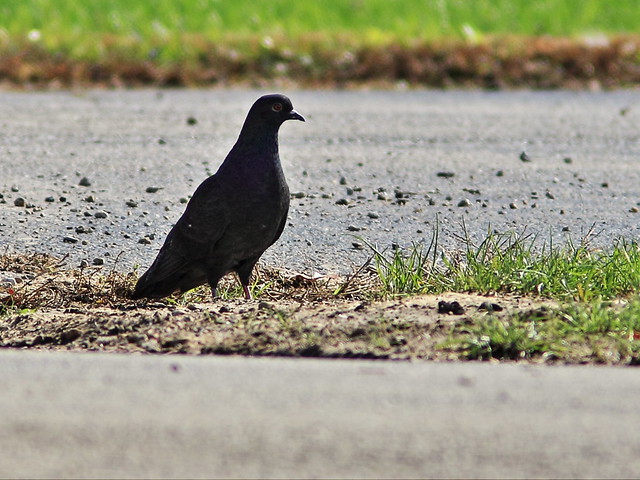
...to nearly black:

Black Rock Pigeon 20141020

Linking to Misty's  CAMERA CRITTERS, and to Eileen's SATURDAY'S CRITTERS,

________________________________________________


FENCE: Mourning Dove at Chapel Trail Nature Preserve:

Mourning Dove on fence 20141215

Mourning Dove on fence 20141208

Linking to GOOD FENCES by Tex (Theresa). 

________________________________________________
SKYWATCH: 

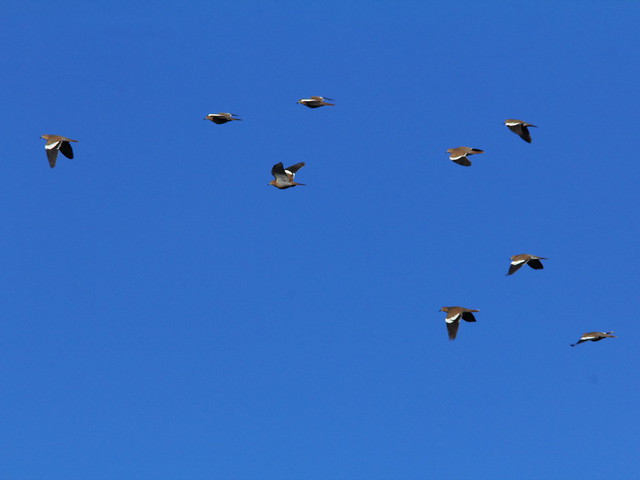
A flock of White-winged Doves:

White-winged Doves 20141124

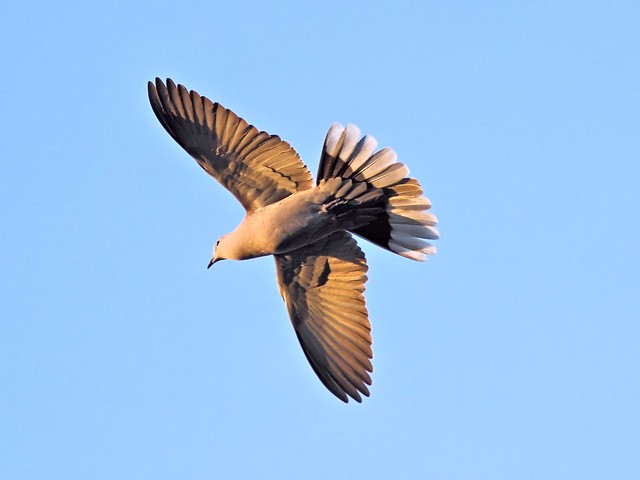
This Eurasian Collared-Dove demonstrates the extensive white tips of its tail feathers, almost half way from their ends, with the black on the central feathers extending 2/3 of the length of its tail.

Eurasian Collard-Dove 20130130

Linking to SKYWATCH FRIDAY by Yogi, Sylvia and Sandy

________________________________________________
REFLECTION: I couldn't find any reflections of doves, but while I searched my archives for photos marked "dove" I found one, and just missed another.

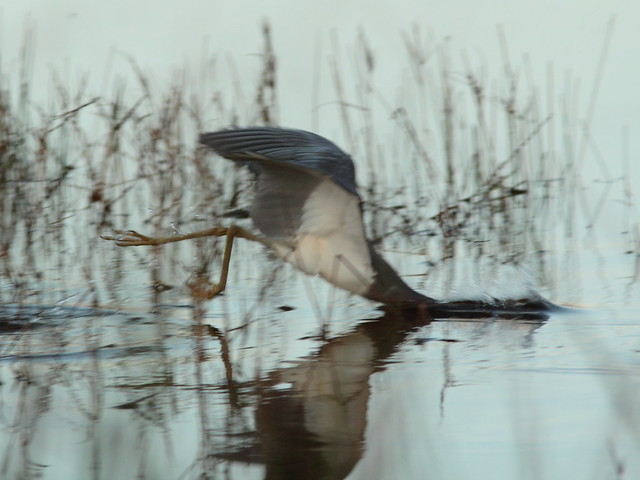
This Tricolored Heron "dove" after a fish...

Tricolored Heron diving 20120218

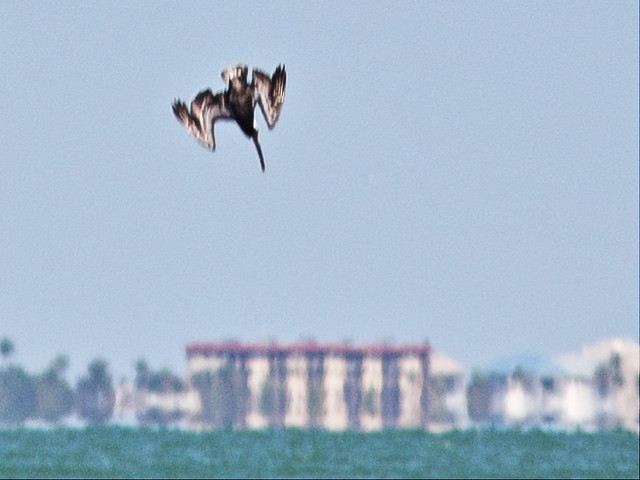
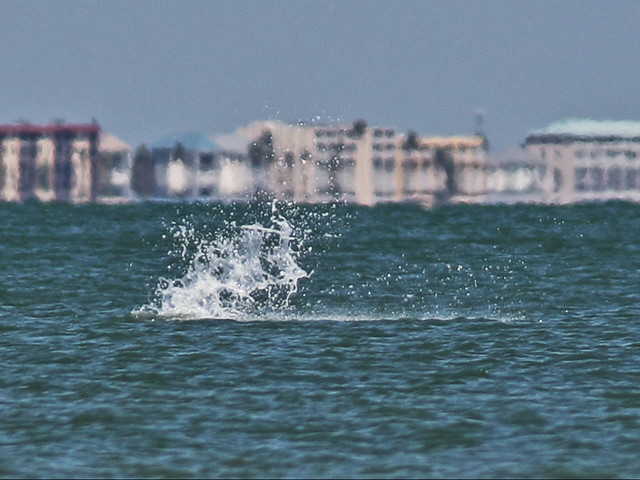
...and I just missed the reflection as this Brown Pelican "dove" into the ocean off Fort Lauderdale, Florida. You must imagine it between these two photos:

Pelican Dive sequence 4-20140423

Pelican Dive sequence 5-20140423


Linking to WEEKEND REFLECTIONS by James

________________________________________________
Please visit the links to all these memes to see some excellent photos on display

________________________________________________