Showing posts with label Loggerhead Shrike. Show all posts

Thursday, November 18, 2021

Parade of the ibises

It was a week of medical appointments and as much backyard bird watching as possible. As is usual during the first two weeks of November, a Yellow-bellied Sapsucker returned to our West Indies Mahogany tree. 

What I cannot understand is that each year it is a new immature sapsucker. A few years I have documented their molt into adult plumage, gradually adding red feathers on head and throat. I expected that each young bird from the previous year would return as an adult. 

Over the years the sapsuckers have peppered our tree with sap wells. They clean up old ones and drill new holes. This bird has a hint of yellow on its undersides:


Our Mahogany seems none the worse for all the damage done to its bark. Look closely to see its emerging fruit (actually nut-like drupes which contain large seeds relished by squirrels and jays):

Over twenty adult White Ibises marched together along the shore:


One stopped to preen:

They filed past the "For Sale" sign in our back yard. We just had open house and attracted over 30 family groups, nearly 100 visitors. (We received seven offers to buy, selected one and now have less than a month to move out to Connecticut):

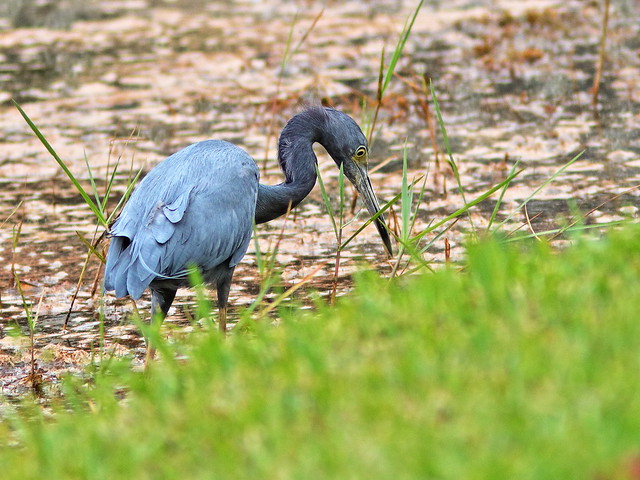
A Little Blue Heron foraged in a shallow spot:


This species has a habit of sitting very still with the tip of its bill nearly touching the water. It seems to be  near-sighted:
A Tricolored Heron exhibits its impatient and erratic feeding methods, almost running across in front of me:


It flew diagonally across the lake:


I ventured out for my first visit to nearby Chapel Trail Nature Preserve in over 6 weeks. The Gray-headed Swamphens were quite vocal:

A Great Egret stalked in the sedges, probably looking for insects and reptiles:

Light was poor and a Common Gallinule was far away:

MaryLou spotted a raptor on a distant treetop. This is how it looked through the binoculars. By its shape it was a small falcon:

I increased exposure compensation and was able to see enough detail on the cropped image to identify it as a Merlin:

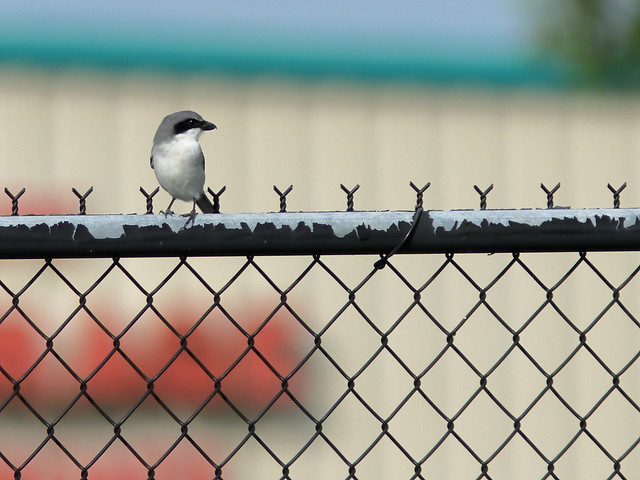
In the parking lot, a Loggerhead Shrike perched on a fence:
There were pink clouds over our lake early in the evening on November 16: 

A bit later the nearly full Beaver Moon emerged from the clouds:


= = =  = = =  = = = =  = = = = =

Linking to:


Fences Around the World

Nature Thursday

Skywatch Friday

Weekend Reflections

Saturday's Critters

BirdD'Pot

Camera Critters

All Seasons

Wordless Wednesday (on Tuesday)

Natasha Musing

Our World Tuesday

________________________________________________

Please visit the links to all these posts to see some excellent photos on display
________________________________________________

Thursday, August 19, 2021

A quiet wet week with few butterflies

In early August, morning rain and some necessary appointments have limited and shortened my excursions into the Wounded Wetlands. Predictably, bird counts were low, averaging about 15 common species. We also escaped dual threats from tropical storms Fred and Grace. 

Most photos were taken in bad light due to cloud cover or very early observations.

This Belted Kingfisher was a surprise on August 5, the first County record for the fall migratory season. 


An adult Bald Eagle provided me with a distant early morning view:

In one frame it ventured into full sunlight:

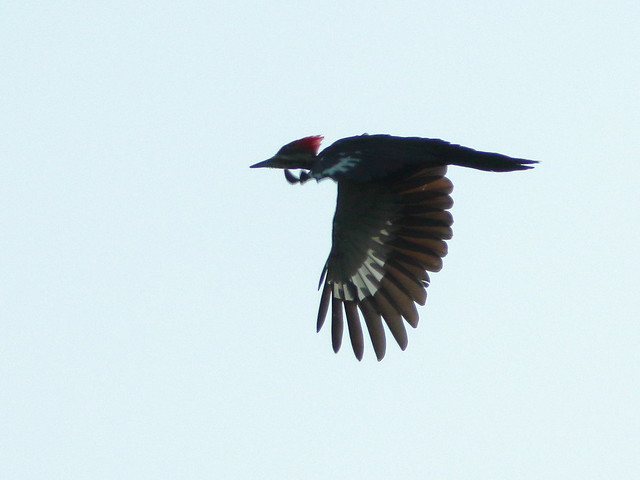
These pre-dawn fly-over shots of a Pileated Woodpecker barely revealed its red crest:


Some mornings I returned with no images at all, so I must reach back a few weeks for some photos not shared in earlier posts:

On August 2, a Great Egret settled into the grass along the path, probably hoping to capture insects and lizards:


The Northern Cardinals were reclusive and not singing, but a juvenile male peered out at me on August 5: 

A Mourning Dove foraged on the gravel track:

A Great Egret rested in a treetop:

I obtained a better flight shot of a female Pileated Woodpecker back in July:

Loggerhead Shrike on July 19:

Our local Wounded Wetlands are bordered by residential properties. I fear that insecticides are having an adverse effect upon butterfly populations. Many residents are utilizing automated  backyard "mosquito misting systems." They dispense aerosols into the air "a few times per day" around the clock. 

Advertisers of these multiple continuous dispersion devices emphasize the dangers of insects in Florida and push them as effective in preventing insect-borne diseases. Most claim to use only pyrethrin, touted as a "natural" or "organic" product derived from chrysanthemumsWhile non-toxic to humans and pets, pyrethrins can be deadly to bees, butterflies, caterpillars and other insects which commonly visit residential gardens. Pyrethrins are relatively safe when applied to individual plants, but it is also used as an aerosol to "knock down" flying insects. 

Alone, pyrethrins are not very potent when dispersed in this manner. To make them more effective they may be mixed with other ingredients to increase effectiveness. For example, a "pyrethrin" aerosol may contain piperonyl butoxide (PBO), a toxic non-organic ingredient which retards the breakdown of pyrethrins. Some mosquito control systems advertise that they utilize innocent-sounding combinations of natural oils and unspecified EPA-approved control products. (Then there is the fact that many home and residential insecticides contain neonicotinoids... but that is another story. End of rant)    

Butterflies have been unusually scarce in numbers and variety. This is a Zebra longwing, the State Butterfly of Florida:

White Peacock:

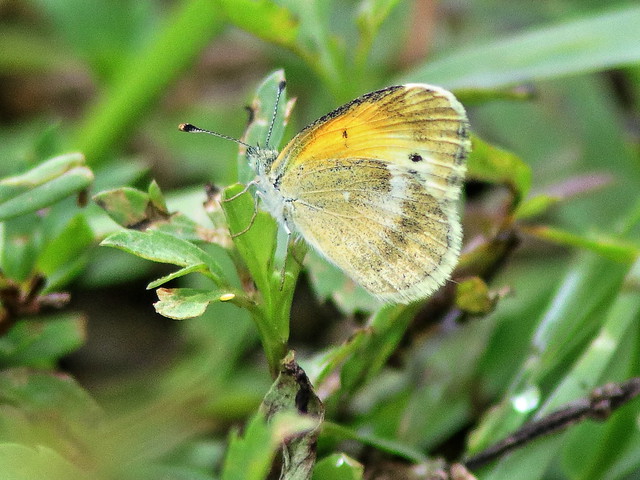
A tiny Dainty Sulphur:

This Orange-barred Sulphur (Phoebis philea) is a very large tropical species with a wingspan of 2 3/4 - 3 1/2 inches (7.0--8.9 cm). It is fairly common in south Florida, but its habits of flying erratically and usually high in the trees makes it difficult to identify and photograph. This was my first image of one from a distance, visiting a Firebush (Hamelia patens), heavily cropped and over-exposed:

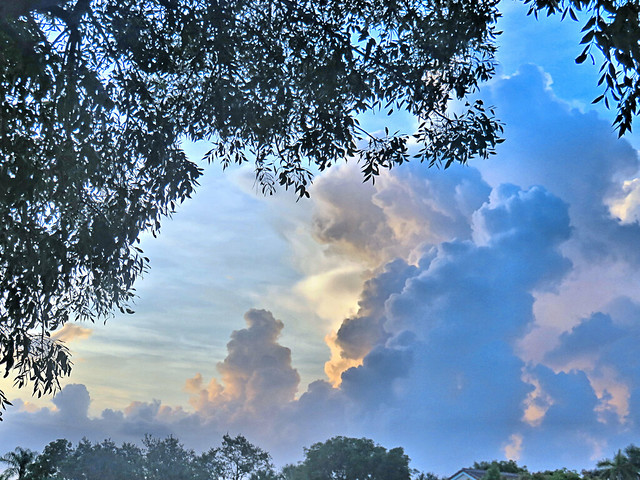
Often, before sunrise, I stop on a peninsula which thrusts out into the lake, listening for owls and nightjars and watching the morning light play over the clouds. It is interesting to see how the rising sun illuminates the clouds as it moves up towards the horizon. These two photos of the same clouds were taken 5 minutes apart, just before and after sunrise on August 11:


= = =  = = =  = = = =  = = = = =

Linking to:


Nature Thursday

Skywatch Friday

Weekend Reflections

Saturday's Critters

BirdD'Pot

Camera Critters

All Seasons

Wordless Wednesday (on Tuesday)

Natasha Musing

Our World Tuesday

________________________________________________

Please visit the links to all these posts to see some excellent photos on display
________________________________________________

Thursday, July 1, 2021

Crops & Clips: Flashback to July, 2018

As I do each month, I enjoyed looking back over my archived photos, taken three years previously, to remember how things were then and maybe get some idea of what to expect this year.  

As usual, I searched for images which reflected favorite memes: critters of all kinds (especially birds), skies and clouds, reflections, flowers and fences, as well as scenes which speak for themselves. We spent the entire month in Florida, having just completed sale of our Illinois condominium. 

My first bird photos of the month, on July 1, were of a female Red-bellied Woodpecker on the paper bark of a Melaleuca tree...

...and a Common Nighthawk in flight:

The next morning a male Red-bellied Woodpecker exhibited the more extensive red on his crown:

A Red-winged Blackbird looked down from his perch in a Swamp (Red) Maple:

The streaked breast of this Green Heron indicates that it is an immature bird:

A Great  Egret flew over against the dawn sky:

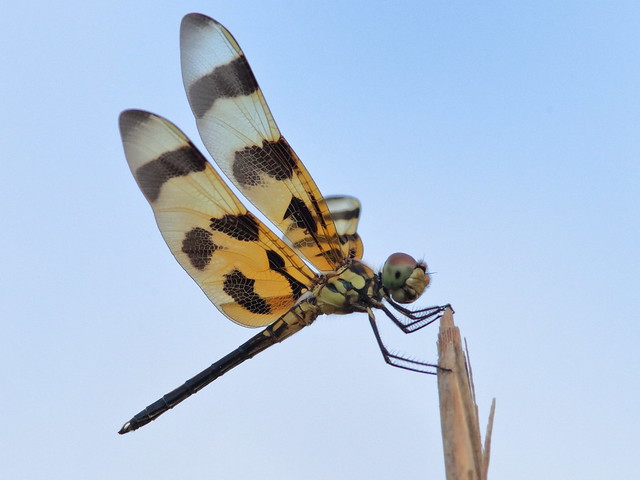
A Halloween Pennant, true to its name, faced  the wind like a flag atop a grass stalk: 

Quite a distance ahead, a Bobcat strolled across the gravel path. I captured a burst of photos and later stitched them together to form a composite image:

A Killdeer posed in warm morning sunlight:

West Indies natives descended from escaped pets, Curley-tailed Lizards were becoming more common:

A Yellow-crowned Night-Heron roosted in the rookery:

The adult Bald Eagle from the local nest flew over the Wounded Wetlands, followed by the juvenile:


The tail of this male Anhinga is corrugated, a feature which reduces drag while it is swimming underwater:


A Great Egret reflected nicely:

Loggerhead Shrike against the full Moon:

Monarch Butterfly on Lantana:

White Peacock:

Phaon Crescent:

The Blood Buck Moon of July set behind the trees on July 27:

Sunrise from our back patio on a typical rainy season morning, July 28:


= = =  = = =  = = = =  = = = = =

Linking to:


Skywatch Friday

Weekend Reflections

Saturday's Critters

BirdD'Pot

Camera Critters

All Seasons

Wordless Wednesday (on Tuesday)

Natasha Musing

Our World Tuesday

________________________________________________

Please visit the links to all these posts to see some excellent photos on display
________________________________________________