Showing posts with label Red-winged Blackbird. Show all posts

Thursday, July 1, 2021

Crops & Clips: Flashback to July, 2018

As I do each month, I enjoyed looking back over my archived photos, taken three years previously, to remember how things were then and maybe get some idea of what to expect this year.  

As usual, I searched for images which reflected favorite memes: critters of all kinds (especially birds), skies and clouds, reflections, flowers and fences, as well as scenes which speak for themselves. We spent the entire month in Florida, having just completed sale of our Illinois condominium. 

My first bird photos of the month, on July 1, were of a female Red-bellied Woodpecker on the paper bark of a Melaleuca tree...

...and a Common Nighthawk in flight:

The next morning a male Red-bellied Woodpecker exhibited the more extensive red on his crown:

A Red-winged Blackbird looked down from his perch in a Swamp (Red) Maple:

The streaked breast of this Green Heron indicates that it is an immature bird:

A Great  Egret flew over against the dawn sky:

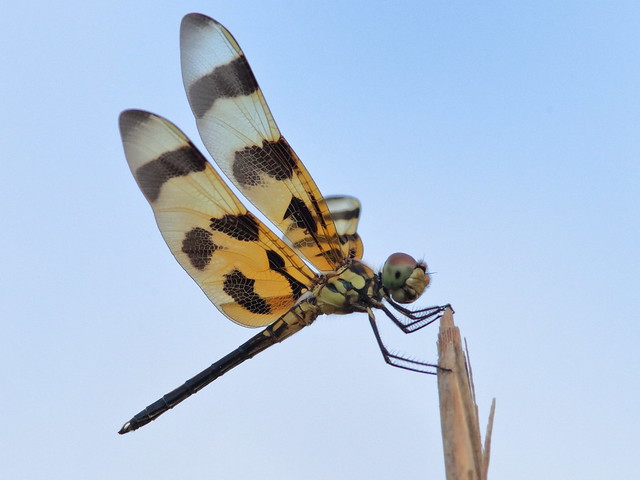
A Halloween Pennant, true to its name, faced  the wind like a flag atop a grass stalk: 

Quite a distance ahead, a Bobcat strolled across the gravel path. I captured a burst of photos and later stitched them together to form a composite image:

A Killdeer posed in warm morning sunlight:

West Indies natives descended from escaped pets, Curley-tailed Lizards were becoming more common:

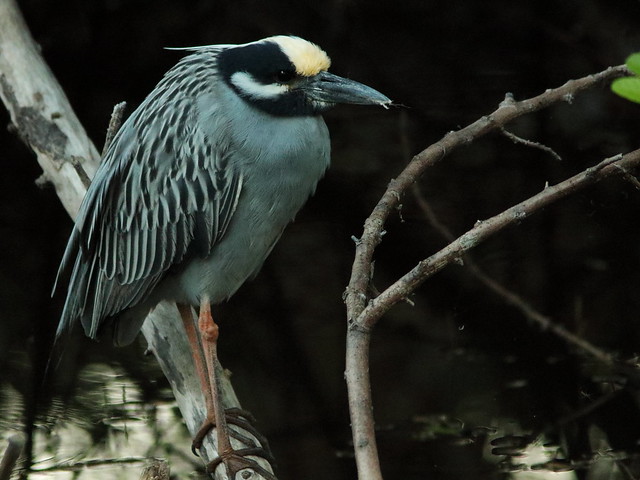
A Yellow-crowned Night-Heron roosted in the rookery:

The adult Bald Eagle from the local nest flew over the Wounded Wetlands, followed by the juvenile:


The tail of this male Anhinga is corrugated, a feature which reduces drag while it is swimming underwater:


A Great Egret reflected nicely:

Loggerhead Shrike against the full Moon:

Monarch Butterfly on Lantana:

White Peacock:

Phaon Crescent:

The Blood Buck Moon of July set behind the trees on July 27:

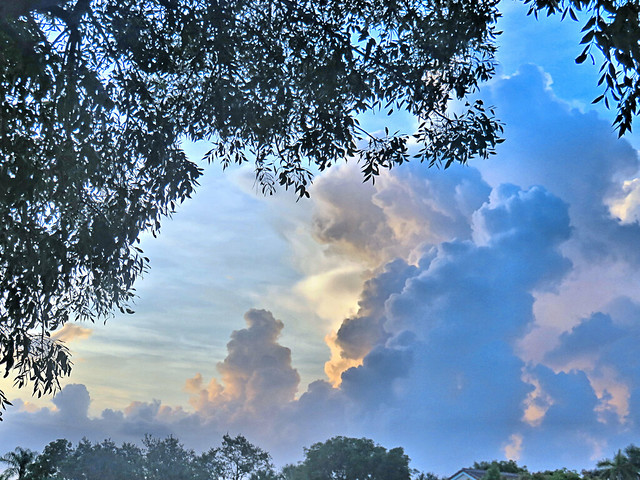
Sunrise from our back patio on a typical rainy season morning, July 28:


= = =  = = =  = = = =  = = = = =

Linking to:


Skywatch Friday

Weekend Reflections

Saturday's Critters

BirdD'Pot

Camera Critters

All Seasons

Wordless Wednesday (on Tuesday)

Natasha Musing

Our World Tuesday

________________________________________________

Please visit the links to all these posts to see some excellent photos on display
________________________________________________

Thursday, May 13, 2021

Second Eaglet Rescued - The value of having many eyes on the eagles #963

This is a follow-up to the events described in my earlier post: EAGLETS DOWN

After the failure of the rescue crew to locate the second downed eagle on Wednesday, April 28, our hopes were dashed. We watched for the adults and listened for any eaglet calls. Volunteers heard no sound of an eaglet during multiple visits on Thursday and Friday. Then, late on Saturday) afternoon, May 1, Richard stopped by on his bicycle and heard a call which he recorded and then confirmed as indeed the cry of an eaglet. Phil notified Florida Fish and Wildlife Conservation Commission (FWC) and arranged to meet an officer at the nest in the morning.

I arrived at the eagle nest on Sunday morning at 6:50 AM, just after sunrise. At first all was quiet, but at about 7:10 AM there were the distinct calls of an eaglet from an area very close to the sidewalk and a short distance east of the nest tree. With other watchers, we heard over a dozen eaglet cries before the arrival of FWC, at about 8:15 AM.

Phil and the FWC Officer entered the woodland and searched through the tangle of fallen trees for over two hours. Probably because the eaglet was startled by the presence of the rescuers, it fell silent, calling only about twice but never near enough for Phil and the Officer to determine its location. Then at about 10:45 AM they finally felt that, because of the  nearly impenetrable undergrowth and tangle of fallen trees left by Hurricane Irma, it was necessary to suspend the search.

The FWC Officer was just preparing to depart when Richard looked into a break in the foliage and said he could see the eaglet! I waved down the Officer just as he was departing. It was amazing because I found it almost impossible to see the eaglet in the dark and dense forest floor. Richard did his best to point it out, saying, "Look for its yellow feet." That did it and I got partial views of the eaglet standing tall on a fallen log, only about 20 yards from our position at the edge of the woodlands. 


We watched as the Officer, carrying a large net, got within a yard or so from the eaglet. It suddenly ran into a hole between the limbs of the fallen tree. It was crouched down and quite inaccessible. Phil and his wife Mary joined the FWS Officer in trying to access the eaglet. They brought some fish, in case it might entice the hungry bird to come out into the open.

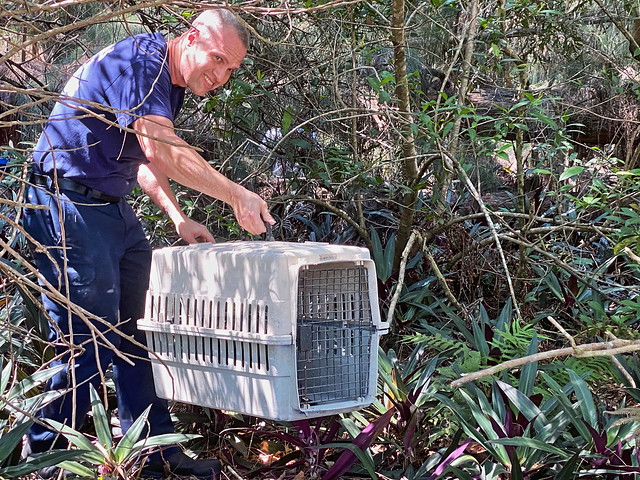
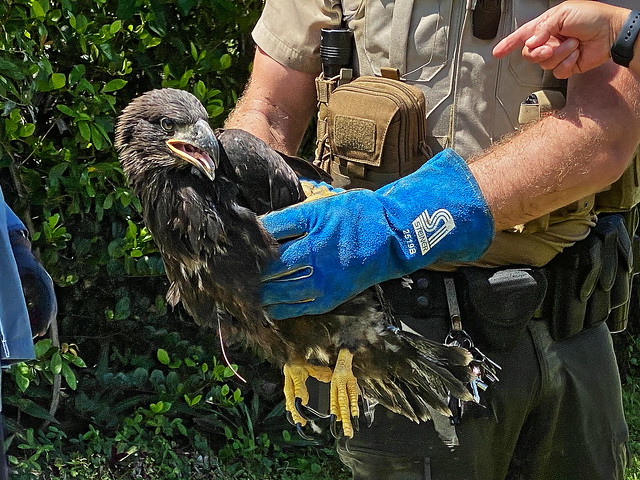
Pembroke Pines Fire & Rescue then arrived with longer poles and a chain saw. The latter was not needed as the eaglet responded to gentle probing by moving to a spot where is was finally captured. 


It was brought to a local wildlife rehabilitation facility for examination and treatment as necessary. Except for mild anemia and hookworm infestation, it was hungry but uninjured. 

Kudos to volunteers Phil and Mary for being part of the exhausting search effort. Richard was doubly a hero for this eaglet. By hearing and reporting its presence the night before, he renewed the search. To top it off, it was Richard who spotted the eaglet just before the search would have again been suspended.

As we were listening for the eaglet to betray its presence, an Eastern Screech-Owl looked out of its nest from a woodpecker hole in a dead palm tree in front of the abandoned nest. The adult appeared first:

Then, a downy juvenile peered out:


The eagles have kept me so busy that I got behind in processing my photos. After losing a couple of days worth of pictures from our visit to Illinois, we did get out one day to local parks. I also clicked a few shots while relaxing on our daughter's back deck. Here are some backyard birds framed by the bars of their iron fence.

Northern Cardinal:


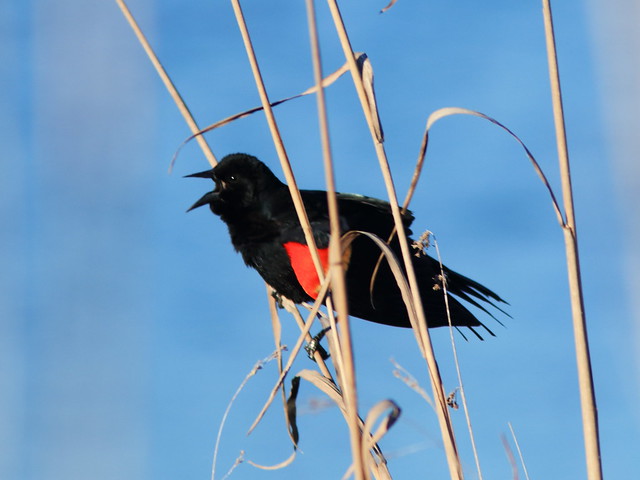
Red-winged Blackbird:

Brown-headed Cowbird at their feeder:

Back yard male House Finch singing:


At nearby Jones Meadow Park, a pair of Canada Geese tended to five goslings:


A demure Field Sparrow at Nelson Lake:

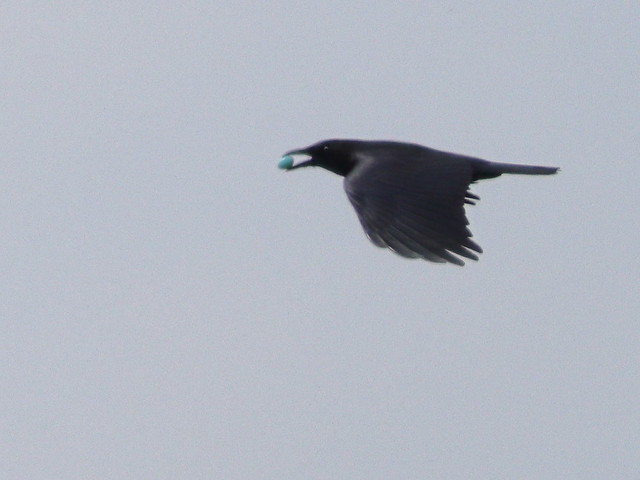
An American Crow carried a stolen robin's egg:

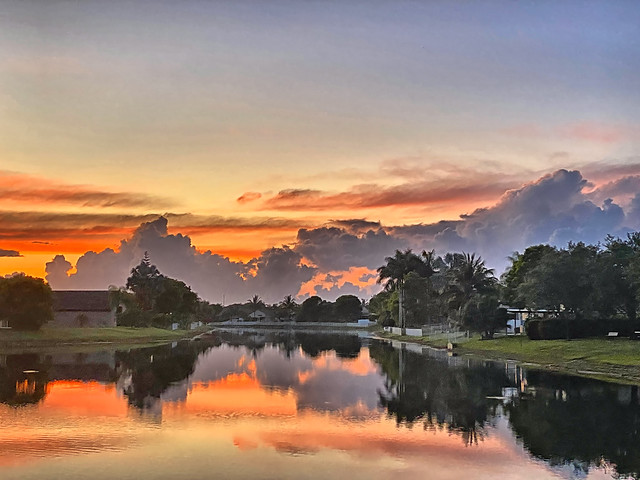
At home in Florida, view from the back patio before sunrise on May 11:

A fish disturbed the surface of the lake:


Later, on our morning walk, I found last year's antler of a young buck, the first I have ever found:


Near where I found the antler, a young white-tailed buck in velvet walked out into the open and stared at me from a distance. Could this have been the one who donated the antler?:


= = =  = = =  = = = =  = = = = =

Linking to:

Fences Around the World

Nature Thursday

Skywatch Friday

Weekend Reflections

Saturday's Critters

BirdD'Pot

Camera Critters

All Seasons

Wordless Wednesday (on Tuesday)

Natasha Musing

Our World Tuesday

________________________________________________

Please visit the links to all these posts to see some excellent photos on display
________________________________________________

Thursday, March 4, 2021

Crops & Clips: Flashback three years to March, 2018

Going through the archived photos from past years excites fond memories and often gives me an idea of what may again be out there in the wild this year. March is a month of transition, as winter residents depart and spring migrants start arriving. During February my daily bird sightings can become a bit monotonous as the same twenty or so species seem tp show up every morning. However, by late March there is greater diversity. I look for favorite themes and memes in the monthly collection-- critters of all kinds (especially birds), skies and reflections, flowers and fences. 

We spent the entire month at home in south Florida. Our morning walk on March 1st yielded nice photos of a Green Heron in subdued morning light:


Red-wing Blackbirds males had returned earlier to set up territories and now were rounding up harems: 

Females were present in greater numbers:

A male Boat-tailed Grackle seemed to be checking his reflection:

Overhead on the first day of March were Bald Eagles, one carrying a small fish...


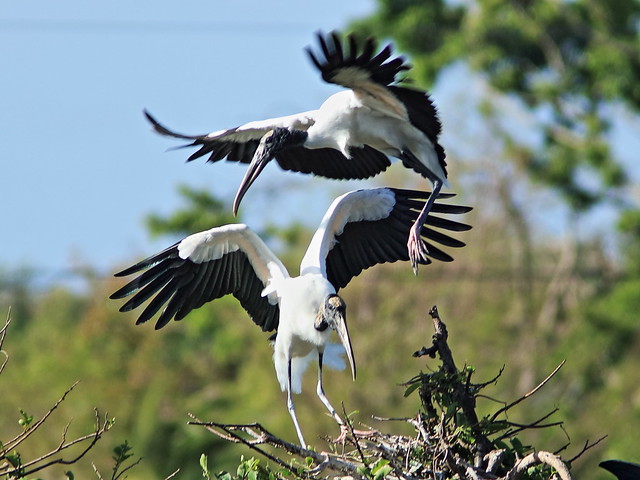
...and a Wood Stork:

A male Bobcat crossed in front of us on March 2. Males occupy a very large territory (in roadless wilderness habitat, up to 30 square miles vs about 6 square miles for females) and visit several females during the breeding season, which peaks in February and March:

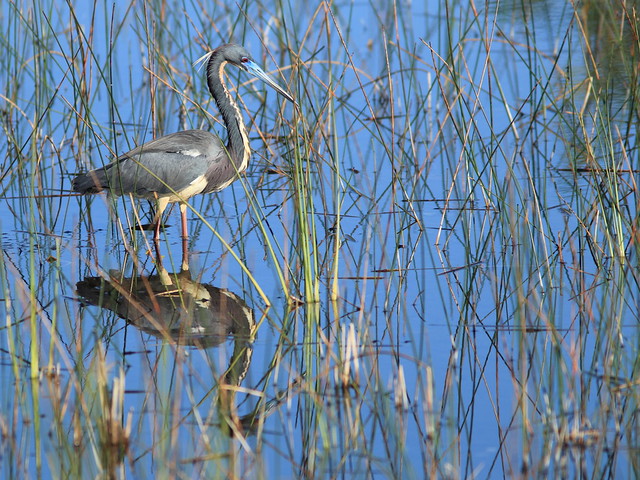
This Tricolored Heron's bill was turning blue, an indication that it is approaching breeding condition:

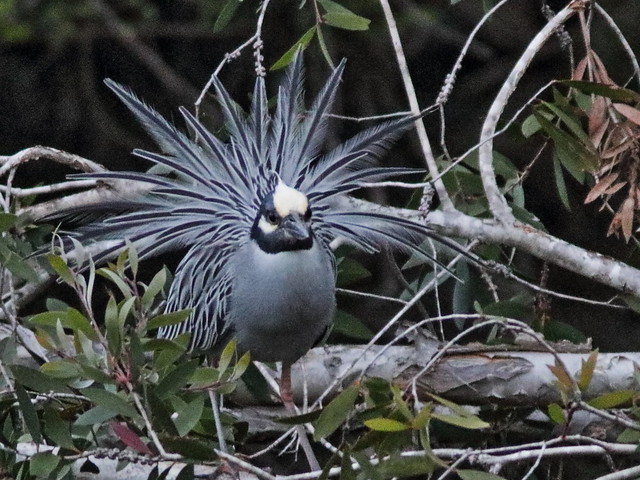
Although streaky and dull for most of the year, the head of this male Yellow-crowned Night-Heron turns clear with a yellow wash and its legs turn from gray to red as spring approaches:

Later in the month, a male extended his scapular plumes in a courtship display.

Pileated Woodpeckers had become more vocal and conspicuous. This is a female. The male has a red "mustache:":

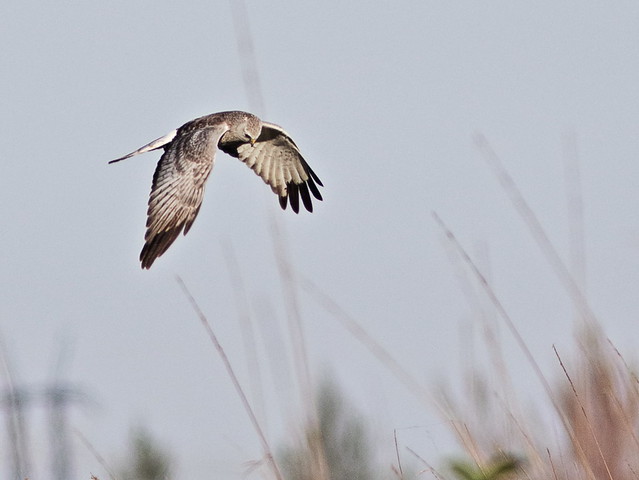
A Northern Harrier male "Gray Ghost" searched for prey over the wetlands:


Yellow-bellied Sapsuckers would soon be migrating back to their northern breeding range:

Northern Cardinals were in full breeding plumage:


Great Crested Flycatchers would soon be breeding:

At the local nest, the adult Bald Eagle (Pride) was tending to the one surviving eaglet

Still present on March 17th, the Yellow-rumped Warblers will have migrated far to the north before the month's end:


American Kestrels would also soon abandon their winter range:

Killdeer were courting:

Prairie Warblers were with us most of the year but would soon undertake a "lateral" migration to nest in the coastal mangroves:

The prior year, for the first time ever, Wood Storks were recorded breeding on an island in a city park to our north. They had returned. On March 27 I counted over 100 adults:


Great Blue Heron on March 28:

A pregnant White-tailed doe was a sure sign of spring:

Sunlight breaking through the fog on March 17:

Up North, the ground was beginning to thaw, hence the Farmer's Almanac name for March's full Moon-- the Worm Moon.

Full Worm Moon on March 3:


Waning crescent on March 13:


= = =  = = =  = = = =  = = = = =

Linking to:

Nature Thursday

Skywatch Friday

Weekend Reflections

Saturday's Critters

BirdD'Pot

Camera Critters

All Seasons

Wordless Wednesday (on Tuesday)

Natasha Musing

Our World Tuesday

________________________________________________

Please visit the links to all these posts to see some excellent photos on display
________________________________________________