Showing posts with label Merlin. Show all posts

Thursday, November 18, 2021

Parade of the ibises

It was a week of medical appointments and as much backyard bird watching as possible. As is usual during the first two weeks of November, a Yellow-bellied Sapsucker returned to our West Indies Mahogany tree. 

What I cannot understand is that each year it is a new immature sapsucker. A few years I have documented their molt into adult plumage, gradually adding red feathers on head and throat. I expected that each young bird from the previous year would return as an adult. 

Over the years the sapsuckers have peppered our tree with sap wells. They clean up old ones and drill new holes. This bird has a hint of yellow on its undersides:


Our Mahogany seems none the worse for all the damage done to its bark. Look closely to see its emerging fruit (actually nut-like drupes which contain large seeds relished by squirrels and jays):

Over twenty adult White Ibises marched together along the shore:


One stopped to preen:

They filed past the "For Sale" sign in our back yard. We just had open house and attracted over 30 family groups, nearly 100 visitors. (We received seven offers to buy, selected one and now have less than a month to move out to Connecticut):

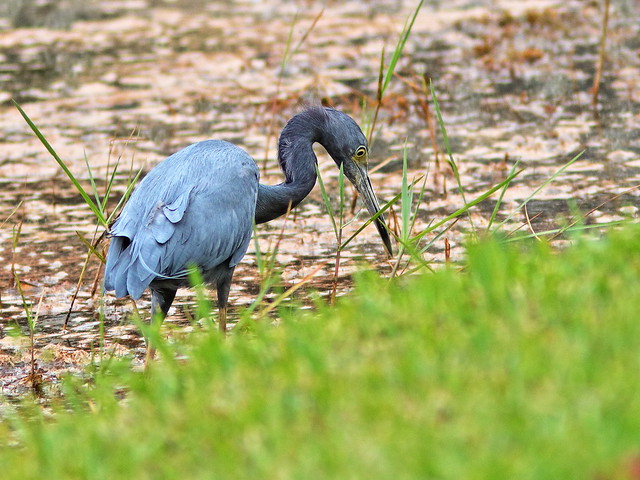
A Little Blue Heron foraged in a shallow spot:


This species has a habit of sitting very still with the tip of its bill nearly touching the water. It seems to be  near-sighted:
A Tricolored Heron exhibits its impatient and erratic feeding methods, almost running across in front of me:


It flew diagonally across the lake:


I ventured out for my first visit to nearby Chapel Trail Nature Preserve in over 6 weeks. The Gray-headed Swamphens were quite vocal:

A Great Egret stalked in the sedges, probably looking for insects and reptiles:

Light was poor and a Common Gallinule was far away:

MaryLou spotted a raptor on a distant treetop. This is how it looked through the binoculars. By its shape it was a small falcon:

I increased exposure compensation and was able to see enough detail on the cropped image to identify it as a Merlin:

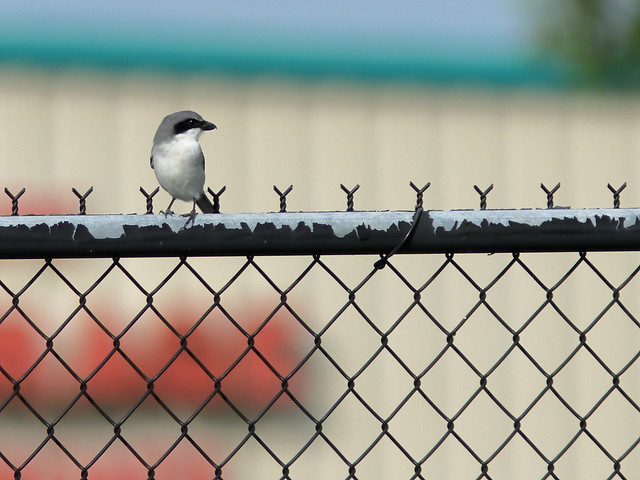
In the parking lot, a Loggerhead Shrike perched on a fence:
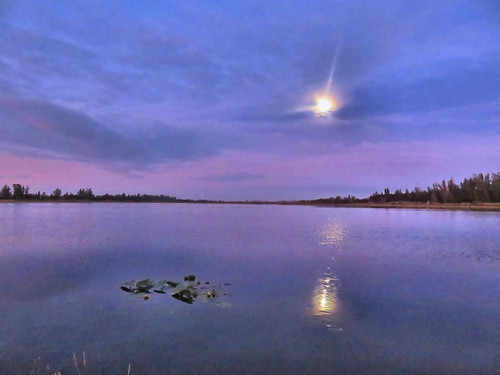
There were pink clouds over our lake early in the evening on November 16: 

A bit later the nearly full Beaver Moon emerged from the clouds:


= = =  = = =  = = = =  = = = = =

Linking to:


Fences Around the World

Nature Thursday

Skywatch Friday

Weekend Reflections

Saturday's Critters

BirdD'Pot

Camera Critters

All Seasons

Wordless Wednesday (on Tuesday)

Natasha Musing

Our World Tuesday

________________________________________________

Please visit the links to all these posts to see some excellent photos on display
________________________________________________

Thursday, November 19, 2020

Finding furry and feathered fauna

Although we get out early in the local wetlands, we generally shelter in place at home for the greater part of the day. 

Our back yard lake attracts waders such as this Great Blue Heron:


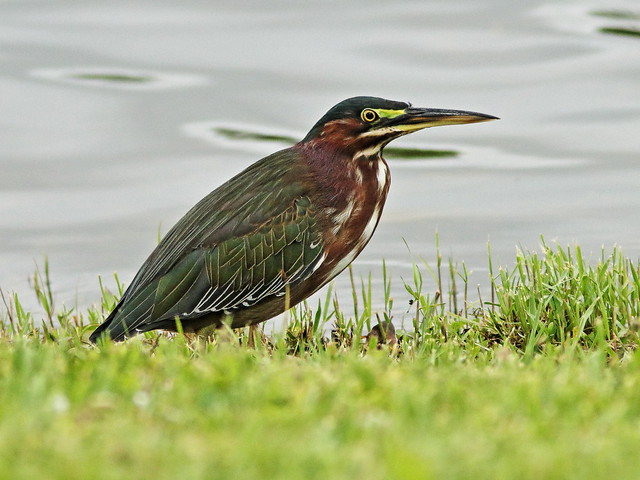
Green Herons are very skittish, so I was lucky to have this one stick in a spot visible from our patio:

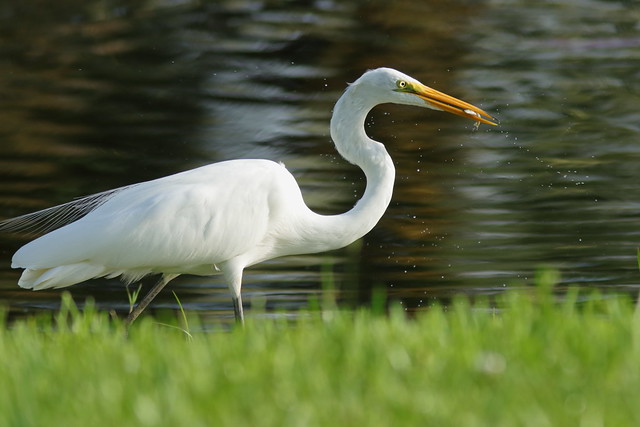
This Great Egret paid me no attention as it spied and then caught a small fish:


The fish wiggled violently and scattered water droplets, to no avail:


The first Yellow-bellied Sapsucker of the season, an immature bird which lacked the red on its head, started drilling sap wells on our Mahogany tree:


At the local Bald Eagle nest, the male "Pride" roosted nearby:

Out in the wetlands, a trio of white herons flew in together and walked in line, as if to show off their distinguishing characteristics:


A Snowy Egret led the parade, followed by an immature Little Blue Heron, the taller of the two, which has a black-tipped gray bill and shows a bit of blue on its head. The snowy Egret has a narrow black bill:


An adult Little Blue Heron was also present:


Along the levee trail, as I was peering into the dense  foliage of the fruiting ficus sp tree which I call the "warbler tree," a Merlin made frequent passes which kept the small birds in hiding. The falcon perched at the top of the tallest pine and had a commanding view of the surroundings:


I tried very hard to get photos of the Merlin in flight as it flew by rapidly and unpredictably, once right over my head:

It was  easier to capture it as it stalled before alighting on its roost:

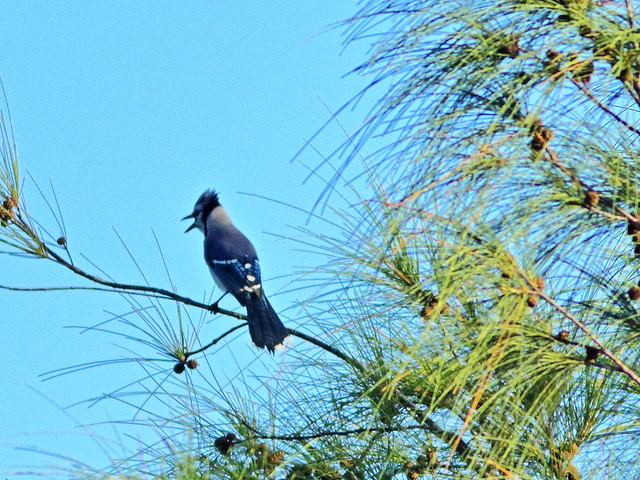
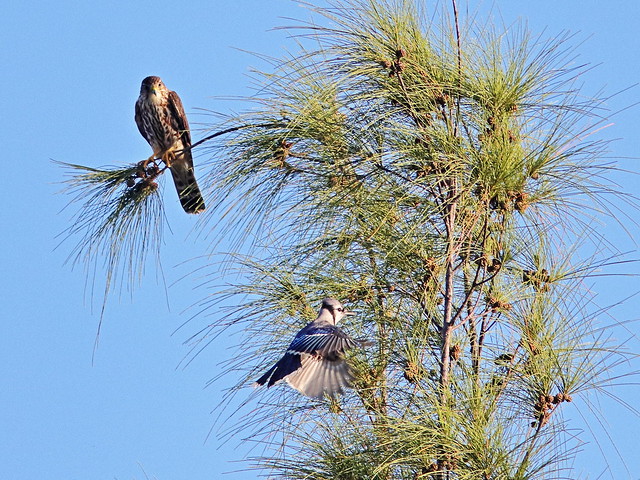
A courageous Blue Jay harassed the Merlin, which has been known to capture even larger birds:


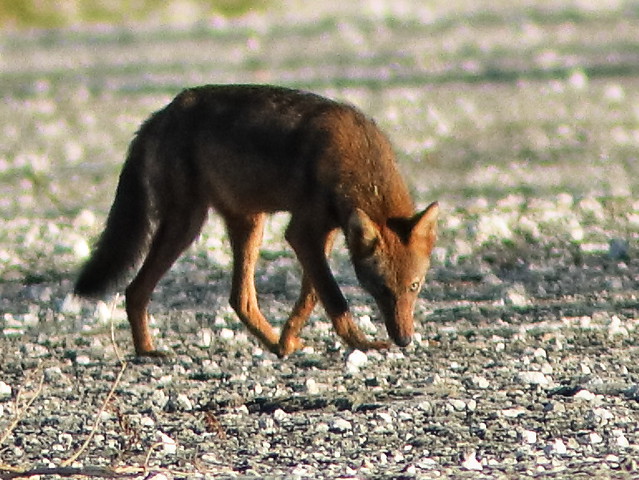
As I emerged from the high grass along the trail to an open area, I cautiously checked for mammals, usually an Opossum, Marsh Rabbit, Raccoon or even a Bobcat. This time I was rewarded by a Coyote with a reddish coat:


A Gulf Fritillary sipping nectar:

A Hunters Moon, also a Blue Moon as it was the second full Moon in October, was ready to disappear over the egret on the lake just before sunrise:

Slightly to the right, in the northwest sky, a streaming cloud caught the rays of the sun before they reached ground level:


= = =  = = =  = = = =  = = = = =

Linking to:


________________________________________________

Please visit the links to all these posts to see some excellent photos on display
________________________________________________


Thursday, November 21, 2019

Two small falcons

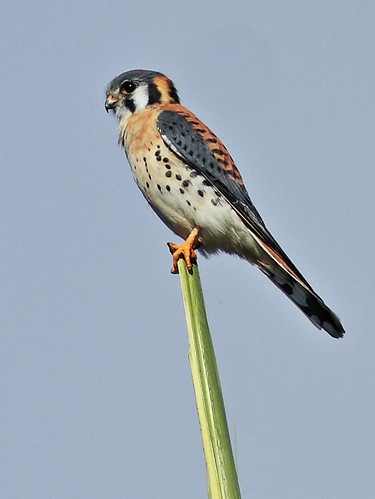
Most winters we have hosted two or three American Kestrels in our local wetlands preserve. Each has occupied rather distinct foraging/hunting territories along the 1.5 mile stretch of gravel road which runs through the area. All have been males, although some females have passed through. I always welcome their arrival and try to determine the extent of their territories, which they sometimes defend if another kestrel ventures near them. They have had favored roosts, usually high on a utility pole, pine tree or Royal Palm apical shoot. 

The kestrel which occupies the southernmost territory almost always may be found sitting atop the spire of the emerging leaf of one of the Royal Palms which line the road near the entrance. It eats mostly insects, mainly grasshoppers and dragonflies, but also takes amphibians and reptiles such as small lizards, frogs and snakes. It also catches small rodents and songbirds:

American Kestrel 01-20191113

American Kestrel 4-20160202

American Kestrel 20160109

A Northern Mockingbird competes with a kestrel for a dominant perch:

Northern Mockingbird attacks American Kestrel 00-20180201

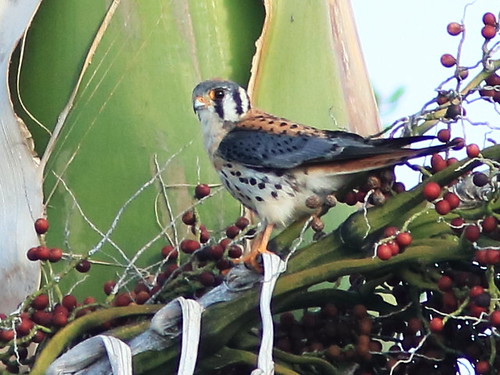
Male searching for insects among the fruit of a Royal Palm

American Kestrel male on Royal Palm 01-20180205

The other two kestrels tend to range either to the north or south of the lake which is about 3/4 mile north into the preserve. They often come into conflict along the lake shore, with the one whose territory is invaded most deeply usually chasing the other one away from the lake area. The central territory provides a variety of roosts from which its occupant can survey the the stretch of gravel road and its surroundings:

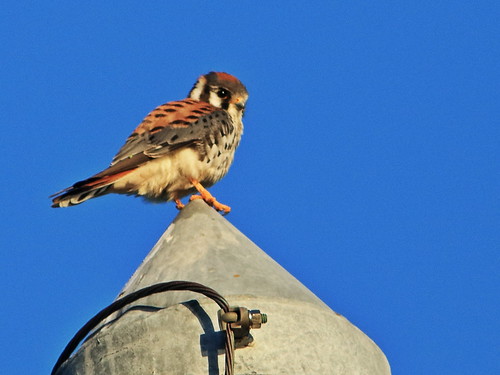
Power distribution lines run along this part of the track. Photos taken on wires disturb some purists, but I will settle for whatever view I can capture:

American Kestrel, male 980x400 20151113

American Kestrel male 3-20151220

American Kestrel preening 20151207

Small trees along the lake shore are also favored:

American Kestrel HDR 20160217

In the northernmost territory, I often find its occupant high on a lightning arrestor pole next to an electrical power sub-station:

American Kestrel 20171118

It also selects the top of one of the tallest trees nearby:

American Kestrel 04-20191106

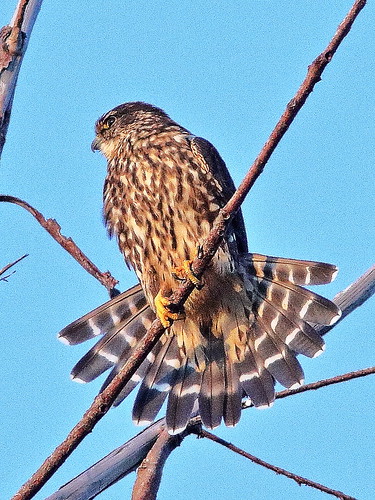
This particular territory was recently visited by another small falcon, a Merlin, an efficient predator of small to medium-sized birds:

Merlin 04-20191101
.
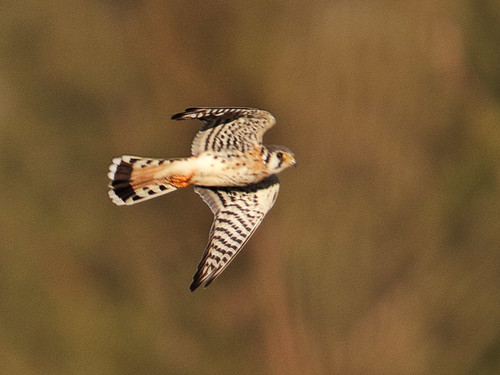
With an average length of about 12 in (31 cm) and wingspan of 25 in (64 cm) the Merlin is slightly larger than the American Kestrel, North America's smallest falcon, which is 10.5 in (27 cm) long and has wings which spread to 23 in (58 cm). The Merlin has a bulkier, muscular appearance and its flight is energetic and direct, while the kestrel seems rather delicate and more buoyant in flight.

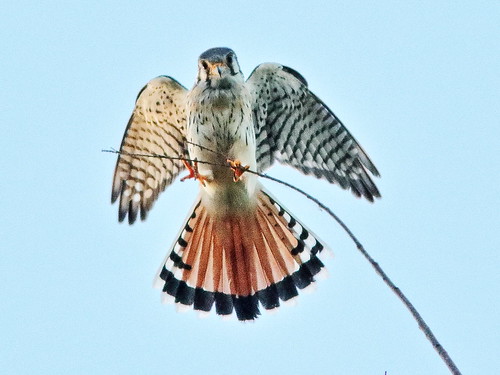
American Kestrel in flight:

American Kestrel 03-20180218

Merlin:

Merlin in flight 02-20191031

For several days, both falcons co-existed without signs of conflict:

American Kestrel and Merlin 01-20191101

The Merlin fanned its tail, possibly as a sign of aggression towards a grackle which landed (fearlessly) in an adjacent tree:

Merlin 4200K 01-20191101

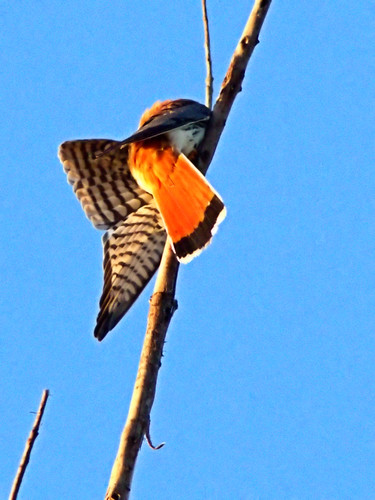
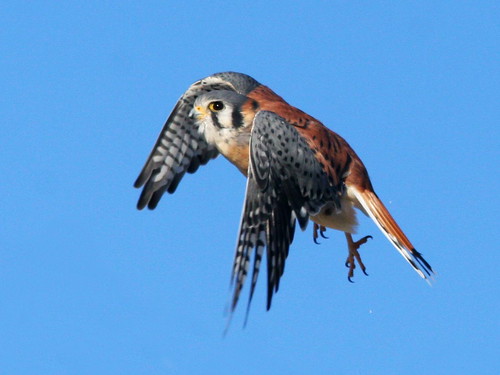
The male kestrel's plumage is especially colorful. His steel-blue wings contrast with copper-red tail and topside:

American Kestrel in flight 20180113

American Kestrel male 04-20191101

American Kestrel IL20101108

Nearly all the American Kestrels I have seen and photographed have been males. The female is also quite beautifully marked with barred brown wing coverts and matching back and tail:

American Kestrel female 2-20140301

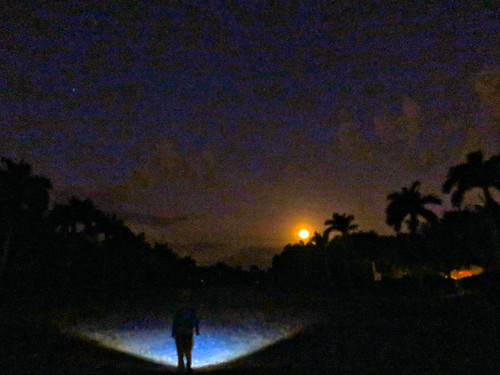
There was a full Beaver Moon in mid-November as we started  walking out about 40 minutes before sunrise. As usual, my child bride MaryLou was out ahead of me with her flashlight. (62 years ago, on November 22, 1957 I popped the question and we became engaged to marry). The Royal palms stand out against the dark sky in the southernmost winter territory of the kestrel:

Full Beaver Moon COREL 03-20191112

The Beaver Moon shines over the lake which is the zone of conflict between the north and central territories of the American Kestrels:

Beaver Moon looking west 20191113

Zebra heliconian, Florida's State  Butterfly on Firebush (Hamelia patens) flower:

Zebra heliconian 20191112


= = =  = = =  = = = =  = = = = =

Linking to Misty's  CAMERA CRITTERS,

Linking to Eileen's SATURDAY'S CRITTERS,

Linking to SKYWATCH FRIDAY by Yogi, Sylvia and Sandy

Linking to WEEKEND REFLECTIONS by James

Linking to BirdD'Pot by Anni

Linking to Our World Tuesday by Lady Fi

Linking to Wild Bird Wednesday by Stewart

Linking to Wordless Wednesday (on Tuesday) by NC Sue

Linking to ALL SEASONS by Jesh

________________________________________________

Please visit the links to all these memes to see some excellent photos on display
________________________________________________