Showing posts with label Coyote. Show all posts

Thursday, September 16, 2021

The eagles have landed, but...

There is drama at the local Bald Eagle nest. I have been observing the nest since it was "discovered" back in 2007. Over the years, the same male "Pride" has fathered 27 known eaglets, of which all but eight survived to fly freely. Pride's first mate was Joy, who disappeared just before the 2014-2015 breeding season after producing the first 13 eaglets, of which only two did not survive to fledge. 

Pride then paired up with Jewel in December, 2014 but it was either too late in the season, or she may have been too young to breed.  However Jewel went on to hatch out 14 more eaglets. As of now she has lost 6 of them. Two (and probably their newly hatched unseen nestmates) were assumed to have been killed in 2016 and 2020 when early spring storms disrupted the nest. In both seasons the pair went on to raise second broods of two eaglets. They lost one of these to unknown causes in 2016, but successfully raised both in 2020. 

Those two youngsters hatched 2-3 months later than usual. In normal years they would have fledged in April or May, but these two were dependent upon their parents well into late summer. This probably delayed the start of the 2020-2021 breeding season, which usually begins around October 1. The pair worked to build a new nest in a very precarious location, high in a limber Australian Pine with only two major supporting limbs. 

Eggs are normally deposited by early December and hatch in early to mid-January. Instead, their first egg was laid around February 1, 2021 and two eaglets hatched around March 7-12th. Normally the eaglets fledge at about 10 weeks of age.  A severe thunderstorm on April 11 damaged the flimsy nest and a week later the younger eaglet fell to the ground. The older sibling fell on April 28 and was recovered after 5 days of searching. 

Both eaglets suffered broken bones, but the injuries to the younger bird (P Piney 27) were more serious and eventually fatal, while the older sibling (P Piney 26, a male) was successfully rehabilitated and released to the wild on June 14. It was sad to see Jewel visit the site of the demolished nest several times during the summer. Suddenly Pride showed up and joined her on  Freed from the burden of rearing any eaglets, they instituted courtship and began rebuilding the failed nest.

On September 11. Pride occupied a dead branch near the site of the original (old) nest, about 100 yards away:

Jewel was roosting above the remains of the failed nest. This was not a good omen. Some researchers report that the female more frequently chooses the nest site. Her position corresponded to the placement of the main nest platform (bole). The empty space under her had been occupied by nesting material which collapsed during the storm and began the process resulting in the grounding of both eaglets: 


The next day, both adults were carrying sticks and exhibiting courtship behavior with copulation attempts. On the morning of September 14 the eagle watchers saw Jewel fly into a tree and attempt to break off a large dead branch. It would not budge...

...so she settled for a smaller one, indeed a twig...


...and added it to the sparse material already deposited in their restorative effort:

Some of the structure of the failed nest is still lodged below its original site. The nest was placed between the main trunk and a single side branch. We are not very optimistic about their chances this breeding season:

She then roosted nearby and Pride flew in to join her. They perched shoulder-to-shoulder. Jewel is to the left in these photos. Note her very long rear talon (hallux), a distinguishing characteristic of the female:

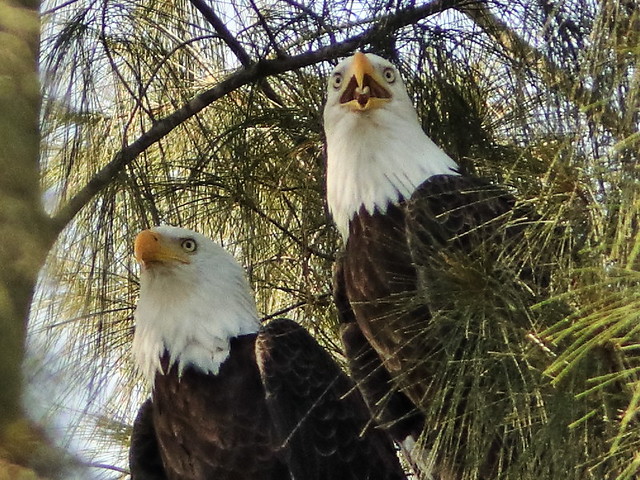

Both called together. Their fixed fierce facial expressions made the lovers' interaction look more like a hostile encounter: 

Fall migration is getting off to a slow start. Prairie Warblers have migrated "sideways" from their coastal breeding habitat:

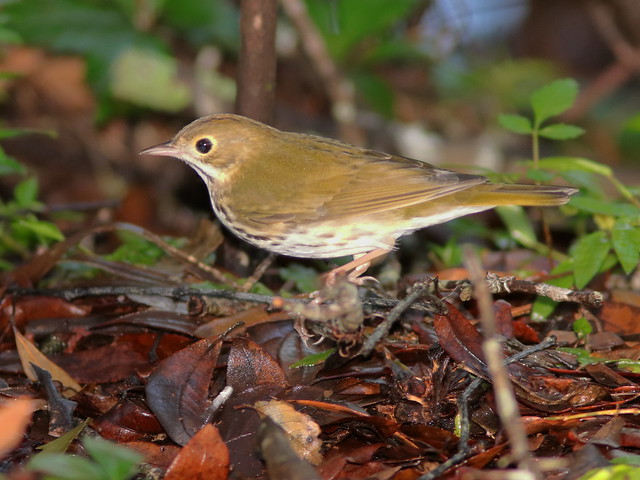
An Ovenbird foraged in the damp leaf litter:
Blue-gray Gnatcatchers flitted about actively, in search of insects:


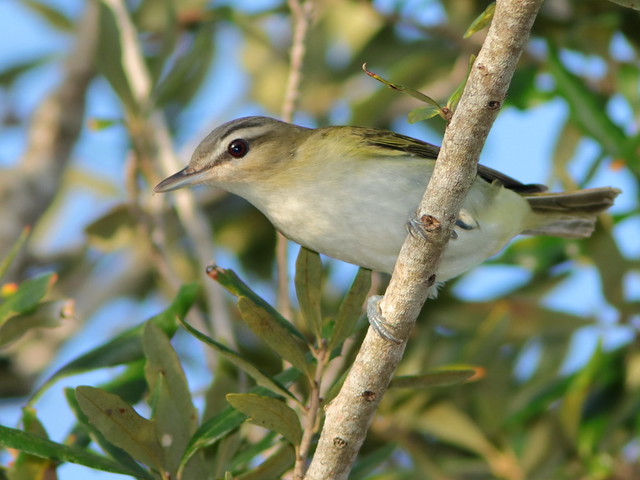
Sleek Red-eyed Vireos scavenged for ripe  berries:
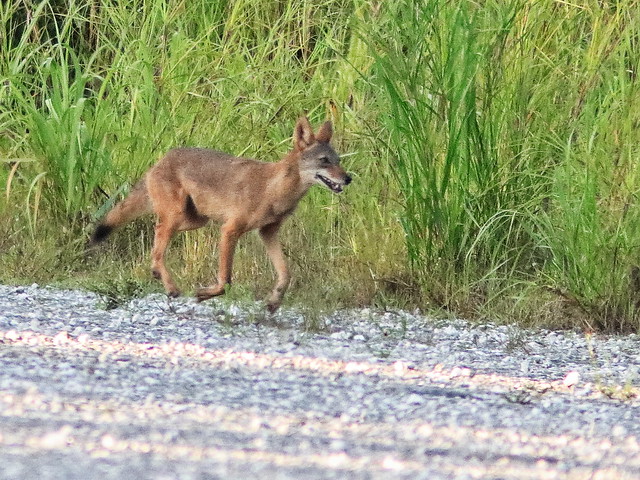
A distant Coyote crossed the path:

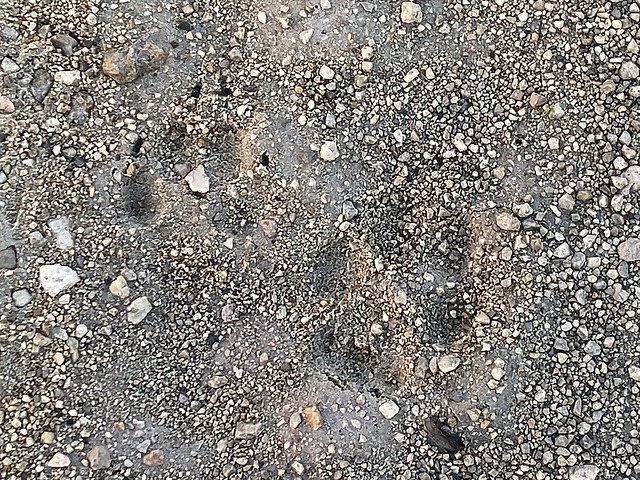
The Coyote's track was imprinted in moist sand. The smaller rear paw print is to the left of its front print:
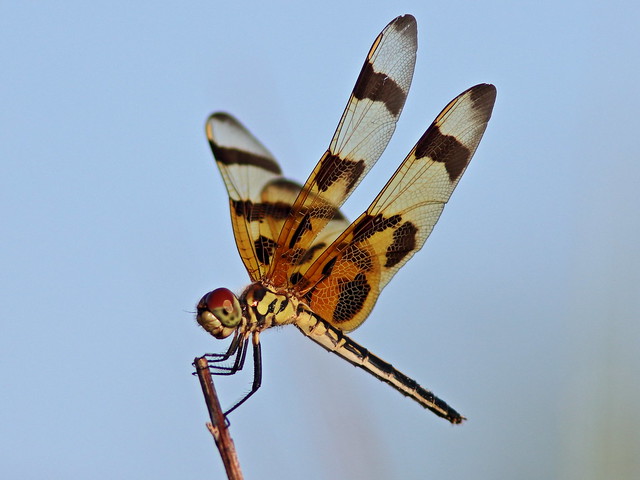
True to its name, a Halloween Pennant perched like a flag atop a tall stalk:
Just after sunrise, clouds reflected on the still surface of the lake:

= = =  = = =  = = = =  = = = = =

Linking to:

Garden Affair


Skywatch Friday

Weekend Reflections

Saturday's Critters

BirdD'Pot

Camera Critters

All Seasons

Wordless Wednesday (on Tuesday)

Natasha Musing

Our World Tuesday

________________________________________________

Please visit the links to all these posts to see some excellent photos on display
________________________________________________


 . 


Thursday, July 29, 2021

Late July Potpourri #974

It has been another week of clear morning skies and early afternoon downpours, some of which cut short our walks. The bird species list rarely breaks 20, but even the common birds can provide interesting sightings.

An immature Red-shouldered Hawk roosted high on an abandoned telephone pole:

The next morning it selected a cross-timber for preening:


A Great Egret preened lakeside before sunrise, its white plumage contrasting with the reflected pink sky on tranquil waters:


A bit later, the morning rays added contrast and a nice reflection: 

A distant Bald Eagle coursed above the lake:

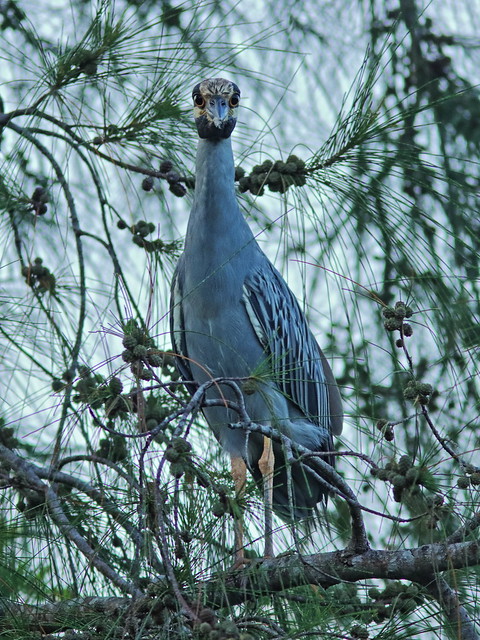
Early morning snaps suffer from underexposure. I could barely see this Yellow-crowned Night-Heron in the dark foliage but was surprised at the clarity of its image:

It turned to look straight at me. During breeding season its cap would have been white with a yellow tinge, but now it is streaked:


"Take me to your leader!"

At nearby Chapel Trail Nature Preserve, a perky juvenile Northern Cardinal perched on the boardwalk railing:

I am not sure whether it is a male or female. Young birds of both sexes somewhat resemble adult females, but their dark bills contrast with the bright red of their parents:

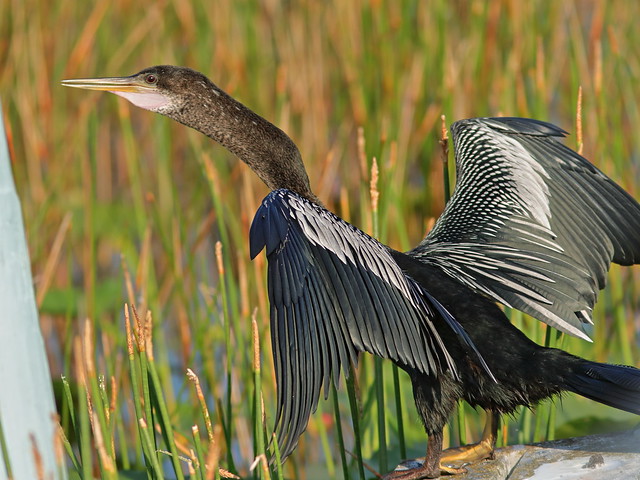
The post-breeding molt is in progress. This Anhinga revealed its motley tail feathers after it took flight. The central corrugated feather is fresh as compared to the worn ones about to be replaced:


This molting adult Northern Mockingbird's fresh tail feathers are emerging on top of the old worn ones:

This adult male Northern Cardinal also shows loss of feathers on his head, exposing his black facial skin:

To be kind to the birds when they are not in their best attire, I often back off to show their habitat. This male is harvesting the berries of a Trema tree:

Another juvenile cardinal chews on a the Trema fruit:

I was surprised to find a warbler, an American Redstart, also plucking the berries:

Redstarts are not commonly encountered here during midsummer, as they normally breed north of Florida. This one appears to be an adult female. It was the only one seen in our our County, of the three reported in all of south Florida during this month:

This week's biggest surprise was a Coyote crossing the gravel road in front of me. It was quite far away and the early morning light was not very intense, so my photos are soft:


I found a small patch of wild Poinsettia. The cultivated "Christmas Flowers" have an array of entirely red petal-like leaves (bracts) which surround the tiny yellow flowers:

Lingering Saharan dust continues to provide color at sunrise. The rising sun issues crepuscular solar rays...

...which converge as anti-crepuscular (anti-solar) rays over the Everglades to the west:

= = =  = = =  = = = =  = = = = =

Linking to:


Fences Around the World

Nature Thursday

Skywatch Friday

Weekend Reflections

Saturday's Critters

BirdD'Pot

Camera Critters

All Seasons

Wordless Wednesday (on Tuesday)

Natasha Musing

Our World Tuesday

________________________________________________

Please visit the links to all these posts to see some excellent photos on display
________________________________________________

Thursday, November 19, 2020

Finding furry and feathered fauna

Although we get out early in the local wetlands, we generally shelter in place at home for the greater part of the day. 

Our back yard lake attracts waders such as this Great Blue Heron:


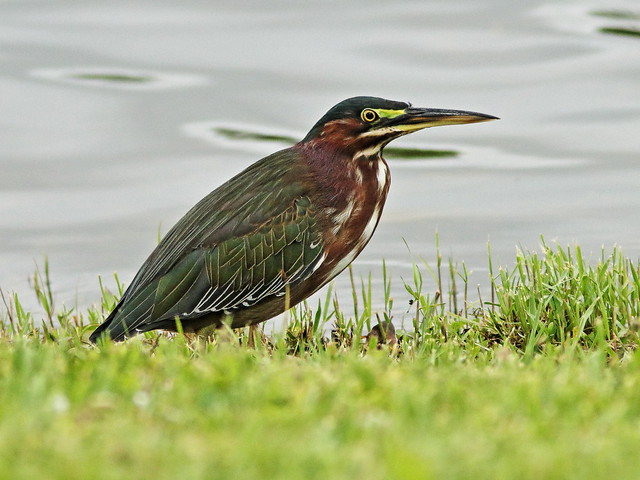
Green Herons are very skittish, so I was lucky to have this one stick in a spot visible from our patio:

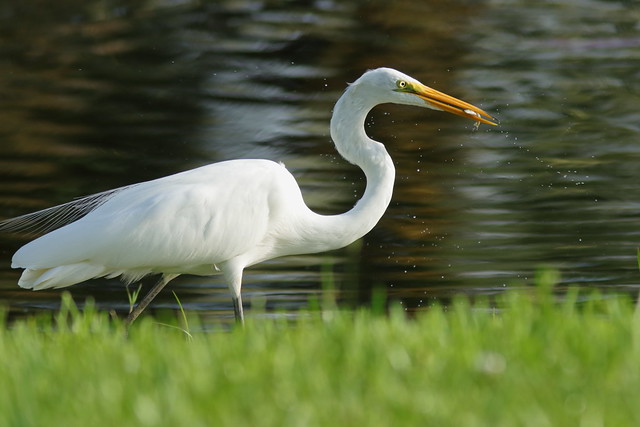
This Great Egret paid me no attention as it spied and then caught a small fish:


The fish wiggled violently and scattered water droplets, to no avail:


The first Yellow-bellied Sapsucker of the season, an immature bird which lacked the red on its head, started drilling sap wells on our Mahogany tree:


At the local Bald Eagle nest, the male "Pride" roosted nearby:

Out in the wetlands, a trio of white herons flew in together and walked in line, as if to show off their distinguishing characteristics:


A Snowy Egret led the parade, followed by an immature Little Blue Heron, the taller of the two, which has a black-tipped gray bill and shows a bit of blue on its head. The snowy Egret has a narrow black bill:


An adult Little Blue Heron was also present:


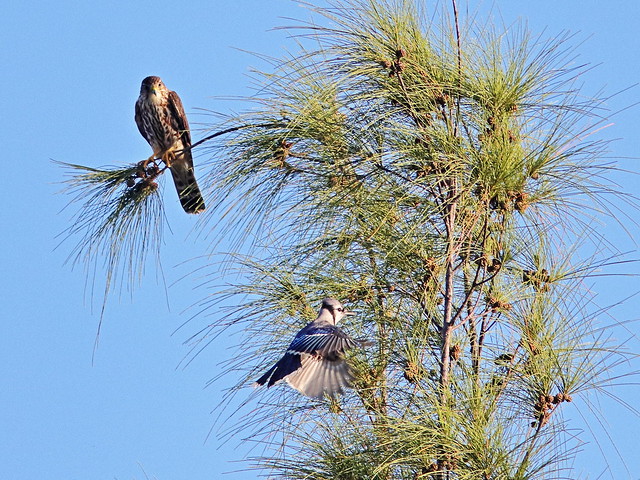
Along the levee trail, as I was peering into the dense  foliage of the fruiting ficus sp tree which I call the "warbler tree," a Merlin made frequent passes which kept the small birds in hiding. The falcon perched at the top of the tallest pine and had a commanding view of the surroundings:


I tried very hard to get photos of the Merlin in flight as it flew by rapidly and unpredictably, once right over my head:

It was  easier to capture it as it stalled before alighting on its roost:

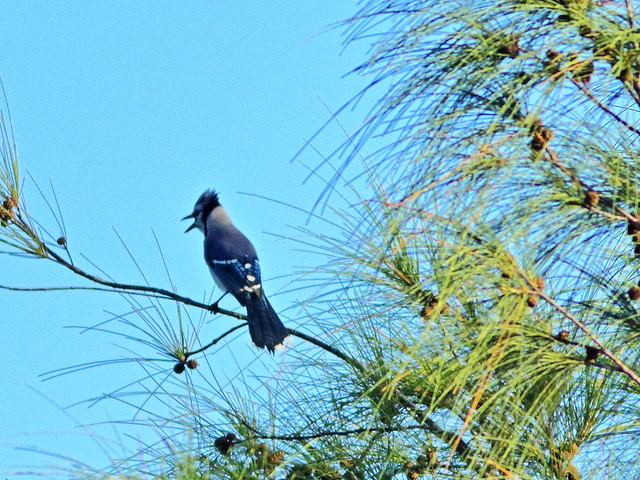
A courageous Blue Jay harassed the Merlin, which has been known to capture even larger birds:


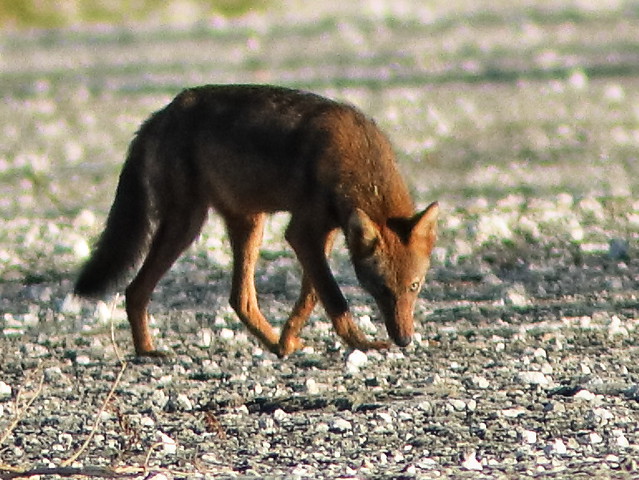
As I emerged from the high grass along the trail to an open area, I cautiously checked for mammals, usually an Opossum, Marsh Rabbit, Raccoon or even a Bobcat. This time I was rewarded by a Coyote with a reddish coat:


A Gulf Fritillary sipping nectar:

A Hunters Moon, also a Blue Moon as it was the second full Moon in October, was ready to disappear over the egret on the lake just before sunrise:

Slightly to the right, in the northwest sky, a streaming cloud caught the rays of the sun before they reached ground level:


= = =  = = =  = = = =  = = = = =

Linking to:


________________________________________________

Please visit the links to all these posts to see some excellent photos on display
________________________________________________