Showing posts with label Red-eyed Vireo. Show all posts

Thursday, September 16, 2021

The eagles have landed, but...

There is drama at the local Bald Eagle nest. I have been observing the nest since it was "discovered" back in 2007. Over the years, the same male "Pride" has fathered 27 known eaglets, of which all but eight survived to fly freely. Pride's first mate was Joy, who disappeared just before the 2014-2015 breeding season after producing the first 13 eaglets, of which only two did not survive to fledge. 

Pride then paired up with Jewel in December, 2014 but it was either too late in the season, or she may have been too young to breed.  However Jewel went on to hatch out 14 more eaglets. As of now she has lost 6 of them. Two (and probably their newly hatched unseen nestmates) were assumed to have been killed in 2016 and 2020 when early spring storms disrupted the nest. In both seasons the pair went on to raise second broods of two eaglets. They lost one of these to unknown causes in 2016, but successfully raised both in 2020. 

Those two youngsters hatched 2-3 months later than usual. In normal years they would have fledged in April or May, but these two were dependent upon their parents well into late summer. This probably delayed the start of the 2020-2021 breeding season, which usually begins around October 1. The pair worked to build a new nest in a very precarious location, high in a limber Australian Pine with only two major supporting limbs. 

Eggs are normally deposited by early December and hatch in early to mid-January. Instead, their first egg was laid around February 1, 2021 and two eaglets hatched around March 7-12th. Normally the eaglets fledge at about 10 weeks of age.  A severe thunderstorm on April 11 damaged the flimsy nest and a week later the younger eaglet fell to the ground. The older sibling fell on April 28 and was recovered after 5 days of searching. 

Both eaglets suffered broken bones, but the injuries to the younger bird (P Piney 27) were more serious and eventually fatal, while the older sibling (P Piney 26, a male) was successfully rehabilitated and released to the wild on June 14. It was sad to see Jewel visit the site of the demolished nest several times during the summer. Suddenly Pride showed up and joined her on  Freed from the burden of rearing any eaglets, they instituted courtship and began rebuilding the failed nest.

On September 11. Pride occupied a dead branch near the site of the original (old) nest, about 100 yards away:

Jewel was roosting above the remains of the failed nest. This was not a good omen. Some researchers report that the female more frequently chooses the nest site. Her position corresponded to the placement of the main nest platform (bole). The empty space under her had been occupied by nesting material which collapsed during the storm and began the process resulting in the grounding of both eaglets: 


The next day, both adults were carrying sticks and exhibiting courtship behavior with copulation attempts. On the morning of September 14 the eagle watchers saw Jewel fly into a tree and attempt to break off a large dead branch. It would not budge...

...so she settled for a smaller one, indeed a twig...


...and added it to the sparse material already deposited in their restorative effort:

Some of the structure of the failed nest is still lodged below its original site. The nest was placed between the main trunk and a single side branch. We are not very optimistic about their chances this breeding season:

She then roosted nearby and Pride flew in to join her. They perched shoulder-to-shoulder. Jewel is to the left in these photos. Note her very long rear talon (hallux), a distinguishing characteristic of the female:

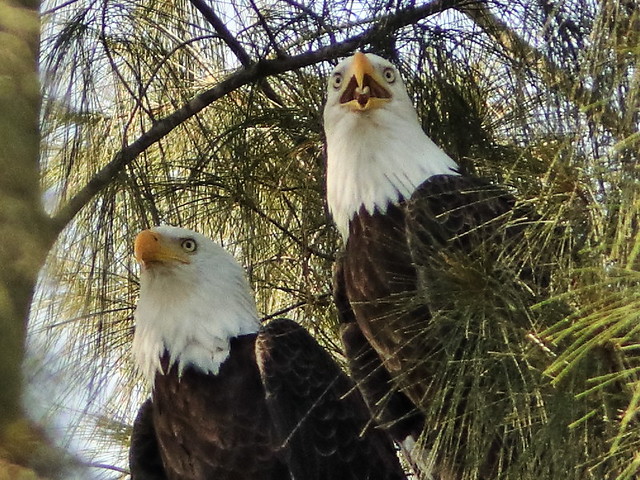

Both called together. Their fixed fierce facial expressions made the lovers' interaction look more like a hostile encounter: 

Fall migration is getting off to a slow start. Prairie Warblers have migrated "sideways" from their coastal breeding habitat:

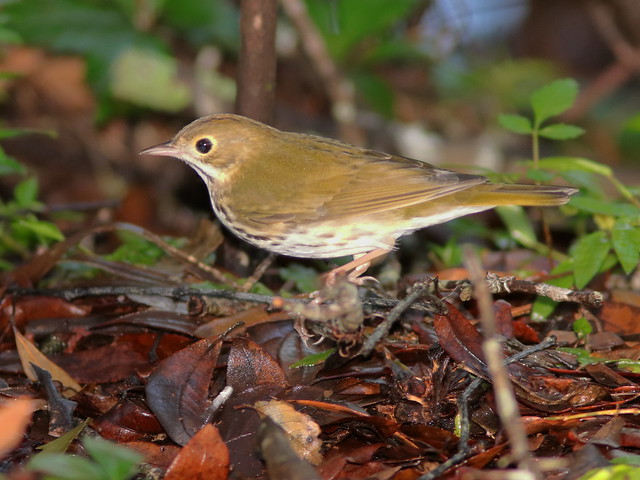
An Ovenbird foraged in the damp leaf litter:
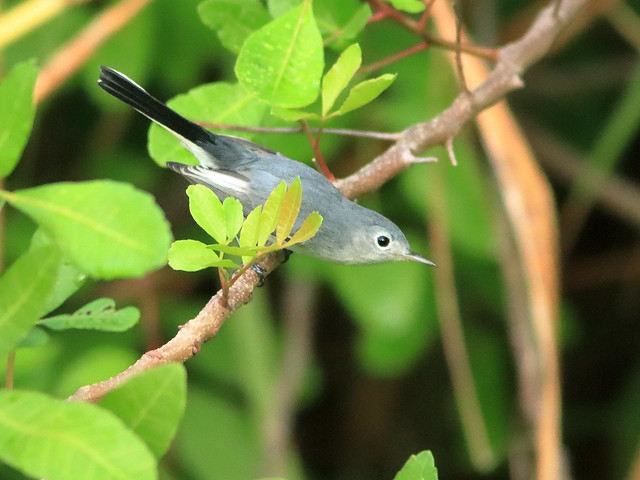
Blue-gray Gnatcatchers flitted about actively, in search of insects:


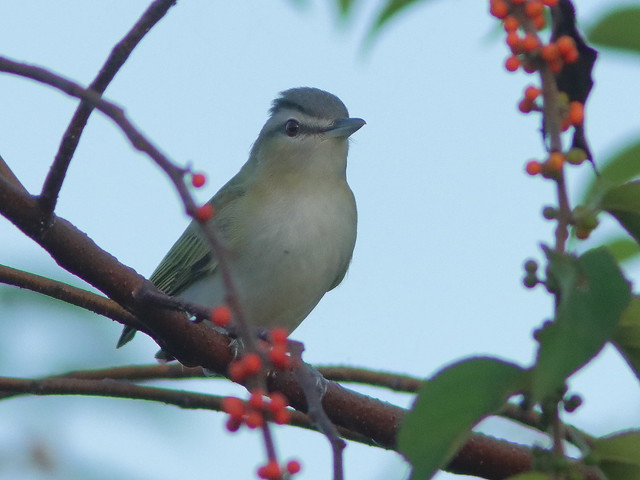
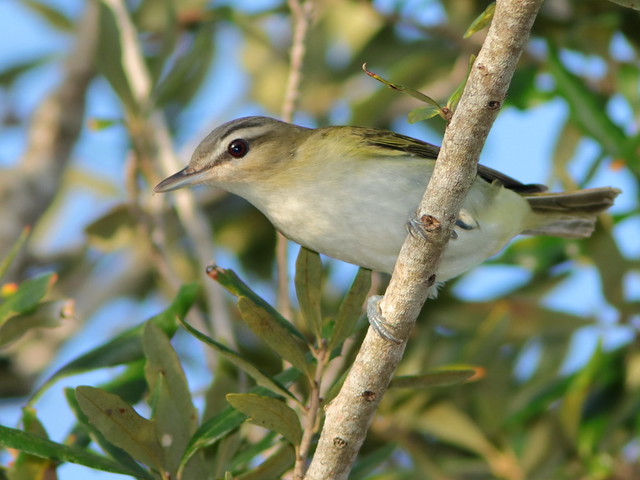
Sleek Red-eyed Vireos scavenged for ripe  berries:
A distant Coyote crossed the path:

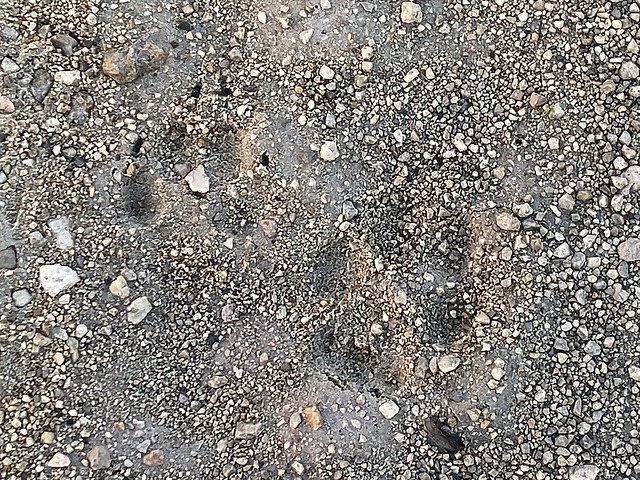
The Coyote's track was imprinted in moist sand. The smaller rear paw print is to the left of its front print:
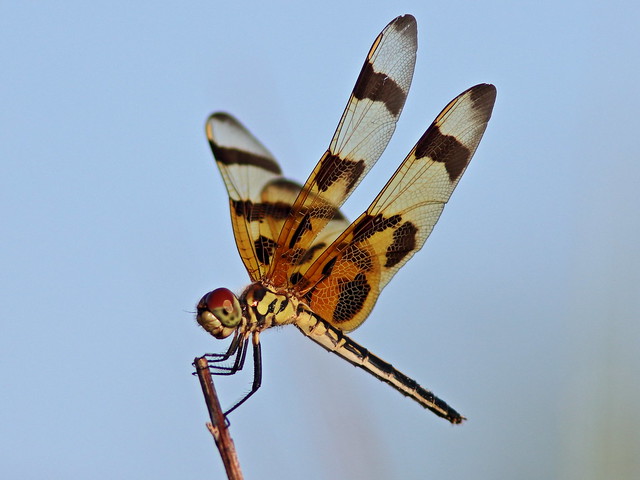
True to its name, a Halloween Pennant perched like a flag atop a tall stalk:
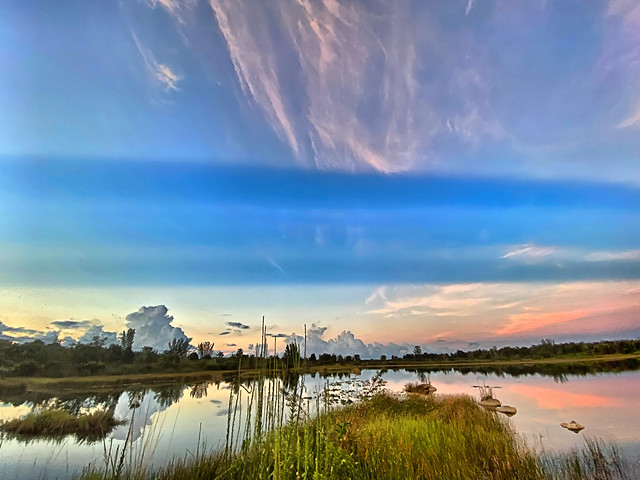
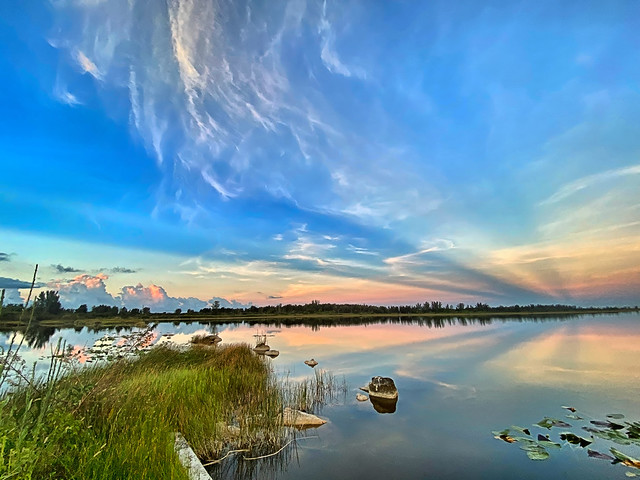
Just after sunrise, clouds reflected on the still surface of the lake:

= = =  = = =  = = = =  = = = = =

Linking to:

Garden Affair


Skywatch Friday

Weekend Reflections

Saturday's Critters

BirdD'Pot

Camera Critters

All Seasons

Wordless Wednesday (on Tuesday)

Natasha Musing

Our World Tuesday

________________________________________________

Please visit the links to all these posts to see some excellent photos on display
________________________________________________


 . 


Wednesday, September 8, 2021

Avian Red-eye special

Scores of Florida Trema trees* in our local Wounded Wetlands were destroyed by Hurricane Irma back in October, 2017. Nearly all the taller ones were either felled or stripped of their leaves. Most went on to die within a year. Those remaining were mostly saplings which flowered but did not bear the fruit which is so attractive to wildlife. Tremas normally produce abundant berries just in time for autumn migration. This year, some of them have matured and been very productive.
Southbound Red-eyed Vireos usually arrive ahead of most of the other songbirds, often by mid-August and become quite common by early September. On the first day of September, a half hour after sunrise, a flock of five were eating the Trema berries: 


Three days later, just after sunrise, lighting conditions were poor. I did not carry my flash unit, but the vireos provided some nice views as they harvested the fruit:


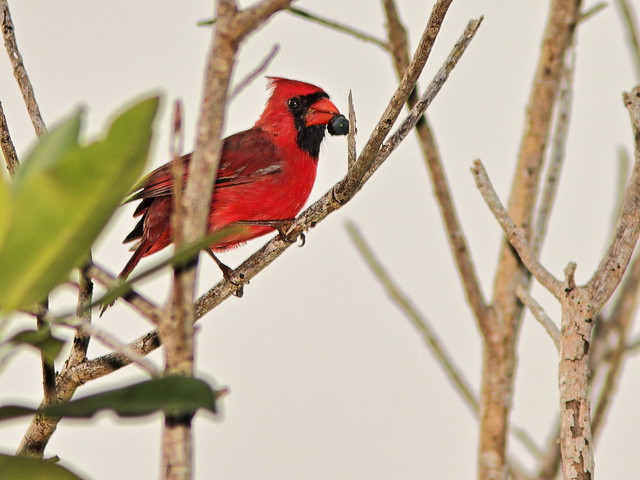
A male Northern Cardinal joined in the feast. His tail feathers were molting::


I wondered why one of my favorite warbler spots was so quiet. Blue Jays were calling from hidden perches in the area. Then this Cooper's Hawk flew in from an adjacent tree. This species is a "true hawk" ( Accipiter) with compact body, short wings and long tail suited for chasing smaller birds through the branches:


The hawk took off, but patrolled the area and returned several times:

Spotted Sandpipers are returning. In spring and summer they have spotted breasts, like this "early bird" on July 11:

Adults like this one photographed on September 3, have clear breasts in fall and winter:

African dust lingered in the atmosphere just before sunrise on August 31, showcasing the dark shadows cast by cloud tops over the Atlantic Ocean. I followed the emerging solar (crepuscular) beams...

...across the southern horizon. Though straight as an arrow, they seemed to curve down opposite the Sun...

...appearing to cluster with other cloud shadows as an anti-solar (anticrepuscular) mirrored "sunrise:"


*Florida Trema (Trema micrantha) is a shrub or small tree up to 10 m tall. It is grouped with Hackberry and Hemp in Tree Family CANNABACEAE.  Leaves are egg-shaped, up to 9 cm long, green on top but covered with white, woolly pubescence underneath. Flowers are greenish-white. Fruits are yellow to bright reddish-orange, up to 4 mm in diameter.

REF: https://www.southfloridatrees.org/?page_id=530

= = =  = = =  = = = =  = = = = =

Linking to:


Skywatch Friday

Weekend Reflections

Saturday's Critters

BirdD'Pot

Camera Critters

All Seasons

Wordless Wednesday (on Tuesday)

Natasha Musing

Our World Tuesday

________________________________________________

Please visit the links to all these posts to see some excellent photos on display
________________________________________________

Thursday, September 24, 2020

Walking Bar Ditch Trail

Despite the threatening afternoon clouds and thunder almost every afternoon, we received relatively little rainfall during August. I was anxious to take advantage of the fact that the Bar Ditch Trail might still be dry. An hour before sunrise on September 5, I set out in the pitch dark, planning to walk back after about two hours, before the sun got too hot. Indeed, the path was not flooded and even dryer than my last walk a few weeks before.

High clouds persisted after sunrise. The shade was welcome, but made it difficult to identify and photograph some birds in dark foliage against the ground-glass sky. One rather large bird showed very little color. Its very large bill stood out. Luckily, I had attached a flash unit. Before it flew off I captured a burst of full-color images which revealed it to be a female Summer Tanager, only the third I have recorded in my patch over the past ten or more years: 

Summer Tanager 01-20200905

Summer Tanager 03-20200905

Summer Tanager 04-20200905

Earlier, I heard the call of a Green Heron but could barely see it:

Green Heron 20200905

About five minutes before sunrise, an adult Bald Eagle passed overhead against an amorphous pink sky. Its image is grainy at 1/1000 second exposure and ISO of 6400, but I like the effects:

Bald Eagle 02-20200909

Blue-gray Gnatcatchers were numerous:

Blue-gray Gnatcatcher 01-20200908

Blue-gray Gnatcatcher 0220200907

A male Northern Cardinal carried a berry:

Northern Cardinal male 02-20200905

A female cardinal with a berry-stained bill peered out of the shadows:

Northern Cardinal female 20200908

My flash brightened up a female Prairie Warbler...

Prairie Warbler female 01-20200908

...and brought out the hooked bill but  not the eye color of a Red-eyed Vireo:

Red-eyed Vireo 20200908

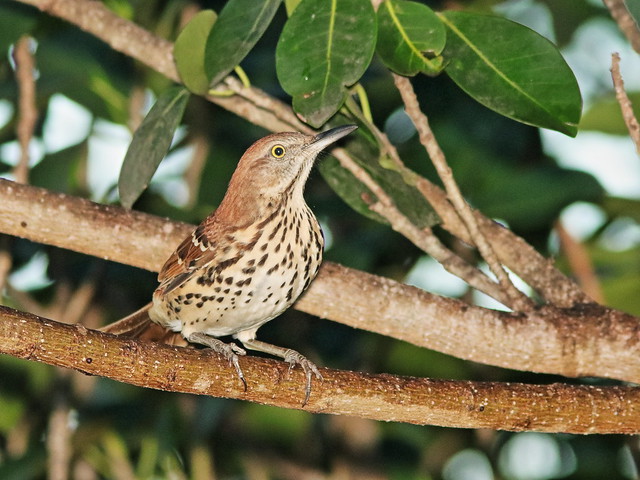
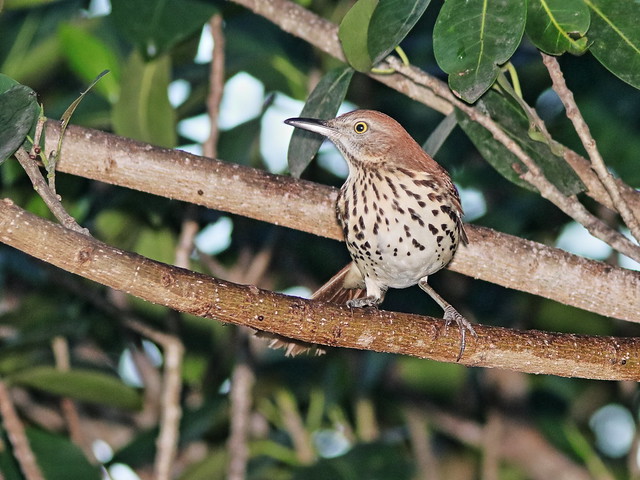
A Brown Thrasher scolded me briefly:

Brown Thrasher 09-20200909

Brown Thrasher 08-20200909

A Loggerhead Shrike kept watch from a treetop:

Loggerhead Shrike 02-20200908

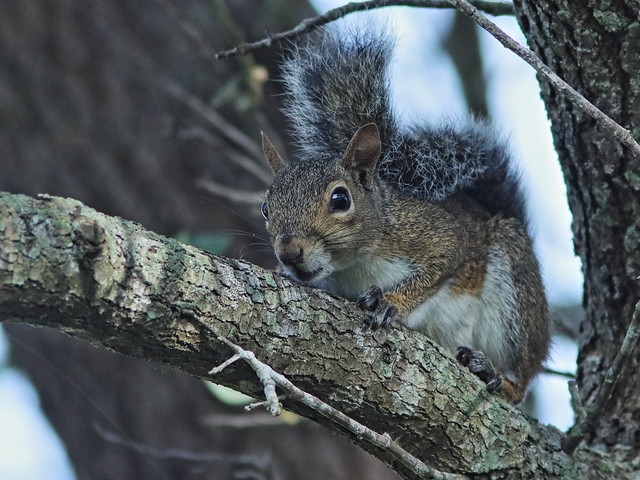
A Gray Squirrel was almost invisible as it crouched on a limb. I think I can see my reflection in its eye:

Gray Squirrel 01-20200907

Sunrise over the Bar Ditch Trail:

Bar Ditch Trail 03-20200905

This is my favorite stop along the far reaches of the trail. Here the ditch widens a bit and is surrounded by Cattails and Sawgrass:

Bar Ditch Trail and ditch  05-20200905

Back on September 3, the Corn Moon reflected in the lake in pre-dawn twilight:

Corn Moon 02-20200903

While photographing the Moon, about 10 minutes before sunrise, I caught motion out of the corner of my eye. It was a Coyote, carrying something in its mouth:

Coyote with prey or cub 02-20200903

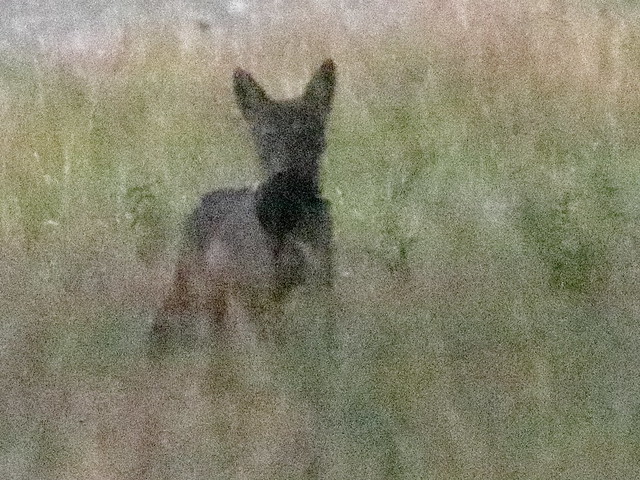
I then adjusted my camera settings to "see in the dark" by manually cranking the ISO up to an unprecedented 25,600, which allowed the shutter to function at 1/1000. The results were poor, but I hoped to identify whatever the Coyote was carrying. Was it a prey item, or possibly one of its pups. It might be relocating its den?  

 Coyote with prey or cub 01-20200903

The (same?) Coyote soon walked out from the same area of brush. It appeared to be a female with swollen teats. She wandered off to the north, sniffing here and there as if hunting:

Coyote prob female 06-20200903

Moments later, a second Coyote emerged. This looked like it was probably a male, larger and with a robust tail:

Coyote prob male 02-20200903

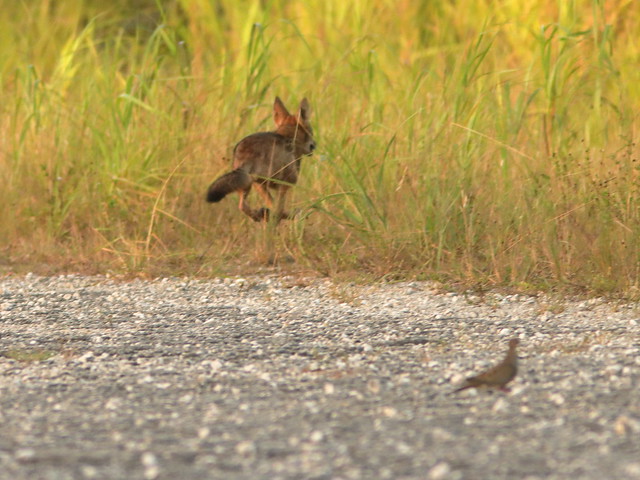
To my surprise, when I turned around, a third Coyote was staring at me. As soon as I raised my camera it fled (a Mourning Dove stood by):

Coyote third one  05-20200903

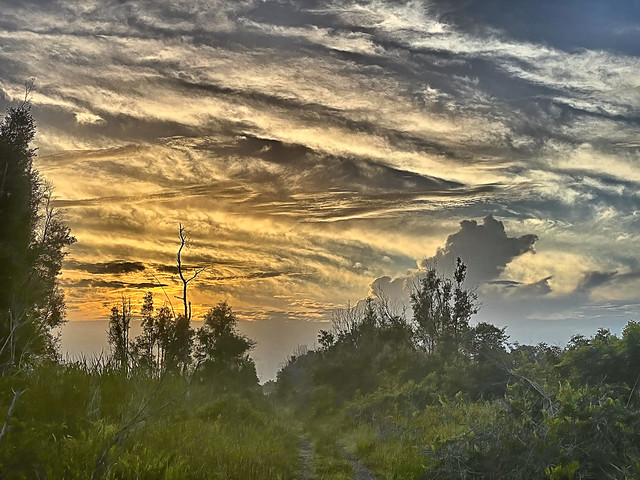
On the way home, looking back from the Levee Trailhead, clouds were gathering to the south:

Levee Trail 02-20200908

Are those birds flying or angels dancing?

Angels dancing 02-20200908

Links to earlier posts about the Bar Ditch Trail (the last two tell how things were here ten years ago, quite a contrast now in the Wounded Wetlnads): 

https://rosy-finch.blogspot.com/2020/09/beauty-is-in-eye-of-barn-owl.html

https://rosy-finch.blogspot.com/2020/04/bobcat-on-bar-ditch-trail.html

http://blog.rosyfinch.com/?p=275

http://blog.rosyfinch.com/?p=274

= = =  = = =  = = = =  = = = = =

Linking to:

Skywatch Friday

Weekend Reflections

Saturday's Critters

BirdD'Pot

Camera Critters

All Seasons

Wordless Wednesday (on Tuesday)

Natasha Musing

Our World Tuesday

________________________________________________

Please visit the links to all these posts to see some excellent photos on display
________________________________________________