Showing posts with label sunrise. Show all posts

Thursday, November 11, 2021

Back yard visions and decisions

Even though my condition prevents me from traveling far and wide, I do keep an eye on our back yard lake. Two very similar birds appeared together on November 2.

They represent our two largest tern species...

The Caspian Tern is largest and has a massive bright red bill. Its dark cap extends through the eyes into the forehead. Usually the tip of its bill is black, but apparently not on this specimen:


The dark cap of the streamlined Royal Tern generally does not extend in front of its eyes. Its longer tail is deeply forked and its bill is slender and more orange than red:


This female Anhinga believes she "owns" a spot at the edge of our lawn. The morning sun and prevailing easterly wind helps dry her extended wings:

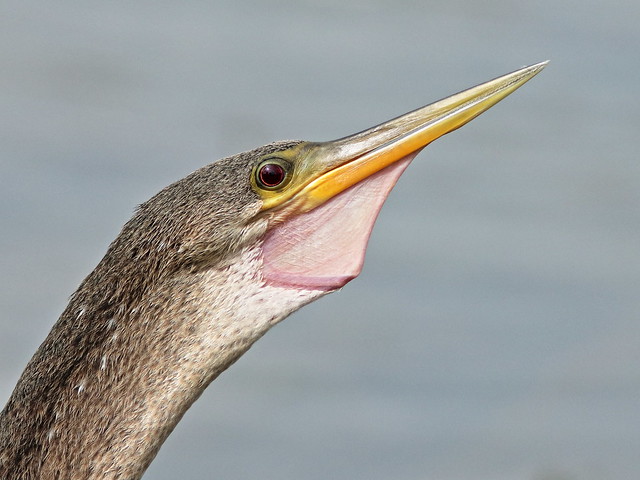
Threatened by my approach, she inflated her gular pouch:
A Great Egret was so nearby that it was necessary to rotate the camera for a portrait exposure:

When the egret extended its neck I had to back away and process the image uncropped:

A Tricolored Heron rested at lakeshore:

Across the lake, another Great Egret hunted intently:


An Osprey passed overhead:


An angry red sunrise on November 2:


Today marks the fourth week since my surgery. The primary cancer in the cecum had not penetrated the colon and there was no evidence of local or lymph node spread. However, there were two small metastatic nodules in my liver. One was removed completely. The other was entirely ablated (cooked) with microwave energy. 

The minimally invasive laparoscopic colon and liver surgeries were done in sequence by two surgical teams and each took about 2 hours. I feel very good right now and undergoing tests to determine whether any hidden metastases may be secreting tumor DNA into my bloodstream. 

At my age (86) the possible benefits of chemotherapy are uncertain. It seems to be a choice between quality versus prolongation of life. Decisions are complicated by  the fact that we are in the middle of selling our Florida home and moving to Connecticut. 

= = =  = = =  = = = =  = = = = =

Linking to:


Garden Affair

Nature Thursday

Skywatch Friday

Weekend Reflections

Saturday's Critters

BirdD'Pot

Camera Critters

All Seasons

Wordless Wednesday (on Tuesday)

Natasha Musing

Our World Tuesday

________________________________________________

Please visit the links to all these posts to see some excellent photos on display
________________________________________________
Thursday, October 28, 2021

My Patch list # 1-10

My health condition now (hopefully temporarily) prevents me from straying very far from home. Therefore I will take advantage of my forced leisure to reflect on the birds I have seen since moving from New Mexico to south Florida. This list only includes bird species seen in our back yard and the preserve adjacent to our home, the West Miramar Water Conservation Area in Broward County, Florida (AKA "Wounded Wetlands"). 

We moved to Florida in 2004, but I only started to report sightings on eBird late in 2008. I did not take up photography until 2008 and deemed two of my earlier sightings important enough to report retroactively. I  picked out a representative photo of each species, not necessarily the first one taken, but always one among many from the Wounded Wetlands. My checklist includes a total of 185 species to date for this location, most of which I eventually photographed here. 

# 1. American Flamingo, 12 Jul 2005

I was fishing in our back yard lake when I looked up in amazement as a flock of four long-legged, crooked-billed flamingos coursed from south to north right over in front of me. I was not sure at the time that this was a most unusual sighting, indeed the first flock reported locally in several years. I saw four again over the lake the next evening, flying almost the same course. 

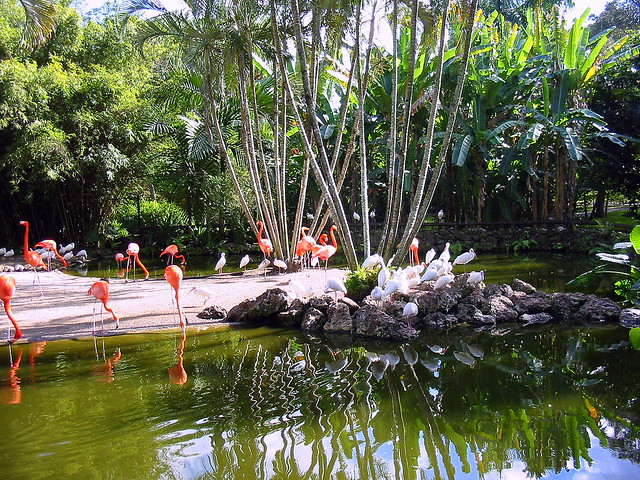
Flamingos once roamed extensively over South Florida, but in recent years the only reliable sightings were of a flock at the southern tip of the peninsula at Snake Bight. Inquiries about all known captive flamingos confirmed that none had escaped. Here is a photo of those in the nearest flock, confined in Flamingo Gardens:

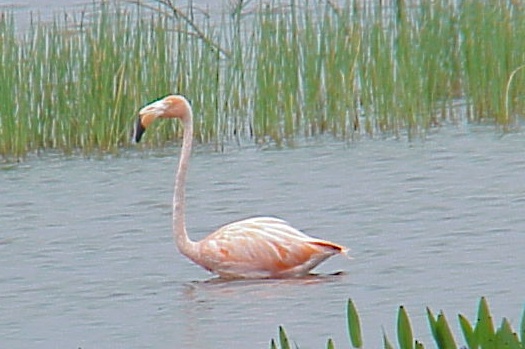
I put the word out on the Internet and others discovered them, a flock of "seven or eight or up to twenty" foraging in a wetland preserve adjacent to the north end of my Patch. I was not carrying a camera, but David Tringo, a neighbor, took this photo and kindly permitted me to publish it: 


# 2. Savannah Sparrow, 26 Dec 2008. This is a photo of one in November, 2018:

# 3. Rock Pigeon, 23 Oct 2009. That day I photographed a feral albino specimen, very likely an escapee from a wedding celebration or peace demonstration:

# 4. White-winged Dove, 23 Oct 2009. This one was looking for nesting materials on our driveway:

# 5. Mourning Dove. 23 Oct 2009. 

# 6. Killdeer, 23 Oct 2009

# 7. Anhinga, 23 Oct 2009

# 8. Double-crested Cormorant, 23 Oct 2009

# 9. Great Blue Heron, 23 Oct 2009

# 10. Great Egret, 23 Oct 2009

Our walks usually started out about an hour before sunrise, to take advantage of the cooler temperatures and listen to the owls and nightjars. The peninsula in the wetlands lake provided a wide open view over the Everglades to the west.   An advantage to being a stay-at-home birder is that I can see the sunrise on the eastern horizon, which is obscured by the trees out in the wetlands. 

The morning after I got home from the hospital this was the view of sunrise from our back patio:

A flock of White Ibises foraged on the lawn of a home across the lake:

Later in the day the overcast sky provided a shadow-less view of a Great Egret, which hurried along our lawn. It appeared to be intently watching a prey item along the shore:

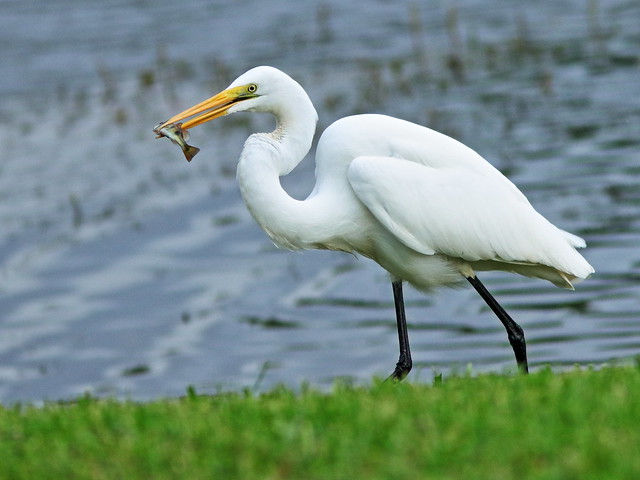
It plunged and came up with a small Peacock Bass:


= = =  = = =  = = = =  = = = = =

Linking to:


Garden Affair


Skywatch Friday

Weekend Reflections

Saturday's Critters

BirdD'Pot

Camera Critters

All Seasons

Wordless Wednesday (on Tuesday)

Natasha Musing

Our World Tuesday

________________________________________________

Please visit the links to all these posts to see some excellent photos on display
________________________________________________

Thursday, September 16, 2021

The eagles have landed, but...

There is drama at the local Bald Eagle nest. I have been observing the nest since it was "discovered" back in 2007. Over the years, the same male "Pride" has fathered 27 known eaglets, of which all but eight survived to fly freely. Pride's first mate was Joy, who disappeared just before the 2014-2015 breeding season after producing the first 13 eaglets, of which only two did not survive to fledge. 

Pride then paired up with Jewel in December, 2014 but it was either too late in the season, or she may have been too young to breed.  However Jewel went on to hatch out 14 more eaglets. As of now she has lost 6 of them. Two (and probably their newly hatched unseen nestmates) were assumed to have been killed in 2016 and 2020 when early spring storms disrupted the nest. In both seasons the pair went on to raise second broods of two eaglets. They lost one of these to unknown causes in 2016, but successfully raised both in 2020. 

Those two youngsters hatched 2-3 months later than usual. In normal years they would have fledged in April or May, but these two were dependent upon their parents well into late summer. This probably delayed the start of the 2020-2021 breeding season, which usually begins around October 1. The pair worked to build a new nest in a very precarious location, high in a limber Australian Pine with only two major supporting limbs. 

Eggs are normally deposited by early December and hatch in early to mid-January. Instead, their first egg was laid around February 1, 2021 and two eaglets hatched around March 7-12th. Normally the eaglets fledge at about 10 weeks of age.  A severe thunderstorm on April 11 damaged the flimsy nest and a week later the younger eaglet fell to the ground. The older sibling fell on April 28 and was recovered after 5 days of searching. 

Both eaglets suffered broken bones, but the injuries to the younger bird (P Piney 27) were more serious and eventually fatal, while the older sibling (P Piney 26, a male) was successfully rehabilitated and released to the wild on June 14. It was sad to see Jewel visit the site of the demolished nest several times during the summer. Suddenly Pride showed up and joined her on  Freed from the burden of rearing any eaglets, they instituted courtship and began rebuilding the failed nest.

On September 11. Pride occupied a dead branch near the site of the original (old) nest, about 100 yards away:

Jewel was roosting above the remains of the failed nest. This was not a good omen. Some researchers report that the female more frequently chooses the nest site. Her position corresponded to the placement of the main nest platform (bole). The empty space under her had been occupied by nesting material which collapsed during the storm and began the process resulting in the grounding of both eaglets: 


The next day, both adults were carrying sticks and exhibiting courtship behavior with copulation attempts. On the morning of September 14 the eagle watchers saw Jewel fly into a tree and attempt to break off a large dead branch. It would not budge...

...so she settled for a smaller one, indeed a twig...


...and added it to the sparse material already deposited in their restorative effort:

Some of the structure of the failed nest is still lodged below its original site. The nest was placed between the main trunk and a single side branch. We are not very optimistic about their chances this breeding season:

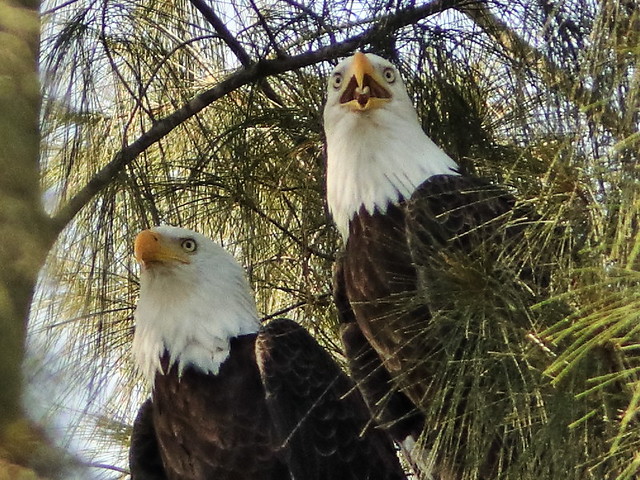
She then roosted nearby and Pride flew in to join her. They perched shoulder-to-shoulder. Jewel is to the left in these photos. Note her very long rear talon (hallux), a distinguishing characteristic of the female:


Both called together. Their fixed fierce facial expressions made the lovers' interaction look more like a hostile encounter: 

Fall migration is getting off to a slow start. Prairie Warblers have migrated "sideways" from their coastal breeding habitat:

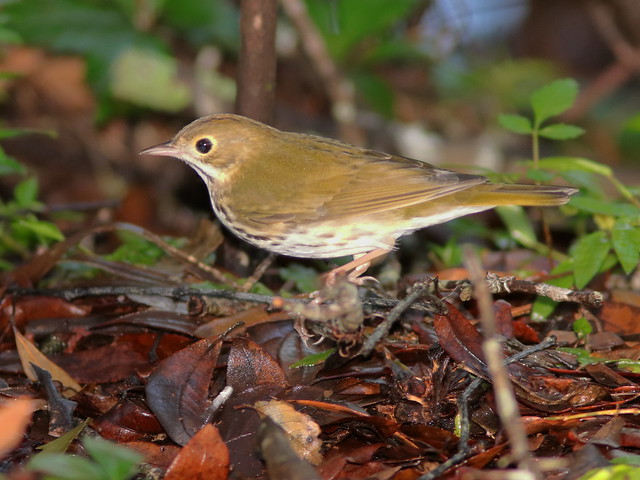
An Ovenbird foraged in the damp leaf litter:

Blue-gray Gnatcatchers flitted about actively, in search of insects:


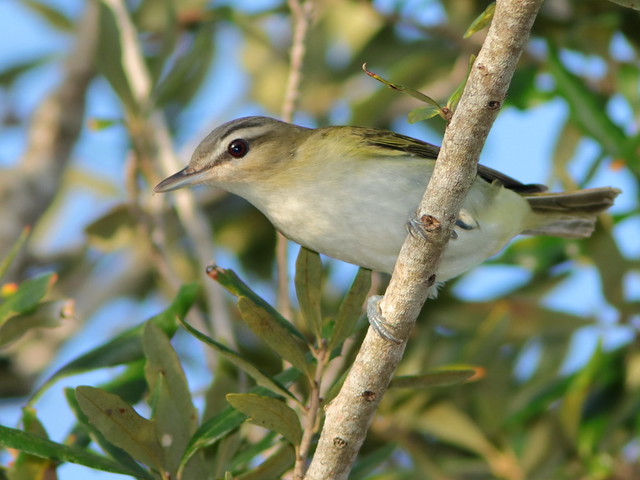
Sleek Red-eyed Vireos scavenged for ripe  berries:

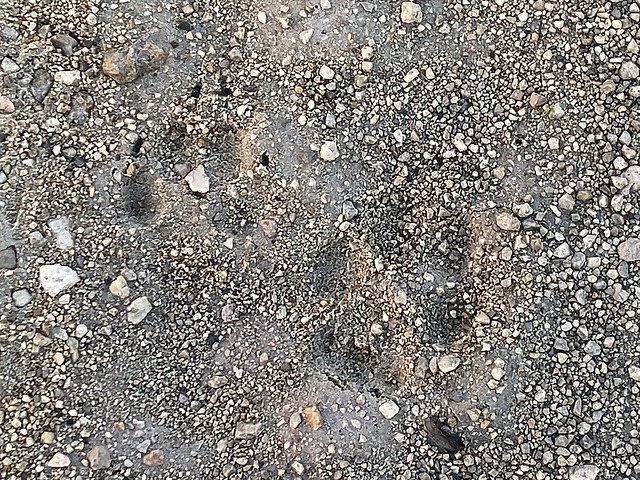
A distant Coyote crossed the path:

The Coyote's track was imprinted in moist sand. The smaller rear paw print is to the left of its front print:

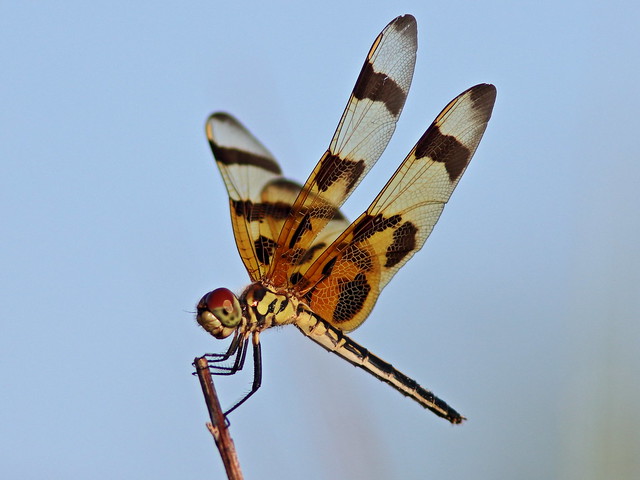
True to its name, a Halloween Pennant perched like a flag atop a tall stalk:

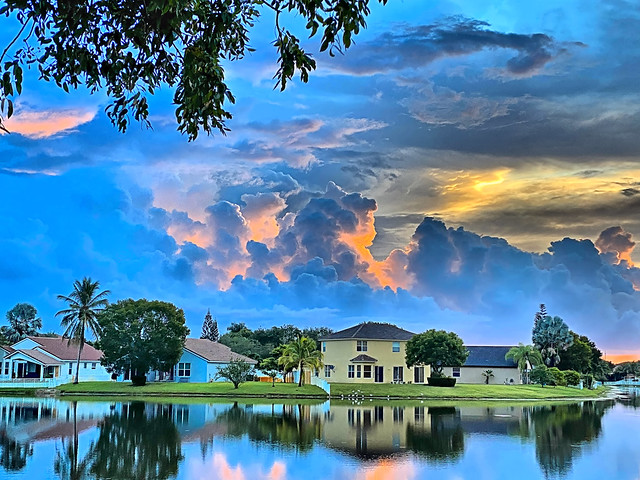
Just after sunrise, clouds reflected on the still surface of the lake:

= = =  = = =  = = = =  = = = = =

Linking to:

Garden Affair


Skywatch Friday

Weekend Reflections

Saturday's Critters

BirdD'Pot

Camera Critters

All Seasons

Wordless Wednesday (on Tuesday)

Natasha Musing

Our World Tuesday

________________________________________________

Please visit the links to all these posts to see some excellent photos on display
________________________________________________


 .