Showing posts with label Summer Tanager. Show all posts

Thursday, September 24, 2020

Walking Bar Ditch Trail

Despite the threatening afternoon clouds and thunder almost every afternoon, we received relatively little rainfall during August. I was anxious to take advantage of the fact that the Bar Ditch Trail might still be dry. An hour before sunrise on September 5, I set out in the pitch dark, planning to walk back after about two hours, before the sun got too hot. Indeed, the path was not flooded and even dryer than my last walk a few weeks before.

High clouds persisted after sunrise. The shade was welcome, but made it difficult to identify and photograph some birds in dark foliage against the ground-glass sky. One rather large bird showed very little color. Its very large bill stood out. Luckily, I had attached a flash unit. Before it flew off I captured a burst of full-color images which revealed it to be a female Summer Tanager, only the third I have recorded in my patch over the past ten or more years: 

Summer Tanager 01-20200905

Summer Tanager 03-20200905

Summer Tanager 04-20200905

Earlier, I heard the call of a Green Heron but could barely see it:

Green Heron 20200905

About five minutes before sunrise, an adult Bald Eagle passed overhead against an amorphous pink sky. Its image is grainy at 1/1000 second exposure and ISO of 6400, but I like the effects:

Bald Eagle 02-20200909

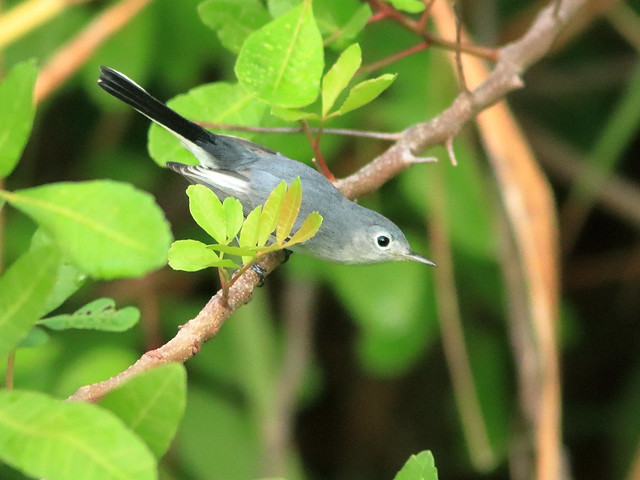
Blue-gray Gnatcatchers were numerous:

Blue-gray Gnatcatcher 01-20200908

Blue-gray Gnatcatcher 0220200907

A male Northern Cardinal carried a berry:
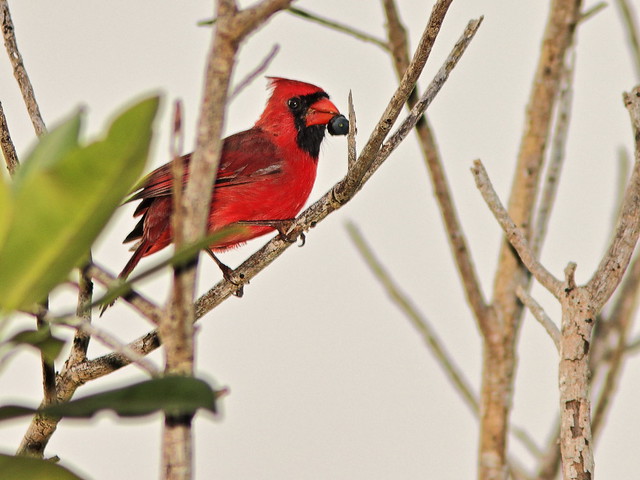
Northern Cardinal male 02-20200905

A female cardinal with a berry-stained bill peered out of the shadows:

Northern Cardinal female 20200908

My flash brightened up a female Prairie Warbler...

Prairie Warbler female 01-20200908

...and brought out the hooked bill but  not the eye color of a Red-eyed Vireo:

Red-eyed Vireo 20200908

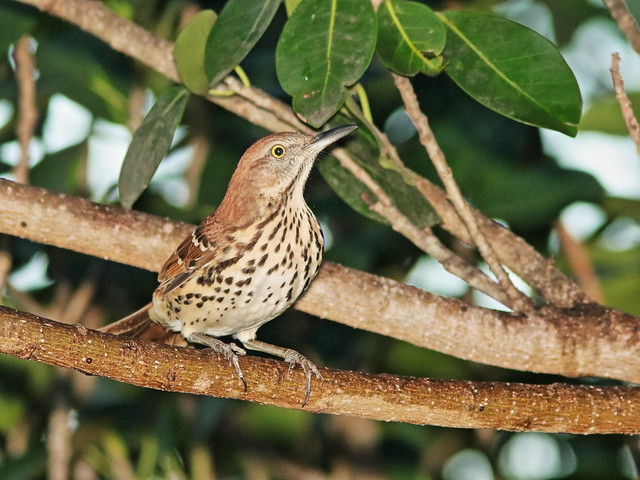
A Brown Thrasher scolded me briefly:
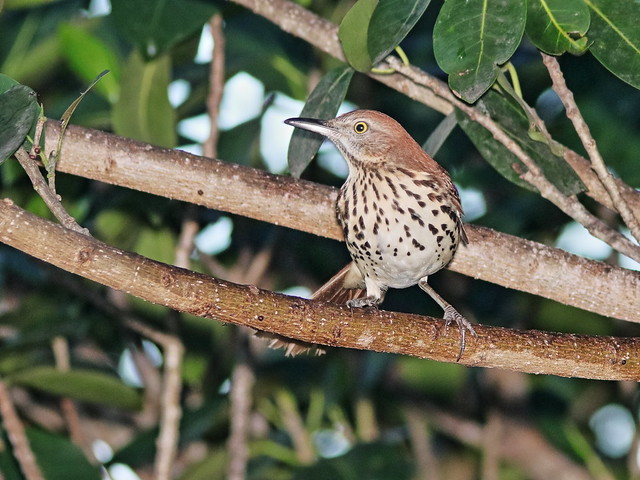
Brown Thrasher 09-20200909

Brown Thrasher 08-20200909

A Loggerhead Shrike kept watch from a treetop:

Loggerhead Shrike 02-20200908

A Gray Squirrel was almost invisible as it crouched on a limb. I think I can see my reflection in its eye:
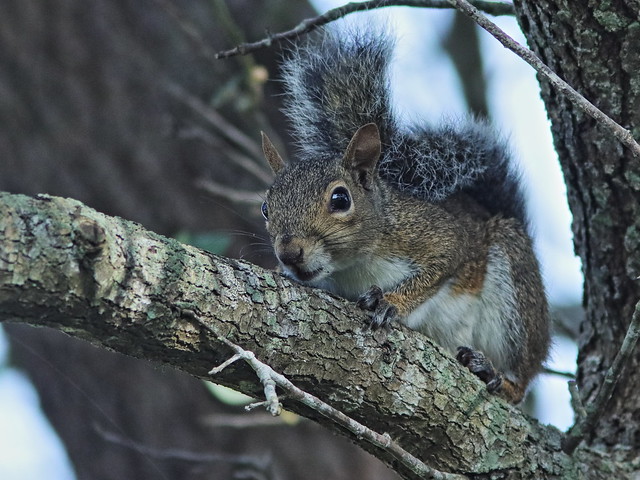
Gray Squirrel 01-20200907

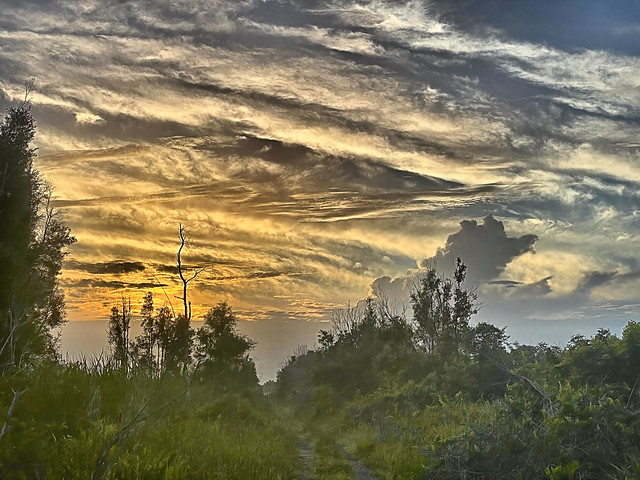
Sunrise over the Bar Ditch Trail:

Bar Ditch Trail 03-20200905

This is my favorite stop along the far reaches of the trail. Here the ditch widens a bit and is surrounded by Cattails and Sawgrass:
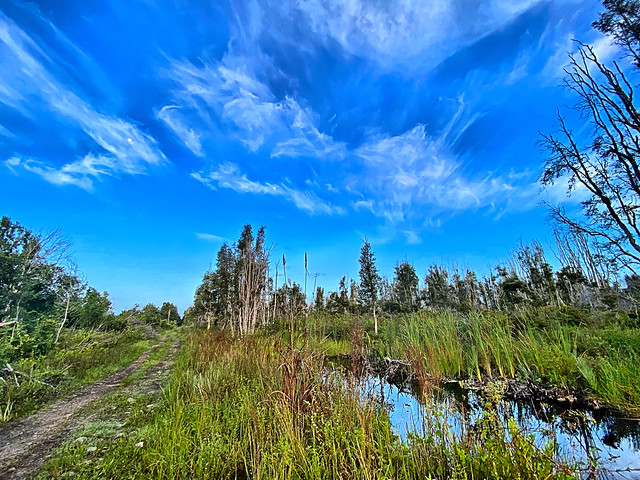
Bar Ditch Trail and ditch  05-20200905

Back on September 3, the Corn Moon reflected in the lake in pre-dawn twilight:

Corn Moon 02-20200903

While photographing the Moon, about 10 minutes before sunrise, I caught motion out of the corner of my eye. It was a Coyote, carrying something in its mouth:
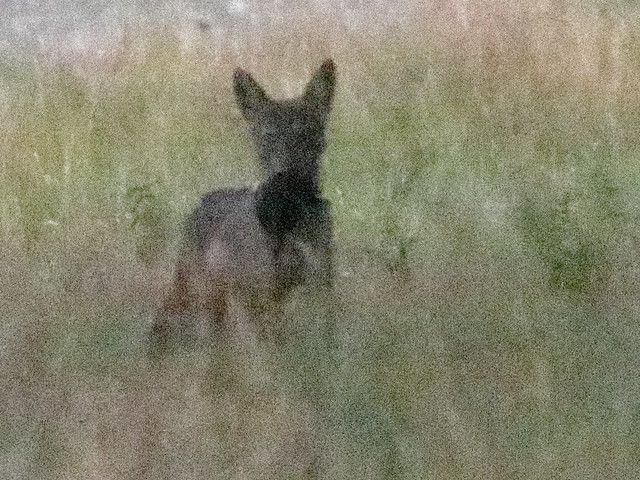
Coyote with prey or cub 02-20200903

I then adjusted my camera settings to "see in the dark" by manually cranking the ISO up to an unprecedented 25,600, which allowed the shutter to function at 1/1000. The results were poor, but I hoped to identify whatever the Coyote was carrying. Was it a prey item, or possibly one of its pups. It might be relocating its den?  

 Coyote with prey or cub 01-20200903

The (same?) Coyote soon walked out from the same area of brush. It appeared to be a female with swollen teats. She wandered off to the north, sniffing here and there as if hunting:

Coyote prob female 06-20200903

Moments later, a second Coyote emerged. This looked like it was probably a male, larger and with a robust tail:

Coyote prob male 02-20200903

To my surprise, when I turned around, a third Coyote was staring at me. As soon as I raised my camera it fled (a Mourning Dove stood by):
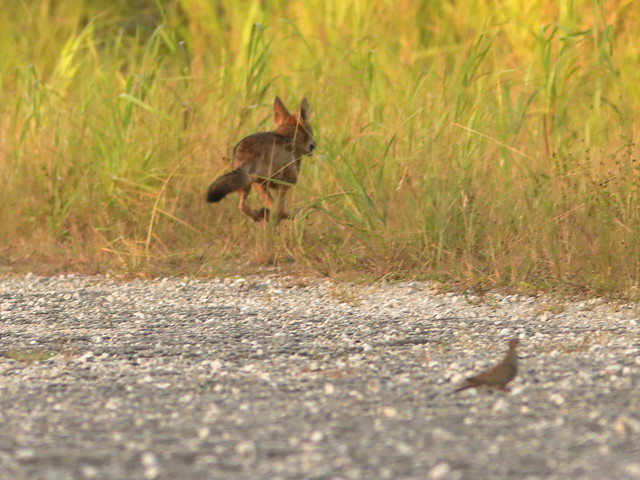
Coyote third one  05-20200903

On the way home, looking back from the Levee Trailhead, clouds were gathering to the south:

Levee Trail 02-20200908

Are those birds flying or angels dancing?

Angels dancing 02-20200908

Links to earlier posts about the Bar Ditch Trail (the last two tell how things were here ten years ago, quite a contrast now in the Wounded Wetlnads): 

https://rosy-finch.blogspot.com/2020/09/beauty-is-in-eye-of-barn-owl.html

https://rosy-finch.blogspot.com/2020/04/bobcat-on-bar-ditch-trail.html

http://blog.rosyfinch.com/?p=275

http://blog.rosyfinch.com/?p=274

= = =  = = =  = = = =  = = = = =

Linking to:

Skywatch Friday

Weekend Reflections

Saturday's Critters

BirdD'Pot

Camera Critters

All Seasons

Wordless Wednesday (on Tuesday)

Natasha Musing

Our World Tuesday

________________________________________________

Please visit the links to all these posts to see some excellent photos on display
________________________________________________

Sunday, July 21, 2013

Birding Oak Creek Canyon in Sedona, Arizona

Sedona, Arizona, our next objective after departing Tucson, was a 250 mile drive that took us about five hours. On the way, we passed through some breathtaking scenery. The winding road moved along Oak Creek Canyon, which appeared as a lush oasis in an otherwise parched landscape.

Oak Creek Canyon 3-20130617

As we approached Sedona, red rocks began to predominate.

Oak Creek Canyon 2-20130617

Two horizontal formations, the Schnebly Hill Sandstone and the Hermit Shale layers, up to 270 million years old, are rich in iron oxide that imparts the rust color.


Oak Creek Canyon HDR 20130617

We did not attempt to enter the town, as the streets do not safely accommodate a 31 foot RV. This photo was taken through the windshield as we passed by Sedona.

Town of Sedona through the windshield 20130617

Our one-night stay at Rancho Sedona RV Park was brief but restful and quite productive. Our space was shaded by tall Sycamore trees, only about 50 yards from Oak Creek. I could hear Bullock's Orioles singing overhead.

Bullock's Oriole 20130616

Our RV in Rancho Sedona 20130616

Once the RV was hooked up we all headed for the creek.

Oak Creek in Sedona 2-20130616

Although I was intent on finding birds, Graci immediately discovered this (presumed) Long-tailed Brush Lizard, which I happily photographed.

Long-tailed Brush Lizard in Sedona 20130616

I had high hopes of finding an American Dipper, as I had seen them near here during a prior visit. I focused my attention on the rapids, where I waited for one to suddenly surface.

Oak Creek 20130617

The dipper never showed itself, but a pair of frame-filling Common Mergansers shot the rapids right in front of me.

Common Merganser 20130617

Common Mergansers 20130617

An Ash-throated Flycatcher made hunting forays over the water.

Ash-throated Flycatcher 20130617

I was delighted to find a family of five Phainopeplas on a tree in the middle of a wide spot in the creek. Members of the Silky Flycatcher family, they hardly ever sat still as they repeatedly took wing to catch flying insects.

Phainopepla 20130617

American Robins and a Song Sparrow stopped by for a drink...

American Robin at Oak Creek 20130617

Song Sparrow at Oak Creek 2-20130617

...as did this Gray Squirrel.

Gray Squirrel at Oak Creek 20130617

The lawn next to our RV attracted a Black Phoebe...

Black Phoebe 20130617

...and a female Bullock's Oriole foraged on the bark of a pine tree.

Bullock's Oriole female 2-20130617

An American Robin showed off his prey in great detail.

American Robin 20130617

This female Summer Tanager was hunting spiders under one of the electrical supply outlets...

 Summer Tanager 7-20130616

...and suddenly looked up, spider silk dangling from her substantial beak.

Summer Tanager 9-20130616

She had found a cafeteria full of spiders!

Summer Tanager 2-20130616

Summer Tanager 5-20130616

Summer Tanager 6-20130616

A feeder next to the registration area attracted Lesser Goldfinches and House Finches.

Lesser Goldfinches at Sedona feeder 20130616

House finches 20130616

A Bridled Titmouse provided me with my first-ever photo of this species.

Bridled Titmouse 20130617

One of the staff called me over to see this insect, which looked for all the world like a dead leaf...

Io Moth 2-20130617

...until it opened its wings to show the brilliant "eye spots" of an Io Moth.

Io Moth 20130617

This outcropping came into full view just before we exited the campground on our way to the Grand Canyon. Note the mostly thin white layers of limestone within the red Schnebly Hill sandstone. The latter is said to be entirely devoid of fossils, and there are only few in the limestone, leading to the hypothesis that the limestone layers were mostly windblown as sea levels fluctuated up and down.

Sedona rock formation HDR 20130616