My weekly potpourri gathered from the archives features eagle themes...
CRITTER: Bald Eagle
A pair of eagles whose nest is near our Florida home provide endless photo opportunities.
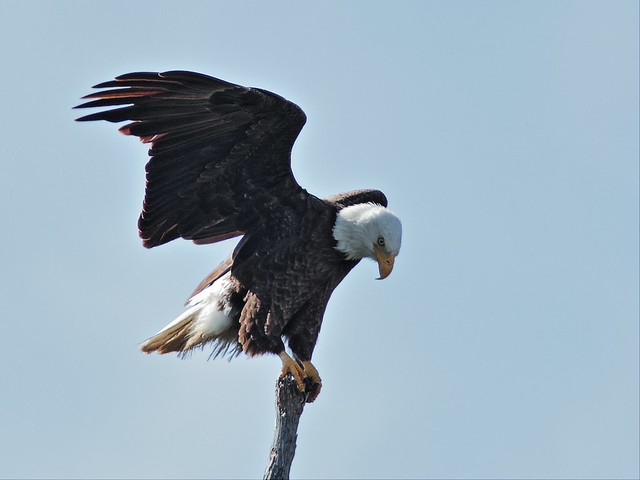
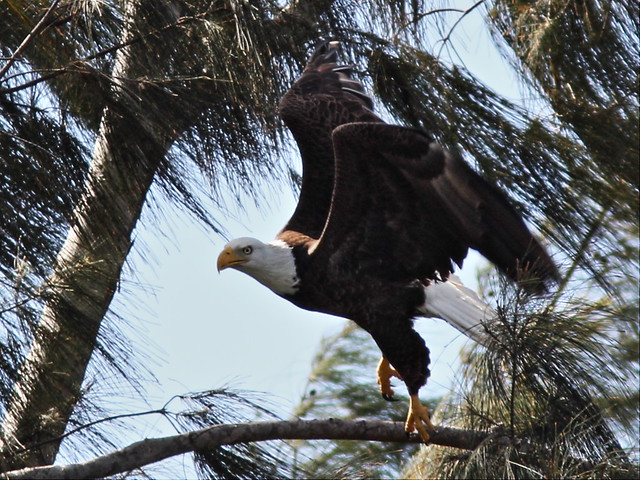
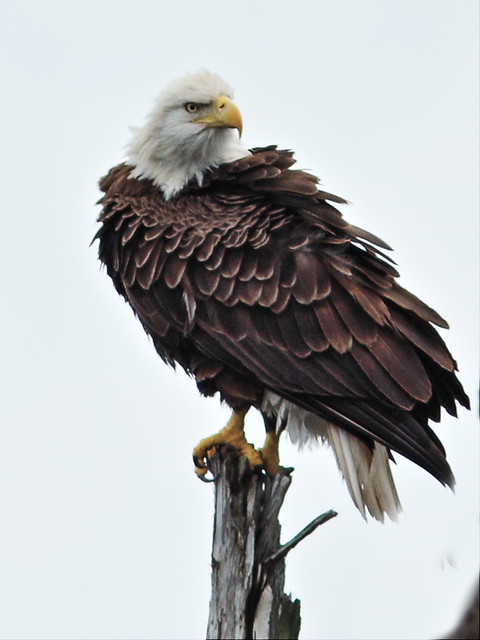
They are a devoted couple...
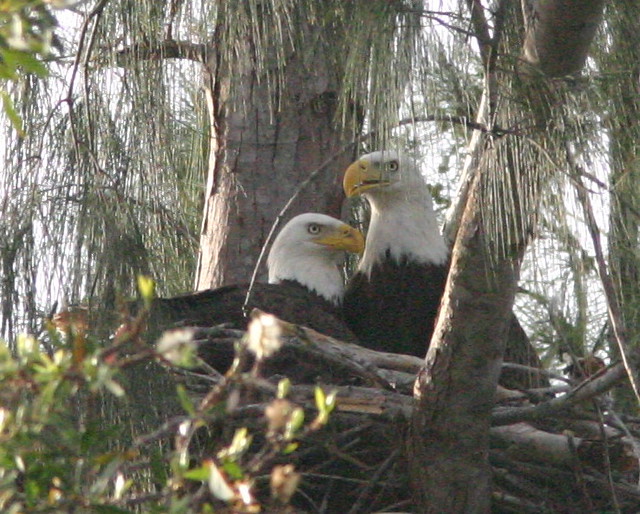
...cooperating at nest-building or disagreeing about where to place this stick?
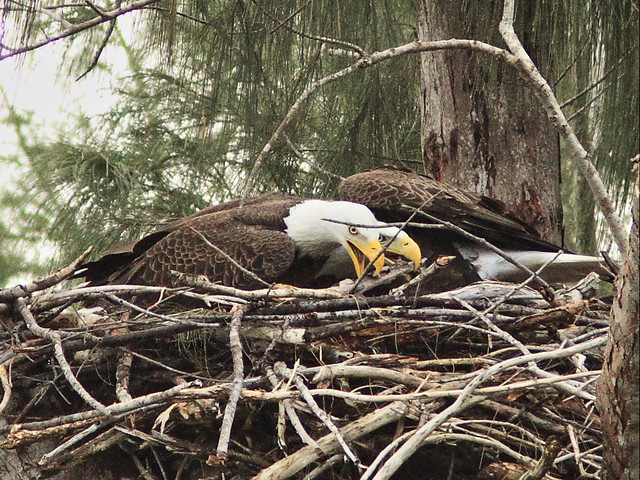
Over eight breeding seasons we have watched their chicks grow up from little fuzzy white balls...
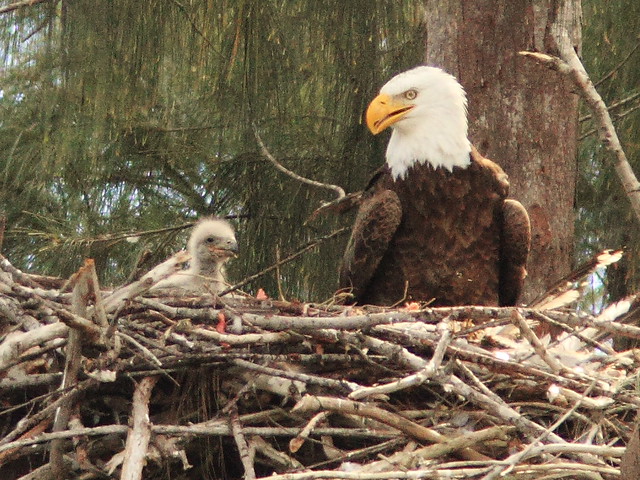
...to hulking flight-ready eaglets, actually bigger than their parents.
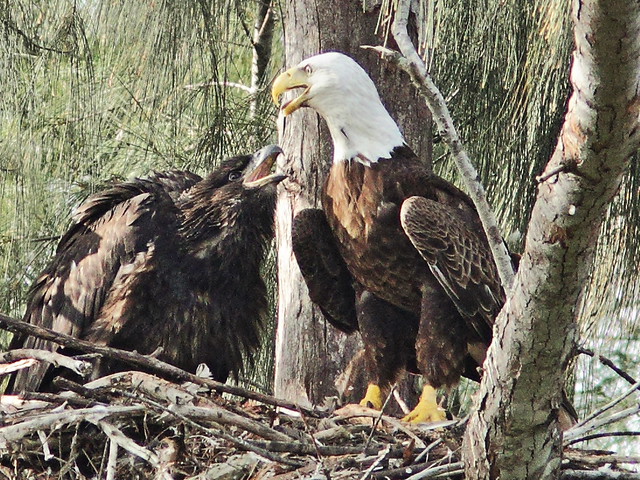
Linking to CAMERA CRITTERS,
Linking to Eileen's SATURDAY'S CRITTERS,
________________________________________________
FENCES: Protection
We worked with the Mayor, who declared the site a Bald Eagle Sanctuary. The traffic department put up cones to deter parking in front of their nest. A local merchant donated the fence, shown here as it was being erected in 2009:
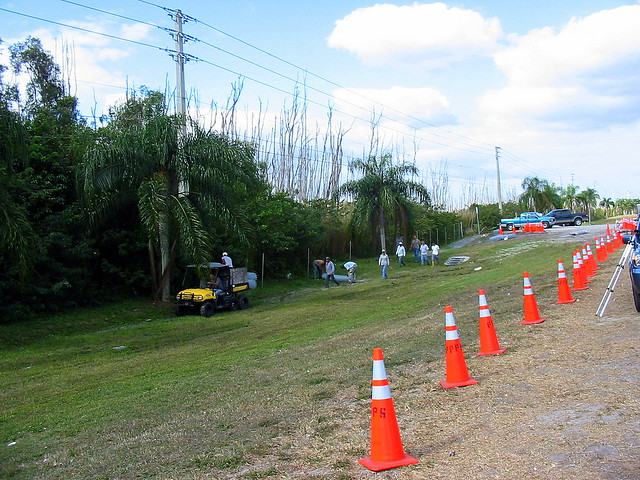
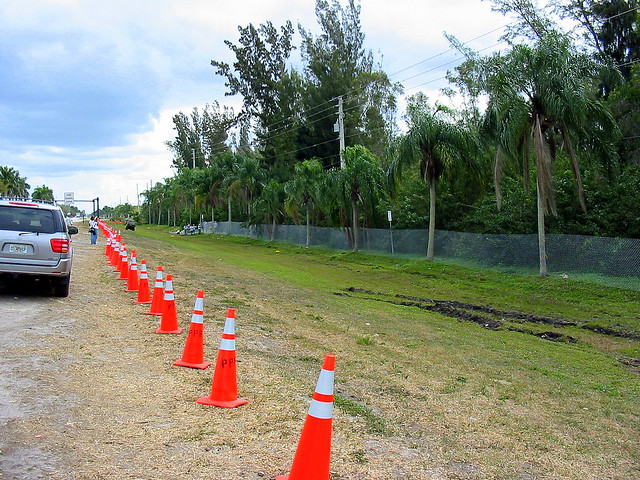
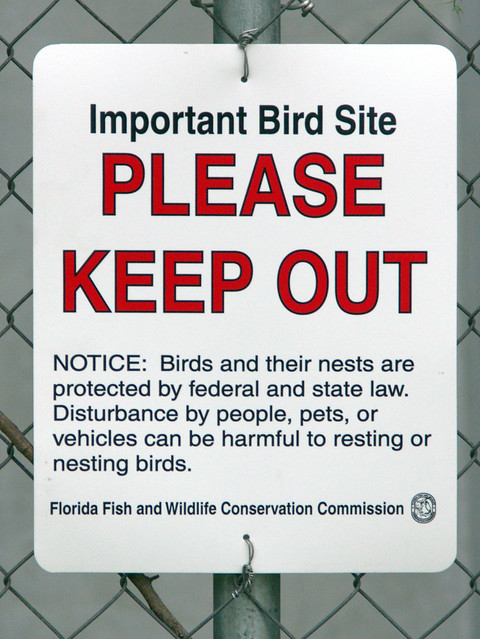
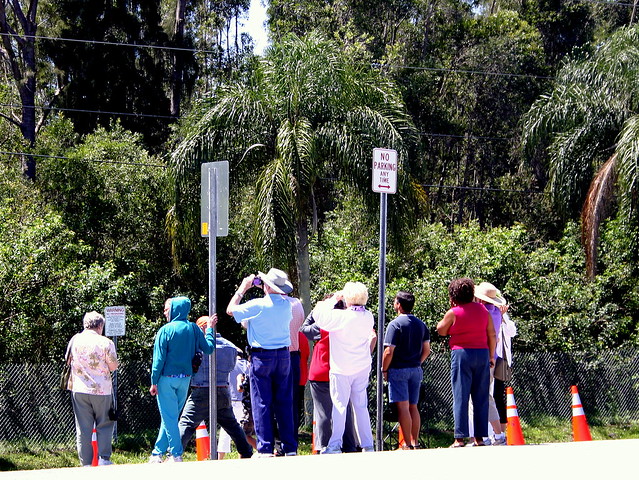 Our granddaughter, then only 4 years old, watches the nest.
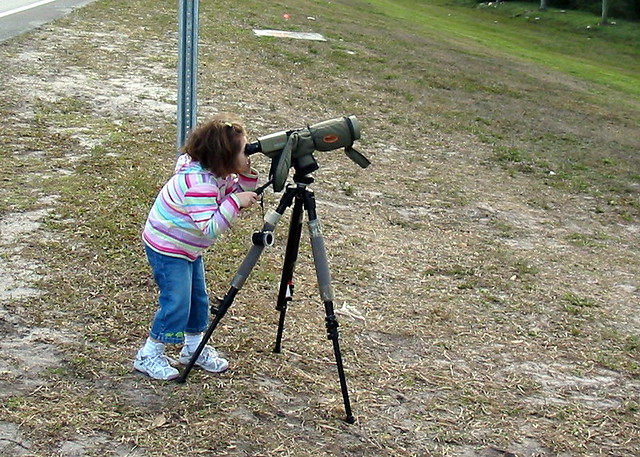
Still at it just after her 10th birthday!
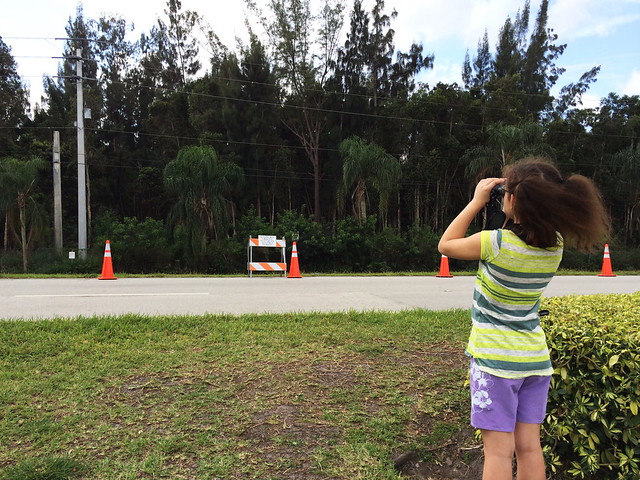
Linking to GOOD FENCES by Tex (Theresa).
________________________________________________
SKYWATCH: Eagle soaring
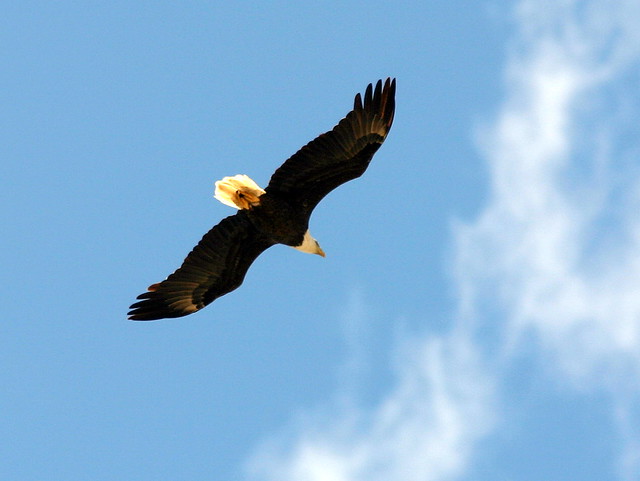
Linking to SKYWATCH FRIDAY by Yogi, Sylvia and Sandy
________________________________________________
REFLECTIONS: Only their white heads show up.
Ketchikan, Alaska, June 15, 2014
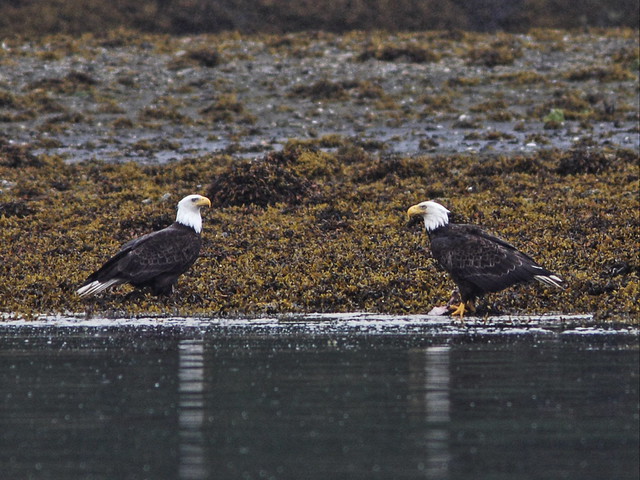
Linking to WEEKEND REFLECTIONS by James
Please visit the links to these photo memes and enjoy some wonderful contributions.
For updated information about the Bald Eagle nest, follow this link to my Bald Eagle Nest FORUM .
Today is the tenth anniversary of my father's death at the age of 95. Yesterday, thinking about this drove me to reflect upon the shrinking wild areas near my childhood home in Rutherford, New Jersey. When I was quite small Dad would often take me for "nature walks," as we called them. I eagerly anticipated those Saturday mornings and was disappointed when it rained or when other obligations got in the way.
So I fired up Google Earth to see if anything was left of those places. Two in particular were small pockets of wetland that sometimes held water all summer and even attracted nesting Mallards. Using Google Street View I "walked" from our home on Springfield Avenue west on Cooper Place, down the hill on what was a cobblestone road but now is paved with asphalt. Most of the frame homes still looked familiar.
I "crossed" busy Jackson Avenue, and made a dogleg turn to the left and then west again on Hastings Avenue. No longer a dirt road that narrowed into a winding path, it was neatly paved, lined with apartments and ended in a cul-de sac, ringed with upscale living units that overlooked the Passaic River. The river was now contained behind bulkheads and its sharp edges neatly landscaped.
Dreams are weird. Last night I dreamed I was a child walking that path, all the way through "Charlie's Woods," past the pond with the "warbler tree," to the banks of the river. I was with another kid, my cousin Corky, I think. Yet I somehow was also in the present, as I knew that Dad and Corky were long gone and that I lived in Florida. I awoke thinking about blogs I wrote about those days. The first is an excerpt written eight years ago, and the second on the third anniversary of Dad's death.
* * * * *
 On Saturday mornings, Dad would often take me on walks over to the west side of Jackson Avenue, a wooded strip a quarter to a half mile wide that extended to the Passaic River. In the winter, we followed the tracks of rabbits and mice in the snow. Once we saw the dramatic record of an encounter between a rabbit and a large bird of prey, probably an owl. The rabbit’s tracks ended suddenly in a disturbed area that showed the imprint of wing feathers and a little blood. At Dad’s funeral, I talked about how special those memories were to me. Maybe he knew, too, but I never told him directly.
New Jersey in springtime was one of the greatest places to see beautiful and colorful migrant birds such as warblers, orioles and tanagers. Even before their leaves fully opened, trees would be alive with warblers of many species. Rutherford now is but a ghost of the birding paradise my friends and I trudged in the 1940s and 50s. My logs refer to the extensive sand dunes along the Passaic River, where cuckoos nested and shrikes impaled insects on thorny twigs. Barn Swallows nested on the abutments of the Union Avenue Bridge (Postcard view to the right). Two spots were especially famous for their variety of birding habitats: “Charlie’s Woods” and “Strinchuck’s Pond.” All are now gone, converted into homes and apartments.
One day my cousin Corky and I caught a batch of “frogs” in Strinchuck’s Pond. We killed and skinned them and fried their legs on a piece of rusty tin with a little bacon. They tasted just fine. Yet they may actually not have been frogs at all, but toads! One spring we caught hundreds of garter snakes. We stuffed them into our pockets and into a bucket we found, intending to release all of them in my backyard. I forgot about the ones in my pockets and they turned up in the washing machine, to Mom’s horror.
We were attuned to the smells of the woods as the seasons changed. Skunk Cabbage was easy to detect in early spring. As the earth warmed we could smell the garter snakes as they came out of hibernation and began mating. Around mid-August there was a particular type of small red ant that gave off a kind of perfume as the winged adults emerged. They had a bitter-sweet taste (the front 2/3 were bitter and the rear 1/3 quite sweet). Yes, we ate some crazy things, but these ants actually smelled good enough to eat, so we tried.
Several of my childhood friends shared my interest in birds. We grew up together, some from kindergarten right through high school. We gradually came to realize that the larger world did not look as kindly upon people who walked around with binoculars. As we advanced in age and wisdom, we found it prudent not to be labeled as “bird watchers.” There were fewer opportunities for group birding. Solitary bird watching did not appeal to me. Competing and collaborating with others to spot and identify bird species is energizing. Seeing new places was not as much fun alone as it was when there was someone to share the experience. I resolved that when I married, it would be to a birdwatcher.

I became a sneaky birder. No one around me knew how happy I was to finally see my first mockingbird (more recent photo above) when I attended a wedding in Maryland. My birding activities ebbed to an all-time low through college and medical school, but picked up after I went into private practice in Bloomfield, New Jersey. Dr. Adrian Sabety, a local surgeon colleague, was an expert birder. We made time to get out to bird locally, if only briefly. We often visited the nearby Watchung Mountains, where hawks congregated during migration. It seemed only a few people even knew about it, but it was to become quite a famous hawk-watching spot.
* * * * *
 My fondest memories of childhood were not those of solitary pursuits. Not having someone there to share an otherwise awesome event seems to take the edge off the experience. Maybe it’s because I simply want to say, “Hey, look at that!” and feel the satisfaction of having another appreciate and later reiterate the experience. Frequently, it works the other way. So many times I might have missed what another pointed out or interpreted.
I feel some sadness when I see parents showering their children with expensive gifts and elaborate parties. How often are the kids more fascinated with the packing crate than the contents? Yes, that Christmas when I received the full-sized balloon-tired two-wheeler persists in my memory, but I smile and relax when I think of those woodland walks with my father. The day we encountered a young Great Blue Heron who could not become airborne because it was trapped among dense trees along the Passaic River—how Dad covered its head and mean-looking beak with his jacket so we could carry it out into an open field—the thrill of seeing the bird slowly rise on untried wings…
One Spring I attended a week-long medical refresher course at the YMCA of the Rockies in Estes Park, Colorado. I invited my parents to join us, and they flew to Dallas. Mary Lou and I and our four children set out with them in our 1972 Oldsmobile Custom Cruiser station wagon. Despite the demands of the curriculum, we found time to walk the trails and see deer, beavers, American Dippers and a family of Blue Grouse (now known as Dusky Grouse).
 We had followed a direct route to Colorado, but after the conference I took leave for a few days to permit a more leisurely trip back to Texas. On the return leg, we spent two nights at Kachina Lodge in Taos, New Mexico.
The first night we watched Pueblo Indian dances, and the next morning we attended Sunday Mass at San Francisco de Asis in Ranchos de Taos. This adobe church, completed in 1815, is said to be the most photographed church in America. (Dad loved the old churches of New Mexico. The photo shows him, on the right, with his brother, Father Dan, on the High Road to Taos, visiting the church at Truchas/Las Trampas).
The ceremony was entirely in Spanish. It happened to be Father’s Day. The priest invited all fathers to join him on the altar to recite the Lord’s Prayer. Dad and I walked up and joined the congregation in prayer. I knew some Spanish, but Dad knew none. That did not dissuade him. He put his hand on my shoulder and launched into the Latin version of the prayer. While everyone else was saying “Padre nuestro que estás en los cielos, santificado sea tu nombre…” Dad was confidently announcing “Pater noster qui es in coelis, sanctificetur nomen tuum.” The Romance cadences were so similar that no one seemed to notice. That Father’s Day and all others afterwards held special significance for me.
During my working years I enjoyed beating the traffic and getting to the office early. I was able to close my office door and organize my day in peace and quiet before my co-workers appeared. When I retired from active duty I resolved never to sleep late. Therefore, when we moved to the mountains of New Mexico I set the alarm on my watch for 7:30 AM to nudge me awake just in case, but I rarely needed it. Dawn came quick and bright as the sun emerged in a blue sky above the ridge to the east.
So it happened that on Sundays, 7:30 AM Mountain Time was an ideal time for me to call my father, back home in New Jersey. By then he had returned home from early Mass and had finished his breakfast, and was in the middle of his morning papers. The chirp of my watch alarm was a gentle reminder, and rarely did I miss placing the call. If I happened to be a little late, he would ask about the reason for the delay. At Dad’s funeral, his younger brothers told me how important those calls were to him. Unbeknown to me, he arranged his Sunday morning schedule to accommodate my call.
We talked about nothing in particular, though we often filled the greater part of an hour with banter. Embedded among discussions of the weather, politics and sports were those “I wish you could have seen…” and “Remember when we…” moments that swept us back to those earlier days.
I last called Dad only a few days before he died. He spoke of how wonderful it was to have a hospital room with a view.
Now in the Eastern Time Zone, my wristwatch still chirps at 7:30. Though two hours earlier in real time, the sun already dapples on the surface of our lake. And I whisper a Pater Noster in remembrance.
As a kid birder, I tried to imagine some day seeing a Painted Bunting. Living in New Jersey and rarely venturing beyond my own neighborhood, this seemed an unlikely possibility. It was only after I got drafted and eventually moved to New Orleans that my dream was realized. I think that most birders remember their first sightings of many species, but for me this event stands out. It was a tantalizing brief glimpse of the unmistakable psychedelic coat of a male bunting, in a park along the Mississippi River.
More recently, I took up photography. Now the Painted Bunting is a favored subject. I have many shots of them at bird feeders, but I strive to capture their image in more natural surroundings.

There are two breeding populations of Painted Buntings in the US. One occupies a large area centered in "Arklatex" (Texas, Louisiana, Arkansas) and nearby Oklahoma. The other, smaller area is along the southeastern Atlantic coast, from the Carolinas into northern Florida. The western population winters in coastal Mexico and Central America, while we in South Florida enjoy those migrating through the state to Cuba and the Bahamas, many of which remain here all winter.

The eastern population is adversely affected by human development of the coastal wetlands. Their numbers have steadily decreased, dropping by almost two-thirds since 1966. Ref: http://www.allaboutbirds.org/guide/Painted_Bunting/lifehistory

Unfortunately, they are popular cage birds in Latin America and even in Miami. Despite their protection under the Migratory Bird Treaty, they are commonly trapped in south Florida, in residential neighborhoods and even in and immediately outside Everglades National Park.
Excerpt from The Danger of Beauty: "Our preliminary data analysis shows that for the domestic trade in Mexico alone, more than 100,000 Painted Buntings were trapped from 1984 through 2000, an average of 5,800 birds per year. This does not include any information on the illegal trade, which is commonplace but very difficult to document..."
A frustrating fact is that if birders find traps or even see them being captured the perpetrators cannot be arrested unless the crime is witnessed by a law enforcement officer. Read more here, with photos of trapped buntings: http://www.tropicalaudubon.org/trapping.html

I have unfairly favored the males in the above images. Females are beautiful in their own right. They are so green that they can sometimes remind one of small parrots.

First year males can resemble the females, so green birds greatly outnumber the brightly colored males in the wetlands near our south Florida home.

A few birds will stray out of their normal range, especially during migration, and they have been reported along the east coast as far north as New York.

I suffer no shortage of pictures of the females!


This is the seventh breeding season during which we have monitored a Bald Eagle nest near our south Florida home, the first recorded active Bald Eagle nest in Broward County in more than fifty years since before the use of DDT was prohibited.
Several attempts to install a nest camera have been unsuccessful, so all our observations are from the ground. Local eagle-watchers report their findings and post photos to my Bald Eagles of Broward County FORUM. You are invited to subscribe if you wish receive copies of observations as they are posted or in digest form.
Located in an exotic Australian Pine, the nest is massive. Each year the eagles return to enlarge and renovate it.

The eagles have produced at least eleven chicks, ten of which successfully fledged. Last season they hatched out two eaglets, but one disappeared when only two weeks old, and the second may have fledged at 86 days of age, before it was prepared for free flight, and was lost.
If you visit the above link to the FORUM you may see the data we compiled about the life events in this pair, whose nest is clearly visible from a main thoroughfare in Pembroke Pines, a little more than a mile away from our home. The nest site is located on City land. The eagle-watchers rallied successfully in support of its official designation as a Bald Eagle Sanctuary.
This season, the eagles were first seen at their nest site on September 18, which is about average, and they started rebuilding the nest on October 15. Over the years they have laid their first egg between November 24 and as late as December 11.
Yesterday morning (October 30) Mary Lou and I arrived at the nest site at 9:05 AM and found the male on the nest.

He flew off almost immediately but both male and female returned at 9:13 AM. We think it was the the male who brought in a large stick. The female watched as the male worked with the nest material for a short time.

Then the female flew down and joined him at 9:15 AM.


While both sexes have similar plumage, the female is larger and can also be distinguished by the profile of her head and beak. She has a higher forehead as compared to the male, whose bill and forehead are almost in line. The female's bill is also deeper at the base. When roosting her lower belly appears proportionately wider than that of the male. When not seen side by side, these subtle differences may not be easy to detect.
Here, the female supervises as the male moves the stick. Is that a look of disapproval?

The pair worked together on nest construction until the female flew off at about 9:18 AM.

The female returned with a stick at 9:32 AM and the pair touched bills and postured in a recognition ritual that lasted less than a minute (the female is on the right).


The female then rearranged some sticks that the male had already placed.

However, they did work cooperatively.

Then at 9:35 the male pulled at a string that looks like monofilament fishing line, which could pose a hazard. This is worrisome, as an adult or eaglet could become hopelessly entangled.

The Ovenbird has an unusual enemy in the lowly earthworm. Ovenbird breeding populations have declined in the far northern areas of its range in the US, particularly in the Great Lakes states. They were quite common when I started birding in New Jersey, where I recorded my first Ovenbird, #58 in my life list, on May 5, 1949. Back then, their "Teacher-Teacher-Teacher" song filled the woods during spring migration.
In south Florida they are fairly common during spring and fall migration, and some remain here all winter.

However, after moving into our part-time home in northeastern Illinois, in 2007, I was surprised that they did not breed there and their songs were absent. On April 30 of this year, I saw my first Illinois Ovenbird, at Nelson Lake/Dick Young Forest Preserve in Batavia. It was the fourth sighting of an Ovenbird ever reported on eBird from this birding hotspot in 10 years, and the very first seen there during spring migration.
The decline in Ovenbird numbers has been attributed to the fragmentation of deciduous woodlands by development. There is less food for them on the edges and they prefer larger tracts of forest. However, recent research may have uncovered another important reason for their scarcity in some areas.
During the last Ice Age, native earthworms were killed out in areas covered by the glaciers, and over the 11,000 years since the ice retreated they have extended their range northward very slowly, only about 1/2 mile in the last 100 years. In fact, no native earthworms have yet been found in the Great Lakes area of the US.
The northern hardwood forests evolved in the absence of earthworms. Leaf litter accumulated under the trees, holding the moisture and providing an ideal substrate for herbaceous plants and native tree seedlings, among which the Ovenbirds hid their oven-shaped nests and found abundant food.
This American Robin has caught a juicy alien tidbit in a park near our Illinois home:

Native earthworms face competition from invasive European earthworms, introduced by early settlers and spread in mulch, root balls and by commercial trade in "nightcrawlers" and "angleworms," used in compost piles and released by anglers. They now occupy the northern hardwood forests and have had a devastating effect on the habitat. Ironically, this is due to the very property that makes earthworms so valuable to gardeners as they break down waste vegetation, aerate and fertilize the soil.
The enriched soil of the forest floor invites invasion by exotic plants that do not provide suitable nesting or foraging sites for Ovenbirds.
"Researchers at the University of Minnesota, and elsewhere, have documented dramatic changes in native hardwood forest ecosystems when exotic earthworms invade. These changes including losses of native understory plant species and tree seedlings, changes in soil structure and declines in nutrient availability. There is also fascinating evidence emerging that the changes caused by exotic earthworms may lead to a cascade of other changes in the forest that affect small mammal, bird and amphibian populations, increase the impacts of herbivores like white-tailed deer, and facilitate invasions of other exotic species such as European slugs and exotic plants like buckthorn and garlic mustard. These results suggest that exotic earthworms may pose a grave threaten [sic] the biodiversity and long term stability of hardwood forest ecosystems in the region. Much more research is needed." Ref: Earthworms to blame for decline of Ovenbirds in northern Midwest forests, study reveals
Although grouped as members of the New World wood-warbler family, Ovenbirds lack the flamboyant coloration of many of that tribe, and mostly walk on the ground to find their food rather rather than hop through tree branches.

Their legs are pale pink, and the Ovenbird often cocks up its short tail.

With an olive brown back and white breast streaked and speckled with black, they somewhat resemble tiny thrushes, but they have distinctive eye rings and an orange crown bordered by dark lines.

Sometimes there is very little orange on the crown, but the black streaks are very evident.

This is not mentioned in any of my field guides, but I notice that Ovenbirds' wings are very noisy. I can often hear one flying before I find it.

This one high-stepped along a branch, as if walking a high wire in the circus.


