Showing posts with label nesting. Show all posts

Saturday, January 17, 2015

Green Heron is ABA Bird of the Year!

To celebrate the American Birding Association' s selection of the Green Heron (Butorides virescens) as ABA Bird of the Year, I have updated my post of January 5, 2013, "Shape-shifting Green Heron." Sad to say, the repeated herbicide treatment of the nest trees in the local rookery may now make it unlikely that any herons will successfully nest this year. The post is documented with brief video clips which show interesting behaviors of this species in the first two weeks after hatching. Most remarkable is the protective instinct of the male parent when the nestlings are in danger of falling.


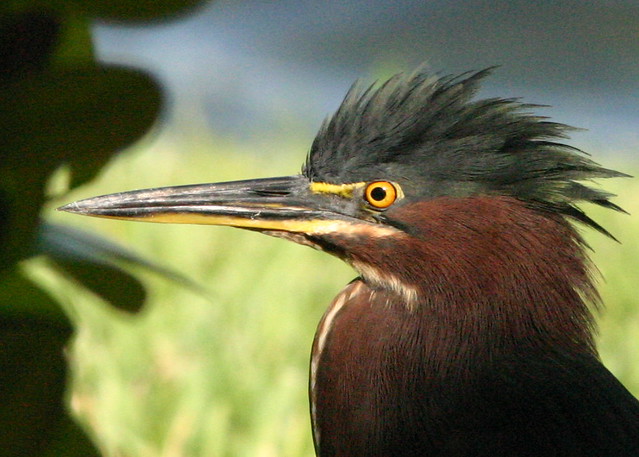
Green Heron Close 20081017


Green Heron 20140718


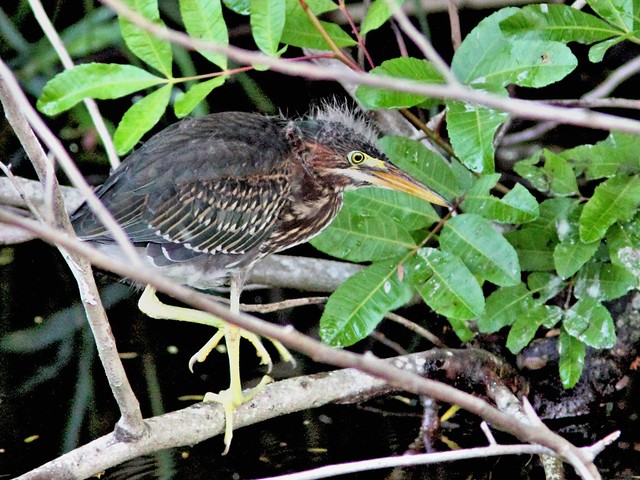
Green Heron juvenile 20130602


The first herbicide treatment occurred some time before the 2012 breeding season. This photo, taken on March 4, 2012 shows Yellow-crowned Night-Herons on nests exposed by the defoliation:
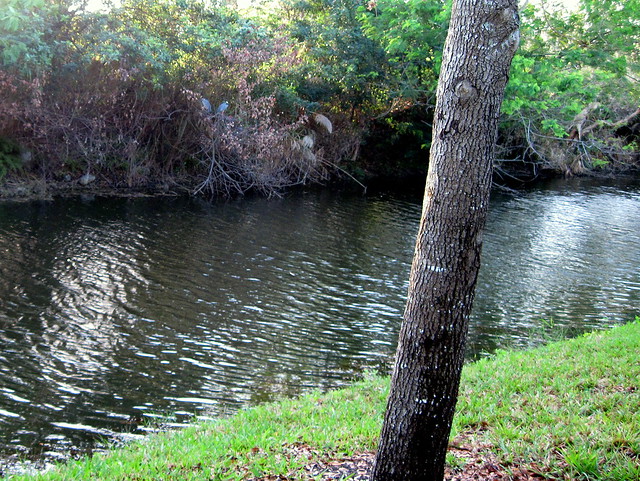
Heron rookery herbicide effects 20120304

During the following year the shrubs, mostly Ligustrum and exotic Brazilian Pepper, had recovered somewhat  The rookery, which I have been monitoring since the spring of 2011, contained at least 8 nests of Yellow-crowned Night-Herons and 3 Green Heron nests, mostly over the water and still fairly well-concealed, when this photo was taken on March 15, 2013:

196th Av Canal HDR 20130315

This photo, on December 14, 2014, shows the devastating effects of a subsequent herbicide application, along with floating debris from nearby road construction:
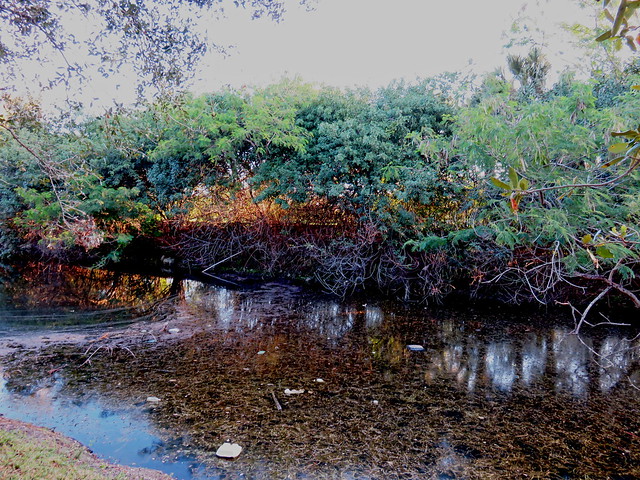
Heron Rookery north end 196 Canal 20141214


Most of the branches which extended over the water were defoliated and killed, as shown in this photo taken on January 15, 2015. Homes that were formerly hidden by the nest trees are now in plain view.
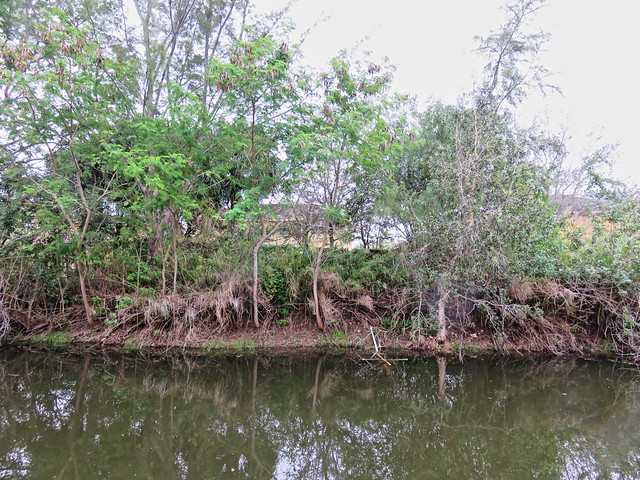
Heron Rookery herbicide damage 20150115

During the spring of 2012, in the Yellow-crowned Night-Heron rookery along a canal at the north end of the wetlands birding patch next to our south Florida home, a pair of Green Herons selected a secluded spot for their nest. 

Unfortunately, this tree, which extends over the water, had been treated with herbicides by the agency that maintains the canals, and by the time the eggs hatched almost all the leaves had fallen off to expose the nest. 

These brief clips illustrate some interesting behaviors and are best viewed in HD, full screen size. Pardon the shakiness, as they are taken with my hand-held DSLR camera with a telescopic lens, from about 50 feet (15 meters) across the canal from the nest.

The Green Herons are excellent parents. Here a female feeds her tiny chicks, about 3-5 days old. At the time, we only counted three, as the youngest one was not yet visible (April 15, 2012).


Trouble viewing this video? Try visiting https://vimeo.com/40415469

The four chicks have grown quite a bit over the next 3 days. They are now 7-9 days old. Perhaps not unexpectedly in view of the flimsy perches, the smallest chick disappeared the next day, following a heavy thunderstorm (April 19, 2012).


Trouble viewing this video? Try visiting https://vimeo.com/40865604

 Now on April 22, the chicks are 10-12 days old. This remarkable sequence shows the protective behavior of the male, who had fed the chicks just moments before I started this video. The female then flew in with more food, but the ravenous appetite of the chicks placed them in danger. The male, sensing their predicament, flew in to solve the problem. See how he did it.


Trouble viewing this video? Try visiting https://vimeo.com/44908718

The Green Heron can be described as a compact little neck-less ball of feathers...

Green Heron 2-20120113

...or a spindle-shaped pointed object:

Green Heron 2-20120124

But where did that neck come from?

Green Heron 4-20120124

Sometimes it looks like almost any other heron, though its legs are short and its neck is a bit thick:

Green Heron 5-20121211 

Then, extending its neck full length, it becomes almost snake-like...

Green Heron 8-20121211     

...and raises a handsome crest:   

Green Heron 7-20121211

Their color-- How did they ever get the name of "Green?" Sometimes they look as dark as crows:

Green Heron 20090522

The immature birds have streaked underparts and can be quite dark in color:

Green Heron in flight 20120717

Here is an adult. Why, I do see a bit of green in there!

Green Heron 20100712

Usually a loner, it is unusual to see several in a flock. These are immature birds. perhaps some are siblings:

Green Herons five 20120731

Those wings-- they are surprisingly long and seem to have so many more feathers than expected:

Green Heron taking flight  (view large) 20120410

During breeding season, the male does have respectable plumes:

Green Heron culvert nest male 20120413

Saturday, October 18, 2014

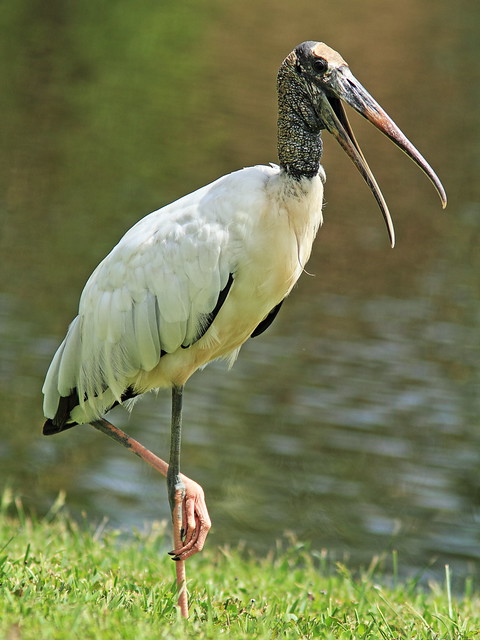
Wood Storks: Missing but not Endangered

South Florida contains the historic breeding grounds of Wood Storks, but the species has had almost total reproductive failure here over the past four seasons. Ironically, the US Fish and Wildlife Service (USFWS), under pressure from developers and agricultural interests who are largely responsible for the loss of their habitat, proposed to remove them from the protection of the Endangered Species Act. In June 2014, USFWS officially upgraded their status to "Threatened." 

Adult Wood Stork in our south Florida back yard, August 19, 2014:

Wood Stork 20140819

While it is true that Wood Storks have extended their breeding range northward into Georgia and the Carolinas, their status in Florida is critical. This is somewhat analogous to the situation of the Bald Eagle, which was almost extirpated from the lower 48 States but continued to thrive in Alaska where DDT poisoning was not a threat. I had hoped that the USFWS would grant the stork continued Federal Endangered protection under the Act as a "distinct population segment" (DPS) in southeastern Florida while reclassifying it to Threatened status in the other States. My hopes were not realized.  

Breeding success of Wood Storks in the historic Everglades of south Florida depends upon a complicated and delicate balance between water levels and prey abundance. Young storks must become self-sufficient before the rainy season which normally begins in late May or early June. Nesting normally begins as the wet season ends, around late November and it takes four months for their young to gain independence. In recent years, unusual weather patterns and human activity have greatly altered the hydrological cycle of the Everglades.

When we first moved to south Florida from New Mexico in 2004, we commonly saw immature Wood Storks on our back yard lake.  They were often accompanied by one or two parents, but sometimes the youngsters flocked together. They appeared in greatest numbers in the fall and early winter, such as these two in November, 2009.

Two Immature Storks 20091125

Water levels must be high during the early nesting period for two important reasons. High water protects the storks' nests, encouraging alligators and discouraging terrestrial predators such as Raccoons, Gray Foxes and Bobcats. It also nourishes an abundance of fish to eventually serve as food for the storks when it is most needed. Receding water concentrates the fish, making it easier for parents and young birds to catch them. As tactile rather than sight feeders, Wood Storks depend upon high prey concentrations for successful foraging. 

As this adult stork demonstrates, water that is just deep enough to cover their bill but lets them keep their eyes above water is ideal. Jaws open, the bird is ready to clamp down on any prey that ventures between them. The stork stirs its foot and extends its wing to provide shade where the fish will tend to retreat, thus luring them into the trap.

Wood Stork 2-20140211

This short video illustrates the foraging habits of our backyard Wood Stork.

If you do not see it in the space below, visit this link    


Drainage, filling of sloughs and development have altered the natural cycle, and aberrant rainfall patterns have complicated this balance. Summer drought or early onset of the wet season produce adverse conditions. Prolonged drought kills off the fish and their populations may take more than a year to recover even if water conditions are favorable. The 2012 wet season had much greater rainfall than normal, which was very favorable, but heavy rains during late winter reversed the drying process and dispersed prey, accounting for their failure to produce young during 2013.

The role of invasive Burmese Pythons in nesting failure is presently uncertain, but these top predators are known to feed on storks and have caused a massive decrease in the small mammal population. They even eat deer and alligators. Running out of rabbits and raccoons, they may increasingly prey on larger bird species (Ref: Snakes on the 'Glades).

Immature Wood Storks were particularly abundant here during the winter of 2009-10.These four were part of a larger assembly in our local wetlands in January 2010.

Stork Cluster 20100113

Young storks seemed to be everywhere:

Stork Tree 20100118

Restoration projects are helping to reestablish  the historic hydrologic conditions of the Everglades, but Wood Storks have gradually delayed the onset of nesting to January or even as late as March, producing nestlings into the wet season, leading to abandonment of the nests and/or loss of the young birds. This is because parents may need to fly 50 miles or more to find suitable foraging areas, resulting in fewer feedings and starvation of the nestlings. Even when water levels are adequate over the wet prairies, storks must find their prey in sloughs and canals where the the fish converge. 

During the winter of 2009-10, South Florida and the Everglades experienced a severe spell of cold weather. The jet stream descended and persisted for nearly 2 weeks. On January 11, 2010, air temperatures in Miami reached 35° F (1.7° C), but dipped below 28.4° F (-2° C) at the Royal Palm Station in Everglades National Park and below 26.6° F (-3° C) in Everglades City. For 12 consecutive days, air temperatures did not go above 51.8° F (11.5° C) -- (Ref: Recover: 2014 System Status Report-- Greater Everglades). This had a devastating effect upon fish in estuarine and wetland habitats. Canals and sloughs were littered with fish carcasses, a temporary boon for carrion-eaters but a population setback for storks that was worsened by subsequent drought. 

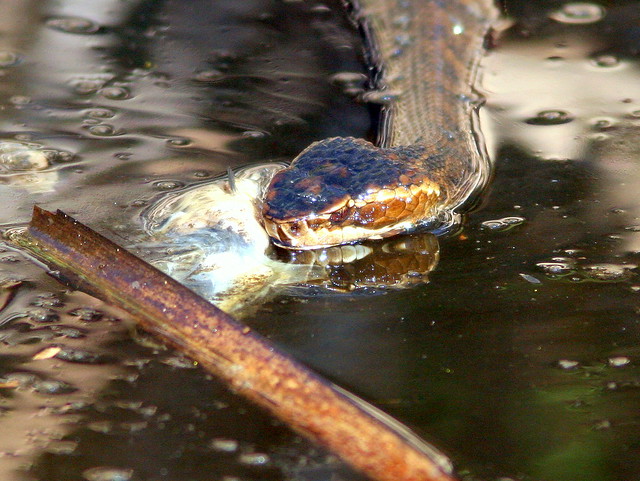
Venemous Cottonmouth Water Moccasins actually may favor carrion over live food. Here one is eating a fish killed by the cold spell: 

Cottonmouth Attacks Dead Fish 20100118

Beginning in the summer of 2010, adult Wood Storks remained rather common the year around. This was a bad sign. When they should have been tending to nests and offspring, pairs of storks were working to save their own lives. Despite actively watching for them, I saw no more immature storks in our back yard for the next three winters. During that period I photographed one in January, 2012, in nearby Long Key Nature Center:

Wood Stork immature 3-20120109

Then, in November of 2012 I saw only one locally. Note the pale bill of this immature stork:

Wood Stork immature in flight 20121125

Finally, in April, 2013 at nearby Chapel Trail wetlands a pair of adults with one young bird showed up:

Wood Storks 20130406

The juvenile bird begged to be fed:

Wood Stork chick begging from adult 20130406

Since then, no youngsters have visited our lake, though adults have been occasionally present during 2014. A single adult Wood Stork, possibly but not certainly the same bird, did shown up almost every day during January and February, but then disappeared. During the months of August through October, no more than one or two Wood Storks were reported to eBird at scattered sites in far south Florida (Broward, Miami-Dade and Monroe Counties). A small colony of this species did breed successfully in West Palm Beach County just to our north.

What is the significance of these changes in abundance? Was the presence of a single adult an indication that its mate was then incubating or tending young birds? It had periods of absence-- was it flying back to feed its chicks? Is this actually a good omen? I hoped so, but by now I would have hoped to see some immature storks at our lake.

Alarmingly, there are now proposals to further weaken the Endangered Species Act by removing its protection for species that sustain a population, however small, in any area of the nation despite widespread annihilation over the rest of its range. Such a change would never have allowed the Bald Eagle to recover from its near extinction in the lower 48 states because they continued to flourish in Alaska, where DDT had not yet entered the food chain.  A draconian legislative proposal would automatically remove a species from the lists of endangered and threatened species after five years, even if it has not recovered, and require consent of state governors and a joint resolution of Congress before a species can be listed as threatened or endangered. 

My hopes were buoyed by glimmers of "Good News" items, which confirmed my suspicion that Wood Storks were indeed nesting somewhere this year:

March 16 2014

Corkscrew's Wood Storks are Growing Up 

Wood storks returned to their famed Corkscrew nesting grounds starting in December for the first time in five years. Wood storks are endangered, and an indicator of wetland health. Their return tells us the natural system in Southwest Florida still has the capacity to grow wood storks. This group of chicks are around four weeks old, with dark fuzzy heads and a white topknot They are at the life stage in which the birds are ravenous, requiring both adults to search for enough fish to sustain their hungry brood. It can take about 440 pounds of small fish to feed a family of four wood storks. 

May 19, 2014

Corkscrew Wood Stork sanctuary sees first nests in years

Wood stork news in South Florida is good, but it could have been better.

For the first time since 2009, the endangered birds nested Corkscrew Swamp Sanctuary, historically the largest wood stork breeding colony in North America: Storks built 200 successful nests and fledged 300 chicks; in the Everglades, wood storks built about 1,400 nests.

"Nesting occurred early, and the vast majority of the chicks left the nest with several weeks between fledging and the start of rainy season," sanctuary director Jason Lauritsen said. "So they stand a good chance of making to adult breeding age. That's the goal. You can count nests and fledglings, but if they don't make it to be breeders, it doesn't matter."

Nesting success for wood storks depends on a rainfall formula:

* Step 1: Heavy rains in the summer fill wetlands in and around Corkscrew, so fish, crawfish and other good wood stork food breed in high numbers.

* Step 2: The area gets little rain in the fall and winter, so the wetlands "dry down," and the stork food becomes highly concentrated in small, shallow pools. That makes prey easy to catch, so adult storks can get plenty to feed themselves and their chicks.


But sometimes the formula breaks down...

...Although Corkscrew's wood stork nesting season was a success, the numbers were comparatively low.

In 2009, the last time wood storks nested in Corkscrew, 1,120 nests produced 2,570 fledglings.

Even that number is small compared to the wood stork nests of more than 30 years ago.


Since 1958, the first year Corkscrew wood stork nesting data were recorded, the Top 5 nesting years were all before 1980: 1961 (6,000 nests, 17,000 fledglings), 1960 (4,760 nests, 13,724 fledglings), 1959 and 1979 (4,505 nests, 8,910 fledglings) and 1967 (3,680 nests, 7,350 fledglings)... (Read More)

More Wood Stork News:

All need to act to stop loss of wood storks in the Everglades (July 9, 2014)

Wood Storks at Corkscrew Swamp Sanctuary


Wood Stork's Endangered Status Is Up In The Air

Press Statement: Audubon's Jason Lauritsen on USFWS Intent to Downlist Wood Storks


Petition of the Florida Homebuilders Association to Reclassify the Wood Stork Under the Endangered Species Act


Saturday, April 5, 2014

This Week's Crops and Clips: Killdeer

These noisy and active plovers nest every spring along the edge of the gravel road that leads into our local wetland birding patch.

This adult posed on the pavement in the parking lot at Chapel Trail Nature Center in neighboring Pembroke Pines.

Killdeer 20131214

This pair was courting  along the shore of the lake in our wetland patch.

Killdeers courting 20110412

An interloper, on the left,  suddenly appeared and made a threat display by expanding the black band on his throat, but he was subsequently chased away.

Kildeer interloper 20110412

This pair was engaged in a courtship display in our Illinois front yard before the bulldozers came.

Killdeer courtship 20120601

As we walk past their nest sites, the Killdeers perform distraction displays to draw us away from the eggs or young.

Killdeer distraction display 20130524

Killdeer distraction display 2-20100409

I photographed this nest with eggs at the edge of a garden in Batavia, Illinois. There is the appearance of a nest structure, but the entire ground wa littered with similar dried vegetation.

Killdeer Eggs 20090512

Here are three of four chicks that hatched out along our gravel road.

Three Kildeer Chicks 20090416

This little Killdeer hatchling was different. His departure from the other three huddled together caught my attention and I stepped very carefully, knowing he would not likely be alone.

Killdeer Chick Backlit 20090416

This Mom is brooding her chicks.

KilldeerBroodingChicks

Killdeers are swift and graceful fliers.  Flight shots are challenging and those I have were mostly lucky shots.

Killdeer in flight 20120410

Killdeer in flight 20120404

Killdeer in flight 20120402

Saturday, March 1, 2014

Burrowing Owl Tragedy

My grandfather raised chickens in his back yard. Growing up in New Jersey, our homes were adjacent and we shared a common driveway. I got to know Pop's laying hens by name and could often recognize their eggs by their size, color and shape and in which nest box they were deposited. His chickens caused me great emotional trauma on two occasions-- once when I killed one accidentally and then when I unknowingly ate "Biddy," one of my favorites (See: Chicken Killer).

By giving the chickens names I got to know their individual traits and personalities. They were like little people to me, like Bambi whose mother was so cruelly killed in a movie that traumatized many little kids. I hated the "Chicken Hawks" that sometimes took the pullets. Yet I eat my Big Mac without thought of abattoirs or anonymous bovines.

We have watched a Bald Eagle nest over seven breeding seasons. The eagle watchers gave some of them names. This year, Pride and Joy's 12th and 13th eaglets are named Honor and Glory (See them in my Bald Eagle FORUM). Naming them gives people a connection with these majestic birds and has often opened doors to a much greater appreciation of the natural world.

Here is Pride with his eaglets, Honor and Glory when they were about 5 weeks old:

Bald Eagles Pride Honor and Glory 20140220

Is it a good idea to name these wild creatures? School children conducted polls back in 2009 and 2010 to name the broods: twins Hope and Justice, and triplets Lucky, Chance and Courage. 

When eaglets fledge they sometimes disappear for a few days before hunger drives them back to the nest. Since there is a high risk of mortality at the time of first flight, their absence causes great anxiety. "Hope is lost!"  "Waiting for Courage!" These two returned, but two other fledglings (the 9th and 11th) disappeared and ground searches found no sign of them, dead or alive. They were mourned as departed friends (Pride and Joy's Family Album).

I took this photo of the male eagle (Pride) from about 1/2 mile away as he carried a Tricolored Heron to his two growing eaglets. Did I mourn the loss of this beautiful long-legged wader, a species  that often graces the shores of the lake in our back yard? Truthfully, I was indifferent as it had no name. 

 Bald Eagle with heron prey 20140216

Burrowing Owls nest on 65 school properties in the Broward County School District. They have bred at one of the locations for at least 30 years. A nest camera has monitored their daily activities at one school for the past year. The owls were given names by the students and they avidly followed happenings at the nest. Last November I was asked to photograph the pair to provide images for fund-raising T-shirts and trinkets. 

The pair was very obliging, but rarely did both stare at the camera at the same time. Their faces are distinctive-- the male is on the right.

 Burrowing Owls 04-20131114

Most of the time they were always looking in different directions, ever alert because predators higher up on the food chain have learned to look there for an easy meal. Over the eons the fittest survive and the weak and unwary are weeded out.

 Burrowing Owls 01ch-20131114

They face the threat of bird hawks by day, and larger owls by night.

Burrowing Owls 03-20131114

While I was photographing the adults a Cooper's Hawk flew towards them. They immediately saw it coming and dove down into the burrow well before it swooped low over the nest.

Cooper's Hawk 2-20131113

In early January, an immature Cooper's Hawk visited the burrow three times during this 5 minute clip, even reaching down into the cavity in search of the owls.

LINK to video here if the space below is blank


By January there was evidence that the owls had offspring. Heavy rains threatened to flood their burrow, but during February four owlets appeared. They were given names. The first to emerge was an adventurous little owlet named "Peeper."  Perhaps he was too adventuresome. 

Here, the little tyke ventures too far from the nest. Upon seeing a threat, that thankfully never materialized, it dives back into the burrow even before all three of its siblings can get out of the way.

Click here if video does not not appear in the space below


You may skip the next clip if you are disturbed by the raw violence of nature. Why didn't at least one of the dozing babies keep an eye on the sky at all times? The adult Cooper's Hawk is exercising its survival skills just as two of the owlets fail in theirs. There is cunning but no hate. Almost by accident, the hawk grasps two owlets at once, kills both but can carry off only one. Usually these encounters occur out of sight and mind, but the camera captures all. And the owlets had names. 

RIP, Peeper and Owlie.

Link to video here if there is a blank space below


The science teacher at the school wrote:


One of my male students responded after watching the graphic loss of the owlets, "that is so sad". He was obviously in deep thought for a while and then suddenly said, "I know what I will do. I will bring in my favorite piece from my rock collection, obsidian. Will you place it at the burrow as a memorial for the two owlets?" I said yes and he did bring it in. We will let him place it by the perch. This shows some of my students have become attached to the owls and their owlets and will be more likely to show understanding and compassion toward other species as well as an appreciation for nature. Wasn't this one of our owlcam goals from the beginning?

Link to more selected video clips from this nest cam:

Broward County Burrowing Owl Cam You Tube Channel


Sunday, September 8, 2013

Woodpeckers and Waxwings

Fall migration is underway here in Kane County, Illinois. I've spent more time afield and less face time with the computer. Hoping my backlog of unprocessed warbler images will continue to build, so this week's post will be a potpourri of sightings as I rush back to one of our local forest preserves. As we awaited the arrival of what we hoped would be hordes of colorful warblers dripping off the trees, the resident birds provided entertainment.

The Red-headed Woodpeckers mentioned in last week's blog put on a bit of a show. Our friend Marion, who monitors the two nests, reported that the young bird in one of the nests is almost ready to fledge and has been looking out of the hole, begging for food. Mary Lou and I hurried over to see if we could witness the behavior and perhaps capture some interesting images.

When we arrived at the site the two adults were calling excitedly. At first we thought they were chasing after an immature woodpecker, perhaps the one from the first brood that we saw on our last visit. Instead, the source of the disturbance appeared to be a female Northern Flicker who was not welcome in their territory. They chased the flicker away but it returned perstently.

Northern Flicker female 20130903

I set up at a good viewing location. The light was not ideal, but I did not want to use flash. Therefore many of my shots (at 420 mm using a fixed aperture of f/5.6 at high ISO), turned out grainy or soft.

One of the parents, presumably the male, proclaimed victory and ownership of the territory by drumming vigorously at the top of the nest tree.

Red-headed Woodpecker drumming at nest tree 20130903


There was no sign of the nestling, and I wondered whether it had left the nest. Suddenly a parent returned with food. For an instant I was lucky enough to catch a glimpse of the chick.

Red-headed Woodpecker feeding nestling 3-20130903

Most of the time, the adult flew directly to the hole and blocked view of its occupant(s).

Red-headed Woodpecker at nest hole 20130903

After several frustrating attempts to follow the parent bird to the nest and click when the nestling's head appeared, I simply focused on the nest hole and waited. It seemed like an eternity before the parent made a food drop. Success!

Red-headed Woodpecker bringing food 20130903

Red-headed Woodpecker bringing food 2-20130903

Red-headed Woodpecker bringing food 3-20130903

Red-headed Woodpecker bringing food 4-20130903

Red-headed Woodpecker feeding nestling 4-20130903

To my surprise, the nestling watched the parent fly away.

Red-headed Woodpecker nestling 7-20130903

It retreated back into the nest, but soon reappeared, seeming to follow the movements of one of the adults that was foraging.

Red-headed Woodpecker nestling 3-20130903

Red-headed Woodpecker juvenile 20130903

Red-headed Woodpecker 4-20130903

There appeared to be only a single young bird in the nest. At this point it was uncertain whether one or more others had fledged, as they  usually lay 4 to 5 eggs, though some clutches have been reported to contain up to 8 or even 10. The eggs, laid one per day, are not incubated until the last is deposited, and they take two weeks to hatch. The chicks, born blind and helpless, remain in the nest for another 3 to 4 weeks.

This adult was sunning atop a snag.

Red-headed Woodpecker sunning 20130903

On the way home, a short stop at Aurora West Forest Preserve provided an image of a handsome Cedar Waxwing.

Cedar Waxwing 20130830

The waxwings were also engaged in domestic duties. Here an adult fed two fledglings.

 Cedar Waxwing feeding young 20130830

A third youngster arrived...

Cedar Waxwing feeding young 2-20130830

...and this seemed to provoke a hostile reaction by the others. Perhaps this intruder belonged to another family!

Cedar Waxwing feeding young 3-20130830