Showing posts with label Everglades. Show all posts

Thursday, March 8, 2018

Exotic lunch for Florida herons

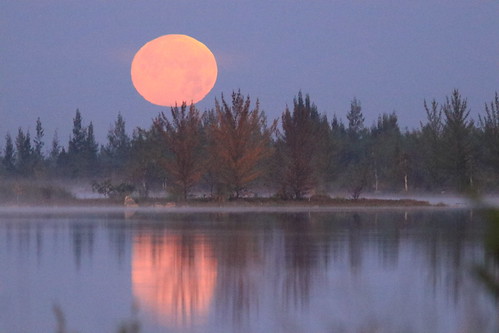
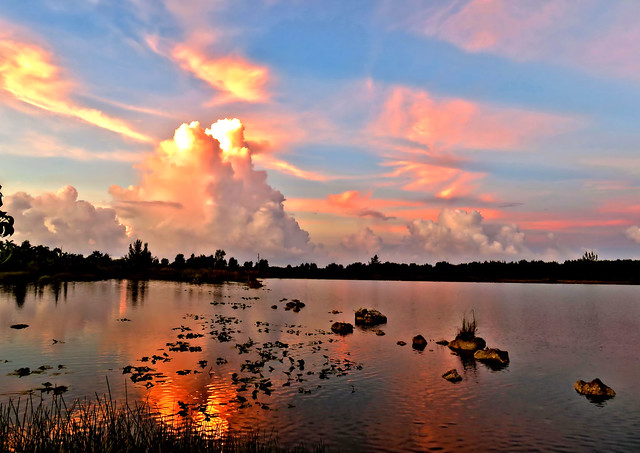
On the first of March a "Semi-SuperMoon" set over the lake in our local Wounded Wetlands. It was about 226,137 miles from Earth, while January's "Super Moon" was nearly 5,000 miles nearer. This was unfair to February, which had no full Moon at all, while January and March each hosted an extra (Blue) Moon. On average, this happens only in non-Leap Years, once about every 25 years--  and I missed celebrating my half birthday as well, for the 60th+ time! 

Semi-SuperMoon setting 01-20180301

Today's post begins and ends at Shark Valley in Everglades National Park.

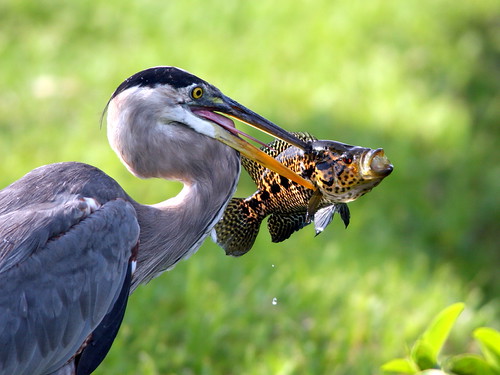
Back in May, 2009 I took one of my favorite photos at Shark Valley. I was not sure of the identity of the fish which this Great Blue Heron had caught, but Internet friends identified it as a Jaguar Guapote, native to Nicaragua in Central America.


I learned from Wikipedia that it is a food fish "and is also found in the aquarium trade where it is variously known as: the jaguar cichlid, managuense cichlid or Managua cichlid, guapote tigre, Aztec cichlid, spotted guapote and jaguar guapote. It grows to 55–63 cm (22–25 in)."
Great Blue Heron Catches Cichlid 20090528

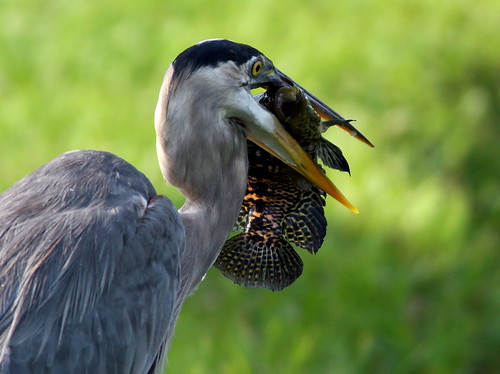
I could not believe that the heron would be able to swallow it!
Great Blue Heron Ready to Swallow 20090528

Great Blue Heron Swallows Tilapia 20090528

Great Blue Heron Swallows Tilapia 2-20090528

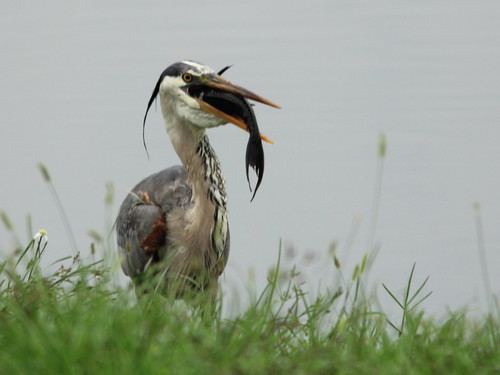
Hypostomus plecostomus, also known as Algae Eater or "Pleco," is a popular aquarium fish from South America which has been introduced into Florida waters. They  are not venomous, though they do have sharp spines that could cause injury if they are handled carelessly. This was the second time I photographed a Great Blue Heron eating one at our back yard lake.
Great Blue Heron with Plecostomas sp 4-20120606

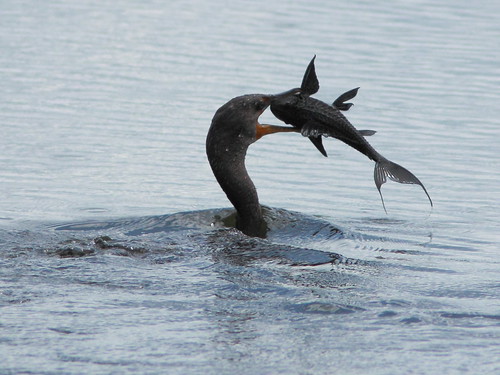
A drama played out in the same lake after I noticed that a Double-crested Cormorant had caught another  large exotic Plecostomus. The 9-10 inch fish struggled vigorously in the bird's beak, its spiny fins fully extended. I do not know how long the fish had been in the cormorant's grasp, but I watched intently to see if the bird could succeed in swallowing it, or whether it might get stuck in its gullet or esophagus. I watched for about 7 minutes and took poor photos from some distance. The bird won!
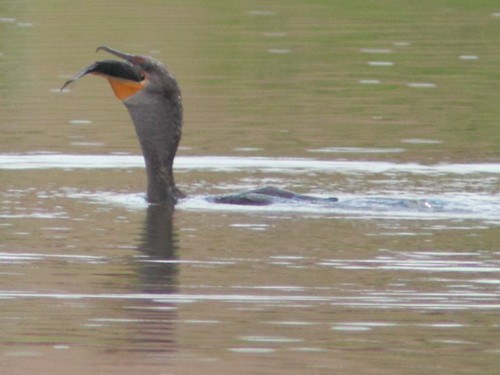
Cormorant (Phalacrocorax auritus) vs Plecostomus 20110925 103439AM

Cormorant vs Plecostomus 20110925 103854 AM

Last month I had the wonderful opportunity to meet up with three Internet friends from New Jersey, my home State. Dave was flying into Miami and Kurt, who now resides in Central Florida, met him at the airport. We planned to meet at Shark Valley before noon, so I headed over earlier. Len, who had driven down from New Jersey, joined the three of us. Although we had not planned to spend much time there, it was so interesting that we stayed well into the afternoon. There were phenomenal photo opportunities:

Alligators...
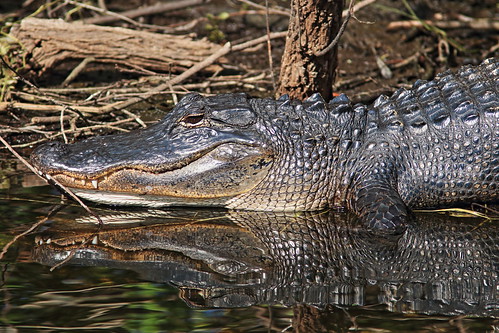
 American Alligator 20180209

...Black-crowned Night-Herons (this one appears to be performing a soft-shoe dance)...
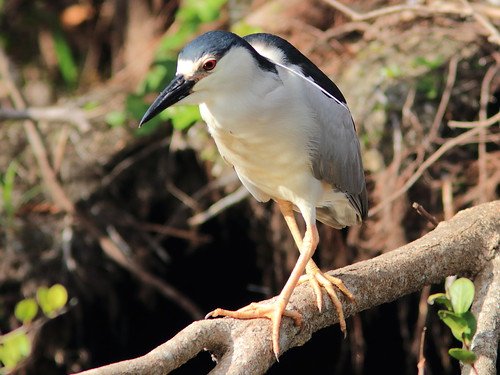
Black-crowned Night-Heron 03-20180209

...but the stars of the show were truly exotic. Florida is home to more than 300 species of exotic fishes. They resulted from intentional and accidental releases from such diverse sources as fish farms, pet trade breeding facilities, spilled shipments and of course, family pets which were freed when it was time to move or they grew too big or were too nasty for home aquariums.


Interestingly, one exotic species, the Pike Killifish was "of importance to medical science as research animals. It is interesting to note that the introduced population in south Florida stems from the release [in 1957] of pike killifish that were the subject of a medical research program whose funding had been terminated." REF: Florida Fish and Wildlife Conservation Commission

Further, the FWCC itself released Butterfly Peacock in 1961 "to control other non-native fishes." It is now a very popular sport fish.

The waterways at Shark Valley were teeming with fish, some native but many were "immigrants." Exotic Walking Catfish and Brown Hoplo gulped air from the surface of a canal while herons and Anhingas took advantage of so many opportunities to capture them.

A Great Blue Heron speared a Walking Catfish:
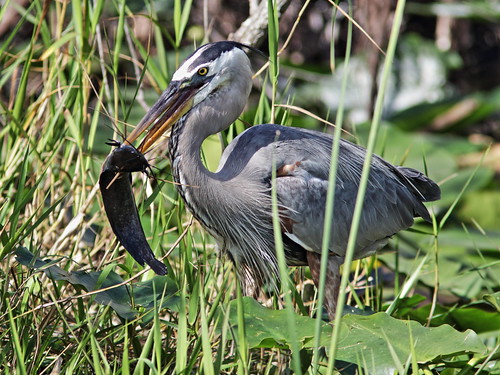
Great Blue Heron with Walking Catfish 001-20180209

After subduing it by repeatedly swinging it down against the ground,...
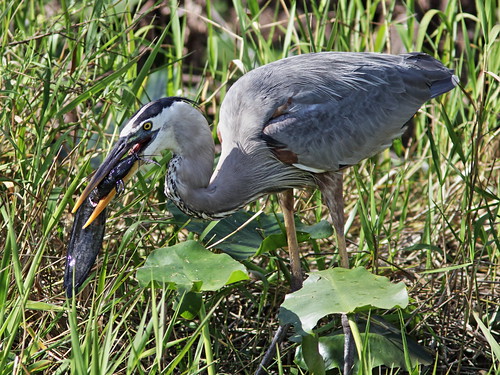
Great Blue Heron with Walking Catfish 002-20180209

...the heron made several attempts to swallow it, head first,...
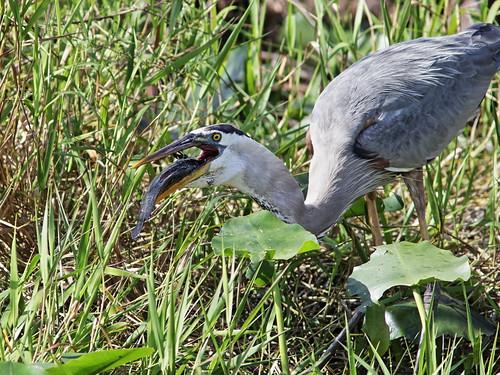
Great Blue Heron with Walking Catfish 003-20180209

Great Blue Heron with Walking Catfish 004-20180209

...and finally succeeded:

Great Blue Heron with Walking Catfish 005-20180209

Great Blue Heron with Walking Catfish 006-20180209

Great Blue Heron with Walking Catfish 007-20180209

A female Anhinga captured a Hoplo. A type of catfish, it is robust and has exceedingly sharp spines under each fin. Yet, it somehow went down:
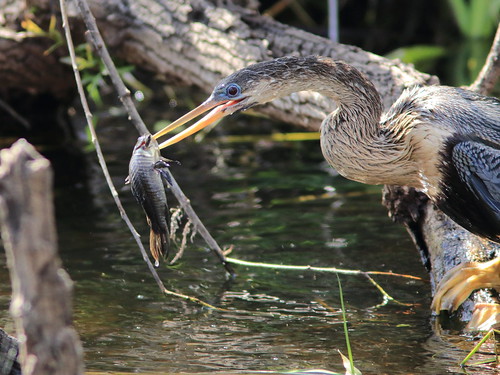
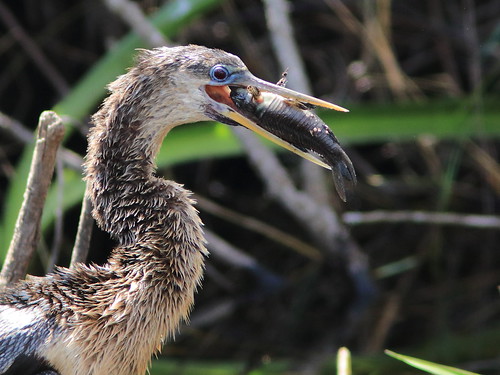
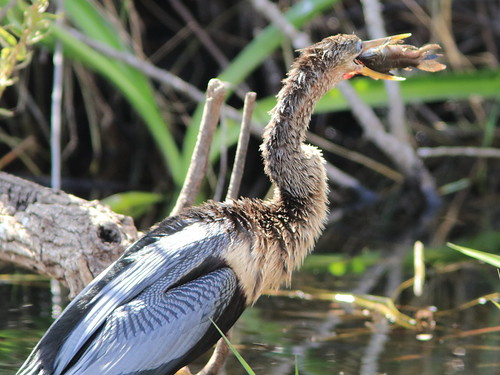
 Anhinga with fish 03-20180209

Anhinga with fish 01-20180209

Anhinga with fish 02-20180209

Anhinga with fish 07-20180209

We did not leave Shark Valley until mid-afternoon, and I felt wiped out by the heat to the point that I feared heat exhaustion might set in. I drank plenty of water and rested in my air-conditioned car for several minutes. Although I felt fully recovered, I thought it best to part with the others, who were heading to Big Cypress Swamp and planned to look for snakes after dark. It was a great day but enough was enough!


= = =  = = =  = = = =  = = = = =

Linking to Misty's  CAMERA CRITTERS,

Linking to Eileen's SATURDAY'S CRITTERS,

Linking to SKYWATCH FRIDAY by Yogi, Sylvia and Sandy

Linking to WEEKEND REFLECTIONS by James

Linking to BirdD'Pot by Anni

Linking to Our World Tuesday by Lady Fi

Linking to Wild Bird Wednesday by Stewart

Linking to Wordless Wednesday (on Tuesday) by NC Sue

Linking to ALL SEASONS by Jesh

________________________________________________

Please visit the links to all these memes to see some excellent photos on display

________________________________________________
Thursday, November 12, 2015

Water levels are high and the storks are gone

Water levels strongly influence the number and species of wading birds that we see on the lake in our local wetlands. Florida's breeding birds have evolved life cycles that adapt to seasonal changes in the availability of food, which in turn is tied to water levels in the historic Everglades.

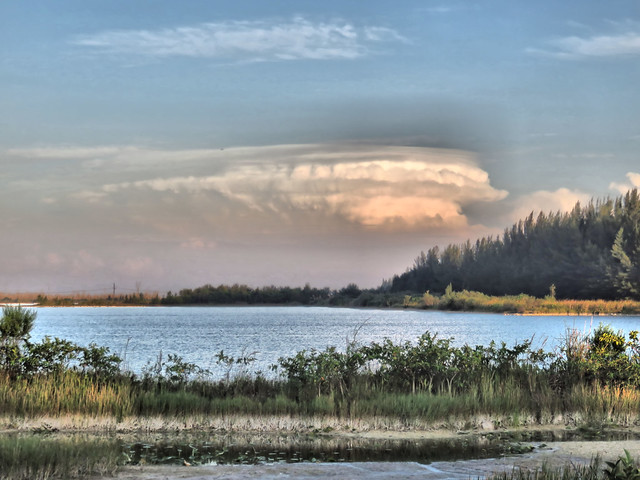
An anvil head looms over the Everglades, August 17, 2015:

Anvil shadow2 HDR 20150817

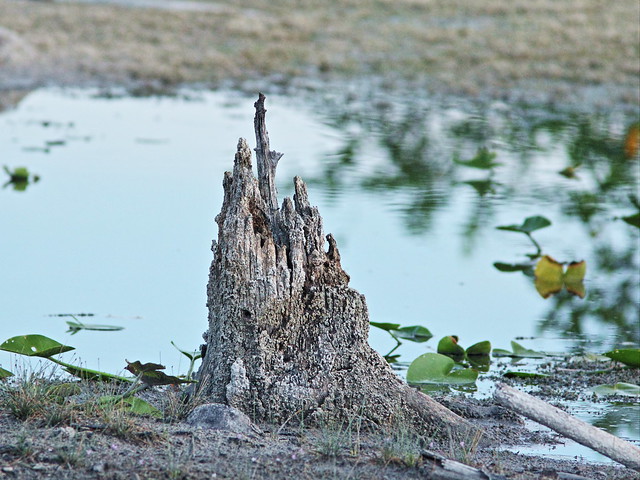
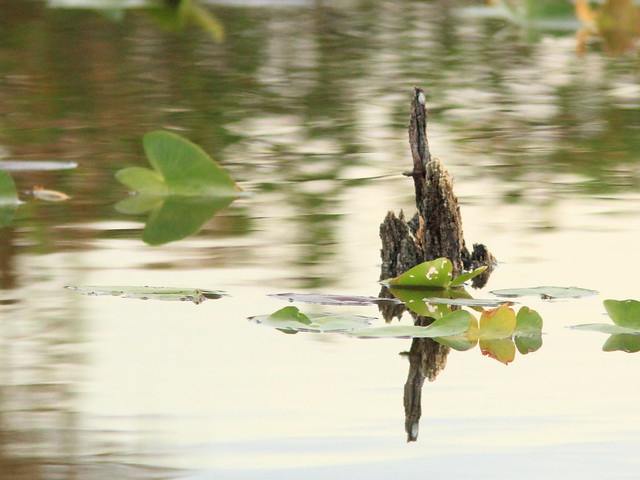
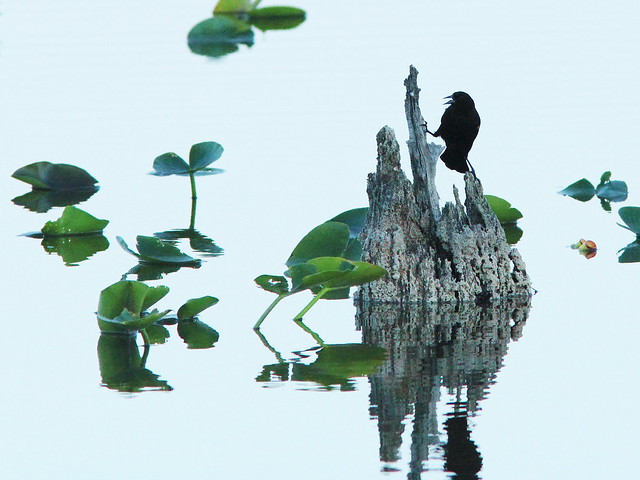
Our local wetlands are not directly connected to the adjacent Everglades preserve and are fed by seepage of ground water and storm water from local rainfall. Yet their cycle of water levels roughly parallels that of the  Everglades. This year the wet season has persisted into early November, in what the weather forecasters call a "spring pattern" of almost daily rain showers and thunderstorms. An old cypress stump in the lake which I call the "Enchanted Island" serves as a convenient water gauge.

A Red-winged Blackbird casts a reflection as it perches on the "Enchanted Island," March 1, 2015:

Red-winged Blackbird reflection 2-20150301

Water levels fell and rainfall was sparse into early summer. Only half the normal amount of rain fell from January through June. The Enchanted Island stump was landlocked, July 24, 2015:

Enchanted Island stump landlocked 20150724

As the lake receded it left isolated pools along the shoreline, trapping fish, to the delight of the herons (July 27, 2015):

Cloud at tree bank HDR 20150727

Heavy rains beginning in mid-summer brought the lake to its highest level. On October 26, 2015 only the tip of "Enchanted Island is visible.

Enchanted Island high water 20151026

The summer wet season normally peaks in August and September, often bringing floods, especially when the normal rainfall is augmented by hurricanes and tropical storm systems. While average annual rainfall is about 52 inches (133 cm) , summer rainfall averages 34-35 inches (88 cm)  and has varied greatly from 23.4 to 53.5 inches (59-136 cm) in years between between 1918 and 1985. The dry season (which peaks between December and February) averaged 17-18 inches (44 cm) with annual extremes between  7.3 and 30.9 inches (19-78 cm).

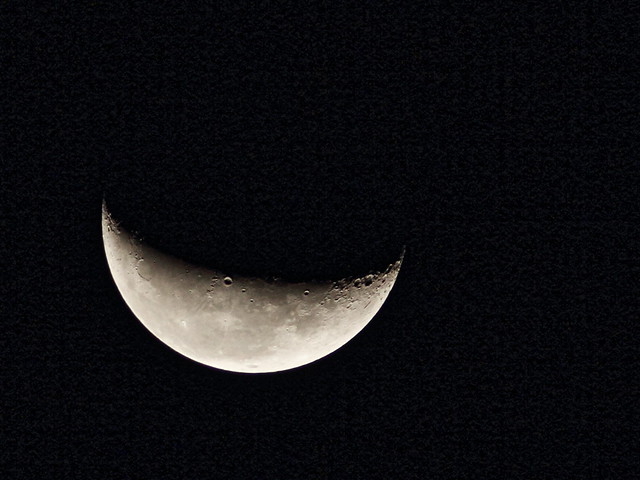
During the winter (dry) season in Florida the crescent moon is illuminated from the bottom, giving it a "U" shape. Legend has it that the cup-shaped moon is trapping the rain water and preventing it from reaching the ground (November 5, 2015):

Moon 20151105

Two general groups of long-legged waders are affected somewhat differently by the changes in water levels: the herons and egrets, which hunt by sight, and the ibises and storks, which are tactile feeders.

Normally, with the approach of the dry season, water levels diminish. If there has been a bountiful wet season, prey items then become concentrated, which is good for both groups of waders. Tactile feeders especially benefit from relatively shallow water as prey must wander into their waiting jaws. However, with drought the wet prairies may dry up completely, confining the water to creeks or channels (sloughs or "slews") where sight feeders have a competitive advantage. Drainage and development of vast portions of the Everglades have reduced the amount of prairie land and channeled the water into deep ditches and canals, further reducing the foraging areas of tactile feeders.

The best time for all of these birds to breed is around November, just as prey is becoming easier to find and standing water helps protect their nesting colonies from terrestrial predators. Ideally, the water will still be low and prey plentiful when nestlings have their greatest need for food.

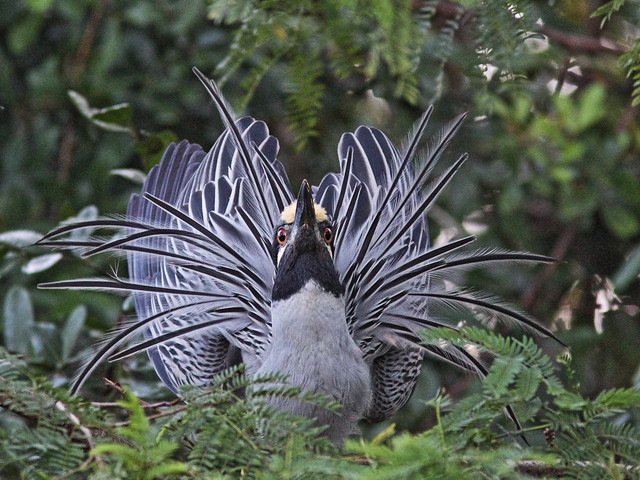
Herons have forward-facing binocular vision, as demonstrated by this displaying Yellow-crowned Night-Heron:

 Yellow-crowned Night-Heron display 05-20140224

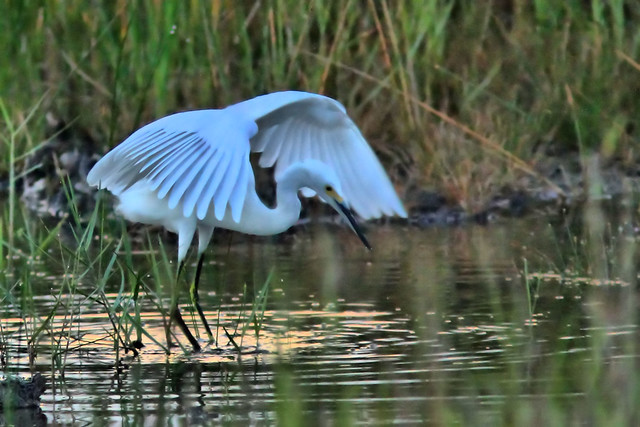
Herons, like this Snowy Egret, are also able to compensate for the shifting of the image of a fish caused by refraction at the surface of the water:

Snowy Egret-12 HDR 20150817

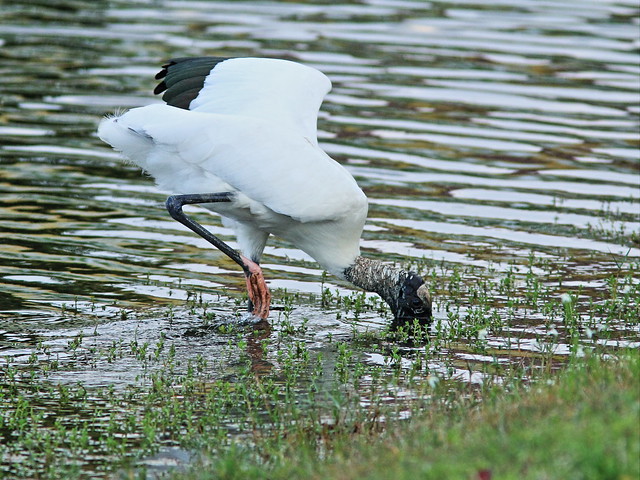
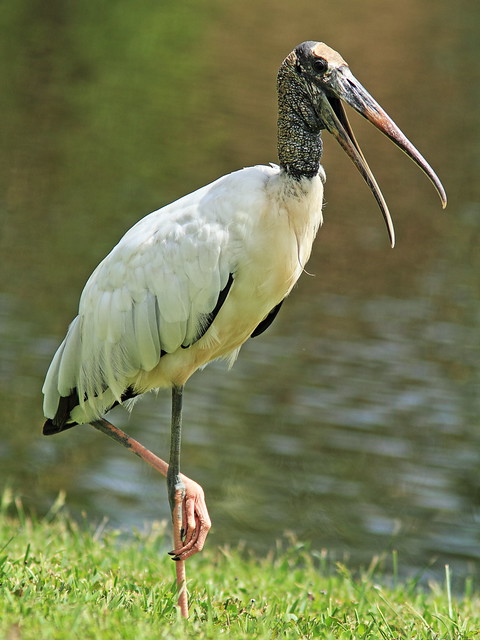
Water that is about 7-9 inches deep is ideal for this tactile feeder, as it allows the Wood Stork to keep its eyes above the surface to watch for predators as it feeds:

Wood Stork 2-20140225

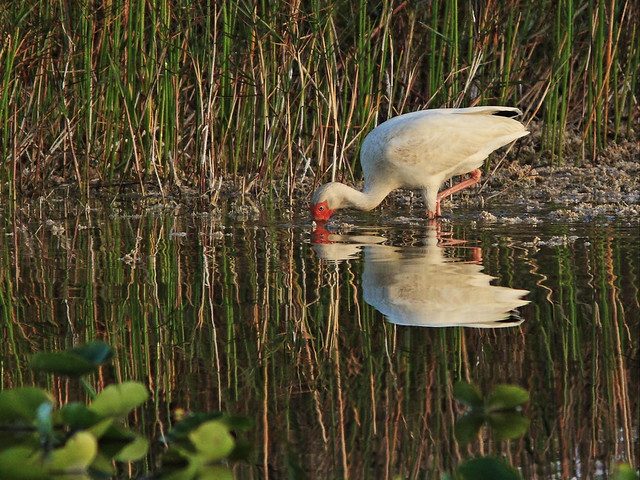
The White Ibis is an adaptable tactile feeder, probing for crustaceans in the mud and even for lizards, worms and other insects in grass turf:

White Ibis 20140411

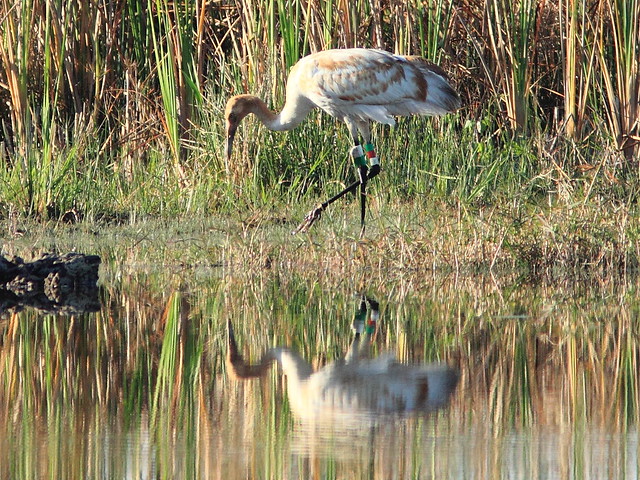
The Whooping Crane (a captive-bred wandering migrant from Wisconsin) captures prey by sight:

Whooping Crane 12-15 at 0839AM  20130207

Ibises generally forage near their nests and may move their breeding colonies to take advantage of local conditions. Wood Storks forage more widely and tend to use permanent colonies. They may delay breeding until water levels fall to an acceptable level, sometimes into February or March. This introduces the danger that offspring may starve if the wet season begins early. In many years the storks may not breed at all (as has happened because of the erratic weather over the past several years), or the parents may need to fly so far to find food that their chicks are left unguarded or starve.   

Only ten years ago, Wood Stork colonies in south Florida included hundreds and even thousands of individuals. Sadly, Wood Storks have now abandoned their historic breeding grounds because of the combination of the effects of a changing climate and human disturbance of their habitat. They now populate new colonies to the north, in Louisiana and up to North Carolina. Families of storks commonly visited our lake in late winter or early spring, following breeding season. I have seen none on our lake since February 2, 2015.

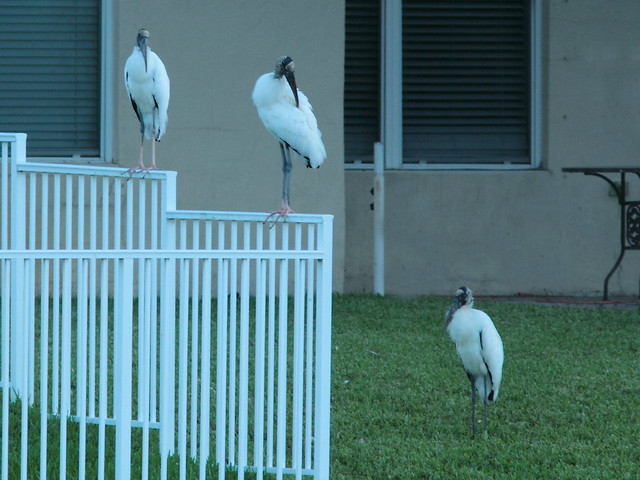
Six Wood Storks, representing two families, each with a single offspring, made a memorable visit to our back yard lake on January 23, 2012 and perched on a fence on the oopposite shore. The immature bird in this family portrait is the one on the left. Note its pale bill and legs and that unlike its parents, its head is not yet bald:
 
 Wood Storks 2-20121023
  
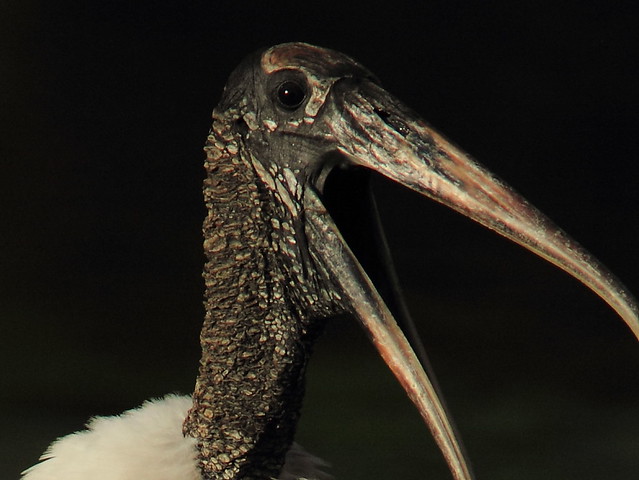
 A Macro view of an adult stork:

 Wood Stork close 20120928

= = =  = = =  = = = =  = = = = =

Linking to Misty's  CAMERA CRITTERS,

Linking to Eileen's SATURDAY'S CRITTERS,

Linking to GOOD FENCES by Tex (Theresa). 

Linking to SKYWATCH FRIDAY by Yogi, Sylvia and Sandy

Linking to WEEKEND REFLECTIONS by James

Linking to BirdD'Pot by Anni

Linking to Wild Bird Wednesday by Stewart

Linking to I Heart Macro by Laura

________________________________________________

Please visit the links to all these memes to see some excellent photos on display

________________________________________________
Saturday, October 18, 2014

Wood Storks: Missing but not Endangered

South Florida contains the historic breeding grounds of Wood Storks, but the species has had almost total reproductive failure here over the past four seasons. Ironically, the US Fish and Wildlife Service (USFWS), under pressure from developers and agricultural interests who are largely responsible for the loss of their habitat, proposed to remove them from the protection of the Endangered Species Act. In June 2014, USFWS officially upgraded their status to "Threatened." 

Adult Wood Stork in our south Florida back yard, August 19, 2014:

Wood Stork 20140819

While it is true that Wood Storks have extended their breeding range northward into Georgia and the Carolinas, their status in Florida is critical. This is somewhat analogous to the situation of the Bald Eagle, which was almost extirpated from the lower 48 States but continued to thrive in Alaska where DDT poisoning was not a threat. I had hoped that the USFWS would grant the stork continued Federal Endangered protection under the Act as a "distinct population segment" (DPS) in southeastern Florida while reclassifying it to Threatened status in the other States. My hopes were not realized.  

Breeding success of Wood Storks in the historic Everglades of south Florida depends upon a complicated and delicate balance between water levels and prey abundance. Young storks must become self-sufficient before the rainy season which normally begins in late May or early June. Nesting normally begins as the wet season ends, around late November and it takes four months for their young to gain independence. In recent years, unusual weather patterns and human activity have greatly altered the hydrological cycle of the Everglades.

When we first moved to south Florida from New Mexico in 2004, we commonly saw immature Wood Storks on our back yard lake.  They were often accompanied by one or two parents, but sometimes the youngsters flocked together. They appeared in greatest numbers in the fall and early winter, such as these two in November, 2009.

Two Immature Storks 20091125

Water levels must be high during the early nesting period for two important reasons. High water protects the storks' nests, encouraging alligators and discouraging terrestrial predators such as Raccoons, Gray Foxes and Bobcats. It also nourishes an abundance of fish to eventually serve as food for the storks when it is most needed. Receding water concentrates the fish, making it easier for parents and young birds to catch them. As tactile rather than sight feeders, Wood Storks depend upon high prey concentrations for successful foraging. 

As this adult stork demonstrates, water that is just deep enough to cover their bill but lets them keep their eyes above water is ideal. Jaws open, the bird is ready to clamp down on any prey that ventures between them. The stork stirs its foot and extends its wing to provide shade where the fish will tend to retreat, thus luring them into the trap.

Wood Stork 2-20140211

This short video illustrates the foraging habits of our backyard Wood Stork.

If you do not see it in the space below, visit this link    


Drainage, filling of sloughs and development have altered the natural cycle, and aberrant rainfall patterns have complicated this balance. Summer drought or early onset of the wet season produce adverse conditions. Prolonged drought kills off the fish and their populations may take more than a year to recover even if water conditions are favorable. The 2012 wet season had much greater rainfall than normal, which was very favorable, but heavy rains during late winter reversed the drying process and dispersed prey, accounting for their failure to produce young during 2013.

The role of invasive Burmese Pythons in nesting failure is presently uncertain, but these top predators are known to feed on storks and have caused a massive decrease in the small mammal population. They even eat deer and alligators. Running out of rabbits and raccoons, they may increasingly prey on larger bird species (Ref: Snakes on the 'Glades).

Immature Wood Storks were particularly abundant here during the winter of 2009-10.These four were part of a larger assembly in our local wetlands in January 2010.

Stork Cluster 20100113

Young storks seemed to be everywhere:

Stork Tree 20100118

Restoration projects are helping to reestablish  the historic hydrologic conditions of the Everglades, but Wood Storks have gradually delayed the onset of nesting to January or even as late as March, producing nestlings into the wet season, leading to abandonment of the nests and/or loss of the young birds. This is because parents may need to fly 50 miles or more to find suitable foraging areas, resulting in fewer feedings and starvation of the nestlings. Even when water levels are adequate over the wet prairies, storks must find their prey in sloughs and canals where the the fish converge. 

During the winter of 2009-10, South Florida and the Everglades experienced a severe spell of cold weather. The jet stream descended and persisted for nearly 2 weeks. On January 11, 2010, air temperatures in Miami reached 35° F (1.7° C), but dipped below 28.4° F (-2° C) at the Royal Palm Station in Everglades National Park and below 26.6° F (-3° C) in Everglades City. For 12 consecutive days, air temperatures did not go above 51.8° F (11.5° C) -- (Ref: Recover: 2014 System Status Report-- Greater Everglades). This had a devastating effect upon fish in estuarine and wetland habitats. Canals and sloughs were littered with fish carcasses, a temporary boon for carrion-eaters but a population setback for storks that was worsened by subsequent drought. 

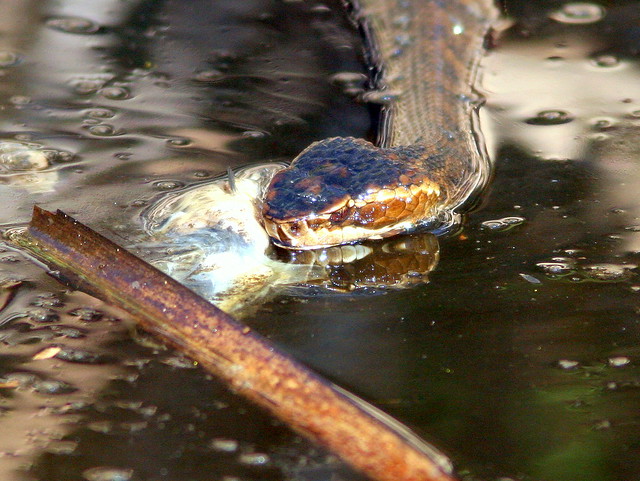
Venemous Cottonmouth Water Moccasins actually may favor carrion over live food. Here one is eating a fish killed by the cold spell: 

Cottonmouth Attacks Dead Fish 20100118

Beginning in the summer of 2010, adult Wood Storks remained rather common the year around. This was a bad sign. When they should have been tending to nests and offspring, pairs of storks were working to save their own lives. Despite actively watching for them, I saw no more immature storks in our back yard for the next three winters. During that period I photographed one in January, 2012, in nearby Long Key Nature Center:

Wood Stork immature 3-20120109

Then, in November of 2012 I saw only one locally. Note the pale bill of this immature stork:

Wood Stork immature in flight 20121125

Finally, in April, 2013 at nearby Chapel Trail wetlands a pair of adults with one young bird showed up:

Wood Storks 20130406

The juvenile bird begged to be fed:

Wood Stork chick begging from adult 20130406

Since then, no youngsters have visited our lake, though adults have been occasionally present during 2014. A single adult Wood Stork, possibly but not certainly the same bird, did shown up almost every day during January and February, but then disappeared. During the months of August through October, no more than one or two Wood Storks were reported to eBird at scattered sites in far south Florida (Broward, Miami-Dade and Monroe Counties). A small colony of this species did breed successfully in West Palm Beach County just to our north.

What is the significance of these changes in abundance? Was the presence of a single adult an indication that its mate was then incubating or tending young birds? It had periods of absence-- was it flying back to feed its chicks? Is this actually a good omen? I hoped so, but by now I would have hoped to see some immature storks at our lake.

Alarmingly, there are now proposals to further weaken the Endangered Species Act by removing its protection for species that sustain a population, however small, in any area of the nation despite widespread annihilation over the rest of its range. Such a change would never have allowed the Bald Eagle to recover from its near extinction in the lower 48 states because they continued to flourish in Alaska, where DDT had not yet entered the food chain.  A draconian legislative proposal would automatically remove a species from the lists of endangered and threatened species after five years, even if it has not recovered, and require consent of state governors and a joint resolution of Congress before a species can be listed as threatened or endangered. 

My hopes were buoyed by glimmers of "Good News" items, which confirmed my suspicion that Wood Storks were indeed nesting somewhere this year:

March 16 2014

Corkscrew's Wood Storks are Growing Up 

Wood storks returned to their famed Corkscrew nesting grounds starting in December for the first time in five years. Wood storks are endangered, and an indicator of wetland health. Their return tells us the natural system in Southwest Florida still has the capacity to grow wood storks. This group of chicks are around four weeks old, with dark fuzzy heads and a white topknot They are at the life stage in which the birds are ravenous, requiring both adults to search for enough fish to sustain their hungry brood. It can take about 440 pounds of small fish to feed a family of four wood storks. 

May 19, 2014

Corkscrew Wood Stork sanctuary sees first nests in years

Wood stork news in South Florida is good, but it could have been better.

For the first time since 2009, the endangered birds nested Corkscrew Swamp Sanctuary, historically the largest wood stork breeding colony in North America: Storks built 200 successful nests and fledged 300 chicks; in the Everglades, wood storks built about 1,400 nests.

"Nesting occurred early, and the vast majority of the chicks left the nest with several weeks between fledging and the start of rainy season," sanctuary director Jason Lauritsen said. "So they stand a good chance of making to adult breeding age. That's the goal. You can count nests and fledglings, but if they don't make it to be breeders, it doesn't matter."

Nesting success for wood storks depends on a rainfall formula:

* Step 1: Heavy rains in the summer fill wetlands in and around Corkscrew, so fish, crawfish and other good wood stork food breed in high numbers.

* Step 2: The area gets little rain in the fall and winter, so the wetlands "dry down," and the stork food becomes highly concentrated in small, shallow pools. That makes prey easy to catch, so adult storks can get plenty to feed themselves and their chicks.


But sometimes the formula breaks down...

...Although Corkscrew's wood stork nesting season was a success, the numbers were comparatively low.

In 2009, the last time wood storks nested in Corkscrew, 1,120 nests produced 2,570 fledglings.

Even that number is small compared to the wood stork nests of more than 30 years ago.


Since 1958, the first year Corkscrew wood stork nesting data were recorded, the Top 5 nesting years were all before 1980: 1961 (6,000 nests, 17,000 fledglings), 1960 (4,760 nests, 13,724 fledglings), 1959 and 1979 (4,505 nests, 8,910 fledglings) and 1967 (3,680 nests, 7,350 fledglings)... (Read More)

More Wood Stork News:

All need to act to stop loss of wood storks in the Everglades (July 9, 2014)

Wood Storks at Corkscrew Swamp Sanctuary


Wood Stork's Endangered Status Is Up In The Air

Press Statement: Audubon's Jason Lauritsen on USFWS Intent to Downlist Wood Storks


Petition of the Florida Homebuilders Association to Reclassify the Wood Stork Under the Endangered Species Act


Saturday, January 12, 2013

Snipe hunt

I must admit that during the winter I'm always looking for snipe in our local South Florida birding patch. Up until now I had only gotten fleeting glimpses of single birds, usually flying away from almost underfoot at breakneck speed. Taken from a distance in poor light, this photo shows the characteristic shape and bold vertical markings on the sides of the breast of a Wilson's Snipe.

Wilsons Snipe 20111020

I came to believe that there is no such creature as a snipe that sits in one place and poses for the camera. So frustrating. Was I being victimized?

As a Boy Scout tenderfoot, I learned the hard way about "snipe hunts."


Urban Dictionary: "You've never heard of snipe hunting? Dude we should go this weekend."


A North American prank and rite of passage wherein older adolescents take younger boys into the wilderness for the supposed purpose of “snipe hunting.” Snipes are an imaginary game bird purported to resemble quails or pheasants or what have you (the fictional snipe is not to be confused with the extant North American shorebird of that same name). Snipe hunts take place on moonless nights; the victims are provided burlap bags with which to catch the birds, while the conspirators spot them with flashlights. The conspirators make birdcalls, through rocks in the bushes, and urgently cry out “snipe” to make the victims believe that there are actually birds in the area. The victims don’t want to be the only one who can’t see the imaginary birds, so they claim to have seen them also. Pretty soon the victims have convinced each other they are surrounded by snipes and proceed to run about foolishly in search of the non-existent birds.


A recent encounter resulted in my first photo of one on the ground in our patch. I had flushed it while walking out on a small peninsula. It flew some 50 yards to an area of shoreline that was rimmed by high grasses. There had been no time for a photo, and I scanned with binoculars but could not find the bird. I took a single photo of the area where it landed, just to remember the experience. Back home I displayed it on the computer screen.

"Where's Waldo?"

Couldn't find the snipe 20121202

Look closely at the enlarged image, and note how its cryptic plumage blends with the background.

Wilson's Snipe found 20121202

Not a very satisfying record, but I added it to my collection of bird species photgraphed on my patch. This past week my luck changed. My "burlap bag" is now full and brimming!

One morning last week Mary Lou and I set out into our local wetlands patch about 15 minutes before sunrise. It was overcast at first, and darker than usual. As we passed along the lake, I caught movement at the near shore. The silouhette of a bird contrasted with the soft glare of the water's surface.

Despite having the ISO cranked up to 3200, I obtained only a grainy image of the bird's head, but its markings confirmed that it was a snipe! While Mary Lou continued her "power walk" another mile into the wetlands area, I remained at the spot, waiting for better light. On her way back she stopped for a while, but the bird had hardly moved and was hidden in the vegetation.

Finally my patience was rewarded. After almost an hour of getting only tantalizing shadows, a snipe walked out into the open, acting as if I were not even there!

Wilson's Snipe 20130102

It walked out into the water...

Wilson's Snipe 2-20130102

...took a bath...

Wilson's Snipe 3-20130102

...and preened its feathers.

Wilson's Snipe 4-20130102

To my surprise, three more snipes appeared, as if out of nowhere.

Wilson's Snipe 5-20130102

This short video illustrates the feeding behavior of the Wilson's Snipes.

FLICKR Link:http://www.flickr.com/photos/rosyfinch/8346840919/


VIMEO Link: http://vimeo.com/56789503


Wilson's Snipe from Ken Schneider on Vimeo.