Since the rookery is located on our way to shopping and medical care, Mary Lou and I had stopped there several times in hopes of timing their arrival. As has happened in previous years, they waited until February to arrive. They are starting to build their nests, which can be very close to each other.

We can expect nest construction to be followed by egg-laying in early March. Most of the young will fledge during June. Double-crested Cormorants and Anhingas are nesting among the storks, which are gathered into several groups:


We counted 80 storks (75-83 in several hand counts of those in the rookery plus others in surrounding grounds), 45 cormorants and 7 Anhingas in the rookery. Many more herons will also begin nesting there in coming weeks.
The storks are graceful in the air:


Although the cormorants are often derided as ugly pests, I find that their plumage has an almost sculptural quality. This one is coming in for a landing:


We found only three Tricolored Herons, but expect to see many more during their nesting season:

The rookery and surrounding park is home to a multitude of Green Iguanas. They are vegetarians and appear not to be a direct threat to the birds except that they compete for space in the rookery. In breeding condition they develop an orange color, as in this huge specimen, fully 5 feet long:

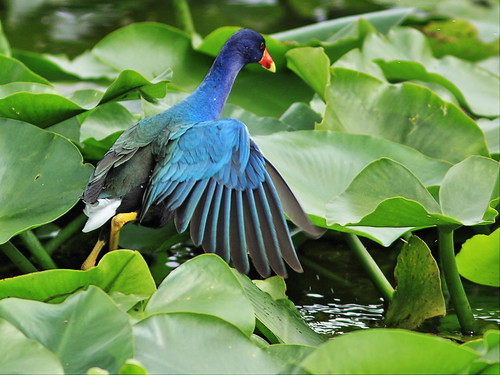
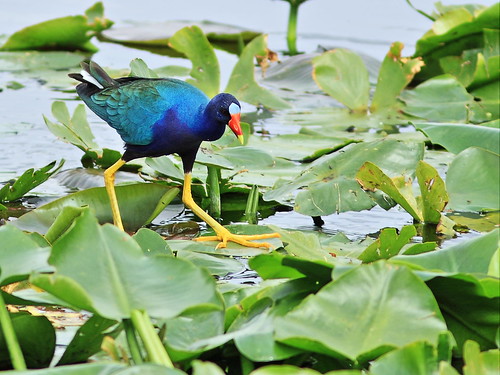
Oddly, a Purple Gallinule, its extremely long toes adapted to walking on lily pads, was perched in a tree across the lake:

It flew down to forage in a more familiar setting:

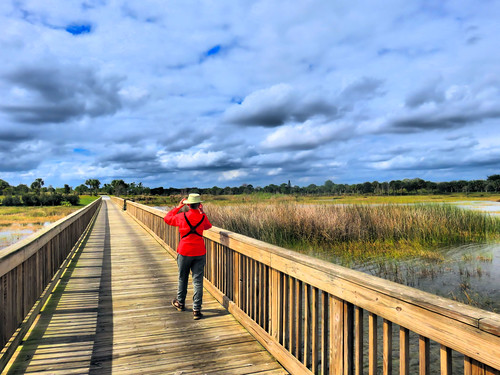
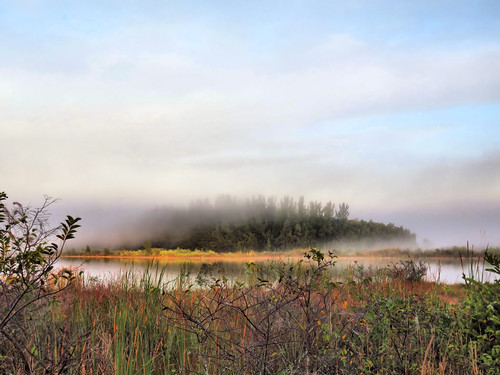
Some of our early morning walks in the local Wounded Wetlands have been cut short by the threat of rain:

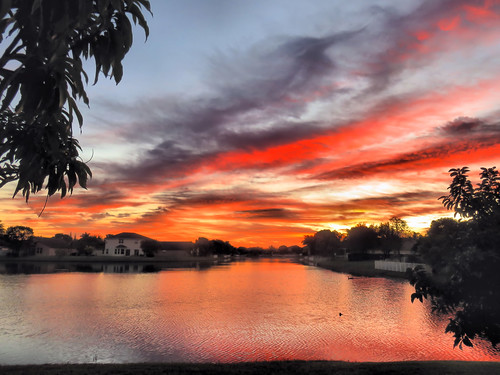
On February 11, our back yard lake was clear and still just before sunrise:

Also on the home front, one clear morning I added a new (dwarf) planet to my "life list." The planets were spaced equally, aligned (from lower left to upper right)-- Saturn, barely visible in the glow of the rising Sun, very bright Venus, then Jupiter... and following the same line, a very faint Dwarf Planet Ceres. The star Antares is also visible just below a line halfway between Jupiter and Ceres. (Click on image to enlarge, and then squint to see them!). Taken with my pocket camera, hand-held:

This is a chart of the sky on the same day (February 7) and time from about the same point of view:

(©2019 Dominic Ford, some rights reserved )
At the local Bald Eagle nest, one of the eaglets has been conspicuous, while the second keeps low. In 2 out of 3 nests, the first-hatched is a female, which gets a head start and also grows faster and is much more aggressive than a male. If the second is a male it learns to stay out of the way of his big sister, waiting his turn to be fed. Here, the older chick appears to be begging for food from the male parent while the female is feeding the younger eaglet:

The male and female take turns roosting nearby and keeping an eye on the nest while the mate forages or tends to the eaglets.
Male (Pride) roosting on a nearby tree:

Female (Jewel) assumes a regal bearing as she stands watch above the nest:

To obtain a photo of a tiny (20mm/0.75 inch) but beautiful creature of interest in the grass in front of the eagle nest, I had to lie down on the ground. This is a Dainty Sulphur:

= = = = = = = = = = = = = = =
Linking to Misty's CAMERA CRITTERS,
Linking to Eileen's SATURDAY'S CRITTERS,
Linking to SKYWATCH FRIDAY by Yogi, Sylvia and Sandy
Linking to WEEKEND REFLECTIONS by James
Linking to BirdD'Pot by Anni
Linking to Our World Tuesday by Lady Fi
Linking to Wild Bird Wednesday by Stewart
Linking to Wordless Wednesday (on Tuesday) by NC Sue
Linking to ALL SEASONS by Jesh
________________________________________________
Please visit the links to all these memes to see some excellent photos on display
________________________________________________