Showing posts with label Bar Ditch. Show all posts

Thursday, September 10, 2020

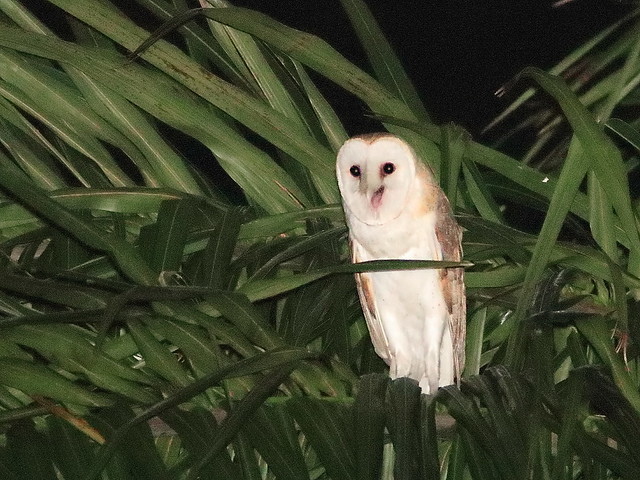
Beauty is in the eye of the Barn Owl

I first encountered a Barn Owl in our local wetlands preserve in 2015, when I saw one on the top of a dead Royal Palm along the gravel entry path. That tree was subsequently removed and replaced by another which also died.  

According to Cornell University's global eBird database, this species has never before been reported to breed anywhere in southern Broward County. The nearest historical sightings occurred in undeveloped areas in Miami-Dade County about 4 miles / 6.4 kilometers to the south.and in Broward County 10.5 miles / 17 kilometers to the north. I never saw another until I photographed one in flight near this location in February, 2019.

Since then they have been present consistently. These are earlier photos:

Barn Owl 02-20200408

Barn Owl 03-20200408

Here is the topless palm tree in an undeveloped spot where I first saw a Barn Owl, in August, 2015:

Palm trunk Barn Owl roost 20150811

Although I never saw them again until 2019, I was encouraged when I found this wing feather in October, 2018, very close to the old tree:

Barn Owl wing feather 20181009

I suspected that they may have been nesting on the top of another Royal Palm behind a home across the gravel road. This tree had also died and lost its foliage. I heard and recorded a young owl nearby only a few weeks ago (Link to eBird checklist). 

This species nests all year round. This week there were two Barn Owls occupying the top of this second tree, too dark for my camera, so here is the daytime view (along with our neighbor's  regulation-compliant fence):


Barn Owl nest tree 01-20200830

Our homeowners association contracts with landscapers to maintain the area along the berm where the nest tree is located.  Many people cannot stand the sight of an old dead tree and I feared they may be planning to remove and replace it with a more "fitting" representative of our refined community. The Barn Owl does not see it this way.

Therefore, I worked with the homeowners association on a plan to to protect the nest tree. A pair of Barn Owls and their brood can eat as many as 3,000 rodents in a single nesting season, so they are much more efficient than a pest control company. While they are protected by the Federal Migratory Bird Treaty Act and they are the least numerous among Florida's 5 owl species, they are not threatened or endangered. 

Happy to say that my mobility and energy have vastly improved since starting on Prednisone. MaryLou and I have been out about an hour before sunrise almost every morning. We arranged for Juan, a fellow birder to meet us on the way in and he was treated to seeing both Barn Owls as they emerged from the palm trunk and flew overhead, their pure white undersides reflecting the glare of our flashlights.

As we were observing the Barn Owls we heard an Eastern Screech-Owl calling nearby. Juan located it and I obtained poor photos with the help of his flashlight:

Eastern Screech-Owl 01-20200829

Eastern Screech-Owl 03-20200829

That day I logged over 10,000 steps for the first time in almost a month as we trekked into a more primitive area of the preserve on the Bar Ditch Trail. As we walked westward, Juan turned around to capture the rising sun:
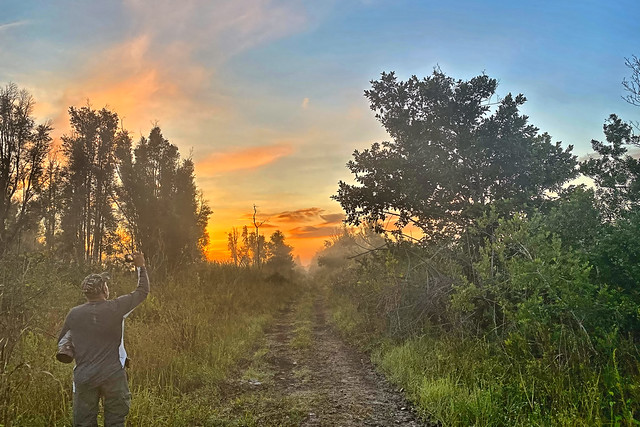
Sunrise captured by Juan 20200829

Were it not for the sound of airplanes and distant traffic, we could have been lost, deep in the wilderness:

Bar Ditch Trail 05-20200829

A motley molting Blue Jay was missing his splendid head-dress:

Blue Jay molting 01-20200829

Later we spotted one almost completely feathered:

Blue Jay 20200825

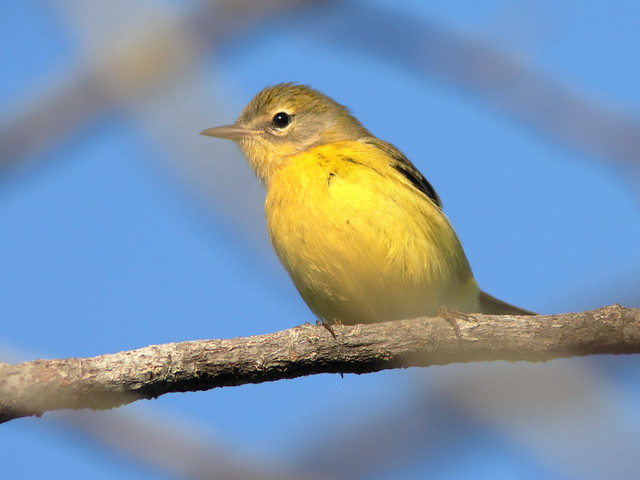
A female Prairie Warbler appeared against the blue sky:
Prairie Warbler 03-20200829

The male Prairie Warbler was partially obscured in the brush:

Prairie Warbler 02-20200829

Blue-gray Gnatcatchers flitted about actively:

Blue-gray Gnatcatcher 01-20200826

Northern Cardinals were numerous, a male...

Northern Cardinal 08-20200526

...and female posed for photos:

Northern Cardinal female  04-20200526

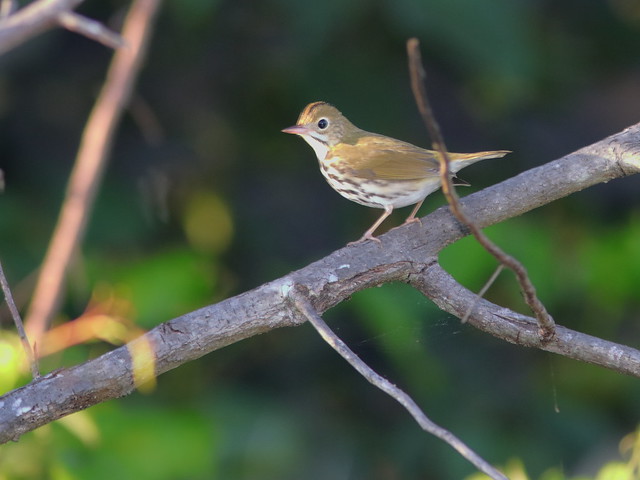
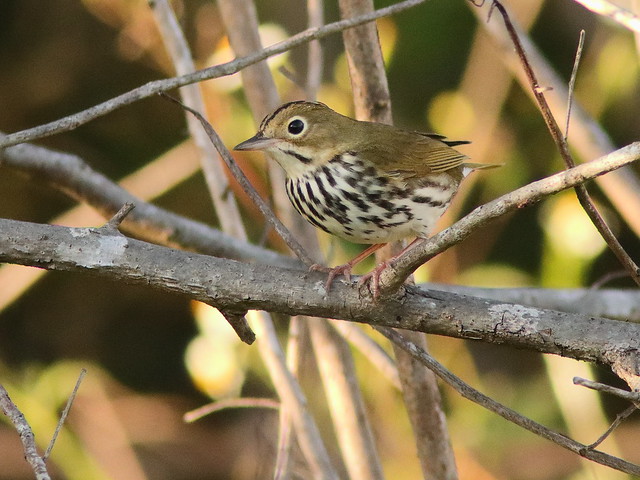
An Ovenbird appeared briefly:

Ovenbird 02-20200826

Ovenbird 01-20200826

There were fresh Bobcat tracks...

Bobcat print 01-20200826

...Raccoon hand-prints...

Raccoon prints 29299826

...and evidence of a large feral hog:
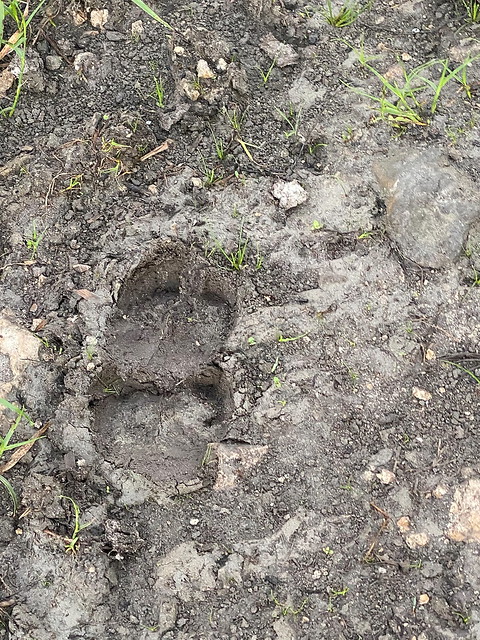
Feral hog print 20200826

A White-tailed Deer with deformed antlers stepped out into the path in front of us:

White-taled Deer one-horn buck 01-20200826

A pair of Loggerhead Shrikes rested together in a treetop:

Loggerhead Shrikes 2-20200825

Two Yellow Warblers were passing through, southbound:
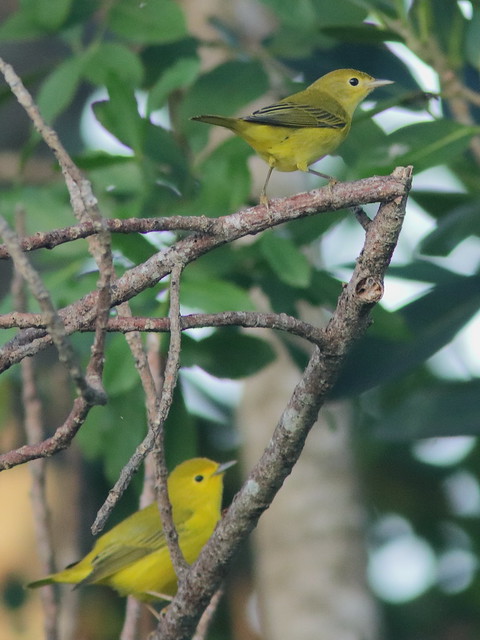
Yellow Warblers 01-20200818

Yellow Warbler 09-20200818

Among the insects, a richly patterned Horace's Duskywing...
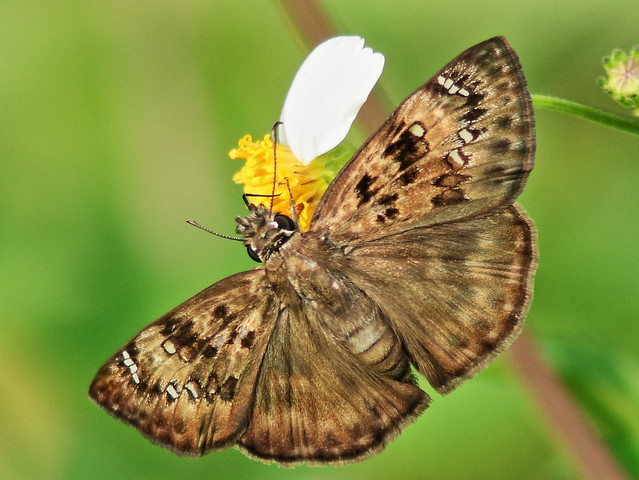
Horace's Duskywing - Erynnis horatius 02-20200820

...and a Band-winged Dragonlet (Erythrodyplax umbrata):
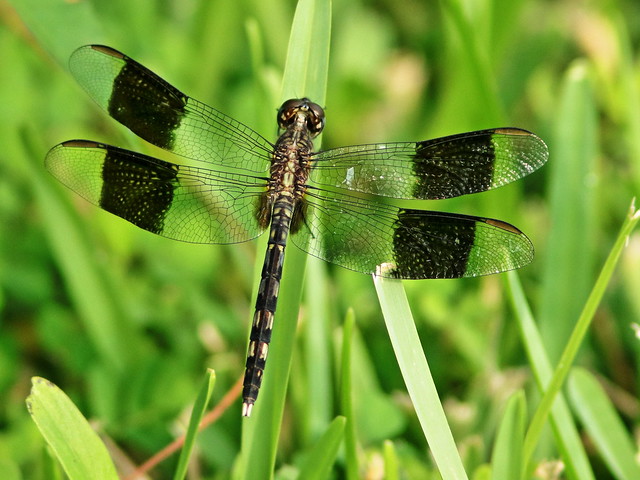
Dragonfly 01-202008120

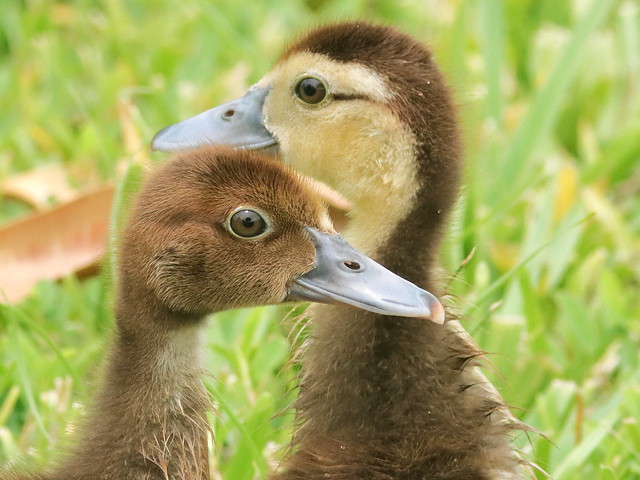
Back home and in seclusion, we enjoyed a visit from the mamma Muscovy Duck, who hatched out 15 ducklings in our back yard. She now was guarding the last four survivors of her brood. Turtles, bass, cats, herons and hawks are not kind to baby ducks:

Muscovy ducklings 02-20200819

Muscovy ducklings 03-20200819

Muscovy ducklings 04-20200819

White Ibises gathered along the shore:
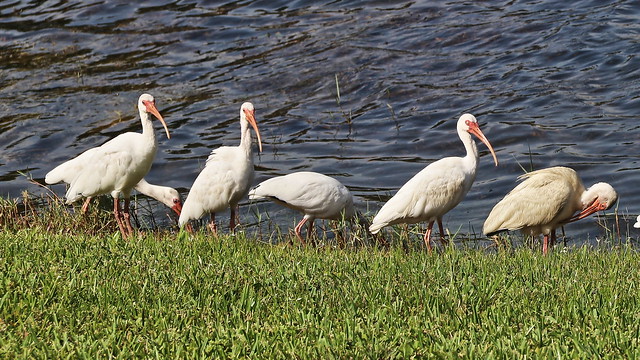
White Ibises 02-20200525

Opposite to the sunrise, the anti-solar rays reflected on dust blown in from the Sahara Desert and the shadows of clouds intersected over the Everglades:

Before sunrise 03-20200830

Morning sun touched the south wet prairie:

South wet prairie 20200831

Great Egret in morning light:

Great Egret 06-20200830

The egret cast a meager reflection on the breeze-dimpled lake surface:

Great Egret 05-20200830


= = =  = = =  = = = =  = = = = =

Linking to:

Fences Around the World

Skywatch Friday

Weekend Reflections

Saturday's Critters

BirdD'Pot

Camera Critters

All Seasons

Wordless Wednesday (on Tuesday)

Natasha Musing

Our World Tuesday


________________________________________________

Please visit the links to all these posts to see some excellent photos on display

________________________________________________

Thursday, February 27, 2020

Cedar Waxwing, ABA Bird of the Year

It is impossible for me to pin down the age at which I started taking an interest in birds. Wildlife fascinated me as far back as I can remember, whether it was following rabbit tracks in the snow with my Dad, catching Garter Snakes, or watching tadpoles develop into frogs and toads. 

My grandmother, who lived next door to our home in New Jersey, fed bread to the "Chippies," English (now House) Sparrows and maintained a nest box for the "Jenny" (House) Wren. 

The abundance and variety of birds always made them creatures which  deserved greater interest. I remember helping Dad rescue a young "crane" (in retrospect, a Great Blue Heron) which had gotten entangled in some kite string and bushes in the Passaic River bottomlands. He placed his jacket over the bird's head and menacing beak as he freed it and carried it out into an open field. There, we watched triumphantly as it took low and lumbering flight. 

My only concrete reference point is a loose-leaf "My Bird List," which I started as a Boy Scout merit badge project in December, 1948. The advent of spring migration boosted my list to 114 species by the end of May, 1949. The penultimate new species that month was a Cedar Waxwing, a member of a flock "in a cherry tree near Neil's yard." 

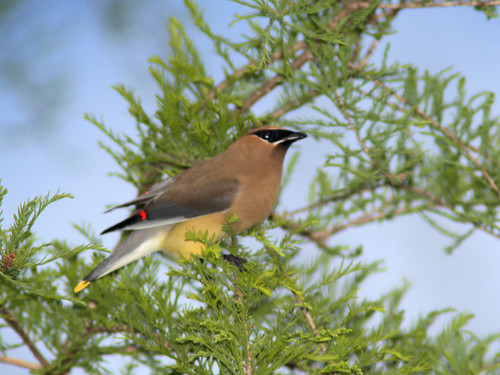
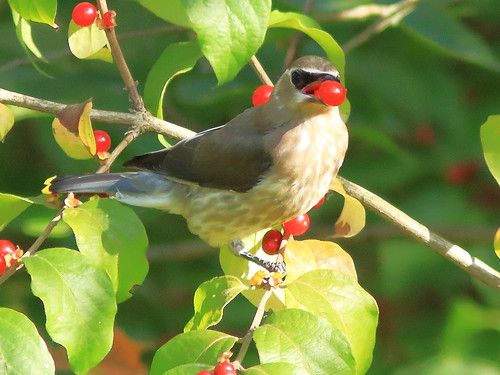
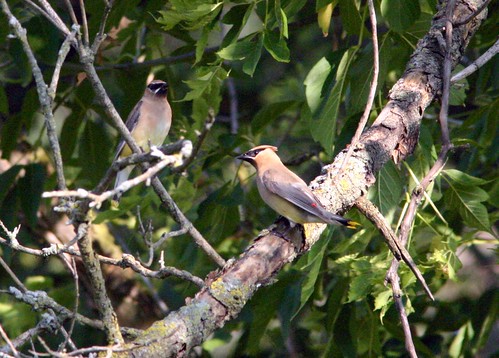
As is the case with many of my first non-routine sightings, I still remember these birds, crested and neatly attired in warm brown with yellow tail-tips and some with bright red accents on their wings. Now the American Birding Association (ABA) has designated the Cedar Waxwing as "2020 Bird of the Year."


Bird photography was not part of my life until 2008, four years after we  moved to south Florida, when our son-in-law gifted me with a first generation (6.3 megapixel) Canon Digital Rebel with a 70-300 mm zoom lens. My first photos of Cedar Waxwings were taken during a visit to their Illinois home, at neighboring Hawk's Bluff Park in September 2008:

Cedar Waxwings

Cedar Waxwing Closeup

Since then I have seen Cedar Waxwings during the winter a few times in Florida, but all my photos were obtained while visiting (and for several years, occupying our second home in) northeastern Illinois.

This photo was taken on May 2, 2009 with my upgraded Canon EOS 30D with 420 mm prime lens system:

Cedar Waxwing 20090502

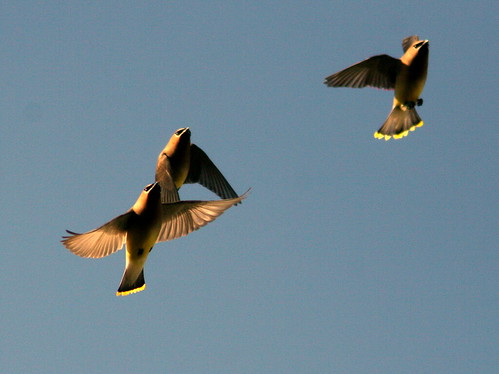
Cedar Waxwings are very sociable. They travel in flocks:

Waxwing Ballet 20100212

Waxwings in Flight 20100207

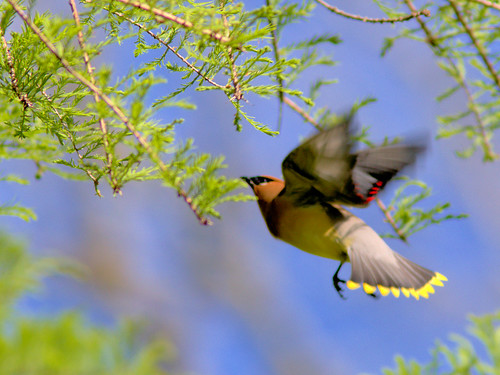
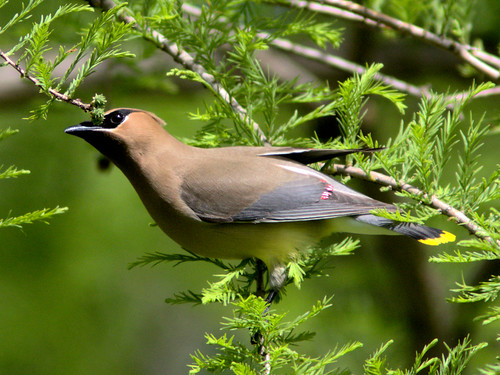
The name of this species is descriptive. It eats the berries of cedar trees during the winter and older birds have waxy-looking red tips on their secondary wing feathers, features visible in this poor photo:

Cedar Waxwing eating cypress buds 2-20170521

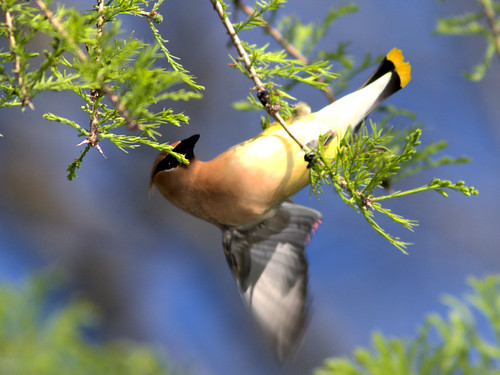
Incidentally, the above waxwing is hovering as it plucks the small female cones on a Bald Cypress tree, on May 23, 2017 in Lippold Park, Kane County, Illinois. Many had assembled to harvest this crop:

Cedar Waxwing 04-20170521 

Cedar Waxwing eating cypress buds 20170521 

Cedar Waxwing 02-20170521

The deciduous Bald Cypress bears male flowers in autumn which persist as catkins on the bare branches all winter but do not produce pollen until spring, when the female cones emerge and are pollinated before new leaves sprout. This bird seems to be closely inspecting two of the cones:

Cedar Waxwing checking cypress buds 2-20170521

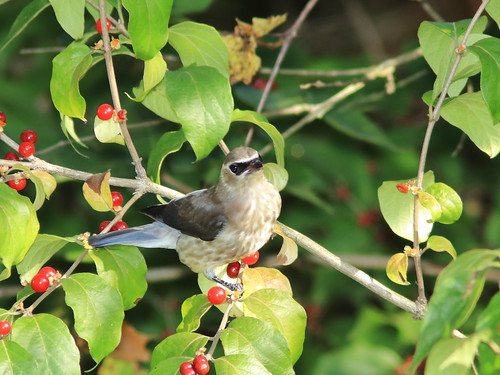
Immature Cedar Waxwings have streaked breasts and little or no head crest (Lippold Park, September 18, 2017):

Cedar Waxwing immature 03-20170918

Cedar Waxwing immature 02-20170918

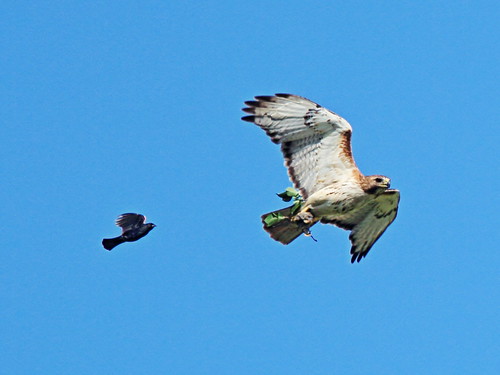
This red-tailed Hawk has captured a young waxwing (along with a twig and some leaves) and is being pursued by a Red-winged Blackbird:

Redtailed Hawk with Cedar Waxwing prey 2-20150715

Red-tail pursued by Red-winged Blackbird 06-20150715

Out an hour before sunrise on our local wetlands on Sunday, February 23, I found that the off-road riders had done me a favor. For more than two years It has  been impossible to access  one of my favorite birding trails. Hurricane Irma had downed several trees and the entrance to the trail was hopelessly blocked. The ATV bunch came equipped with chain saws and opened the entrance. 

I call this trail the Bar Ditch Trail, as  it is a long-abandoned farm road created along a drainage ditch by using the soil from the ditch. The term "Bar" comes from "Borrow Ditch," referring to the earth and rocks "borrowed" for the road. The trail is mostly under water during the wet (summer) season, but I was able to walk in about 1/3 mile before encountering soft mud. 

It was so nice seeing the water and there were signs of aquatic life:

Bar Ditch  091-20200223

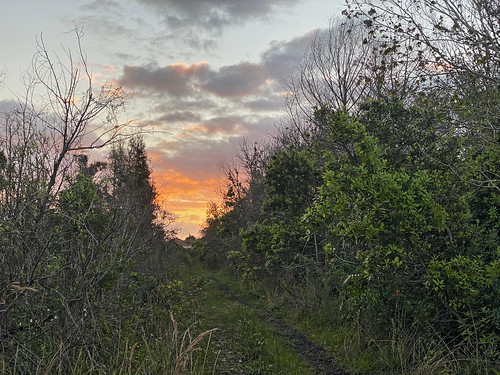
It was still dark when I reached a very muddy patch, so I turned around and enjoyed the sunrise:

Bar Ditch road sunrise 04-20200223

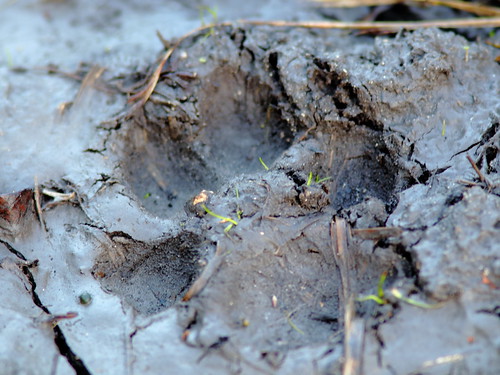
The soft mud contained the tracks of a deer and a Coyote:

Deer and Coyote tracks 20200223

I also found Bobcat tracks:

Bobcat print 02-20200223


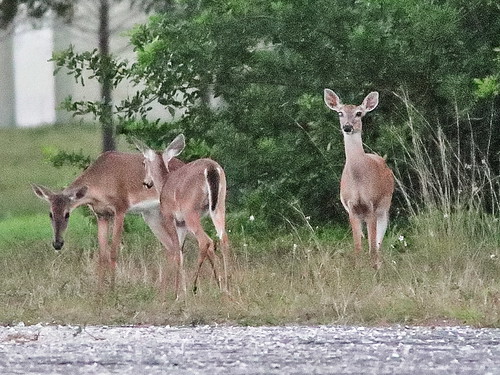
Yesterday (February 26) I encountered a herd of seven White-tailed Deer, the  most I have ever seen together in the local wetlands:

White-tailed Deer herd- seven 2-20200226

I fear that the deer are refugees from a large plot of land which is being developed to the north of us. Interestingly, the second doe from the left in the above photo is blind in her right eye. Here is a closer look:

White-tailed Doe one-eyed 20200226

This is the same animal which I encountered five years ago, in 2015. I call her "One-eye" and had seen her few times since, once with a fawn following her. Here is my first photo of her, taken on January 23, 2015. She certainly is a survivor:

White-tailed one-eyed fawn 20150123

= = =  = = =  = = = =  = = = = =

Linking to :

Fences Around the World


Skywatch Friday

Weekend Reflections

Saturday's Critters

BirdD'Pot

Camera Critters

All Seasons

Wordless Wednesday (on Tuesday)

Our World Tuesday

________________________________________________
Please visit the links to all these posts to see some excellent photos on display

________________________________________________