We just returned from a two week stay in northeastern Illinois. Surprisingly, we had a spell of hot weather with some temperatures higher than those back home in south Florida.
Although we were busy with volleyball games and preparations for a charity gala with 100 guests at our daughter's home, we found time to get out and walk in the nearby parks and forest preserves. We saw many more warblers than we were able to identify, as they tended to forage high in the trees against the very bright sky.
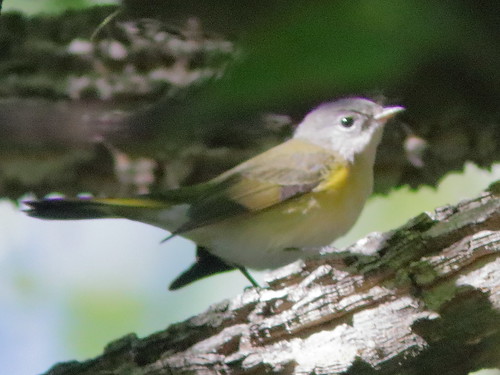
At Les Arends Forest Preserve in their home town of Batavia, we encountered a mixed flock which included American Redstarts. I was only able to get a decent photo of a female:
There were quite a few Bay-breasted and Blackpoll Warblers, which are quite similar in their dull fall plumage.
The Blackpoll shows some streaking of its underparts and has a more greenish cast to its head and neck, so this most likely is one here:
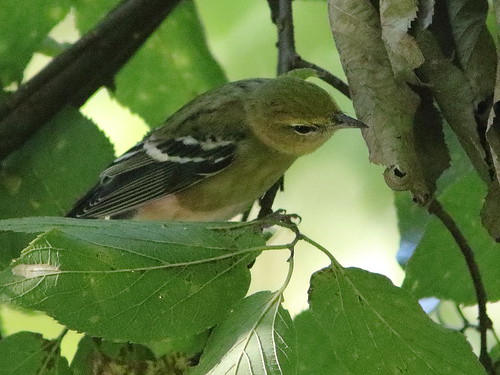
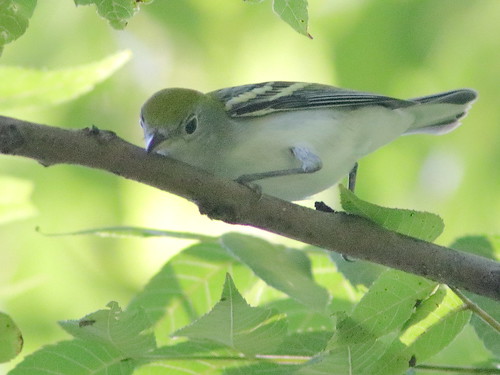
Bay-breasted Warbler? It should have dark legs but these appear to be light as in Blackpoll:
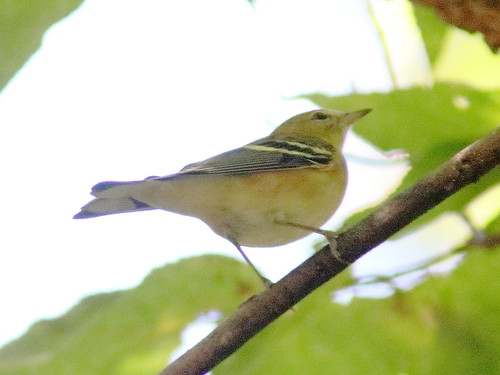
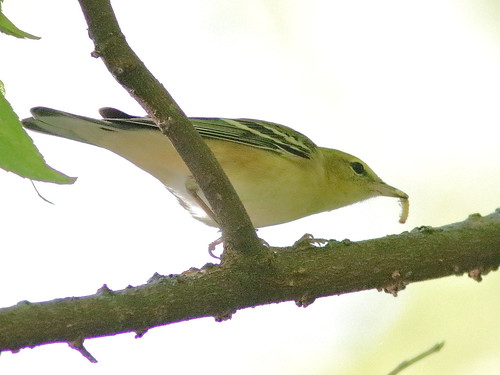
This is a dull female Chestnut-sided Warbler:
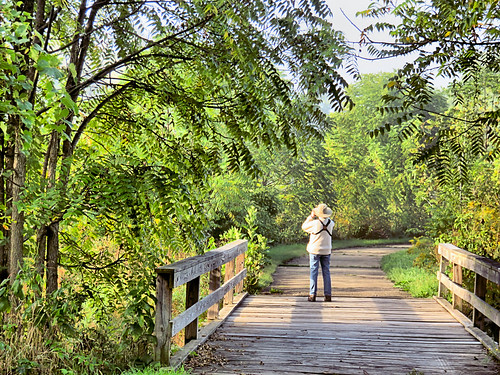
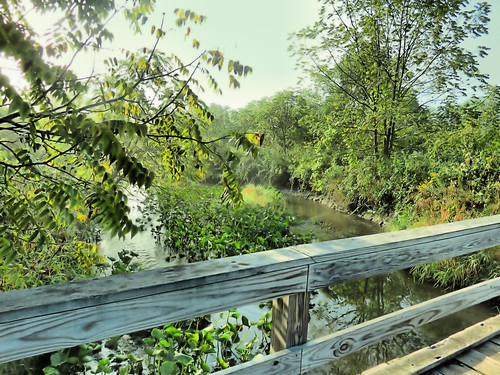
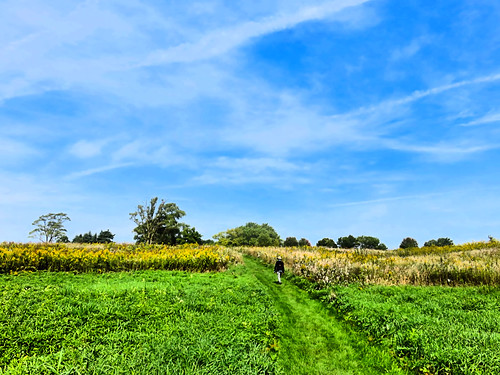
Bliss Woods Forest Preserve in Sugar Grove has very nice walking trails and a wooden bridge over Blackberry Creek, where Mary Lou is looking at a goldfinch:
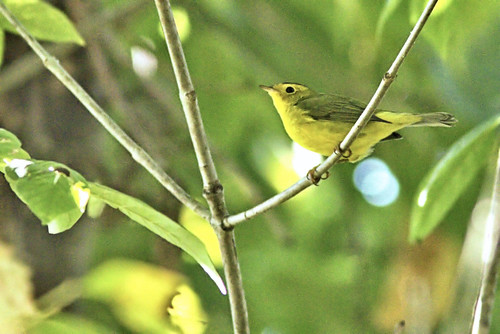
A Wilson's Warbler brightened our morning:
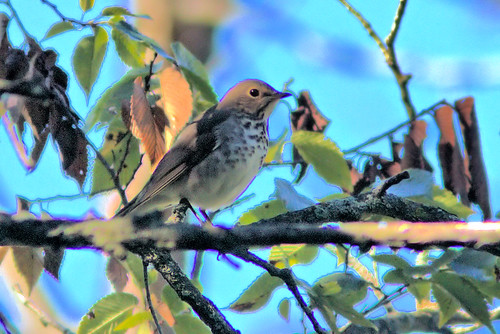
We saw migrating Swainson's Thrushes...
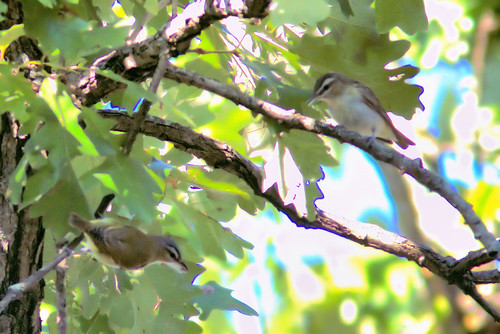
...and a pair of Red-eyed Vireos:
A favorite spot is Nelson Lake/Dick Young Marsh Kane County Forest Preserve:
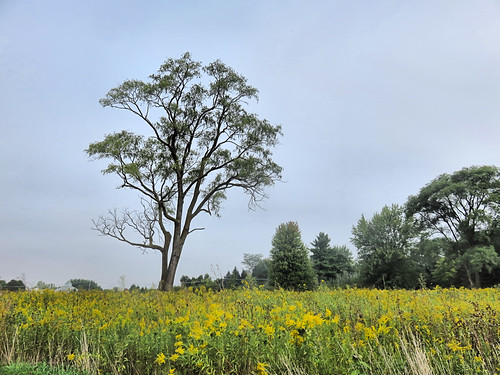
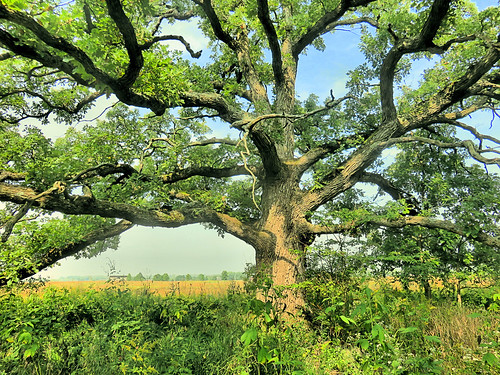
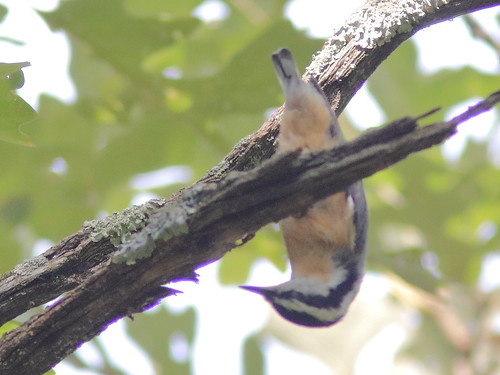
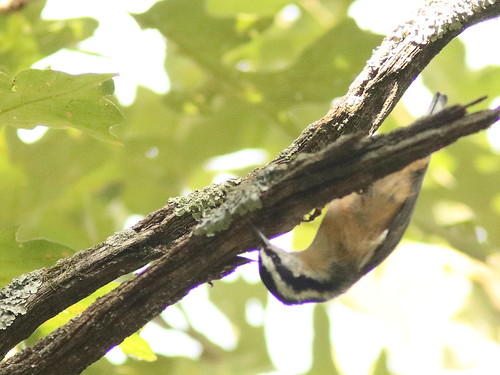
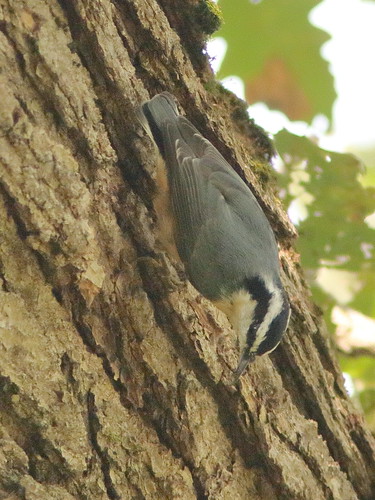
I caught sight of an early migratory Red-breasted Nuthatch, but had to wait a few days before getting one of these little acrobats in my camera viewfinder. It was foraging in this grand oak:
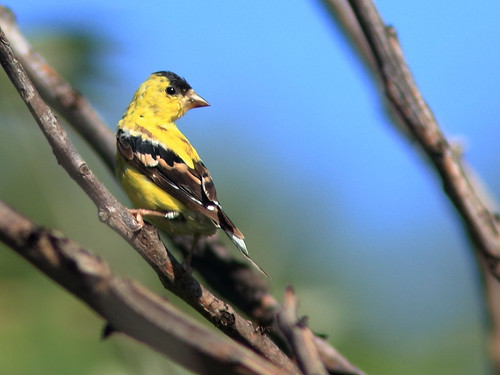
The male American Goldfinches were in various stages of molting into their somber winter coats:
A Mourning Dove struck a nice pose:

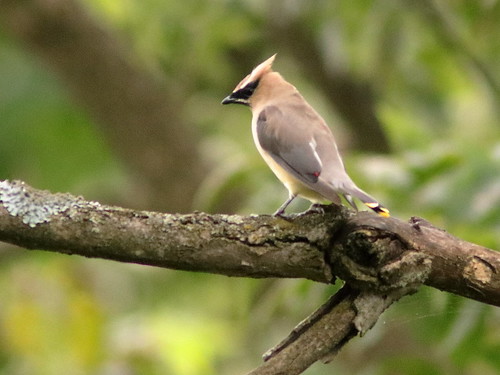
A Cedar Waxwing had a regal appearance:
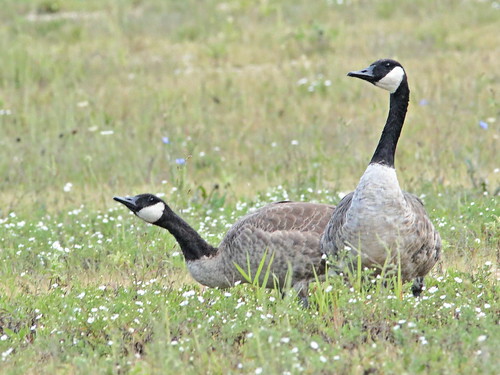
Canada Geese were numerous...
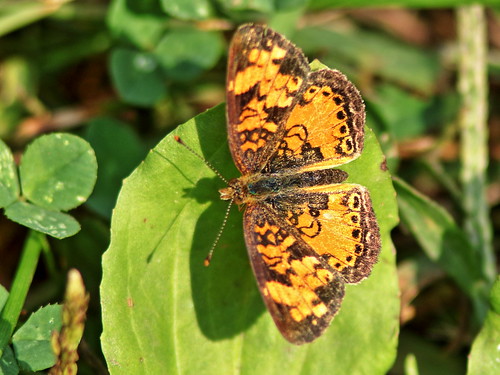
...as were butterflies, including this Pearl Crescent...
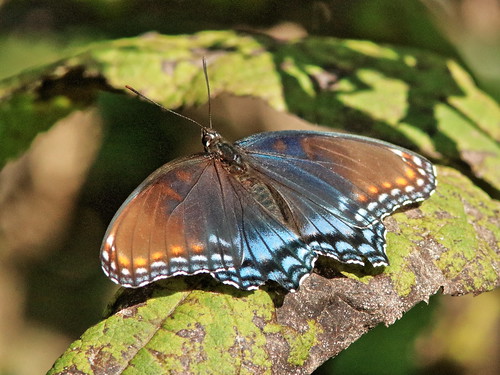
...a Red-spotted Purple...
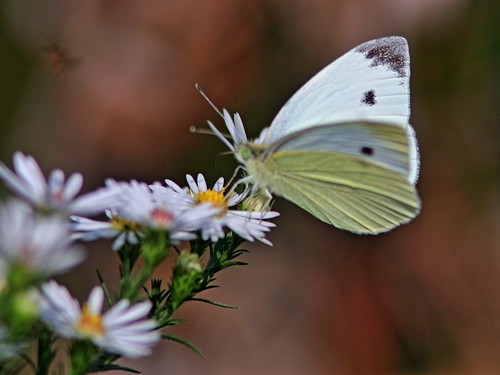
...a Cabbage White...
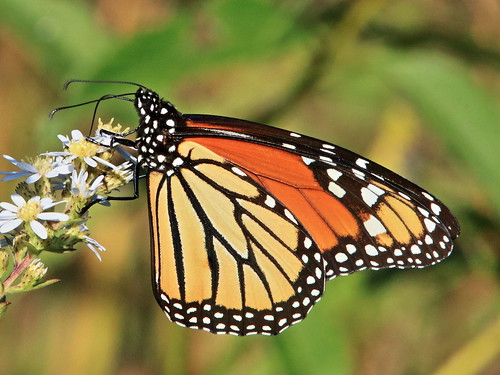
...and many beautiful Monarchs:
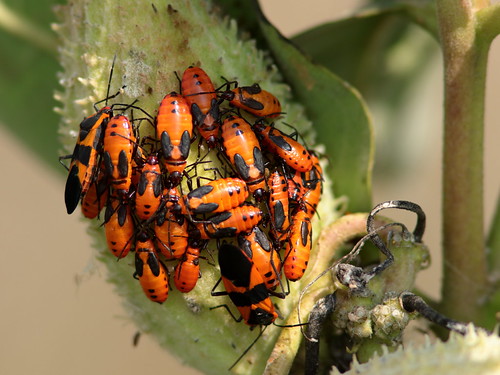
Colorful Milkweed Bugs clustered on the pods of their favorite plant, also host to the Monarch caterpillar:
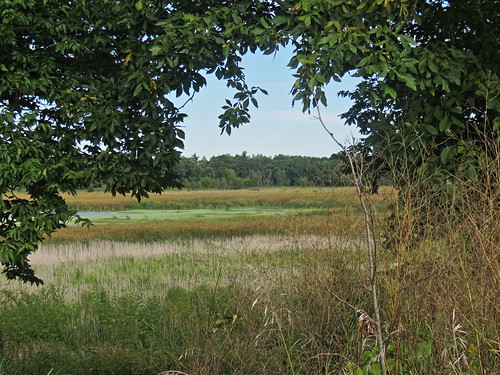
A view of the upper reaches of the marsh at Nelson Lake is framed by tree branches:
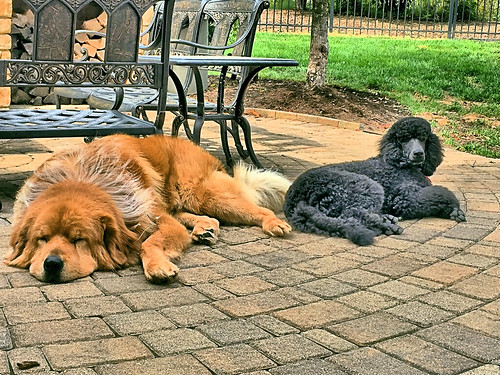
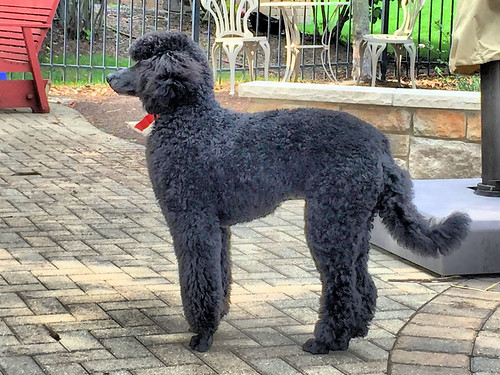
Back home at our daughter's house, their oldest and youngest pets rested on their patio. Tibetan Mastiff Agramonte is eleven years old and Standard Poodle Cazador is 6 months of age:
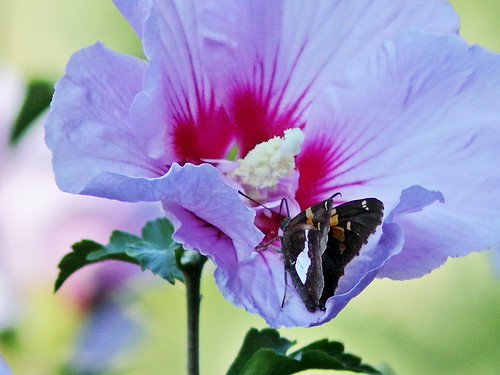
In their back yard, a Silver-spotted Skipper visited a Rose of Sharon:
Upon returning to Florida, I captured this iPhone panorama of the western sky opposite the rising sun (click on image for full view):
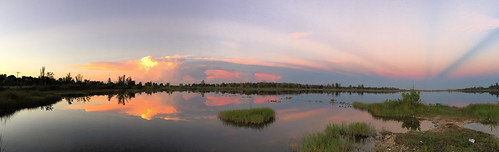
= = = = = = = = = = = = = = =
Linking to Misty's CAMERA CRITTERS,
Linking to Eileen's SATURDAY'S CRITTERS,
Linking to SKYWATCH FRIDAY by Yogi, Sylvia and Sandy
Linking to WEEKEND REFLECTIONS by James
Linking to BirdD'Pot by Anni
Linking to Our World Tuesday by Lady Fi
Linking to Wild Bird Wednesday by Stewart
Linking to Wordless Wednesday (on Tuesday) by NC Sue
Linking to ALL SEASONS by Jesh
Linking to Fences Around the World by Gosia
________________________________________________
Please visit the links to all these memes to see some excellent photos on display
________________________________________________
Birds' faces are frozen for a lifetime. They cannot grimace or smile or furrow their brows. Yet, a bird can exhibit a certain expression that may or may not appear appropriate to a situation or its personality or demeanor. This can cause us to misinterpret its feelings or intentions.
Can a bird, such as the Mad Bluebird, make an angry face? This photo of mine shows a White-eyed Vireo with an "attitude," and was chosen by the National Audubon Society and the Sierra Club to promote their Climate Change information campaign.
The "Vehement Vireo"
 This likely is a different bird, photographed a few months earlier within 1/2 mile of the above. What is "Vehement Vireo II" trying to say?
 Can a bird have a "curious" look? Another of my photos was recently featured in an Audubon bird ID quiz. It shows a female Chestnut-sided Warbler looking quizzically at the camera. She did approach me quite closely, but did her facial expression change? Anthropomorphism at its worst?
 Are these two catbirds engaged in an angry confrontation? (Actually, I am quite sure that this was a courtship interaction.)
 Many raptors exhibit an eternally fierce countenance. Is this female Bald Eagle mad at the world?
 Here she is tenderly feeding her young, not killing them.
 Up close, this Red-tailed Hawk has fire in its eye. As it is with eagles, the pronounced bony supra-orbital ridge shades its eye, but also causes a permanent frown.
 Instead of a pronounced bony brow, a dark area under his eyes reduces glare for this American Kestrel. He looks quite gentle, incapable of any evil intent to harm a little grasshopper or mouse.
 A female House Finch is said to have a "blank" or "innocent" appearance, as her face is unadorned.
 Contrast this with the "expressive" face of a female Purple Finch.
 Of course, owls are said to look "wise," but this Long-eared Owl seems rather surprised to see me.
 These young Great Horned Owls are hardly old enough to be "wise," but they already have that look.
 Beyond wise, this Burrowing Owl appears to be omniscient.
 The Horned Lark looks like a police inspector who means business.
 This Yellow-crowned Night-Heron reminds me of a grumpy old man with bushy eyebrows and bearded jowls.
 What about looking "fearful?" I know it is not possible, but to me this Whooping Crane expresses sheer terror.
 The American Birding Association (ABA) used my Purple Swamphen photo to announce that this introduced species is now "countable" under their rules. It looks like a "Purple Gallinule on steroids," and has an aggressive style that matches its robust appearance.
 Still not "countable," under the ABA rules of the game, the exotic and aggressive Egyptian Geese have spread rapidly up the Florida peninsula during the past five years. (See this video of an intense battle between Egyptian Geese, filmed by StuartDutchmanHQ of the Netherlands.) We just had the first pair on our lake, and the male viciously fought off a competitor, no holds barred! Like a masked gangster, the male (foreground) celebrates victory with his "gun moll."

As we entered the final week of our stay in Illinois at the peak of spring migration, we tried to get out every morning. The weather was mostly cooperative but temperatures varied wildly, going down to freezing one night and the next day we were in the mid-80s (F).
Although our hopes were high, we were disappointed at how few warblers we were seeing. Some birders were reporting well over a dozen species but we were lucky to find 3 or 4. Others reported similar bad luck in our usual haunts. Indeed, one morning we found not a single warbler. We also missed a favorite target bird, the Scarlet Tanager, although I got a fleeting look at one flying several hundred yards away at Bliss Woods.
Rather than grouse about what might have been, we should rejoice in the variety of habitats we visited and the beautiful birds we did see, most of which are uncommon or unseen in South Florida.
I love getting good shots of small birds, so I was elated when they appeared among the flowers, as did this Baltimore Oriole in Fabyan West Park...

...and this Killdeer in Jones Meadow Park.

Six Great Egrets roosted on a dead tree at Jones Meadow.

I almost forgot I was not back in Florida when one left its roost and settled at the edge of the lake.


A Green Heron lifted off from a hiding place nearby.

Jones Meadow provided us with our only sighting of a Chestnut-sided Warbler.


Tree Swallows had already set up housekeeping.

These two seemed to be having a property dispute.

Mallard Drakes dabbled in the wetlands next to the lake. Were their mates sitting on eggs?

Rose-breasted Grosbeaks became quite numerous.

A House Wren fluttered his wings as he sung his heart out.

A nest must have been nearby, as he was reluctant to leave the trunk of this old dead tree.

Field Sparrows were claiming nesting territory along the margins of the prairie at Aurora West Forest Preserve.

I particularly liked this pose.

Demure Warbling Vireos sang loudly in the trees but rarely ventured out from the leafy cover.
 At Nelson Lake, an Eastern Meadowlark was in full song.

A male Northern Cardinal stopped singing just long enough to stare down from his perch.

An American Goldfinch added another touch of color.

It was unusual to see a lone Sandhill Crane overhead, bugling as if calling for a lost lover.

Among the "little birds," a pair of Clay-colored Sparrows gave me my best photos of this species, even though they were reluctant to come out from behind the branches.


The budding trees attracted House Finches. This male was particularly bright.

Yellow Warblers were common along the Fox River, at Les Arends Forest Preserve...


...but a few miles up-river, Fabyan West preserve presented us with our most treasured sighting-- a Yellow-throated Warbler, which is near the northern limit of its range. Singing high in an oak tree and flitting from branch to branch, it was not an easy capture.

The Yellow-throated Warbler is aptly named.

Another nice warbler was nearby-- the Blackburnian.

The Orchard Oriole, smaller than the Baltimore Oriole and brick-red rather than bright orange, has been my "nemesis bird," as I had never gotten a good view of one. The Japanese Garden at Fabyan sheltered one that finally came out into the open!

An American Robin fed its two chicks.

In fairness to the mammal kingdom, here is a cute chipmunk in a beautiful setting inside the Japanese Garden.

We cannot overlook the spring flowers, such as these tree blossoms...

...or the Wild Blue Phlox.

I'm quite sure that this is a Hickory tree bud, but it is an object of unexpected beauty.
