We just returned from a two week stay in northeastern Illinois. Surprisingly, we had a spell of hot weather with some temperatures higher than those back home in south Florida.
Although we were busy with volleyball games and preparations for a charity gala with 100 guests at our daughter's home, we found time to get out and walk in the nearby parks and forest preserves. We saw many more warblers than we were able to identify, as they tended to forage high in the trees against the very bright sky.
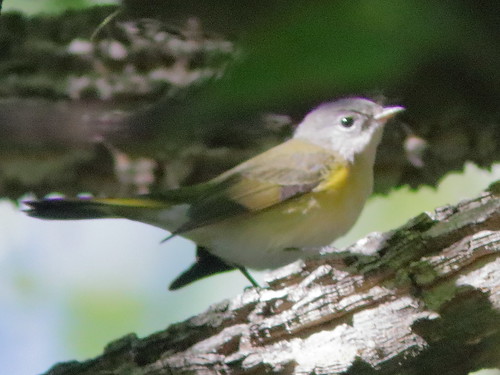
At Les Arends Forest Preserve in their home town of Batavia, we encountered a mixed flock which included American Redstarts. I was only able to get a decent photo of a female:
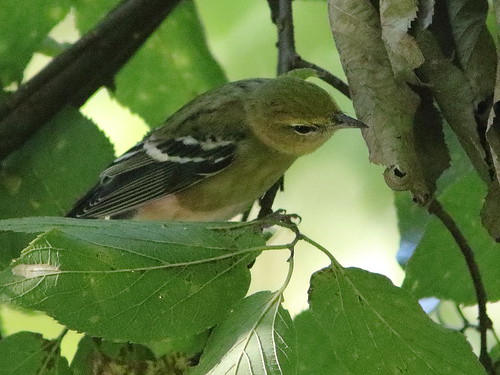
There were quite a few Bay-breasted and Blackpoll Warblers, which are quite similar in their dull fall plumage.
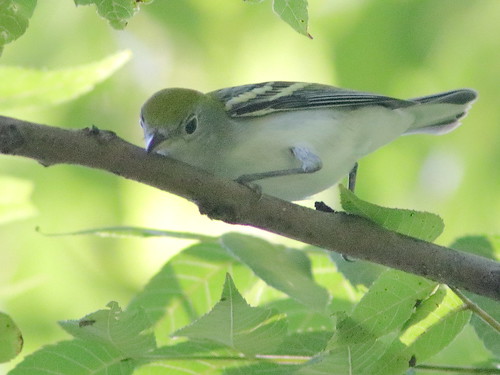
The Blackpoll shows some streaking of its underparts and has a more greenish cast to its head and neck, so this most likely is one here:
Bay-breasted Warbler? It should have dark legs but these appear to be light as in Blackpoll:
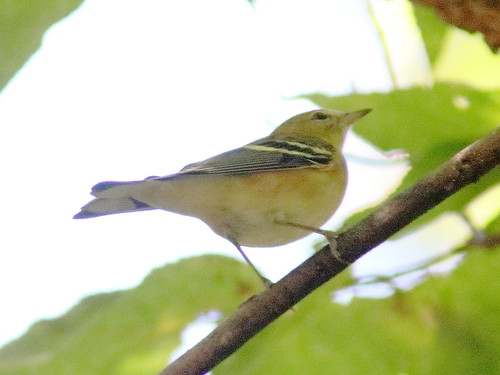
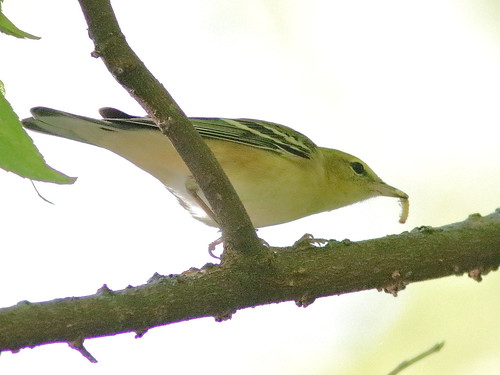
This is a dull female Chestnut-sided Warbler:
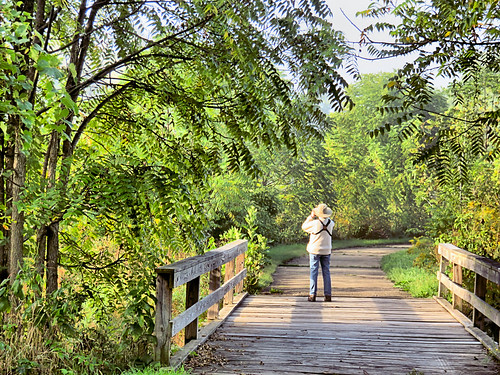
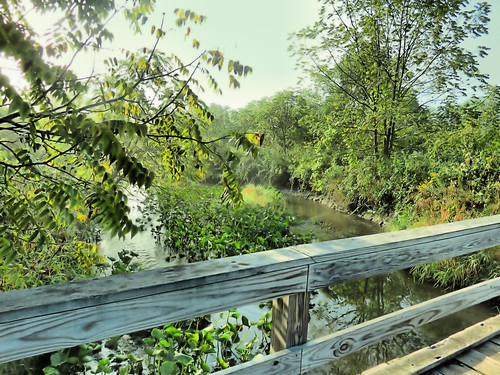
Bliss Woods Forest Preserve in Sugar Grove has very nice walking trails and a wooden bridge over Blackberry Creek, where Mary Lou is looking at a goldfinch:
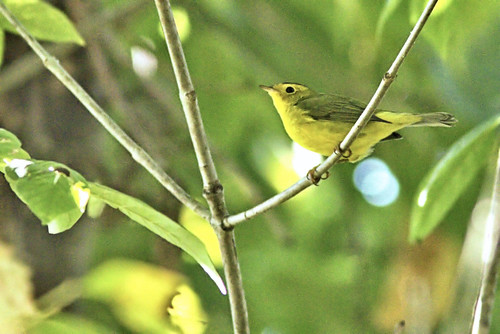
A Wilson's Warbler brightened our morning:
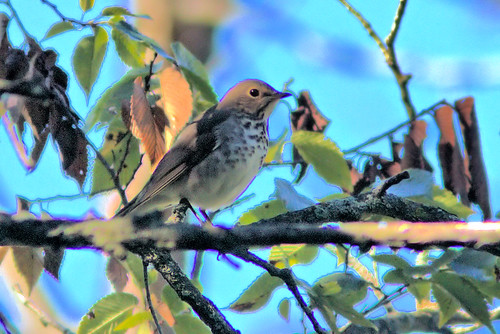
We saw migrating Swainson's Thrushes...
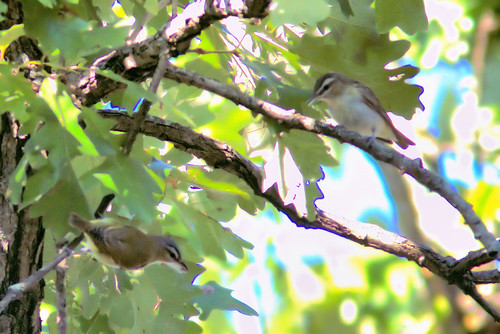
...and a pair of Red-eyed Vireos:
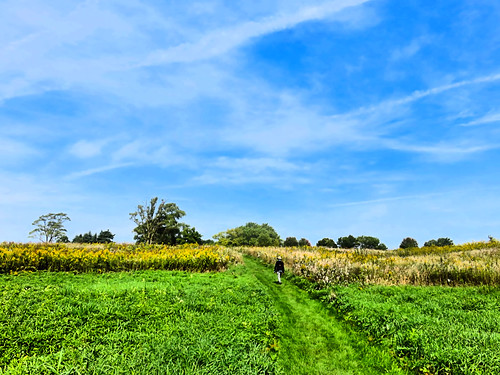
A favorite spot is Nelson Lake/Dick Young Marsh Kane County Forest Preserve:
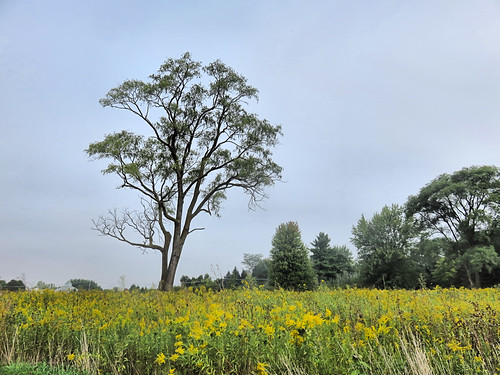
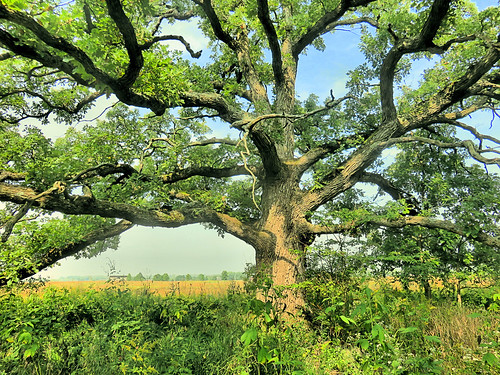
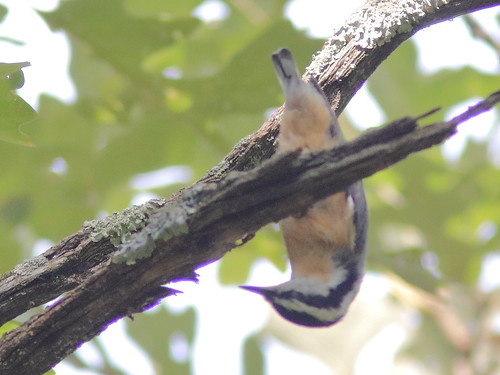
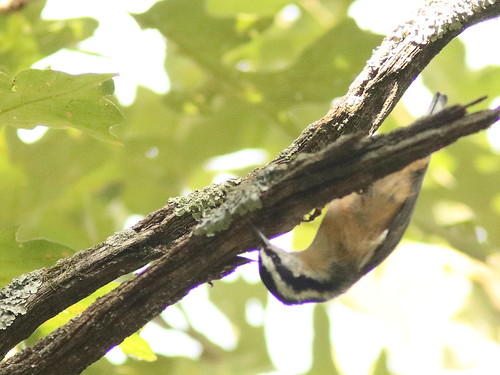
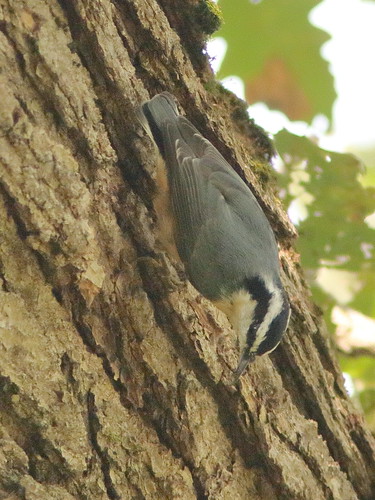
I caught sight of an early migratory Red-breasted Nuthatch, but had to wait a few days before getting one of these little acrobats in my camera viewfinder. It was foraging in this grand oak:
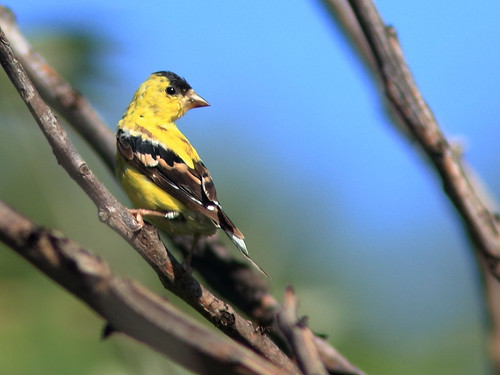
The male American Goldfinches were in various stages of molting into their somber winter coats:
A Mourning Dove struck a nice pose:

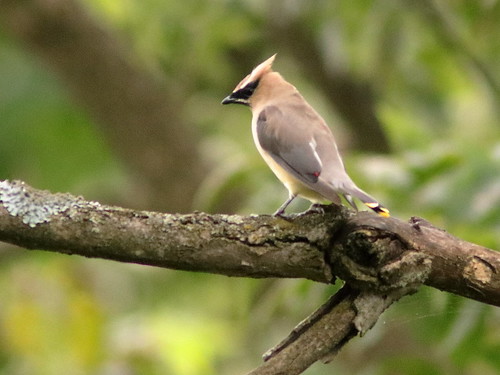
A Cedar Waxwing had a regal appearance:
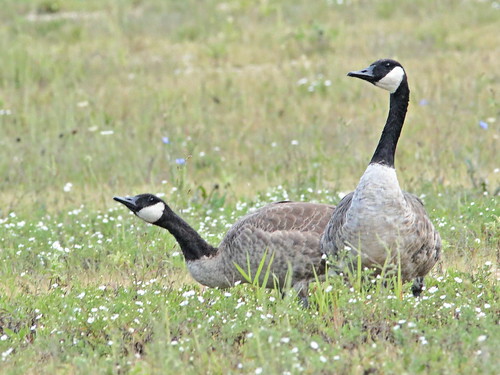
Canada Geese were numerous...
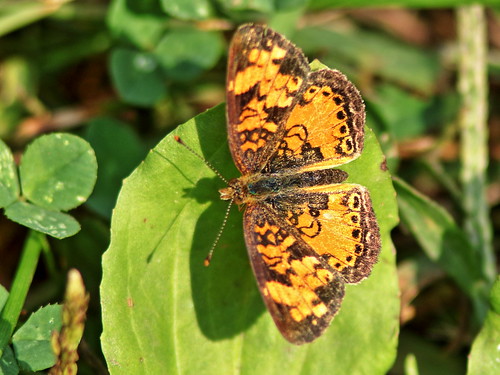
...as were butterflies, including this Pearl Crescent...
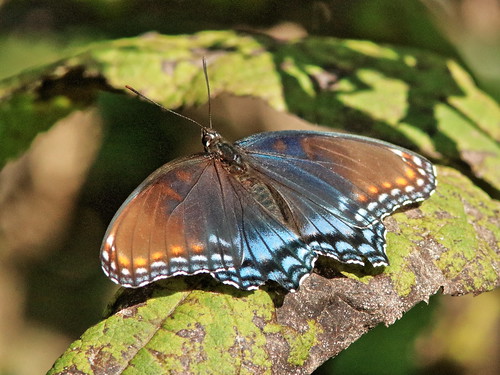
...a Red-spotted Purple...
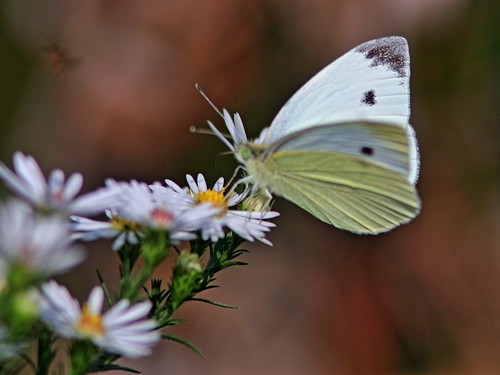
...a Cabbage White...
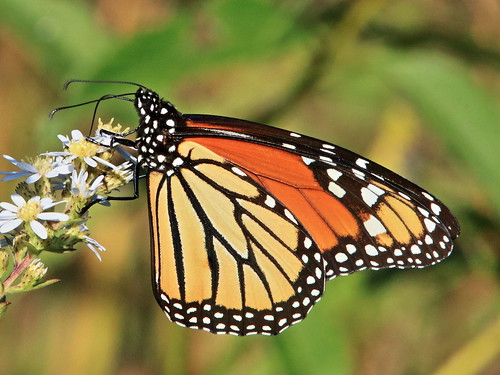
...and many beautiful Monarchs:
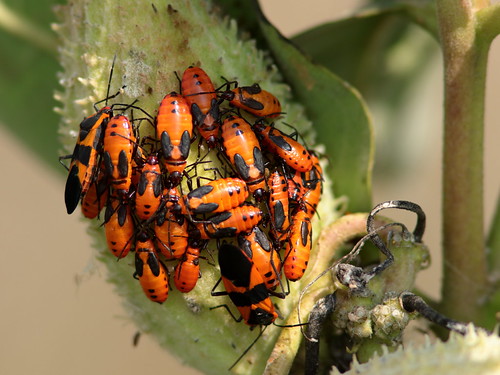
Colorful Milkweed Bugs clustered on the pods of their favorite plant, also host to the Monarch caterpillar:
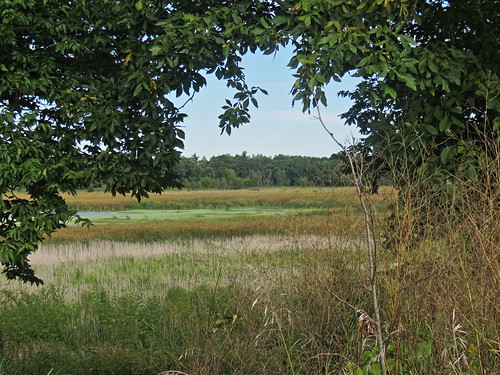
A view of the upper reaches of the marsh at Nelson Lake is framed by tree branches:
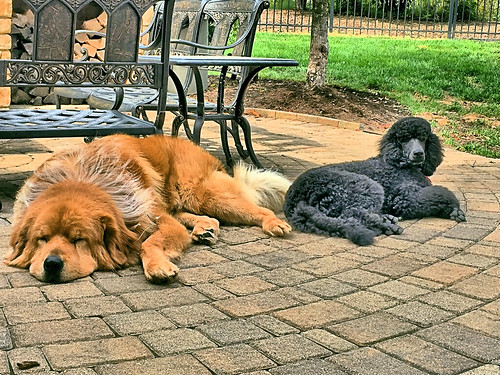
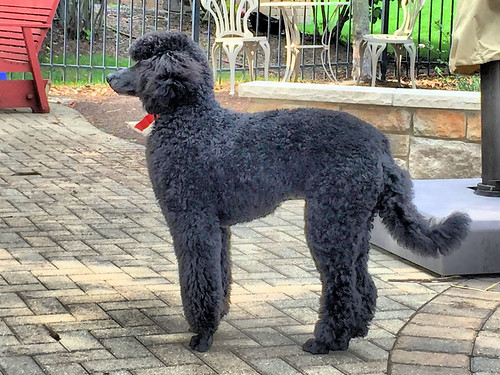
Back home at our daughter's house, their oldest and youngest pets rested on their patio. Tibetan Mastiff Agramonte is eleven years old and Standard Poodle Cazador is 6 months of age:
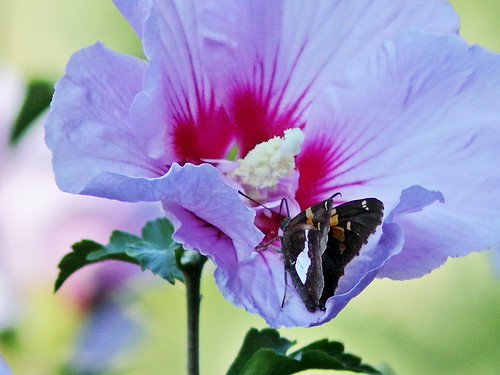
In their back yard, a Silver-spotted Skipper visited a Rose of Sharon:
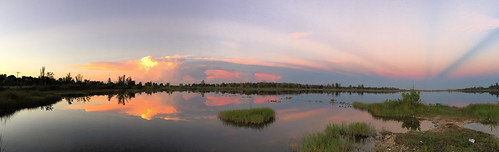
Upon returning to Florida, I captured this iPhone panorama of the western sky opposite the rising sun (click on image for full view):
= = = = = = = = = = = = = = =
Linking to Misty's CAMERA CRITTERS,
Linking to Eileen's SATURDAY'S CRITTERS,
Linking to SKYWATCH FRIDAY by Yogi, Sylvia and Sandy
Linking to WEEKEND REFLECTIONS by James
Linking to BirdD'Pot by Anni
Linking to Our World Tuesday by Lady Fi
Linking to Wild Bird Wednesday by Stewart
Linking to Wordless Wednesday (on Tuesday) by NC Sue
Linking to ALL SEASONS by Jesh
Linking to Fences Around the World by Gosia
________________________________________________
Please visit the links to all these memes to see some excellent photos on display
________________________________________________
Waiting at our door to be picked up by the limousine to the airport at 6:00 AM on our last day in Illinois, I pondered the evolution of our homesite, a former tallgrass prairie turned into a cornfield. Long ago it was covered by ice, then became a wet and barren land deeply scarred by glaciers, succeeded by a lush evergreen forest. As the climate warmed and the land dried up, hardwoods overtook the spruce and fir. Grasslands did not complete their dominance of the land until only some 3,500 years ago. The entire life of our little prairie patch and now its death at the hands of man occupied but a tiny moment of geologic time (see my reference to the Nelson Lake pollen studies that document the genesis of the local prairies).
The noisy carpenters would not arrive for another hour. I listened to the dawn chorus, now muffled by the presence of 29 new townhomes in various stages of construction. Only a few acres in the several blocks now under development will be spared as a "park." The songs of a multitude of robins nearly drowned out the subtle refrains of a meadowlark, Song Sparrows, goldfinches, and surprisingly, the distant territorial peeping of a Spotted Sandpiper and the serenade of a Vesper Sparrow on the roof of our building.
This view from our third story front window had formerly overlooked our "front yard birding patch."

Presently a patch of grassland planned for the park remains relatively undisturbed, though half of its surface has been graded and the pothole was filled in. Last spring it attracted a Muskrat along with nesting Red-winged Blackbirds and visiting ducks, geese and Sandhill Cranes. I doubt that the sandpipers and sparrows will be able to find a breeding niche as there is no longer any open water and the only shrubby cover is beside an old pile of topsoil that almost certainly will be removed for lawns and foundation plantings.
The "park" will occupy the area beyond the black plastic fence. The topsoil mound is presently its highest point, just right of center.

In 2011, I took this photo of a Sandhill Crane from my front doorstep.

Earlier in the week our younger granddaughter had a school excursion to the Brookfield Zoo, where the apes, big cats and wolves were main attractions.


Despite temperatures that varied between 30 and 82 degrees (F), our last couple of days in Illinois provided some photo opportunities at Nelson Lake. Warblers remained scarce, but we did see two Blackpolls...

...an eastern (yellow) Palm Warbler...

...an American Redstart...

...and a Magnolia Warbler.

Two reclusive Lincoln's Sparrows appeared briefly. As usual, they stayed behind the branches.

Another LBJ (Little Brown Job) was this Savannah Sparrow.

For color, here are mandatory last shots of a Rose-breasted Grosbeak...

...an American Goldfinch...

...and a Northern Cardinal.

On our last free evening we baby-sat with our two granddaughters, first taking them out to dinner and then visiting Jones Meadow Park. They played and I explored the area as twilight advanced.
A Spotted Sandpiper flew over the lake and headed for the adjacent wetland, where I caught it in flight as it passed over a female Mallard.

The low light imparted a softness to the image of a Great Egret in flight.

In the waning light, the girls collected dandelion stalks and fashioned them into a long chain. I captured these images with my long lens so they would not suspect they were under surveillance.


Addendum-- After we departed, our Illinois granddaughters had some excitement. Let me tell it as narrated by the 9 year old, and the photos are from her mother's cell phone. I assume this Northern Bobwhite was a captive reared bird often used to train hunting dogs.
Yesterday after school, a Bob White (which are not normally seen in our area) flew into our glass door & knocked itself out. Our big dog, Agramonte, proceeded to investigate. He pawed at it & then picked it up in his mouth.
Thank goodness Mom was able to get Agramonte to drop it! We were so worried about the health & safety of the bird (which was identified as a Bob White by Grandpa) that we decided to bring it to the Wildlife Rehabilitation Center in Elburn at the Forest Preserve on Rt 38. When we brought the box (covered with a white cloth) into the Center, the naturalist uncovered the box & the bird flew out & all around the Center's Office!! The naturalist examined the bird & determined that it was not injured. She then asked us to bring the bird back home to our house & set it free!! It was quite an exciting time at the Orama house, but everything ended well as the bird flew off into the prairie behind our house!!
Just after it hit the glass door.

Taking Bob White to the Rehabilitation Center with Sis in school clothes.

At the door of the Center.

The naturalist examining Bob White.

Back home I'm ready to release him.

Just before Bob White flew into Mom's face when we let him go. Wish we had it on You Tube.
