Take a better look at that long-legged white bird walking along the shore across the lake. At such a distance it may not be possible to see the finer points which clinch the identification. Size alone can be misleading, as without a yardstick for comparison, white birds often seem to be larger than they really are.
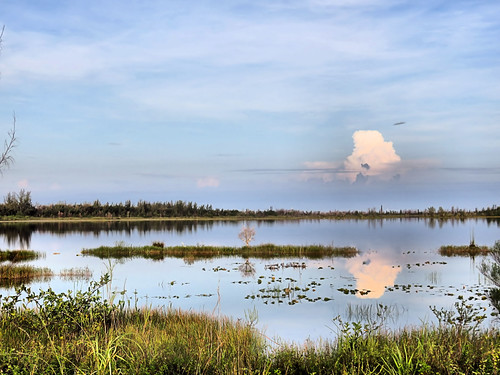
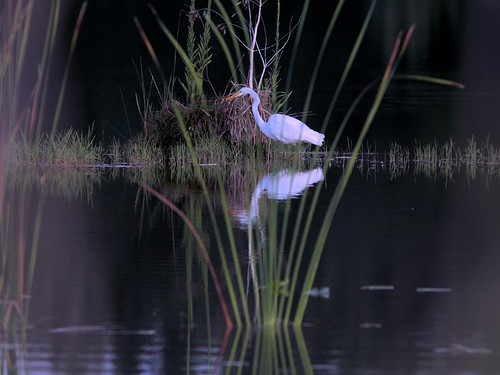
The white bird with a long neck is barely visible in this photo...
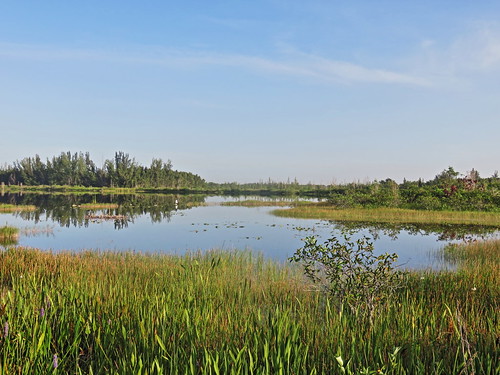
...or here (click on image to enlarge):
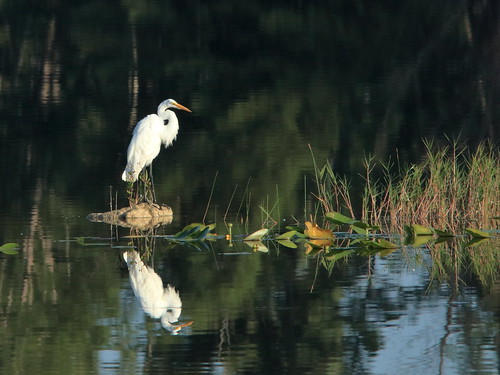
A closer look at the second photo reveals a Great Egret:
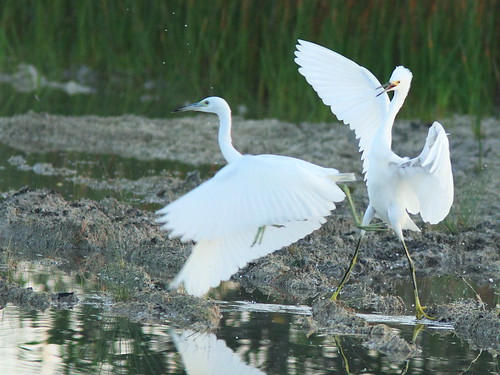
These two smaller birds are having a spat over rights to the best fishing spot. They seem to be about the same size, but there are some difference which set them apart. The Snowy Egret, on the right, has a black bill with yellow base and mostly black legs with yellow feet. The retreating immature Little Blue Heron has a gray bill with dark tip and greenish legs:
The Snowy Egret appears to be gloating in victory...
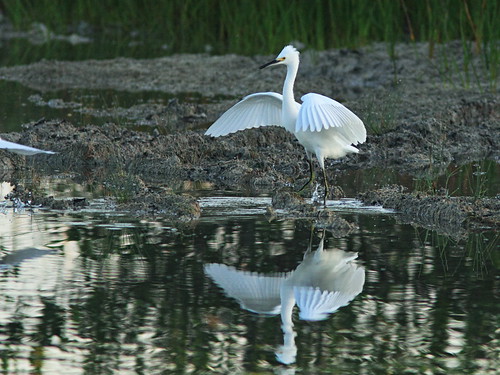
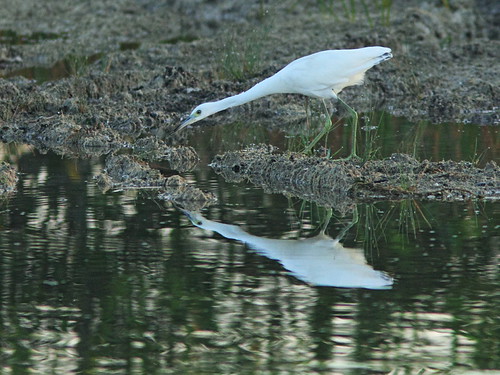
...while the Little Blue Heron is not far away, adopting a characteristic hunting posture, stooped with neck outstretched and bill near the surface of the water. This can help identify it from a great distance:
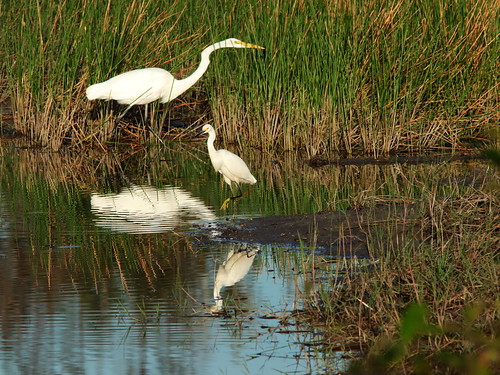
The size difference between these two egrets is remarkable. Note the yellow bill and black legs of the Great Egret and the yellow "golden slippers" of the Snowy Egret:
Here is another nice size comparison between a Great Egret and an adult White Ibis, whose red decurved bill is distinctive.
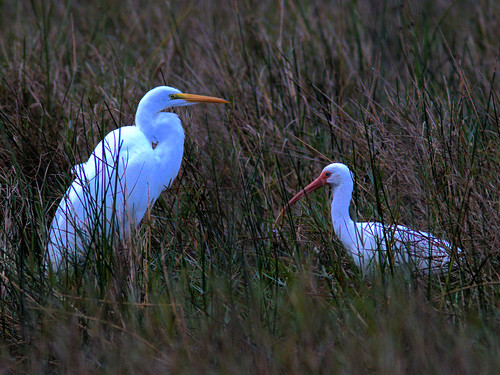
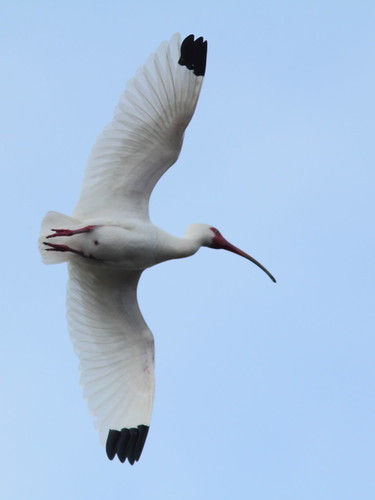
In flight, the ibis displays black wingtips:
This large white wader appeared on our back lawn back in June, 2016:
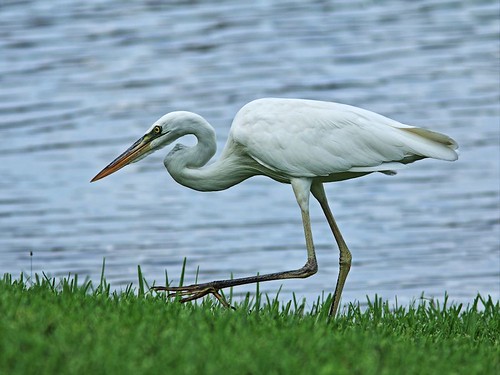
I first saw it at a distance and almost passed it off as another Great Egret. However, its size and posture as it rested next to the lake made me take a second look. It certainly reminded me of this Great Blue Heron:
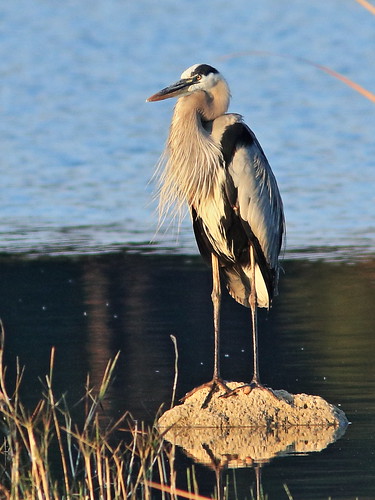
Indeed, it was a "Great White Heron," the white color variation of the Great Blue Heron:
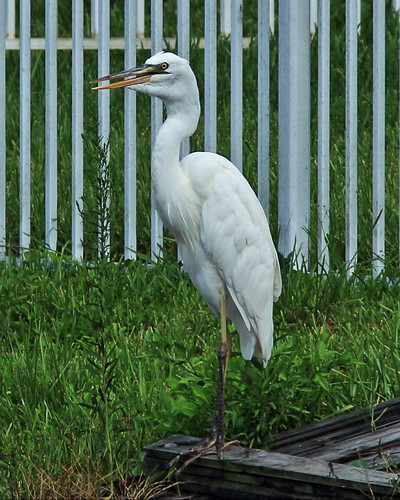
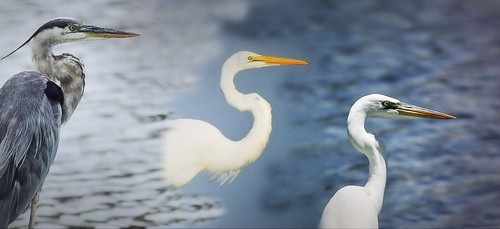
Here is a composite image showing the bills of three herons from about the same distance, all visitors to our back yard, The Great Blue Heron, Great Egret, and "Great White Heron":
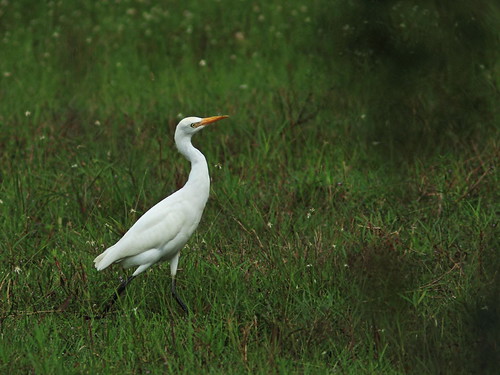
This small white wader with a short yellow bill and black legs is a Cattle Egret:
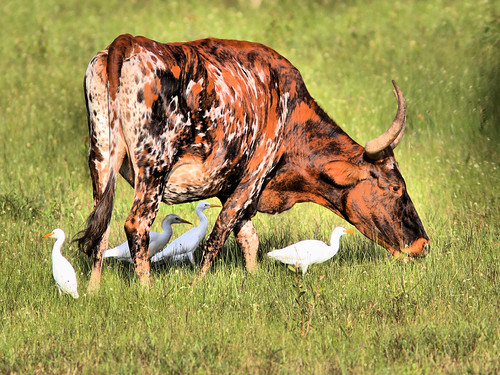
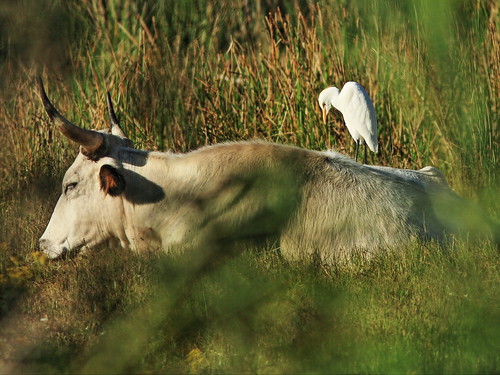
Cattle Egrets usually forage away from water and feel right at home with this Longhorn cow:
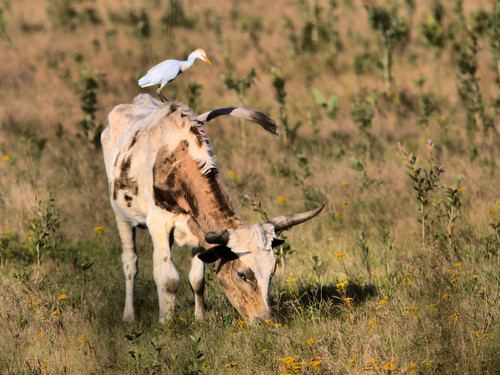
They often perch on the backs of cattle to catch insects attracted to them:
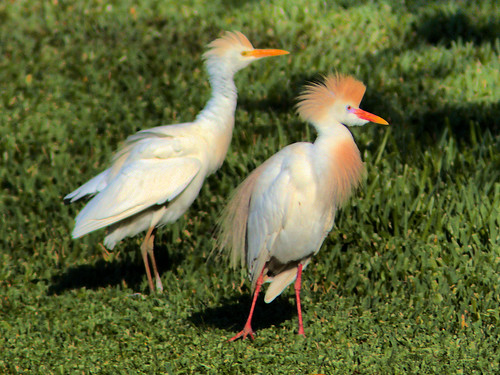
Cattle Egrets are easily identified in full breeding plumage, when their legs turn red (deeper color in the male on right) and they develop rusty plumes:
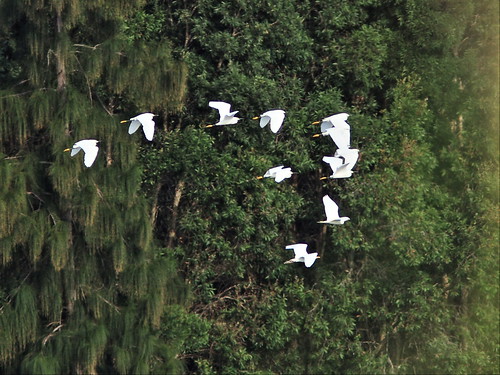
Here are two Cattle Egrets in a flock of with nine Snowy Egrets:
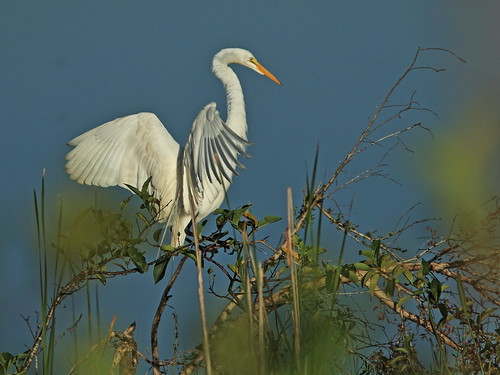
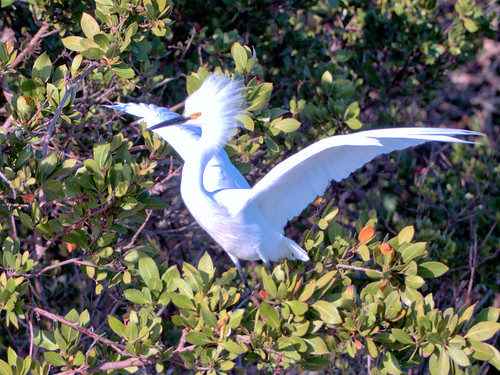
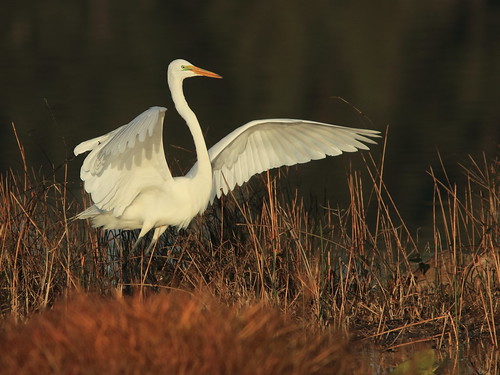
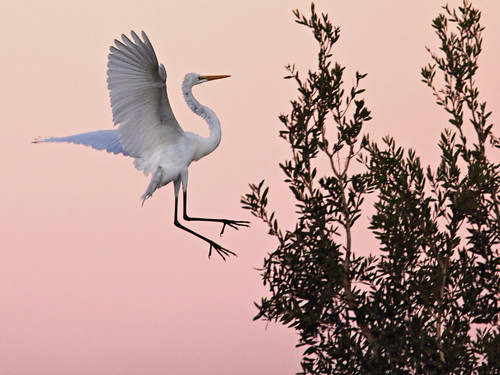
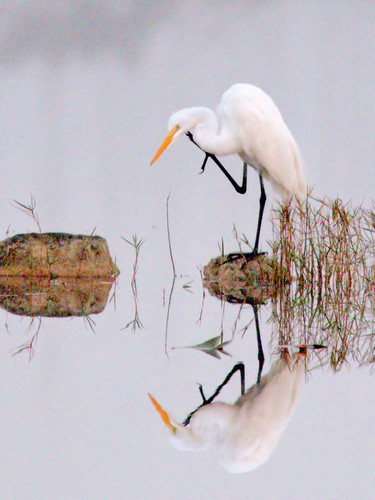
Yesterday I celebrated my entry into the fourth year of the ninth decade of my life, thankful that I can walk the Wounded Wetlands and enjoy the serene beauty and grace of egrets...

= = = = = = = = = = = = = = =
Linking to Misty's CAMERA CRITTERS,
Linking to Eileen's SATURDAY'S CRITTERS,
Linking to SKYWATCH FRIDAY by Yogi, Sylvia and Sandy
Linking to WEEKEND REFLECTIONS by James
Linking to BirdD'Pot by Anni
Linking to Our World Tuesday by Lady Fi
Linking to Wild Bird Wednesday by Stewart
Linking to Wordless Wednesday (on Tuesday) by NC Sue
Linking to ALL SEASONS by Jesh
Linking to Fences Around the World by Gosia
________________________________________________
Please visit the links to all these memes to see some excellent photos on display
________________________________________________
This was the first year since moving to Florida that we spent the entire month of August without a trip to our second home in NE Illinois. Truth is that we were a bit travel-weary after our Alaska RV trip and had to catch up on necessary appointments. As has been my monthly habit, I perused my photo archives from three years ago to find images which illustrate some of my favorite memes: Birds and other Critters, Fences, Skies, Reflections, Seasons and Wordless scenes which speak for themselves.
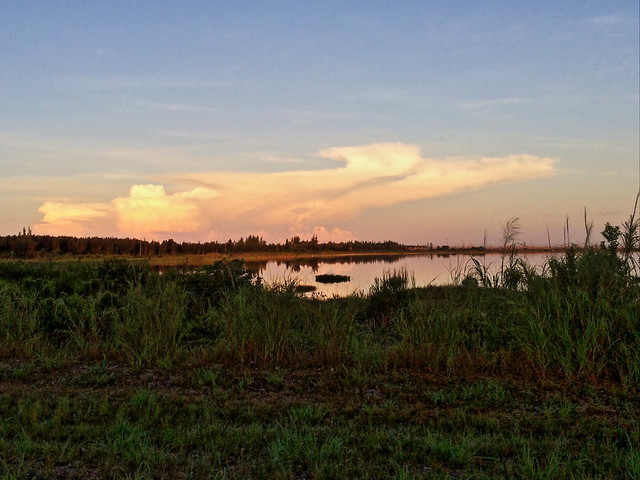
Blown in from Africa, Saharan dust provided unusual pink sunrises...
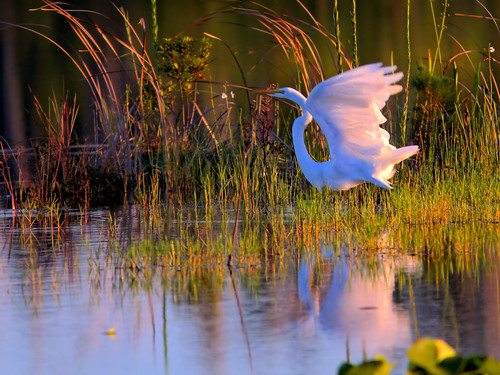
...which reflected on the wings of a Great Egret...
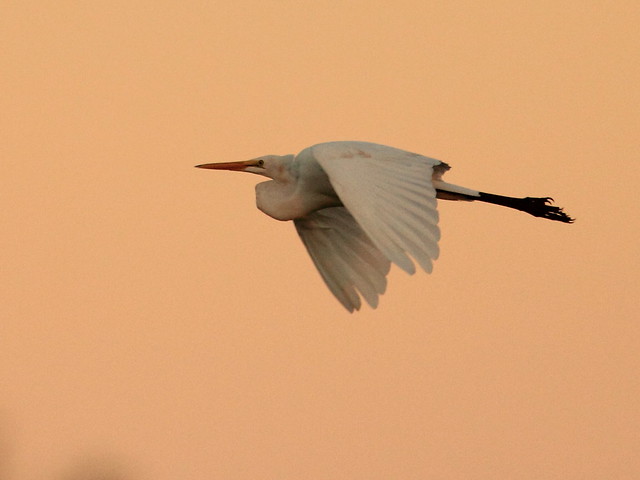
...as well as upon a rare species which visited our back yard lake on August 11 and lingered for over a week:
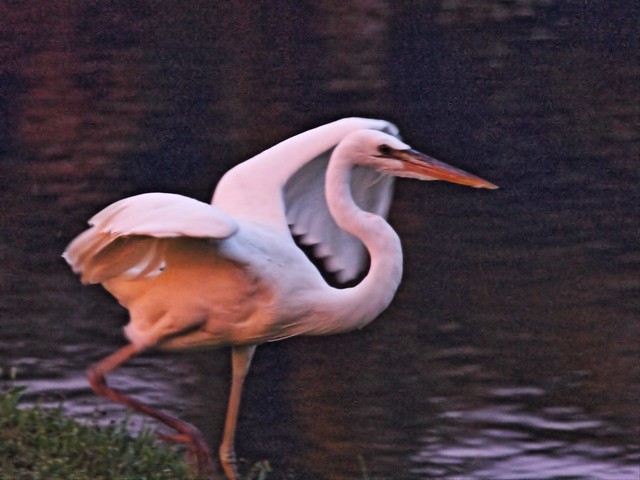
It is a "Great White Heron," actually the white color morph (or subspecies) of the Great Blue Heron:
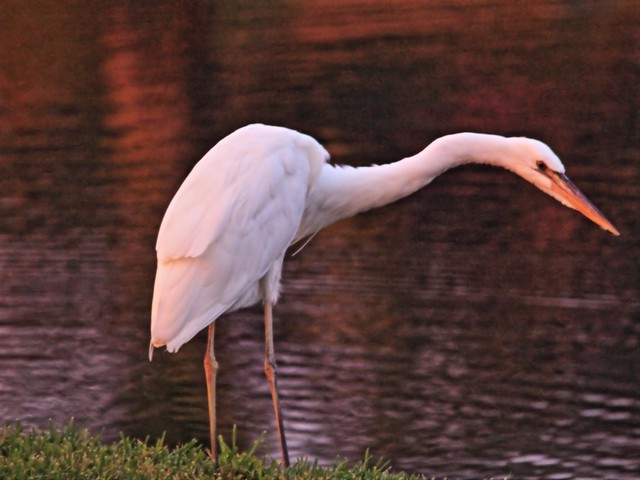
The breeding range of Great White Herons is concentrated far south of our home, in the coastal mangroves of the Florida Keys. They average larger in size than the south Florida population of Great Blue Herons.
Under a blue sky in late afternoon, the Great White Heron shows its true colors. Note that its legs are light in color, unlike the black legs of a Great Egret:
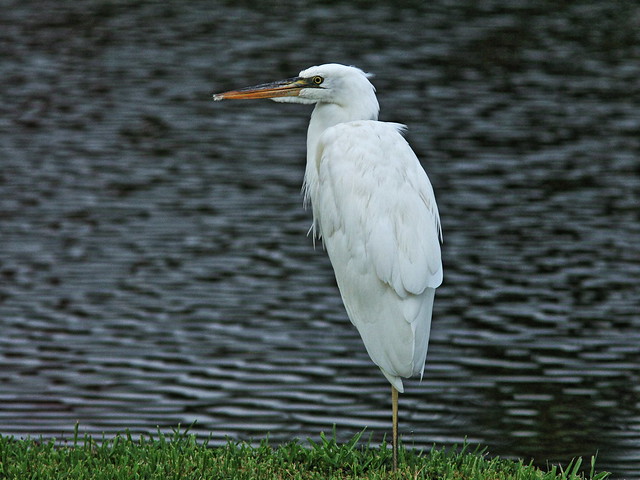
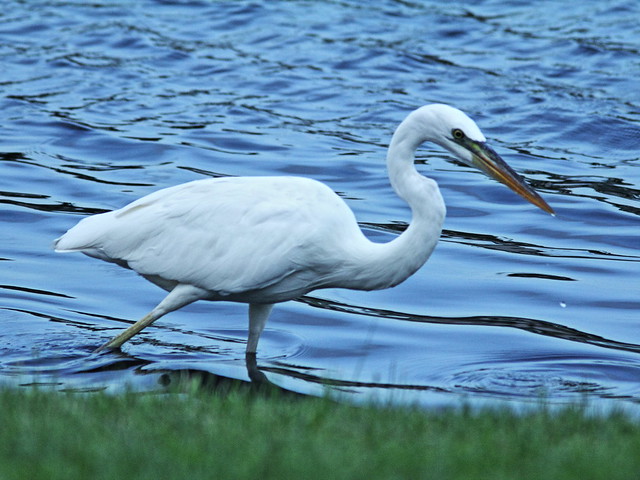
Although the Great Egret (which averages 39 inches/99 cm tall and weighs 2.2 lb/1 kg) is the largest of our local resident egrets, it is dwarfed by the Great White Heron, which is 54 inches/137 cm tall and can weigh up to 7.3 lbs/ 3.3 kg.
This was my best attempt to fit both species in a single frame:
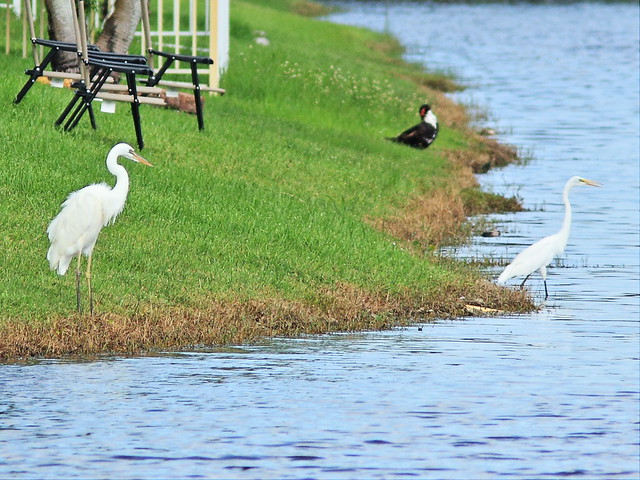
These two photos show each of the white herons walking next to a tree which is 140 feet/43 meters across the lake from our yard. First, the Great White Heron...

...and now the Great Egret:

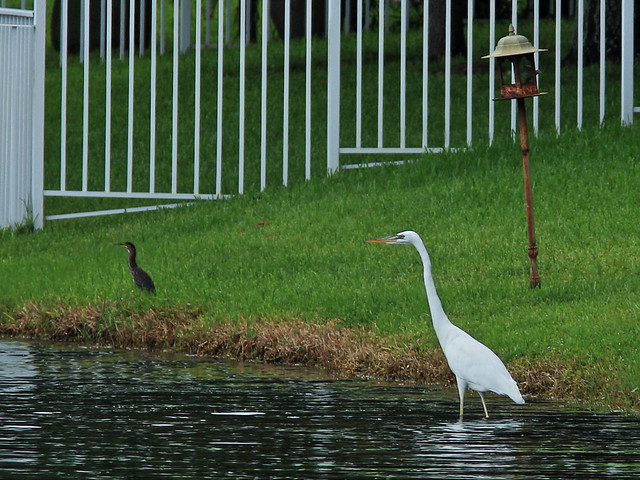
An extreme contrast in size is shown in this photo of the Great White Heron and a Green Heron only 18 inches/46 cm tall, next to a neighbor's fence:
Another unusual event was my discovery, on August 17, of the nest of a Common Ground-Dove, the first ever officially documented in our County. This species actually is a fairly common breeding bird, but its nest is particularly hard to find.
Indeed, this one was very well hidden but only a few steps away from the gravel road in the local wetlands. The parent gave away its location by suddenly flushing as I passed by:
The anxious female parent watched me from a perch nearby:

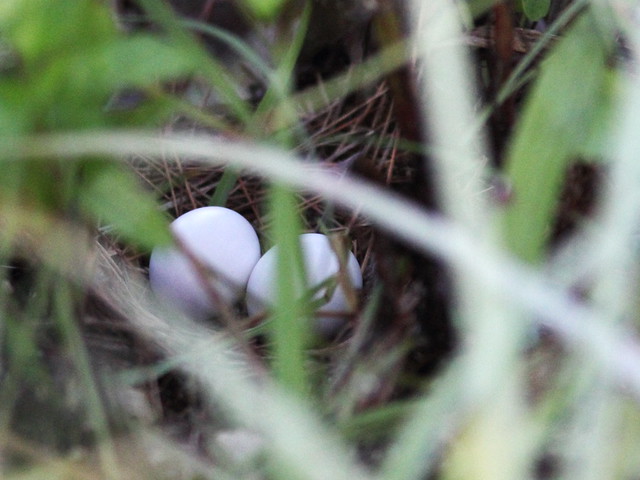
Not wishing to disturb the nest or provide a predator with a scent trail to the nest, I photographed it from the path, about 10 feet away. This was the only camera angle which provided a partial view of the nest:
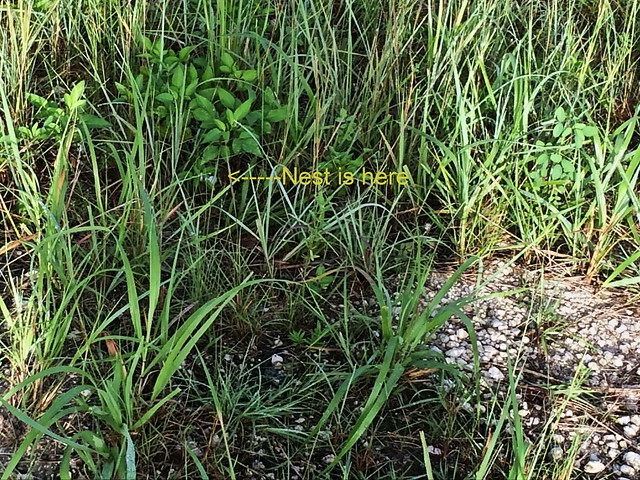
Unfortunately, on August 26, a landscaping crew came through and mowed all the grass along the shoulder of the road and destroyed the nest and its contents:
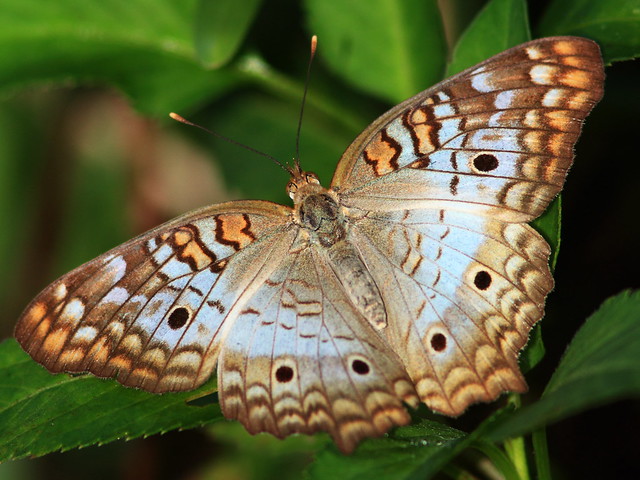
Not wanting to end on a sad note, here are a few clips of other critters seen during the month, starting with a White Peacock butterfly:
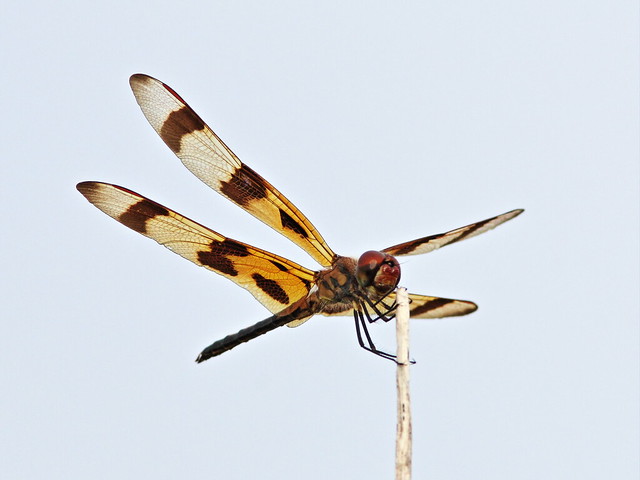
Halloween Pennant dragonfly rests on a grass stem:
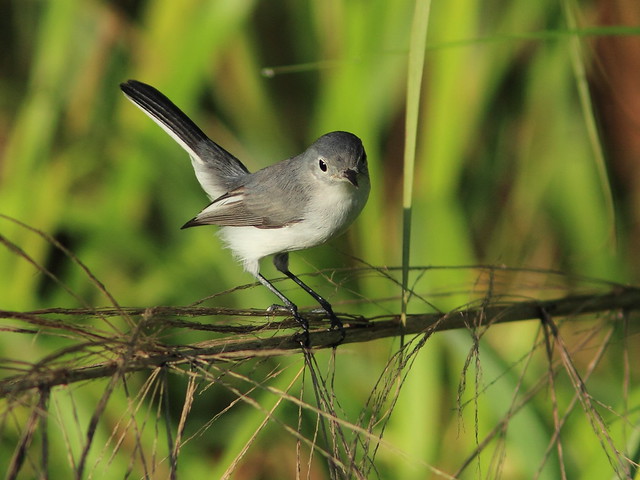
Perky Blue-Gray Gnatcatcher stands still for an instant:
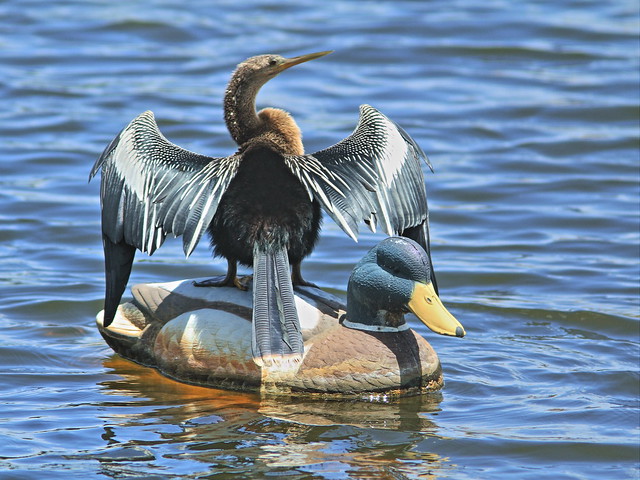
Backyard Anhinga dries its wings on our duck decoy:
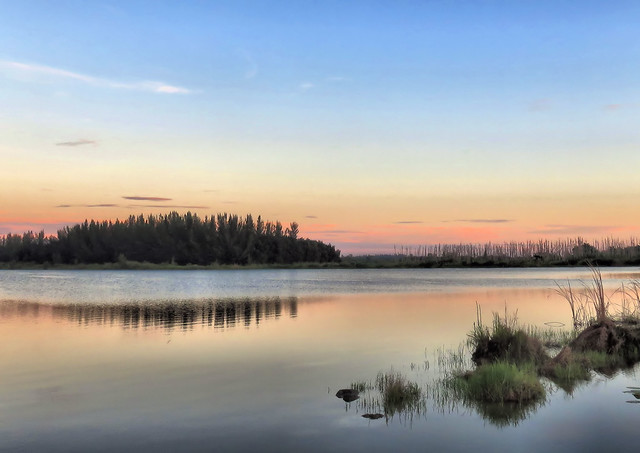
Golden sunrise on August 31, a fitting finale for an eventful month:
 = = = = = = = = = = = = = = =
Linking to Misty's CAMERA CRITTERS,
Linking to Eileen's SATURDAY'S CRITTERS,
Linking to FENCES AROUND THE WORLD by Gosia
Linking to SKYWATCH FRIDAY by Yogi, Sylvia and Sandy
Linking to WEEKEND REFLECTIONS by James
Linking to BirdD'Pot by Anni
Linking to Wild Bird Wednesday by Stewart
Linking to Wordless Wednesday (on Tuesday) by NC Sue
Linking to ALL SEASONS by Jesh
________________________________________________
Please visit the links to all these memes to see some excellent photos on display
________________________________________________
On hot summer mornings we get out on the local wetlands well before sunrise, often to be rewarded by colorful skies and placid waters:
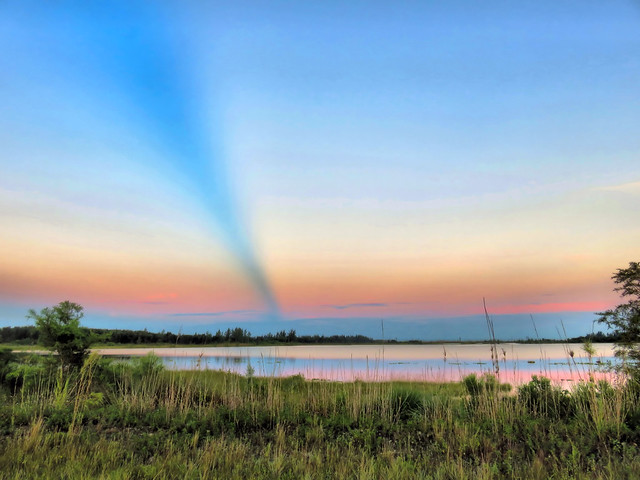
Before sunlight touched the ground, the top of a single thunderstorm over the Bahamas cast a long shadow which stretched westward across the Everglades in the opposite horizon:
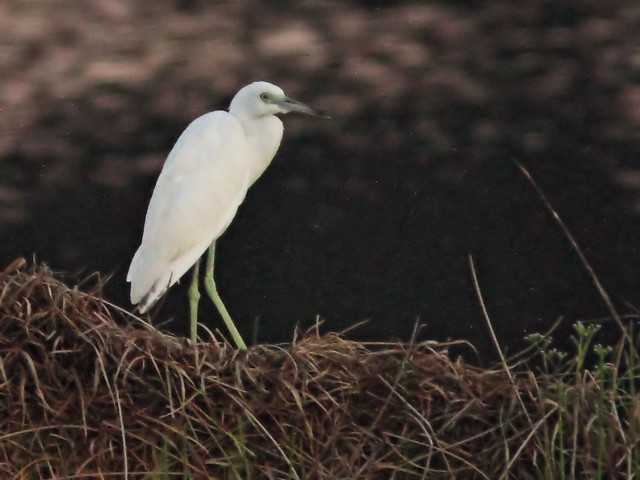
True, all egrets are indeed classified as herons, but all white herons are not egrets. I took this photo of two herons before sunrise, so it is not very sharp. Overlook the plumage difference and note the similarities between them. They are the same size and shape, their bills are blue-gray and tipped with black, and they have pale greenish legs. They are both Little Blue Herons:
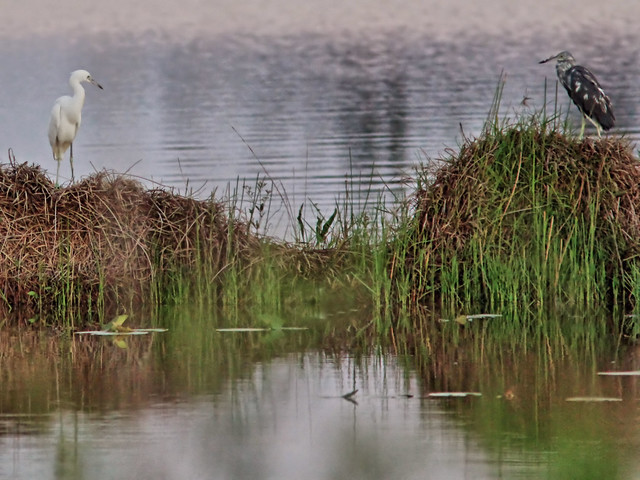
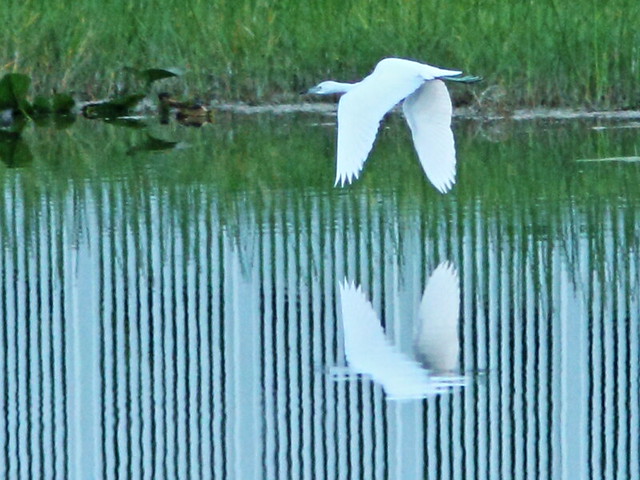
Immature white plumage is retained for about one year:
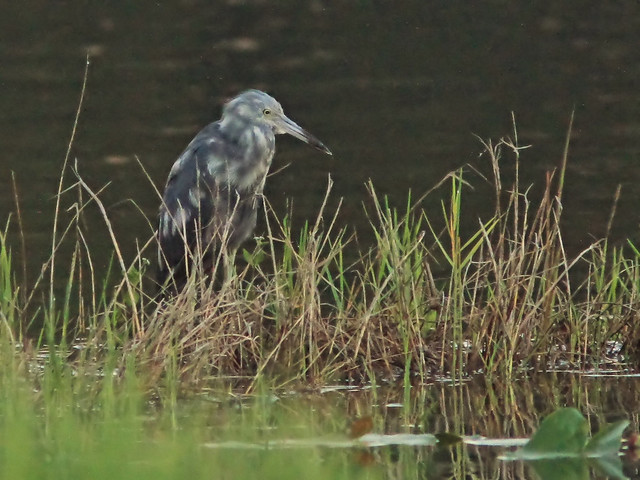
The other heron in the photo is this immature Little Blue Heron transitioning into adult plumage. At this stage they are sometimes called "Calico Herons:"
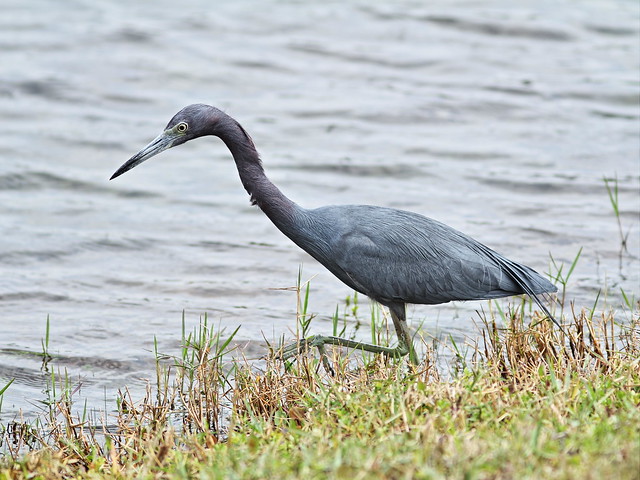
Here is a nice adult Little Blue Heron in our back yard:
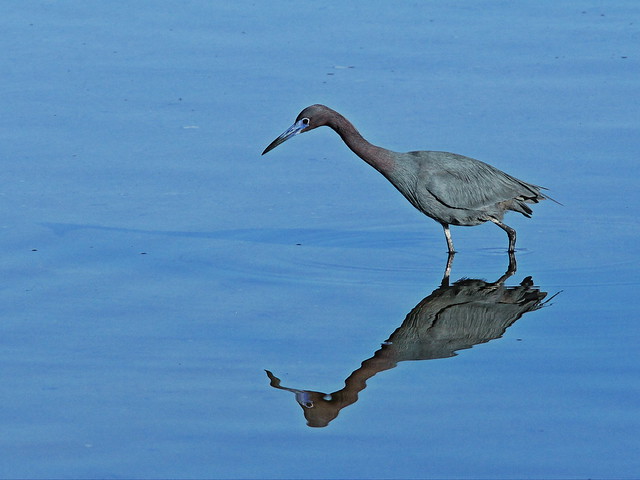
They are deliberate hunters, moving slowly and stalking their prey, often adopting this characteristic pose, identifiable from a great distance:
This Little Blue is dwarfed by a Great Egret:
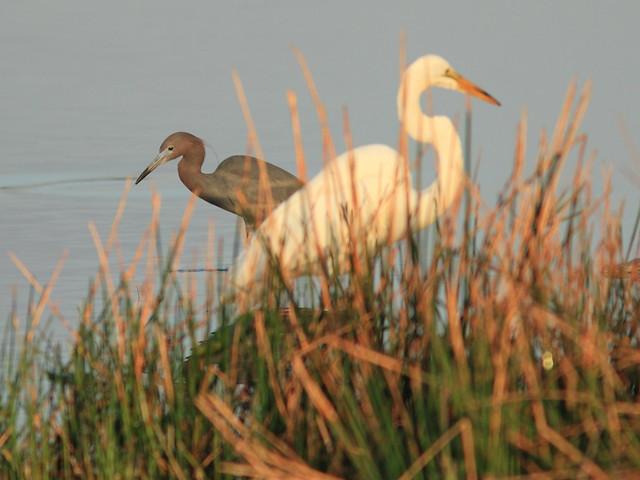
An immature Little Blue Heron casts a nice reflection against that of a neighbor's fence:
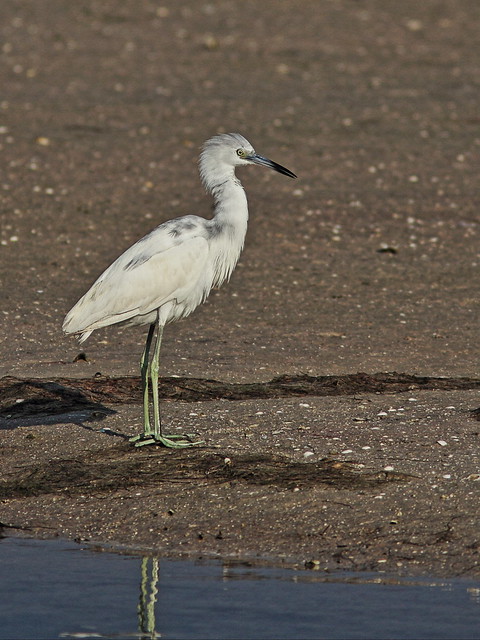
The plumage transition provides a variety of patterns. Early in the process there may only be a few dark feathers:
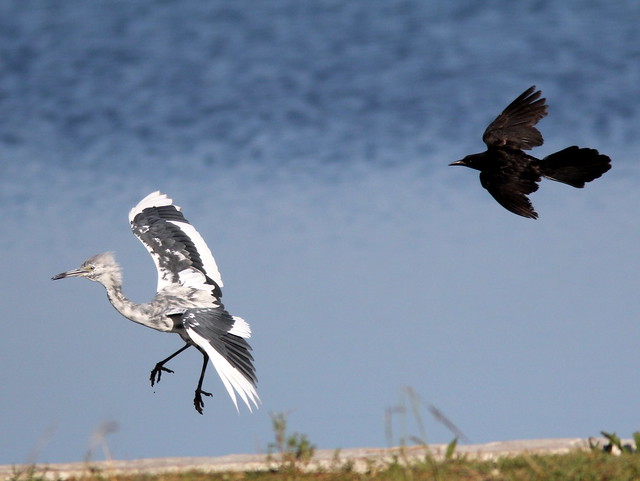
The white flight feathers are replaced by dark adult ones symmetrically, as illustrated in this Little Blue which is being pursued by a Boat-tailed Grackle:
This past week I watched as a backyard immature Little Blue Heron caught a tiny fish (species not identified):
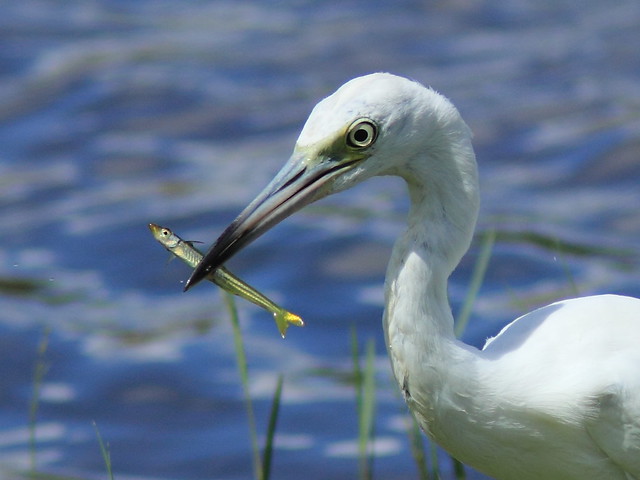
Immature Little Blue herons seem to be at the bottom of the heron pecking order. While herons of all species may vocalize or chase others that approach them too closely when they are hunting, the immature Little Blue Herons seem to be picked upon just for being in the vicinity of adults of the same species as well as Snowy and Great Egrets.
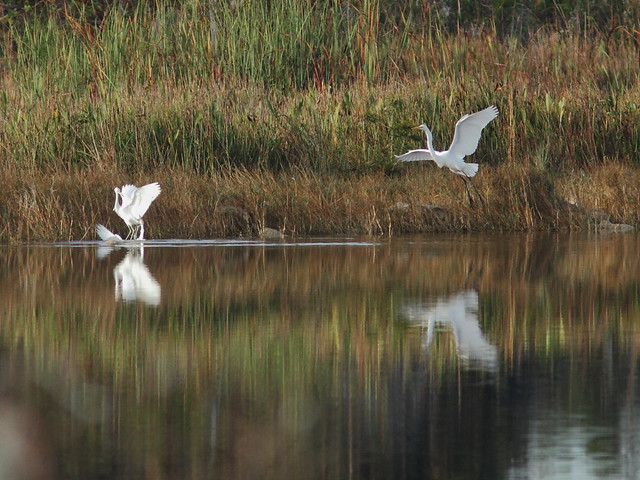
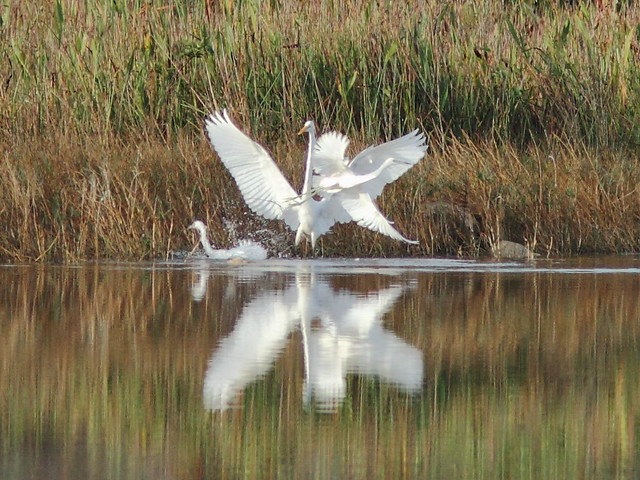
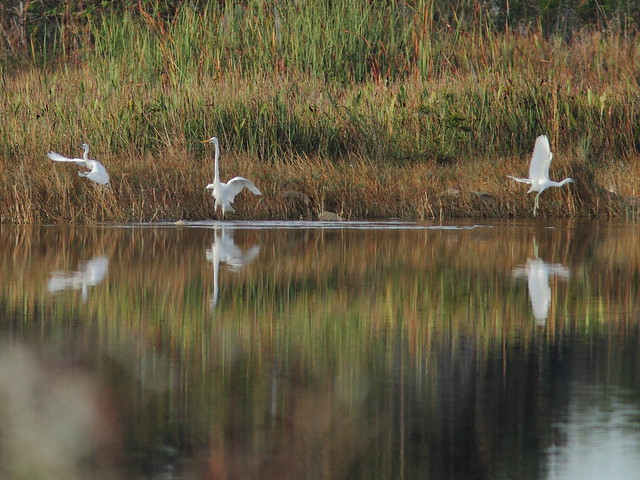
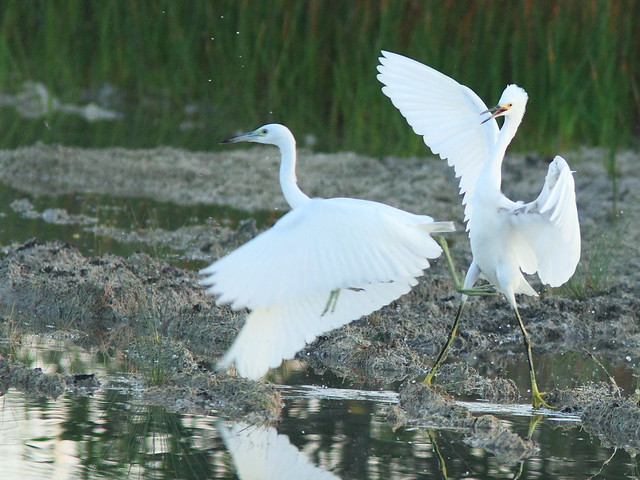
In this sequence, I first noticed two white herons on the far shore of the lake engaged in what appeared to be a hostile encounter, with much parrying and fluttering. It did not look like courtship or mating behavior. As I raised my camera, a Great Egret flew in and intervened. Both combatants were immature Little Blue Herons. One ended up mostly under water with the other standing straight up on top of its back, as seen in the first photo. Upon arrival of the egret, the warring parties took off in opposite directions:
The Snowy Egret is about the same size as the Little Blue, but has a black bill with yellow at its base and black legs with "golden slippers." Here one chases an immature Little Blue Heron:
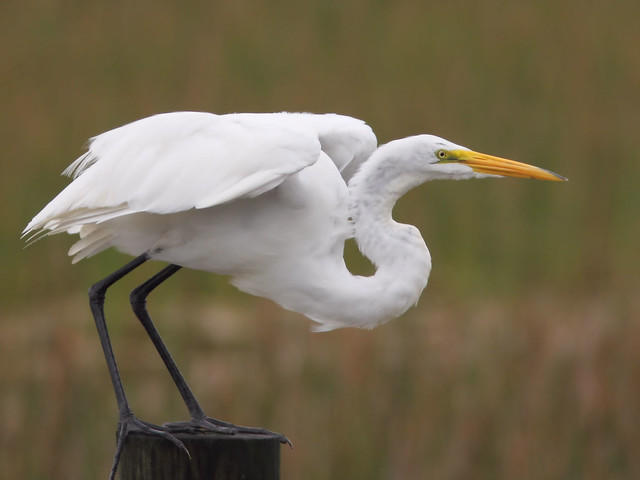
It is important to note the leg color of the following two white herons. The Great Egret has black legs:
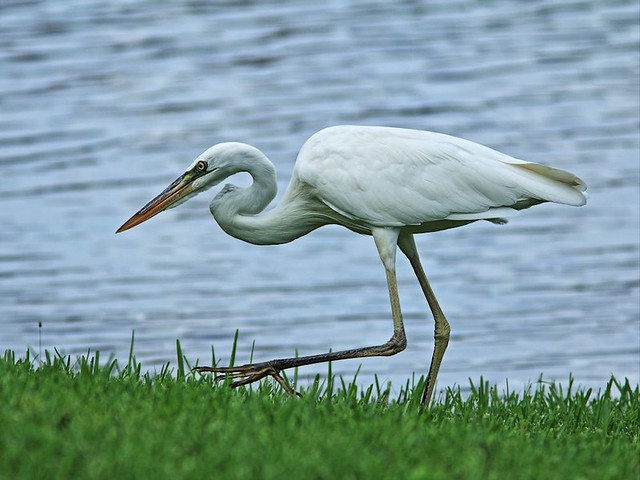
This is not an egret, but a Great Blue Heron white morph ("Great White Heron") in our back yard. Its legs are pale:
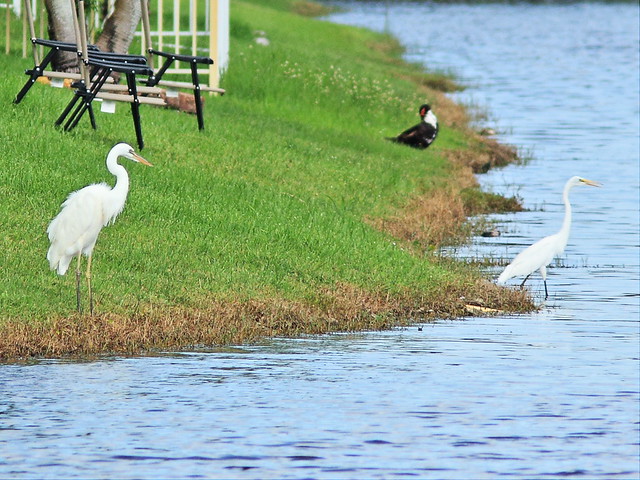
The Great White Heron is also much larger than the Great Egret:
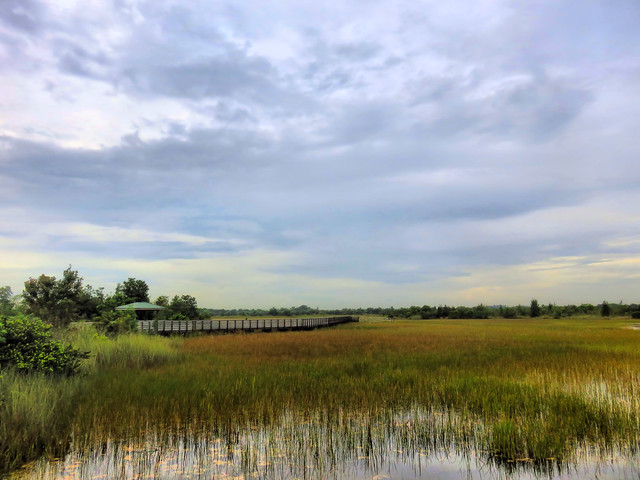
We do not venture out into the wetlands when rain threatens. One morning we visited nearby Chapel Trail Nature Preserve and walked the boardwalk with the car parked comfortably nearby.
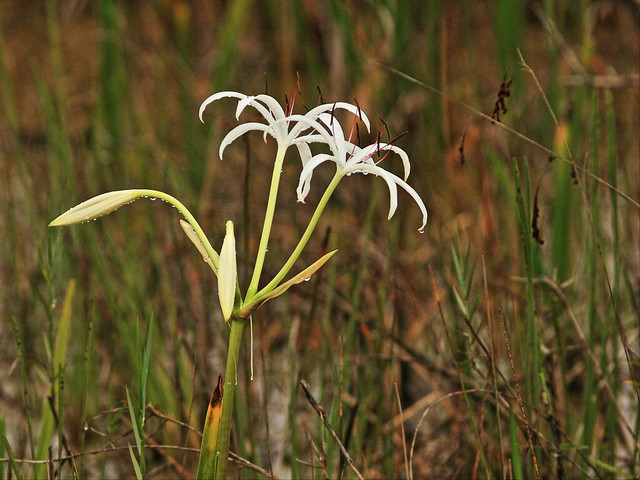
Swamp Lilies bloomed:
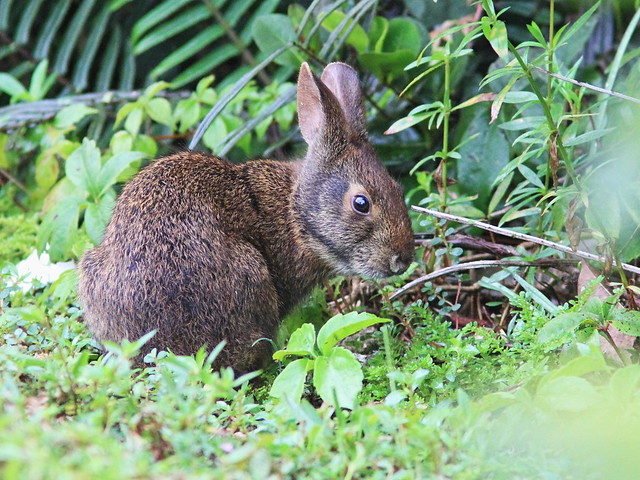
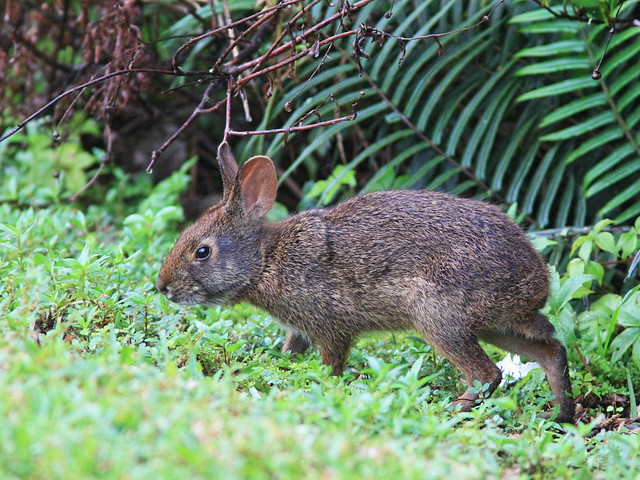
A young Marsh Rabbit nibbled on grass near the parking lot. This small dark cottontail rabbit without any white on its tail is a strong swimmer:
= = = = = = = = = = = = = = =
Linking to Misty's CAMERA CRITTERS,
Linking to Eileen's SATURDAY'S CRITTERS,
Linking to GOOD FENCES by Tex (Theresa).
Linking to SKYWATCH FRIDAY by Yogi, Sylvia and Sandy
Linking to WEEKEND REFLECTIONS by James
Linking to BirdD'Pot by Anni
Linking to Wild Bird Wednesday by Stewart
Linking to Today's Flowers Friday by Denise
Linking to Wordless Wednesday (on Tuesday) by NC Sue
________________________________________________
Please visit the links to all these memes to see some excellent photos on display
________________________________________________