Showing posts with label Northern Parula. Show all posts

Thursday, September 30, 2021

Fall migration

Autumn officially arrived and I visited the boardwalk at nearby Chapel Trail Nature Preserve. A Great Egret happened to pose almost directly  under the day-old Harvest Moon:

I was surprised at how quickly the Moon drifted down:

Shooting between tree branches, I had to contort to place the Moon behind the egret:

The egret was not impressed and went about preening:
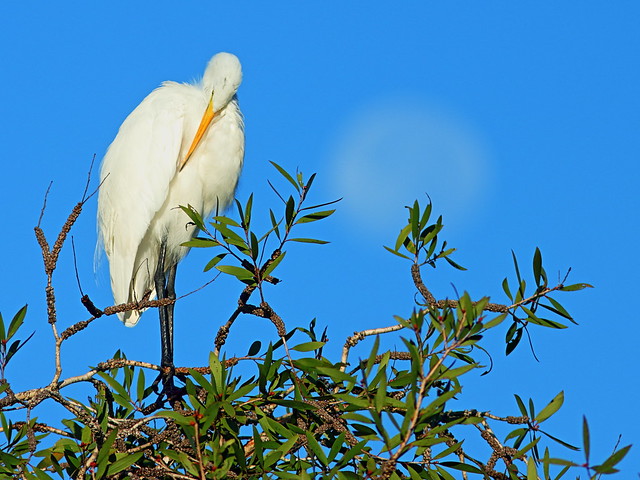
Actually, I had photographed the Moon a few minutes earlier, moved a short distance along the boardwalk and was lucky to look up and see the egret in a treetop: 

View from the dock near the beginning of the boardwalk. The wet prairie is now flooded and the spike-rush is flourishing. 

Although the morning radar showed heavy migration, birding was very slow. This is the Doppler velocity image at 5:00 AM on September 24. Green echoes are approaching Miami and red are heading away towards The Bahamas and Cuba. Our home is at the small red "+" which seems to be in the heart of the action.

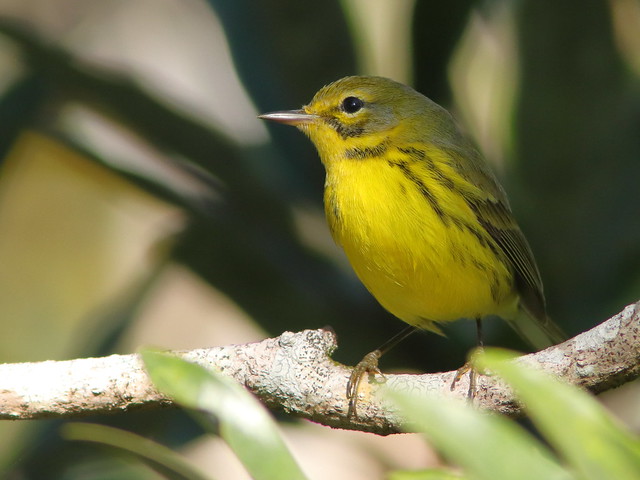
Instead of finding warblers dripping off the trees I logged only a single species. a Prairie Warbler:

A Blue-gray Gnatcatcher was my consolation prize. A distracting dozen or more frolicked in the trees:

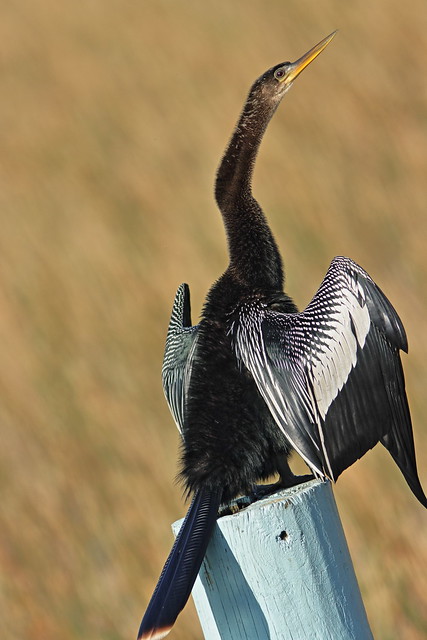
A grumpy Anhinga was sunning at the far end of the boardwalk. She protested my intrusion so I backed off after snapping a few images. Her red eyes glistened like jewels:


Non-avian objects of interest included a pair of mating Halloween Pennant dragonflies:

...and a Green Anole:


I had better luck in the Wounded Wetlands near our home. A Female Golden-winged Warbler showed up on September 20, my first ever record of this species in the local patch:


More Blue-gray Gnatcatchers livened up the scene:

A Prairie Warbler hover-gleaned for insects:

Another Prairie Warbler was missing his tail feathers. They should be finished molting and generally only replace tail feathers in pairs. Therefore this may have resulted from a close call with a predator such as a pursuing hawk. As bird banders can attest, some birds will "blow" all their tail feathers when severely threatened or to avoid being captured.

Other warblers included a female Black-throated Blue Warbler, here peering out from Ligustrum blossoms and berries...

..and a drab female or possibly first year male Common Yellowthroat:

Acrobatic Black-and-White Warblers seemed to defy gravity while seeking insects hidden in the bark of a Live Oak:

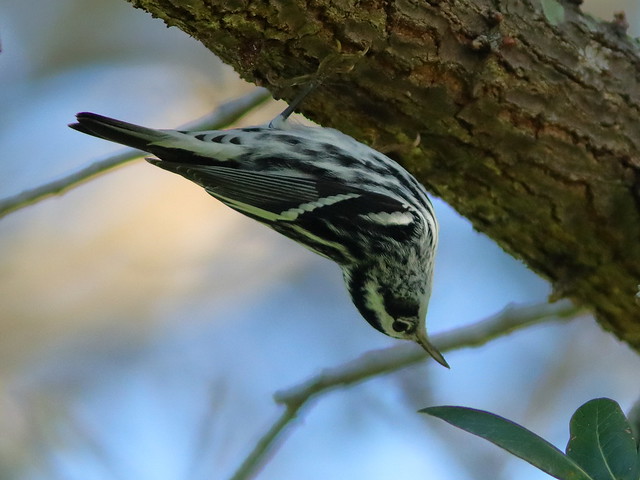

A Northern Parula warbler was mostly out of sight:

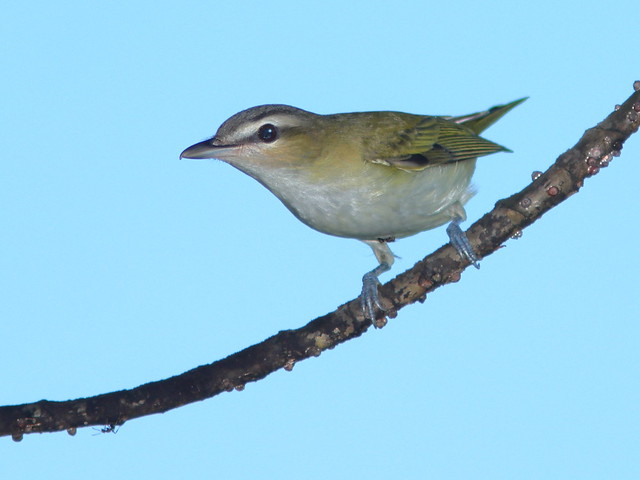
An inquisitive Red-eyed Vireo paid a brief visit:
Oh those eyes! A Brown Thrasher peered out between the leaves:

A migrating male Baltimore Oriole added welcome color to the scene:


Out on the lake, only 5 minutes after sunrise, the Harvest Moon hovered over a swirling cloud (A nice example of the low-light performance of my iPhone 11 Pro Max):


= = =  = = =  = = = =  = = = = =

Linking to:


Skywatch Friday

Weekend Reflections

Saturday's Critters

BirdD'Pot

Camera Critters

All Seasons

Wordless Wednesday (on Tuesday)

Natasha Musing

Our World Tuesday

________________________________________________

Please visit the links to all these posts to see some excellent photos on display
________________________________________________

Thursday, December 17, 2020

Chapel Trail Nature Preserve

Although I have been unable to lead the "First Saturday" wetland walks at Chapel Trail Nature Preserve in nearby Pembroke Pines, I try to get out there at least once every week. I go early and only on weekdays. This affords less contact with other visitors so that social distancing is not a problem. 

The extensive wet prairies in the preserve have suffered from high water conditions due to unusually heavy rain which included a visit from Tropical  Storm Eta. High water disperses fish and other prey items, so the herons and other wading birds must search widely and are not as concentrated as is usually the case as the winter dry season advances. 

Last week I saw only sixteen bird species. This time of year, twenty or more would be the norm. The second of two Great Egrets flew in and settled in the spikerush (actually, technically classified as a sedge and not a rush) which blankets the prairie:


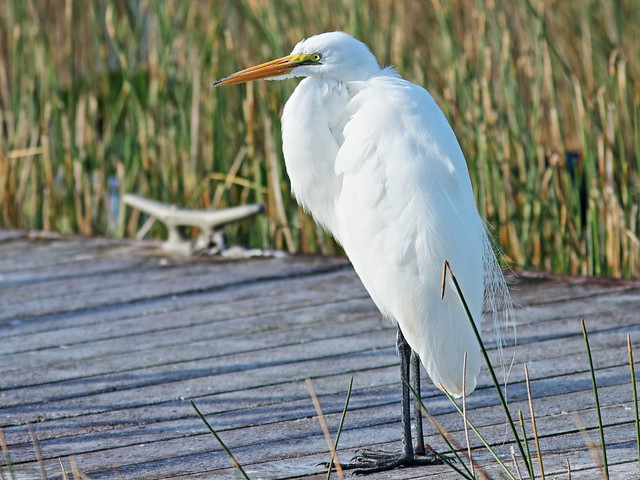
The other Great Egret, resting on the canoe dock, showed signs that it was approaching breeding condition: trailing plumes,  green lores and brightened yellow beak with darkening tip: 

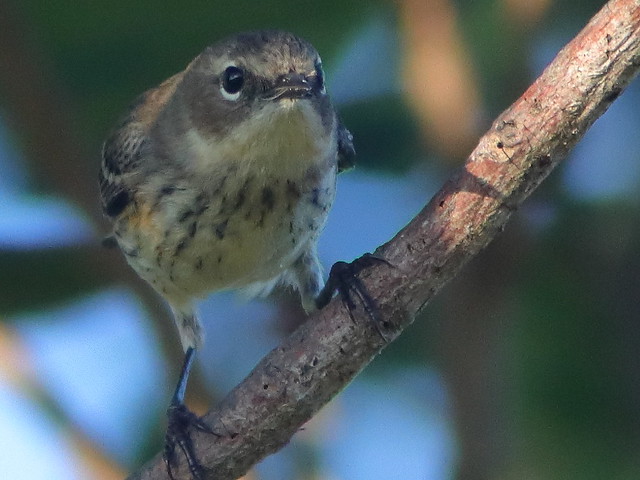
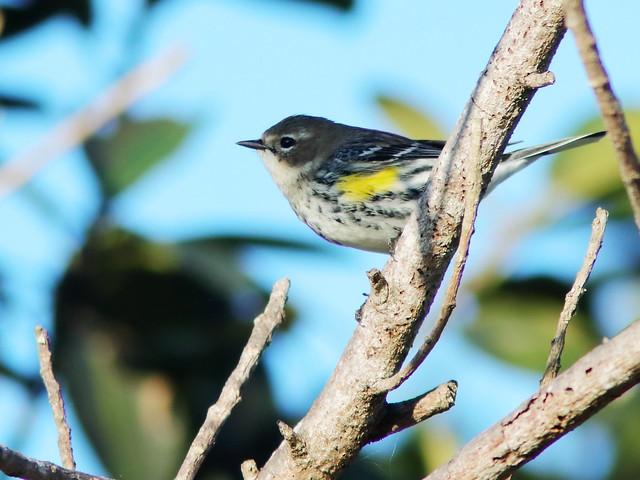
The most common bird species seen was the Yellow-rumped (Myrtle) Warbler. Flocks of five or six and up to 10 or 12 individuals moved together from tree to tree in the upland areas. Their winter plumage is greatly subdued as compared to their bold black, white and yellow breeding colors. Females have brown backs during winter, and first year birds have dull plumage. Some are very pale, like this specimen:


Others are dark brown, like this female. The intensity of their yellow rump and lateral breast patches also varies:


Winter male:


Immature, sex undetermined:

In any plumage, their namesake "butter-butt" rump patch is usually obvious:


This is a spring male Yellow-rump which I encountered in Illinois:


Three other warbler species were present--

Northern Parula male...:


...Prairie Warbler...

...and Palm Warbler:

Through the brush, I obtained a clear view of a Brown Thrasher which eyed me apprehensively: 

Exotic Gray-headed Swamphens foraged on the roots and tender stems  of the spikerush. They were persecuted and subjected to an eradication campaign in which over 3,000 were shot because it was feared that they would decimate this plant, which is a mainstay in the ecology of the Everglades. In fact, the sedge appears to be flourishing, as are the swamphens:

They habitually flick their tails upward to reveal the white under-tail coverts. Like a flashing taillight, this can make them easy to find amid the spikerush:

One swamphen took flight and provided a blurry image:

I remembered this photo of a pair of Gray-headed Swamphens reflecting in still water at Chapel Trail, back in October, 2014. Yes, there are only two birds here:

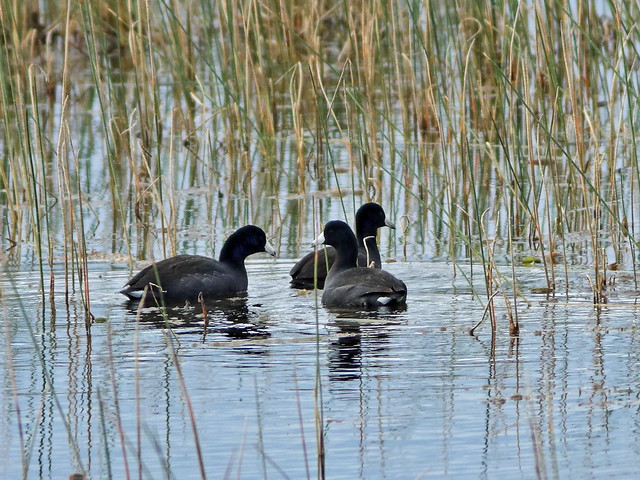
Native relatives of the alien swamphens, American Coots took turns diving:

Another member of the rail, moorhen and coot family (Family Rallidae), a Common Gallinule (formerly called Moorhen) retreated through the sedges:

An Anhinga spread its wings as it occupied a post near the dock:

Soon the male Anhinga will develop green breeding-season "goggles," as modeled by one I photographed in early January:

In the adjacent dry pasture, my favorite Longhorn cow grazed. I assumed that the white heron nearby was a Cattle Egret, but close inspection on my computer screen revealed it has a bluish gray bill with a black tip, characteristics of an immature Little Blue Heron:

Nearby, her calf is starting to sprout horns:

On the way out of the preserve, a passing shower spawned a rainbow, visible from the parking lot:


= = =  = = =  = = = =  = = = = =

Linking to:

Fences Around the World


Skywatch Friday

Weekend Reflections

Saturday's Critters

BirdD'Pot

Camera Critters

All Seasons

Wordless Wednesday (on Tuesday)

Natasha Musing

Our World Tuesday

________________________________________________

Please visit the links to all these posts to see some excellent photos on display
________________________________________________