Showing posts with label Raccoon. Show all posts

Thursday, August 26, 2021

Dusty Blue Moon

Last weekend we celebrated a rare  Seasonal Blue Moon. The usual Blue Moon occurs when there is a second full Moon in a single month. The second during any one of the four seasons is called a Seasonal Blue Moon. The latter is a bit less frequent, but both happen about every two or three years. Both may rarely occur in a single year, as happened in 2018, but this will not be seen again until 2037, a few days before my 102nd Birthday. 

When there is a full Moon, we enjoy getting out early to watch it set into the lake from a vantage point about a 15 minute walk from our home. Best viewing occurs during the half hour before moonset, but on Saturday morning it was too early for us. The  nearly-full Moon set around 6:00 AM and disappeared from the clear sky just as we started out on our walk. 

Steven, a friend and very accomplished birder, accompanied me. As usual, MaryLou broke ranks and power-walked a mile out and we were only about halfway in when, on her way back home, she blew past us in the dark. Steven sought three target birds. The first was the Barn Owl, which we encountered very soon. A pair have been breeding in the hollow tops of dead Royal Palms. I "discovered" them in 2015, but did not find nest #1 until 2019. They occupied nest #2 this past breeding season, raising one owlet which fledged in February. For the past month the pair have been roosting on a third dead palm just to the north of nest #2. This was where we heard and then saw it on Saturday. Much too dark for photos.

A Chuck-wills-widow, the second of Steven's target species, treated us to a nocturnal fly-by. Again, no photos.

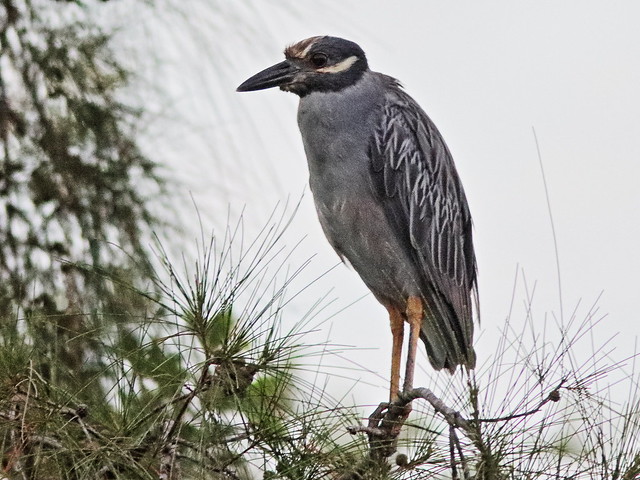
We reached the extinct heron rookery before sunrise. An unseen Green Heron called out. Steven caught sight of a cluster of three Yellow-crowned Night-Herons high in a tree and silhouetted against the brightening eastern sky. My best photos were horrible:


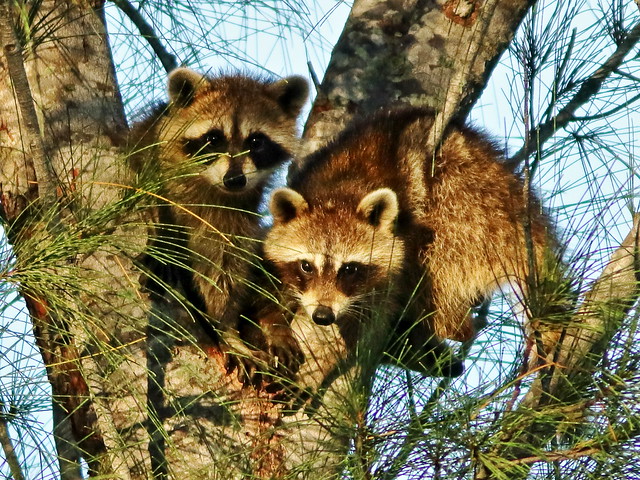
As the sky brightened, Steven's eagle eyes spotted (yes, an immature Bald Eagle, but also) what, at first, appeared to be a large nest. On closer inspection, it was a family of Raccoons. As their parents remained curled up asleep in the branches above them, two youngsters stared back intensely:
A few days earlier, on August 16th I had located an Alder Flycatcher near the entrance to the Wounded Wetlands. This was the priority bird for Steven, but it failed to appear this morning:
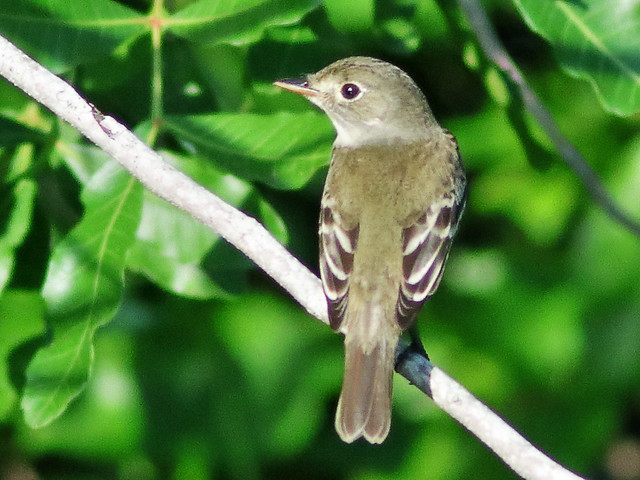

Steven did locate a Great Crested Flycatcher which I had overlooked:

The next morning I hoped to photograph the setting of the Blue Moon just before sunrise. However, it was barely visible through the murky sky, tinged brown by a huge cloud of Saharan dust:

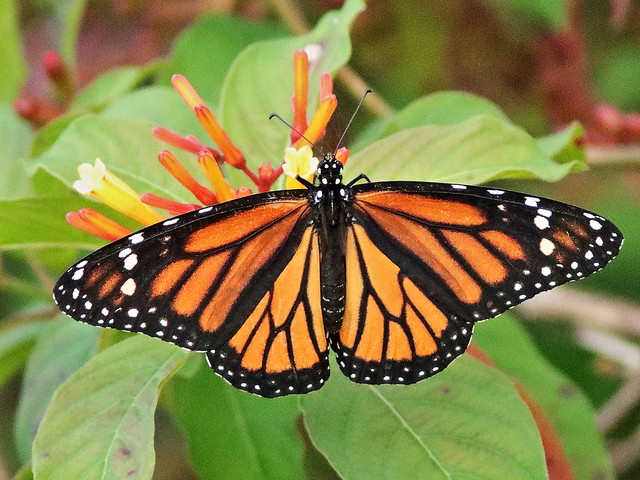
Other sightings this past week have been a Monarch butterfly on the flowers of Firebush:

On August 16, before the dust storm, we enjoyed a pastel sunrise:

= = =  = = =  = = = =  = = = = =

Linking to:


Nature Thursday

Skywatch Friday

Weekend Reflections

Saturday's Critters

BirdD'Pot

Camera Critters

All Seasons

Wordless Wednesday (on Tuesday)

Natasha Musing

Our World Tuesday

________________________________________________

Please visit the links to all these posts to see some excellent photos on display
________________________________________________

Thursday, June 10, 2021

Listing bird species in the Wounded Wetlands

My list of bird species seen in our local south Florida birding patch (West Miramar Water Conservation Area aka the Wounded Wetlands) had reached 182 at the end of 2020. Over the years the productivity of the patch has followed the Law of Diminishing Returns. I began keeping my sightings records in eBird in 2009, when my yearly total for this location included 47 different species. 

The year 2010 began with a flourish, adding 6 new species on January 10, including my first Short-tailed Hawk. It was this light morph. Its tail looks red due to refraction of sunlight:

The year 2010 finally yielded 33 new species, which increased the patch's total output to 80 species, about 70% of the prior year's productivity. The pattern continued during the next 5 years (2011-2015), with new species numbering 27, 13, 14, 15 and 9, during which time the productivity rate gradually decreased to 49% (averaging about 10% per year) despite an increase in my total to 158 species.

Grasshopper Sparrow, February 2, 2011

Each of the next five years (2016-2020) added only single-digit new species counts, bringing my total to 182 with an average productivity rate of 13% (pitifully, only 2.6% annually).  

Clay-colored Sparrow, November 17, 2016:

Despite the pandemic, I added five new birds in 2020. Indeed, it was liberating to walk mask-less in the Wounded Wetlands. 

My highlight new species in 2020 was a Yellow Warbler (actually there were two), my only Florida sighting of this species, on August 18:

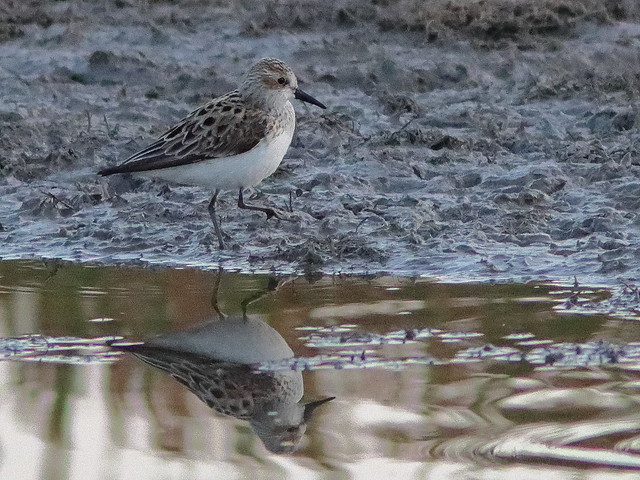
The Law of Diminishing Returns was working against me when 4 Semipalmated Sandpipers appeared at the edge of the lake on May 24, 2021. This species can be difficult to distinguish from the Western Sandpiper. 

Over the years I have seen small sandpipers, but never well enough to distinguish their species unless they had the yellow legs of a Least Sandpiper, another member of the Calidris genus. 

Yet I assumed that I must have reported the species earlier. Nope, it was always entered as a Semipalmated/Western Sandpiper, not "countable" by eBird. I had backed into a new species! 

Semipalmated Sandpiper #183 in the Wounded Wetlands, foraging in very early morning light. Note the webbing which covers only the base of its toes, hence its name:


Here are Least and Semipalmated Sandpipers in much better light, feeding in a pond near our second home in Illinois, July 17, 2012. The Least Sandpiper displays its yellow legs:

Diminishing returns indeed. So far this year my addition of one species has raised my total count for this patch by only 0.54%. 

As my musing maysuggest, I have not been out in the field very often this past week.  Avian highlights were a Pileated Woodpecker...


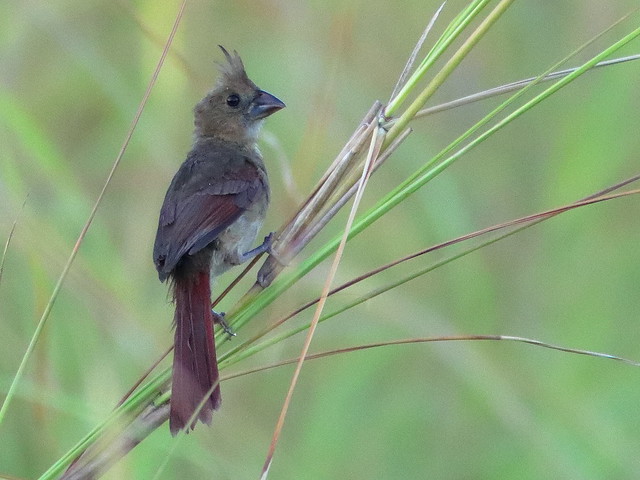
...and a juvenile female Northern Cardinal:


A young Raccoon silently watched me from behind a tree trunk:

In the lake, Longnose Gar:

The pilot of a motorized parachute was checking his phone:

Before sunrise on May 30, Jupiter and Saturn were lined up with the Moon in Aquarius (iPhone photo):

Hand-held DSLR photo of Jupiter and three of its moons, a bit jittery:

Storm clouds to the east  broke up the rays of the rising sun...

...which reflected on the smoke from several wildfires and converged on the western horizon:

= = =  = = =  = = = =  = = = = =

Linking to:


Skywatch Friday

Weekend Reflections

Saturday's Critters

BirdD'Pot

Camera Critters

All Seasons

Wordless Wednesday (on Tuesday)

Natasha Musing

Our World Tuesday

________________________________________________

Please visit the links to all these posts to see some excellent photos on display
________________________________________________

Thursday, June 3, 2021

Crops & Clips: Flashback to June, 2018

To kick off the month of June, I have once again turned to my photo archives, bringing back memories of three years ago, searching for favorite memes: birds and butterflies, flowers, reflections, colorful skies and scenes which speak for themselves.

We spent June, 2018 entirely in Florida. Early in the month, our Texas family visited and we drove to Shark Valley Visitor Center in Everglades National Park.

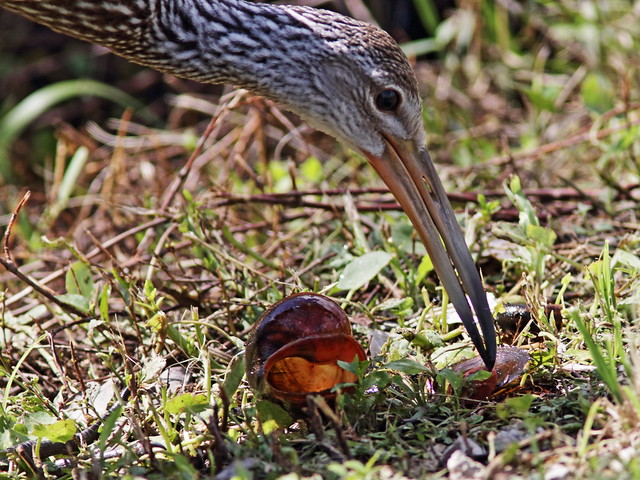
The range of Limpkins is nearly confined to Florida, so they are much sought after by visiting birders. Although they look somewhat like herons, they are more closely related to rails and cranes. Limpkins were abundant, as were Apple Snails, their favorite food:


"The Limpkin's bill is uniquely adapted to foraging on apple snails. The closed bill has a gap just before the tip that makes the bill act like tweezers. The tip itself is often curved slightly to the right so it can be slipped into the right-handed curve of the snail’s shell." (All About Birds, The Cornell Lab)  

Next to the parking lot at the entrance to the Visitor Center, an immature Red-shouldered Hawk cried out incessantly:

Alligators inhabited the canals, thrilling the many tourists:

At the local Bald Eagle nest, only one of the two eaglets survived to fledge. P Piney 19 was 5 months old, ready to leave the care of parents and likely migrate to the north where fish are easier to catch as the water is cooler and they are closer to the surface.

Out in the neighborhood wetlands, male Common Nighthawks patrolled nesting territories along the path. I accidentally captured the waning Strawberry Moon in this photo:

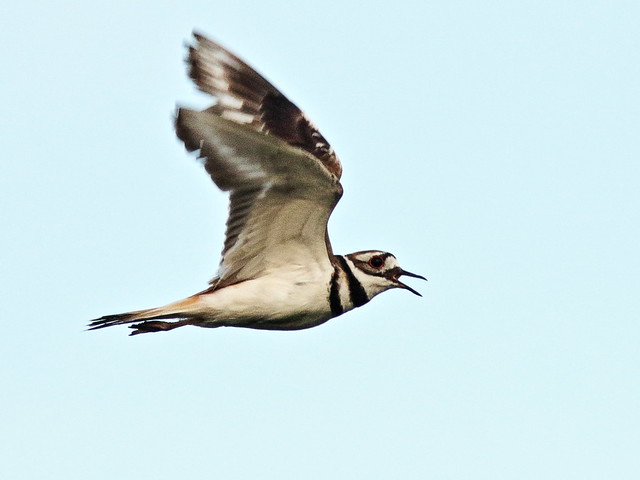
Killdeers also protested as we walked past their nests:


A Raccoon walked out into the open and looked at me before fleeing:

In the marsh, Pickerelweed thrust up their blue flowers...

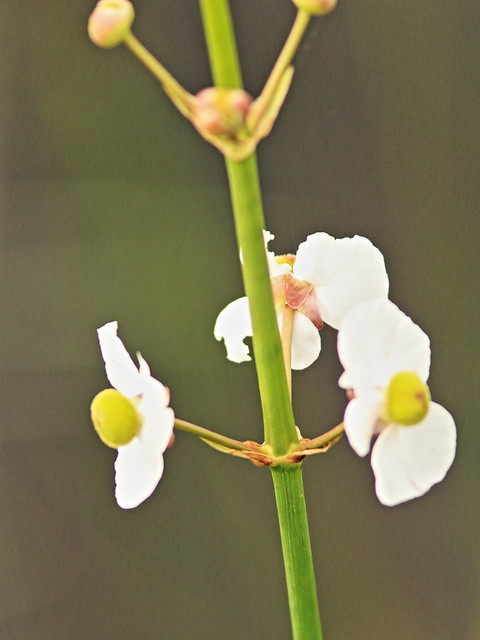
...intermingling with the white blooms of Broadleaf Arrowhead (aka "Duck Potato" for its edible root tubers)...

...and Swamp Lily:

A "piebald" Little Blue Heron was molting from white juvenile to dark blue adult plumage:

A White-tailed Deer doe thrust up her tail as an alarm as she bolted for cover:

An immature Green Heron rested in a small Pond Cypress tree before flying off:

Young Wood Storks awaited to be fed at the rookery about 10 miles north of our home:

Along the path I encountered a Florida Box Turtle. Unfortunately, many people bring them home as pets, often not knowing that they do not live in the water or what to feed them:

Among the insects, A white Peacock...

...a Halloween Pennant...

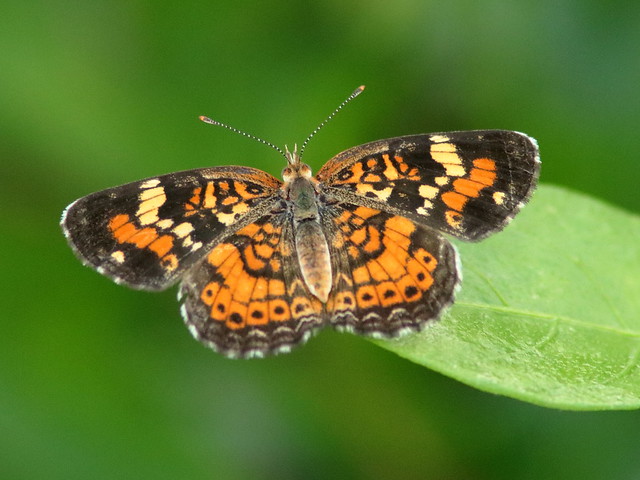
...a Phaon Crescent...

...and a bee-like hoverfly:

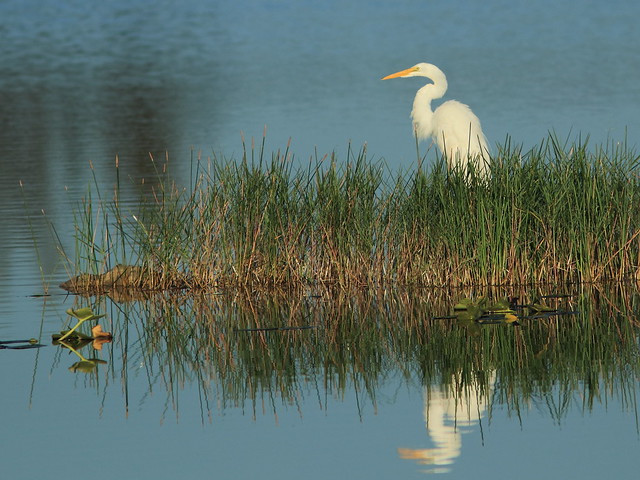
A Great Egret reflected on June 27:

A foggy sunrise on June 29:

Along the path at 20 minutes before sunrise on June 30:


= = =  = = =  = = = =  = = = = =

Linking to:


Skywatch Friday

Weekend Reflections

Saturday's Critters

BirdD'Pot

Camera Critters

All Seasons

Wordless Wednesday (on Tuesday)

Natasha Musing

Our World Tuesday

________________________________________________

Please visit the links to all these posts to see some excellent photos on display
________________________________________________