Join me once again as we peek through the Retrospectroscope and look at events three years ago during the month of June, 2013. I was able to find photos in my archives which met the themes of SKY, REFLECTION, FENCE, MACRO, CRITTERS and a few unidentified FLOWERS. Of course I am never at a loss finding shots of critters of all sorts, but they are mostly avian. It was a month chock full of activities, from Florida to Arizona and Utah.
On June 1, 2013 as we walked into the wetlands adjacent to our south Florida home, the cirrus clouds warned that a change in weather was imminent:

We visited the Yellow-crowned Night-Herons nesting in the rookery:

Their scraggly chicks looked like cartoon characters:


We checked the nest of a Common Nighthawk and, from a distance, saw that the nestling was almost ready to fly:

The adult nighthawk flew anxiously overhead, so we moved on down the path:

Green Heron youngsters had just fledged, and they scrambled about in the branches:

On June 3 the storms moved in and we hurried home ahead of the rain:

An adult Green Heron foraged in a lakeside puddle:

The Yellow-crowned Night-Heron chicks grew quite rapidly over the next week:

A Wood Stork rested on one foot in a small park along our lake:

The stork is in the foreground, and our home is reflected in the lake (on June 2-- four memes of critter, fence, sky and reflection all in one!):

Loggerhead Shrikes were courting:

Unsettled weather persisted into the middle of the month:

It was a wonderful month for butterflies--
Julia heliconians, a male and a female:


White Peacock:

Gulf Fritillary:

Zebra heliconian, State Butterfly of Florida:

Mid-month we departed for Arizona, where we rented an RV and toured the State for 10 days with our daughter's family:

At Tombstone, Arizona with our daughter and granddaughters:


Bobcat at the Desert Museum in Tucson:

Phainopepla in Oak Creek Canyon, Sedona, Arizona:

Black-throated Gray Warbler and Pygmy Nuthatch at Grand Canyon, Arizona:


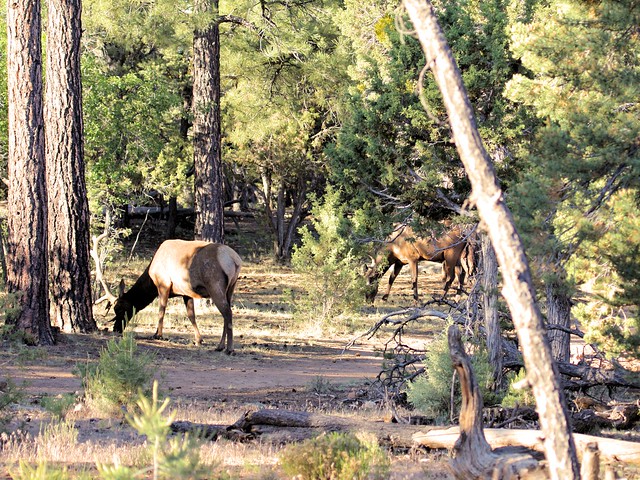
Elk browsing near our campground at Grand Canyon:
Our granddaughter at Hopi Point in the Grand Canyon:

Thanks so much for visiting! I will be on the road for the next couple of weeks and often away from WiFi and even out of cellular range. Mary Lou and I are celebrating our 56th Wedding Anniversary! Tending to my blog from a cellphone does not work out very well, so I have put my posts on "autopilot" in the interim, but promise to visit you as soon as possible when I get back to my PC.
= = = = = = = = = = = = = = =
Linking to Misty's CAMERA CRITTERS,
Linking to Eileen's SATURDAY'S CRITTERS,
Linking to GOOD FENCES by Tex (Theresa).
Linking to SKYWATCH FRIDAY by Yogi, Sylvia and Sandy
Linking to WEEKEND REFLECTIONS by James
Linking to BirdD'Pot by Anni
Linking to Wild Bird Wednesday by Stewart
Linking to Today's Flowers Friday by Denise
Linking to Wordless Wednesday (on Tuesday) by NC Sue
________________________________________________
Please visit the links to all these memes to see some excellent photos on display
________________________________________________
My weekly potpourri gathered from the archives features... bluebirds and more bluebirds!
CRITTER: Guess?
North American bluebirds come in three "flavors." Each one is a sweet as the others
Western Bluebird digiscoped in our front yard, Cedar Crest, New Mexico in November, 2003
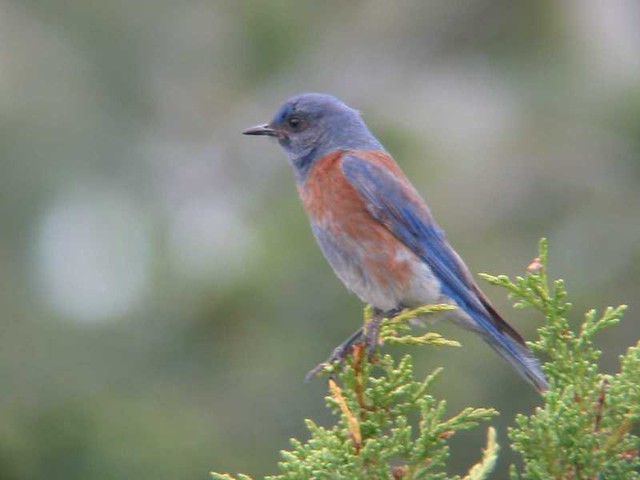
Note the all-blue head and throat of the Western Bluebird, in Grand Canyon, Arizona, June 17, 2013
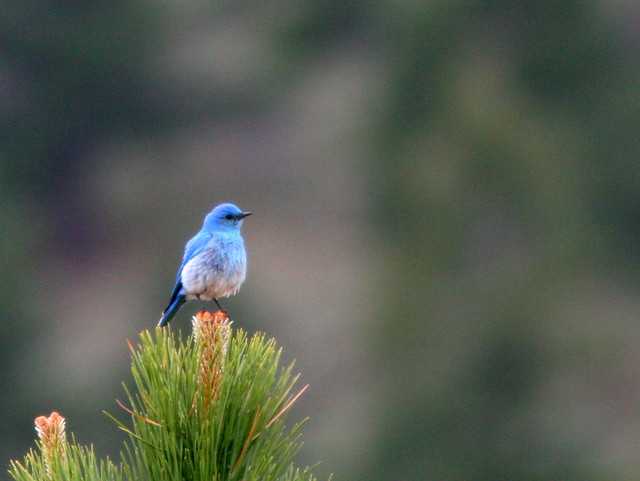
The Mountain Bluebird is an unforgettable shade of blue, seen at YMCA of the Rockies, Estes Park, Colorado on June 17, 2010

Mountain Bluebird, Estes Park, Colorado on June 14, 2010
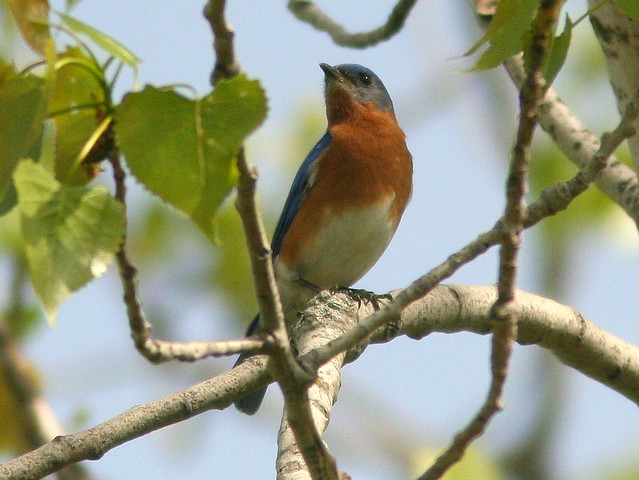
The third species of bluebird ranges in the eastern US and is appropriately known as the Eastern Bluebird, this one photographed in Batavia, Illinois on April 19, 2010
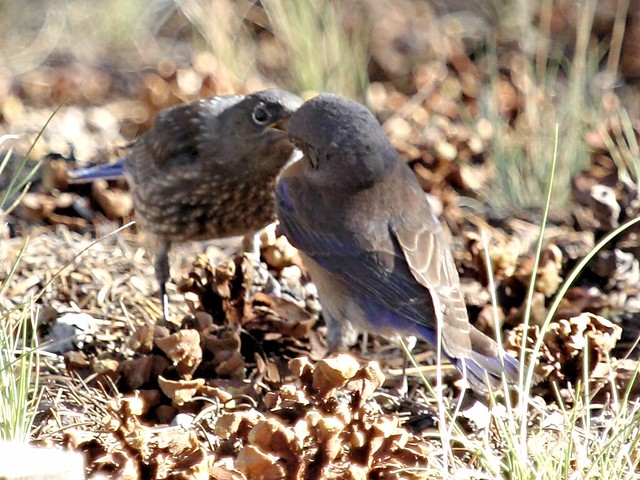
"Ontogeny recapitulates phylogeny" may be a discredited theory, but the spotted breast of a fledgling Western Bluebird bears evidence of its relationship to other members of the thrush family, in Grand Canyon, Arizona, June 19, 2013
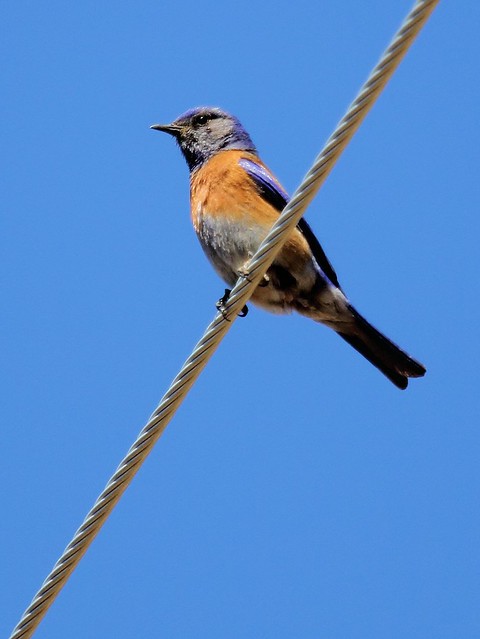
This particular Eastern Bluebird has a story to tell, aside from the fact that she is bringing dinner to a fledgling hidden in the bushes under this wire, in Saint Charles, Illinois, June 22, 2012.

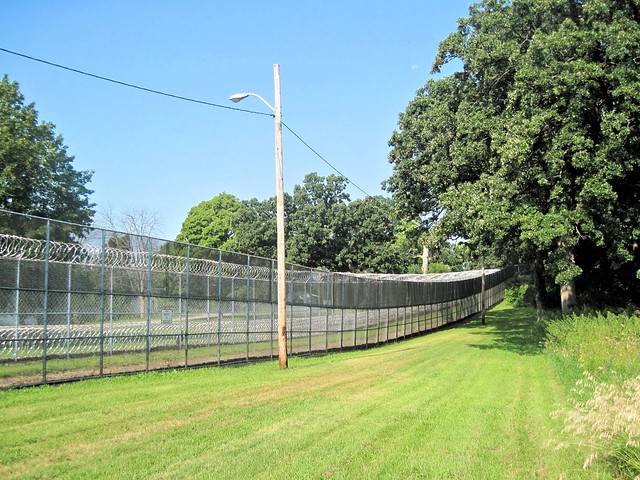
Although she symbolizes the bluebird of happiness and the freedom of flight, her perch overlooks a fence that is particularly good or bad, depending upon whether you are looking in or out. Those inside can only dream of flight.
The Illinois Youth Center is a medium security correctional facility. On the "good" side is the beautiful Hickory Knolls Discovery Center, a nature center and preserve full of old growth hardwoods.
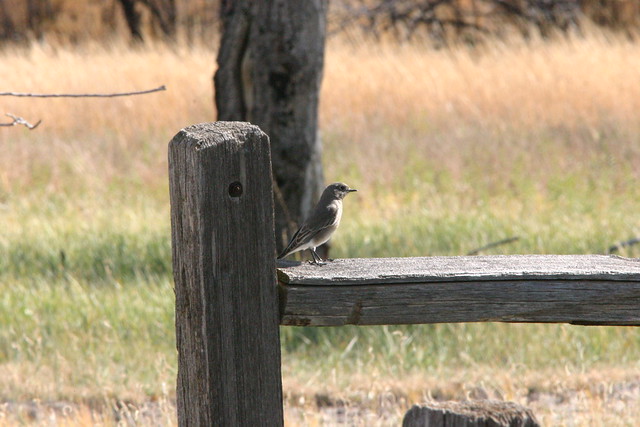
Mountain Bluebird, female on a "Good Fence," Buffalo Lake NWR, Canyon, Texas on November 12, 2008
Linking to CAMERA CRITTERS,
Eileen's SATURDAY'S CRITTERS,
and
GOOD FENCES by Tex (Theresa).
________________________________________________
SKYWATCH: Blue on blue
I just realized that all my bluebirds enjoyed blue skies with nary a cloud, so forgive me for showing such a boring sky.
Mountain Bluebirds in Canyon, Texas, November 12, 2008
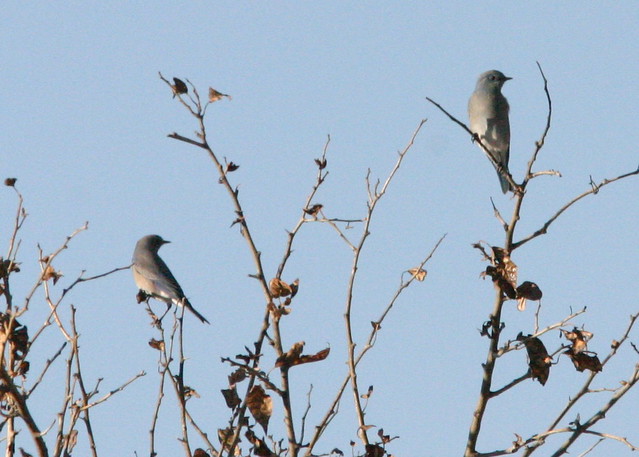
This week I tried again but there were no clouds at all--
Eastern Bluebird male, Nelson Lake, Batavia Illinois October 1, 2014
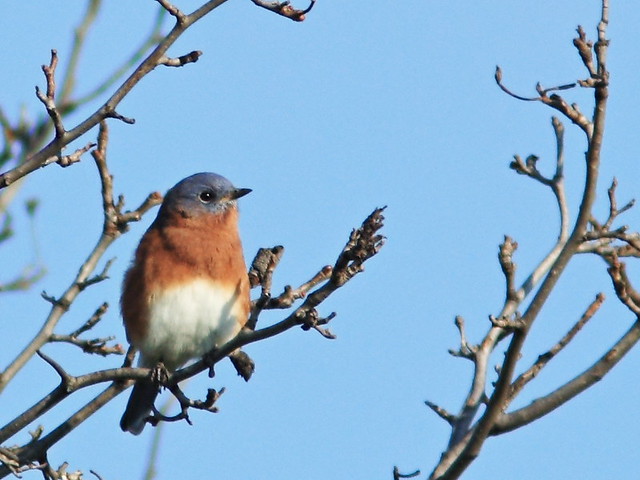 Linking to SKYWATCH FRIDAY
________________________________________________
REFLECTIONS: Poor
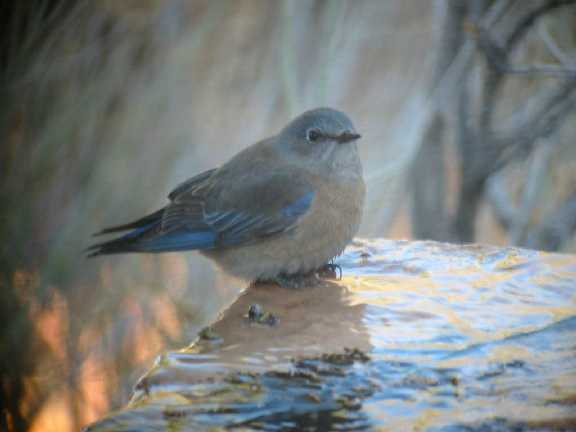
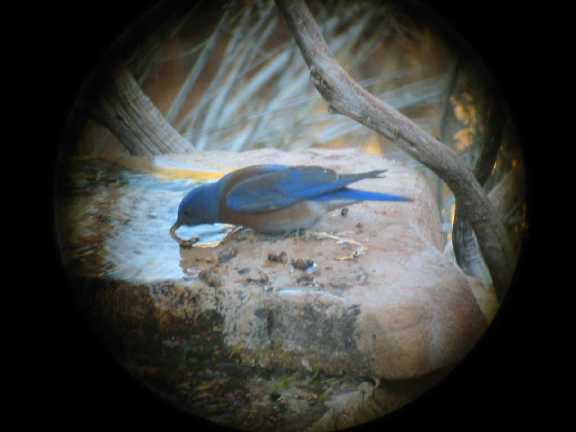
In adherence to our theme, I tried to find some bluebird reflections in my archives. The running water of our backyard fountain in New Mexico distorted them, but also produced some of my favorite bluebird photos.
Like the first picture on this post, they were taken from inside the windows of our home with a tiny Canon PowerShot A-40 with a 2 MP sensor (yes, you have that right, only TWO megapixels!) shooting at 3x optical zoom through the eyepiece of a Kowa 70mm scope zoomed down to 20x. Note that this technique causes natural vignetting of the edges of the photos. See my primitive digiscoping rig at this link.
Western Bluebirds, Cedar Crest, New Mexico, February, 2003
Linking to WEEKEND REFLECTIONS
We continued our twelve day multi-generational journey in a 31 foot RV from Sedona to the south rim of the Grand Canyon, an easy 120 mile drive that took less than three hours. Near the entrance to the National Park, our granddaughters were excited to see an Elk grazing along the road.
After securing our rig in an ideal location at the north end of Grand Canyon Trailer Village, we wasted no time taking the ten minute walk to the Visitor Center at the very edge of the Canyon. The children wanted to see the IMax introductory film, but the projector was broken. We talked to a Park Ranger who told us that California Condors had been reported at Hopi Point, so we planned a visit for the next day. We lingered at the South Rim to observe sunset from nearby Mather Point.

The ever-changing play of colors on the rocks to the east was beautiful, but the clear sky to the west plunged the foreground into shadow and lacked the interest that would have been provided by a few clouds. When the sun went down it was as if someone had simply turned off the lights.
In my haste to eliminate the large number of 25,000 KB RAW outtakes among those that had filled two 32 GB compact flash cards, I inadvertently deleted that day's only bird photos, of two Scrub Jays that posed in a dead tree near the Visitor Center.
The next morning I set out on my first walk in the woods adjacent to our RV. The first bird I saw bears a close resemblance to the Boat-tailed Grackle, a Florida species. It is a Great-tailed Grackle, feasting on a pine nut.

I walked a more few yards, passing a staff parking lot when I realized that a very large (12-point) bull Elk was staring me right in the face. A second smaller one was just behind him. I froze and snapped a few shots, then they both ignored me, moved along the edge of the lot and resumed browsing on tree branches. Soon, a third bull joined them.


I continued down a dirt path through the mixed pinyon-juniper and Ponderosa Pine woodland, keeping an eye on the Elk who followed me erratically among the trees along the path.
 Our camp was at about 7000 feet elevation. Although nighttime temperatures had dropped into the high 30s (F), the sun was quickly warming me up, and I stood silently for a while in the shade of a thicket of Pinyon Pines. Suddenly, I was surrounded by the wheezy squeeze-toy calls of a flock of a dozen or more Pygmy Nuthatches.


The nuthatch calls seemed to attract a few hummingbirds. From the cricket-chirp sound of their wingbeats I could tell that one or more were Broad-tailed Hummingbirds. However I think this one represented the Black-chinned species.

An Ash-throated Flycatcher also responded to the commotion.
 A harsh, strident call revealed the presence of a Steller's Jay.

The pattern of white stripes on the Steller Jay's head varies gradually, being more sharply defined in the eastern part of its range and absent from birds in the northwestern US.

Mountain Chickadees appeared, as if out of nowhere.

On the way back to the RV, I did not see the Elk again, but a Violet-green Swallow roosted in a tree just long enough for me to take its picture.

A shadow of a large bird passed overhead and I looked up casually, ready to dismiss it as a Turkey Vulture. But no-- it had a white band on its tail. It was a Zone-tailed Hawk, known for its ability to hide in a flock of Turkey Vultures, making it easier to surprise smaller birds, mammals and lizards that constitute its prey.


Our granddaughter Graciela has already stolen my thunder by writing about what happened just a bit later that morning, so I will stop here!