Showing posts with label eaglets. Show all posts

Thursday, April 29, 2021

Eaglets down

The local Bald Eagles' new nest containing two 5 week old eaglets was damaged by a severe thunderstorm on Sunday, April 11. The next morning a portion of the right (west) side of the nest had fallen. A week later, while I was away in Illinois, on April 19, the nest split into two pieces which fell a few feet down from its original spot in the "V" formed by two large branches of the tall Australian Pine. (Note important UPDATE at the end of this post).

The smaller eaglet of the two fell to the ground and was rescued. It suffered minor injuries but is doing well at the Pelican Harbor Seabird Station rehabilitation facility in Miami. The older eaglet (presumably a female based upon its size) is active and healthy, occupying the lower remnant of the nest, behind and just to the left of the main trunk. It was hatched around  March 5 or 6th, so she is 57 days or nearly 8 weeks old. Normal fledging age is about 10-13 weeks of age. At this nest site, fledging of the first eaglet occurred as early as 68 and as late as 86 days after hatching. (average 76.5 days with a median of 73 days). 

This part of the nest appears to be supported by smaller branches and some of the long sticks from the original nest. We watched as it was being fed a large fish carried in by the female parent. I only was able to capture a few poor photos of the eaglet, as it was mostly hidden by the debris from the nest. 

I arrived at the nest yesterday ( Wednesday) at about 8:15 AM and found the adult female (Jewel) roosting in the usual spot in the tall pine just east of the nest tree.
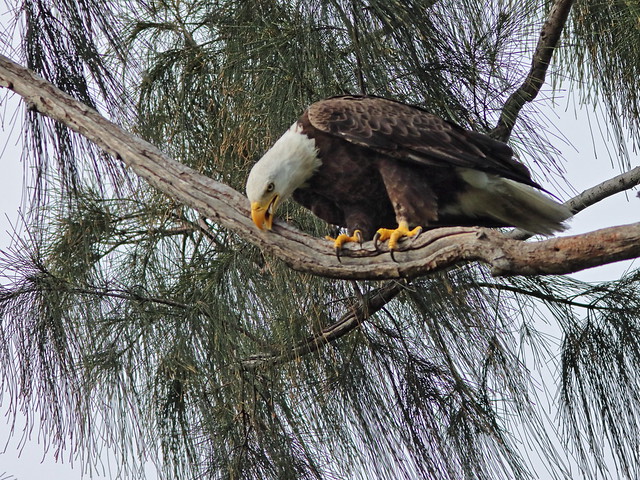

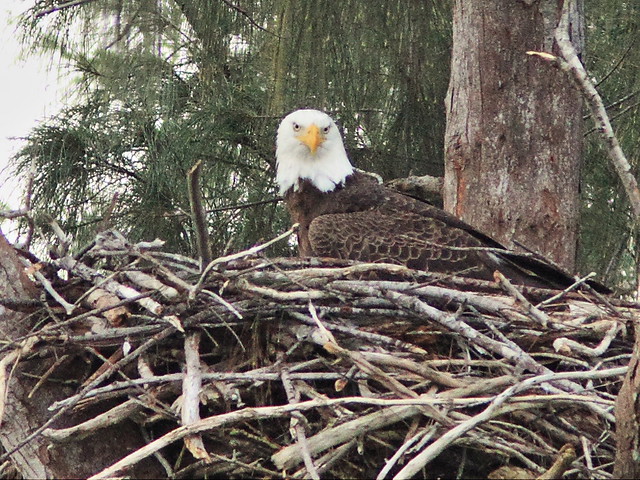
Almost immediately, the male (Pride) flew in and fed the eaglet, which called out incessantly. The eaglet is out of sight in this view, hidden by the left half of the remnant nest: 

Jewel then flew off and things were quiet until about 9:50 AM, when she arrived from the north carrying a large fish.
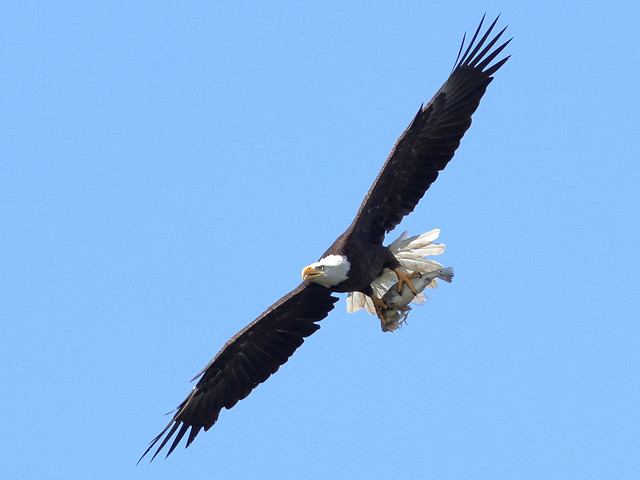


She fed the eaglet which was rather precariously perched below her on the very edge of the sloping lowest portion of the left nest fragment. The eaglet's tail and wing feathers extend to the left beyond most of the nest structure, and her head can be seen as she crouched down, next to the tree trunk:


The eaglet stood up as the female parent tended to her:

In Illinois I lost two days worth of bird photos when I uploaded my photos and got a message that the files could not be opened, then that my SD card was corrupt. Did get out one final day and will review those photos later, but I missed some very nice views of kinglets and terns.

Back home in Florida I did get out one morning and found two Spotted Sandpipers, one of which posed nicely:


When they took flight I shot rather blindly and all bu two of my series were nothing but blurs. Two frames made up fo the loss:


A Killdeer was also very cooperative:


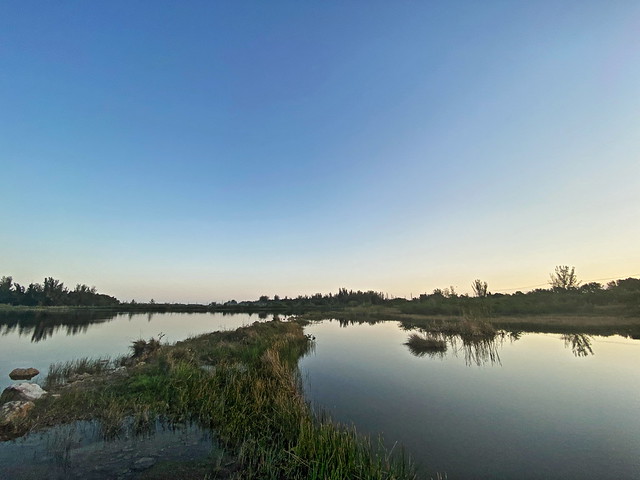
The day-old Full Pink Moon was setting late, but it reflected in the calm before sunrise:

The view to tne north before sunrise:
BULLETIN (Wednesday, April 28): The remaining eaglet has not been seen all day and the adults are not around. No calls are heard to suggest a fallen eaglet. Wildlife rescue is now searching for a possibly downed eaglet. 

UPDATE (late Wednesday): The area in the vicinity of the nest was searched and the eaglet was not found. It is not capable of flight. Searchers found two burrows in higher areas near the eagle nest tree with large openings suggestive of Coyote or fox dens. Raccoons also scavenge the area under an eagle nest for prey remains. Rodents also may be attracted as are predatory Bobcats. There were high winds yesterday evening which may have whipped the nest tree. As I had mentioned above, the remaining eaglet appeared to occupy in a very vulnerable spot in the nest remnant. 

I do not wish to create false expectations, but there is a glimmer of hope worth considering---

At this point it is presumed that the eaglet has not survived. She did have considerable development of flight feathers, as evidences in the photo which shows them trailing out over the left edge of the nest, but I could not document their length in any of the hundreds of photos I took of the nest the day before she disappeared. Could we have miscalculated her age? She occasionally flapped wings but did not venture out on branches ("branching"), which usually occurs about 6-7 days before first flight.

Based upon the female starting to sit continuously deep in the nest, we presumed that the first egg was laid around February 1 and projected a hatch date of March 7 or 8. Jessee suspected she was incubating as early as January 20, but the female continued gathering and arranging sticks through the end of January. 

A problem with this nest has been the difficulty in closely observing the female during incubation. She appeared to change her position, raising up as if tenting an new chick at the end of January or beginning of February. How accurate were our ground observations? In the past we have noted less activity around the nest after only a single eaglet fledged. A single feeding location is most efficient if there are multiple eaglets.

Nest watchers will continue to observe the behavior of the adults and listen for any calls from an eaglet, though there is not much optimism about her survival.  

= = =  = = =  = = = =  = = = = =

Linking to:


Skywatch Friday

Weekend Reflections

Saturday's Critters

BirdD'Pot

Camera Critters

All Seasons

Wordless Wednesday (on Tuesday)

Natasha Musing

Our World Tuesday

________________________________________________

Please visit the links to all these posts to see some excellent photos on display
________________________________________________


Thursday, April 15, 2021

An overdose of flying eagles

On April 7 I arrived at the local Bald Eagle nest at about 9:45 AM and had just missed lots of action, according to the several watchers already present. The female (Jewel) was roosting quietly in the tall tree just east of the nest and the two eaglets were quite active in the nest.

The eaglets were just about one month old and there was a noticeable difference between the first-hatched eaglet (P Piney 26) and the smaller and still downy younger sibling (P Piney 27). Their names indicate that they are the 26th and 27th eaglets known to have hatched in this nest (and the newly constructed alternative nest).  Since we started watching the nest in 2007, 19 eaglets have survived to fledge successfully. 


After more than an hour I decided to call it quits, though Luis and Lazaro remained on watch. I was walking to my car when a couple of families with young children stopped and asked about the eagles. I returned to the nest area and helped them see the roosting female as well as the eaglets. 

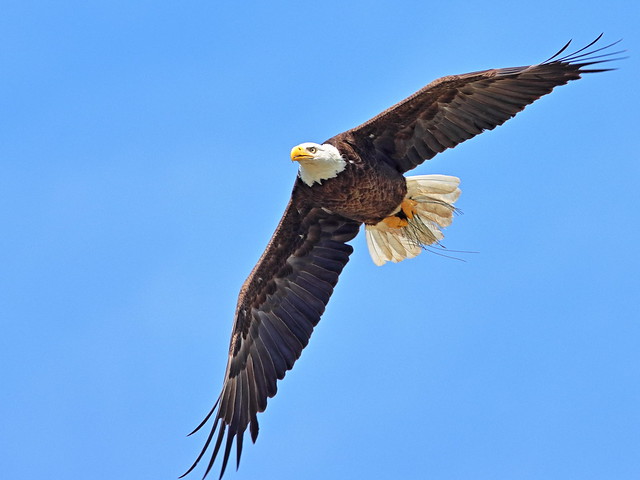
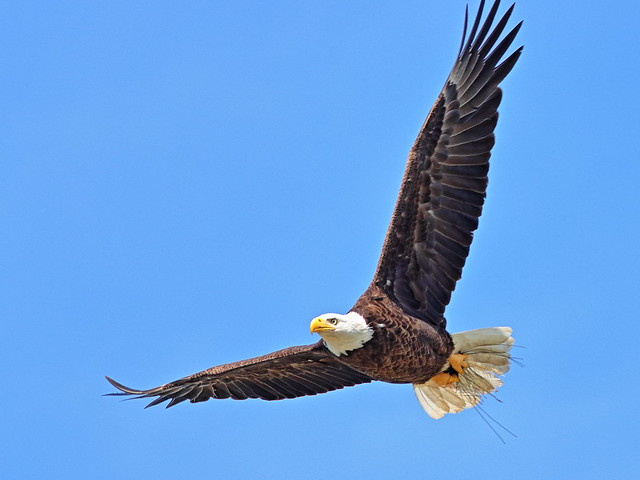
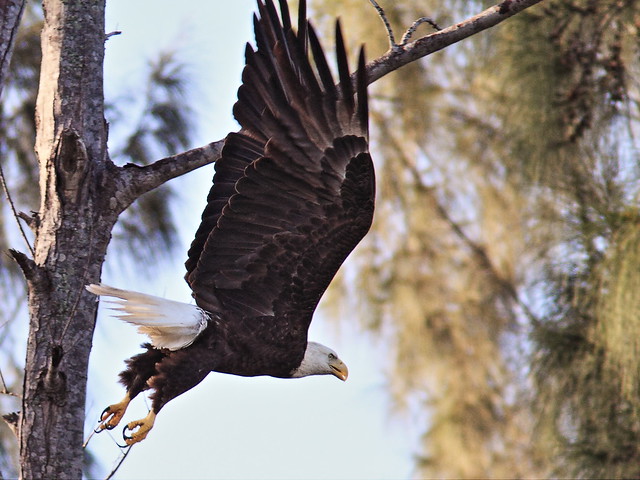
Then, just as I was leaving, my good deed went unpunished, as Jewel suddenly propelled from her perch and flew out to pluck some fresh leaves from an Australian Pine (These trees are not pines and do not have needles-- they are twigs covered by tiny leaves, and also are aromatic and oily. Perhaps they repel nest parasites). 

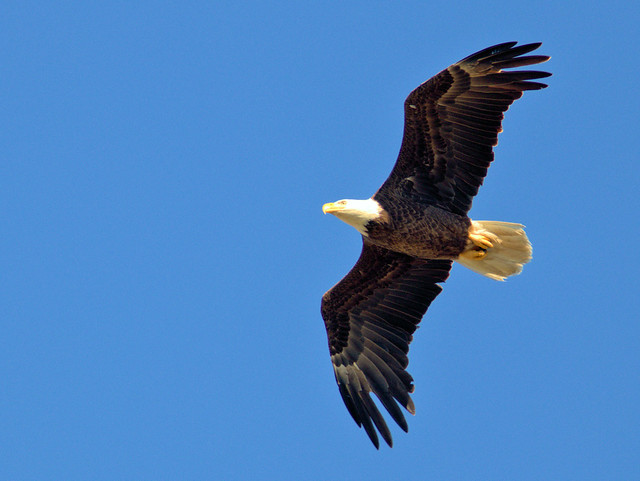
As she flew over my head to return to the nest I captured a series of flight photos which made me happy to be an eagle lover. The sky was magnificently blue with puffy white clouds.


In the local wetlands, conditions have been dry enough to allow me to explore my favorite Bar Ditch Trail. Sometimes it remains underwater the entire year. This is a view to the east just before sunrise:

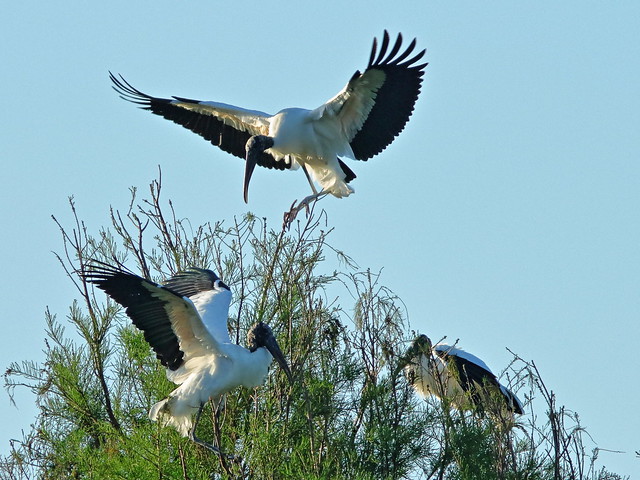
In nearby Weston, the Wood Stork colony in the rookery contained about 30 nests. On the main island, I counted over 85 adults and sub-adult storks, plus many nestlings:

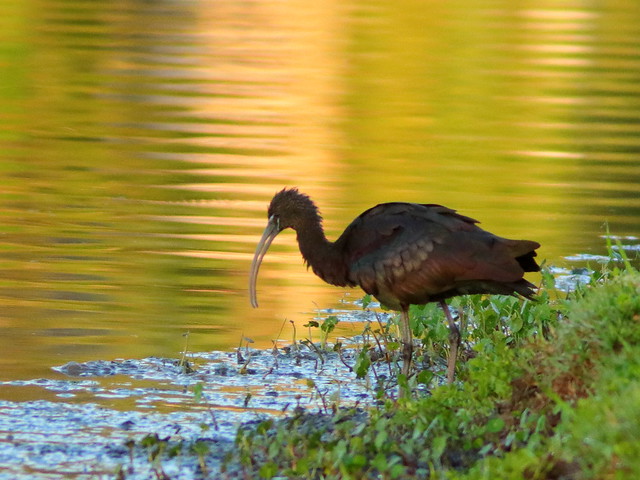
A Glossy Ibis foraged along the shore of the lake:

We will be busy with our granddaughter's Quinceañera (Spanish pronunciation: [kinsea-ɲeɾa]; feminine form of "15-year-old") celebration. Because of the pandemic, it has been postponed three times. Rosyfinch Ramblings will go on autopilot for a couple of weeks. Call me technologically impaired, but I do not enjoy working from iPhone. Thank you for visiting!  

= = =  = = =  = = = =  = = = = =

Linking to:


Skywatch Friday

Weekend Reflections

Saturday's Critters

BirdD'Pot

Camera Critters

All Seasons

Wordless Wednesday (on Tuesday)

Natasha Musing

Our World Tuesday

________________________________________________

Please visit the links to all these posts to see some excellent photos on display
________________________________________________
Thursday, May 28, 2020

Raptor Rapture: Eagles and eaglets

There has been lots of excitement at the Bald Eagle nest in Pembroke Pines near our south Florida home. We have been following this nest since it was "discovered" in 2008. Over that time, the male "Pride," his first mate "Joy" and present mate "Jewel" have produced 25 known eaglets over all the seasons except in 2014-2015. That was when Jewel replaced Joy, who mysteriously disappeared in October, 2014. 

This was Joy in January, 2014, then tending to her final brood:

Bald Eagle adult on nest 3-20140105

Bald Eagle 0909-1 adult2 flies to west 20140111

P Piney 13 and 12, Joy's last brood, January, 2014:

Bald Eagle chicks P Piney 13 and 12  interact 2-20140131

Jewel was young, probably early in her fifth year and still exhibited some immature plumage. She seemed to lack the maternal instinct when they mated in early January 2015, probably too late in the season. She may have laid some eggs which Pride appeared to incubate for a time, but they did not breed successfully. 

The next season (2015-16) got off to a good start, with evidence that their first egg was laid on December 13, about average for this nest. However, a severe wind storm in late January damaged the nest and killed their 4-day old eaglet as well as any unhatched eggs which may have been present. The pair proved they were resourceful and bred a second time, producing two eaglets which hatched out around March 16, 2016. One of their two nestlings appeared to have either been out-competed or killed by its sibling. The surviving eaglet fledged successfully on June 16, 2016.

Jewel in December, 2016: 

Bald Eagle female Jewel 20161228

Jewel in flight, March 2017:

Bald Eagle female in flight 03-20170319

The pair successfully raised two offspring in the 2016-2017 season. The next season (2017-2018), one of their two nestlings also disappeared when about 2 weeks old. The surviving eaglet took her first flight in early April, 2018. Last season (2018-2019), two eaglets were successfully raised during the 2018-2019 season. They fledged in early April, 2019. 

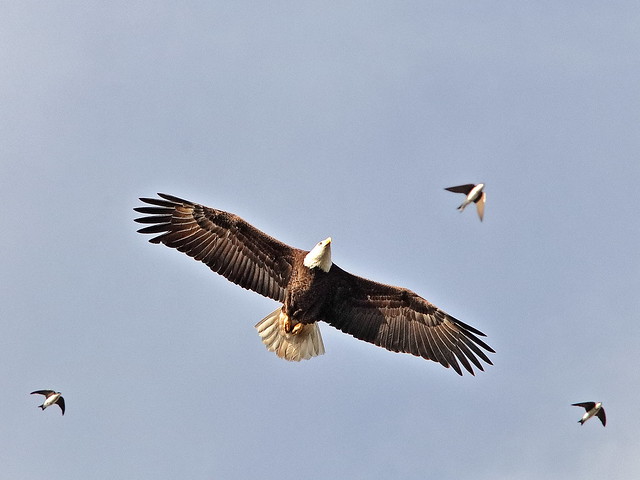
Jewel soaring with Tree Swallows, December 2018: 

Bald Eagle female Jewel in flight101-20181227

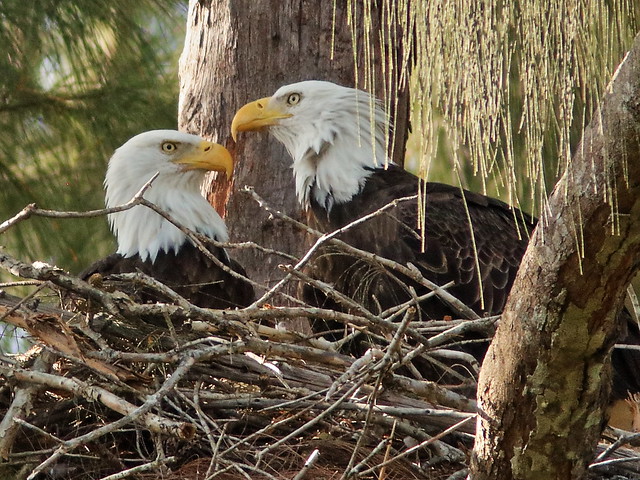
Pride and Jewel (noticeably larger, to the right) on the nest while they were renovating it in late September, 2019

Bald Eagle Pride and Jewel 4-20190929

The present season (2019-2020) was a repeat of the tragedy of 2016. After we saw evidence that at least one eaglet was present in the nest on January 2, 2020, two severe thunderstorms on January 4 and 10th damaged the nest and presumably mortally injured or killed the offspring. After that, the pair worked to restore the nest and they copulated on January 25. 

There was good evidence that the pair was exchanging incubation duties over a second clutch of eggs by mid-February and that at least one of two surviving eaglets was present on March 14, 2020. Two eaglets are now about 10 1/2 weeks (~75 days) old. The first-hatched, which we believed to be the a female ("P Piney 24," the 24th known progeny), fledged successfully  a week ago, on May 21. 

Although she has been heard calling near the nest, she had not been seen at the nest for the past seven days. It is not unusual for newly-fledged eaglets to go missing for a few days until hunger drives them back to the nest to be fed. Most birds tend not to return to their nest after their first flight. Bald Eagles, particularly when there is more than one eaglet, are enticed to continue occupying the nest while they gain hunting skills and learn to become independent. This is habit keeps the family unit together and is a more efficient way of feeding and protecting them. 

Jewel with female eaglet (P Piney 24) on April 1, 2020:

Bald Eagle female 736-20200401

Male eaglet (P Piney 25) alone on nest, May 22, 2020:

Bald Eaglet male P Piney 25 02-20200522

For latest reports on this nest, visit: CURRENT 2019-2020 Observations of Pembroke Pines Bald Eagle Nest

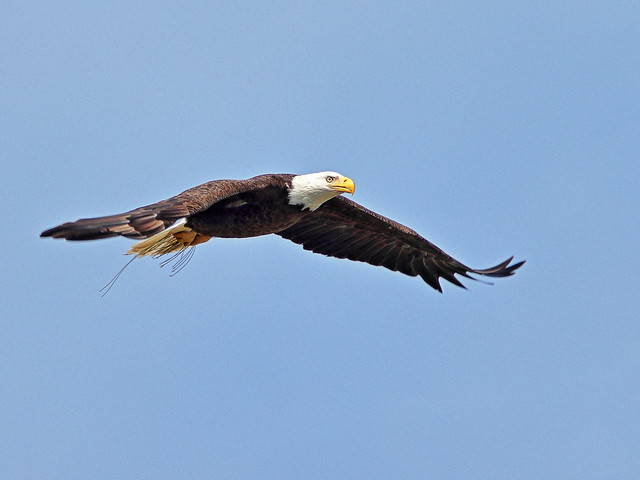
Pride in flight, May 22, 2020:

Bald Eagle male Pride in flight 03 -20200522

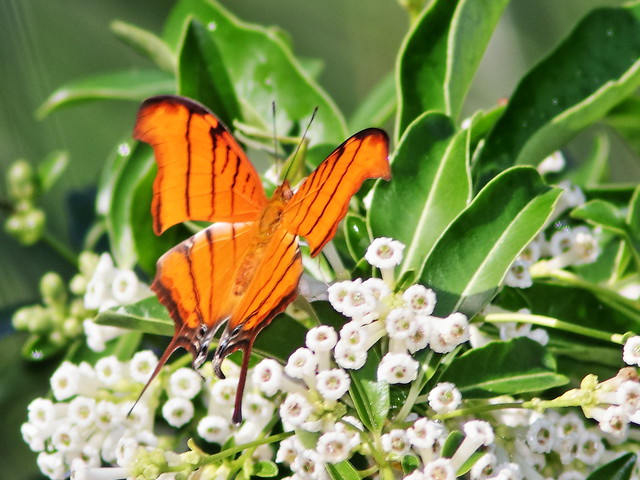
I saw this Ruddy Daggerwing butterfly while watching the nest on May 22:

 Ruddy Daggerwing 01-20200522

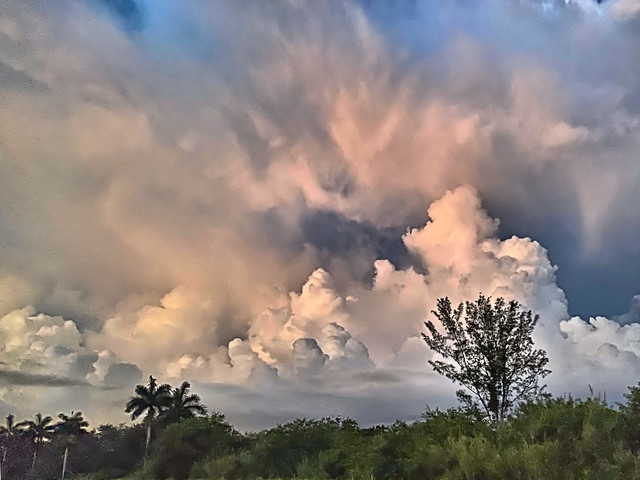
Storms threatened nearly every morning as we moved into the wet season. Here, the sun struggled to escape the cloud cover:

Sunburst over Monaco Cove 20200520

Before sunrise on May 23, the sky to the northwest was alive with color:

Pine Bank before sunrise 2-20200523

Storms appeared to be moving in...

Storms moving in 02-20200523

...but this one passed by and produced a rainbow which reflected nicely:

Rainbow over 196th Ave Canal 20200522

The entrance to our subdivision glows under the rising sun:

Monaco Cove entry 20200522

= = =  = = =  = = = =  = = = = =

Linking to:

Fences Around the World

Skywatch Friday

Weekend Reflections

Saturday's Critters

BirdD'Pot

Camera Critters

All Seasons

Wordless Wednesday (on Tuesday)

Our World Tuesday


________________________________________________

Please visit the links to all these posts to see some excellent photos on display
________________________________________________