Showing posts with label clouds. Show all posts

Thursday, August 19, 2021

A quiet wet week with few butterflies

In early August, morning rain and some necessary appointments have limited and shortened my excursions into the Wounded Wetlands. Predictably, bird counts were low, averaging about 15 common species. We also escaped dual threats from tropical storms Fred and Grace. 

Most photos were taken in bad light due to cloud cover or very early observations.

This Belted Kingfisher was a surprise on August 5, the first County record for the fall migratory season. 


An adult Bald Eagle provided me with a distant early morning view:

In one frame it ventured into full sunlight:

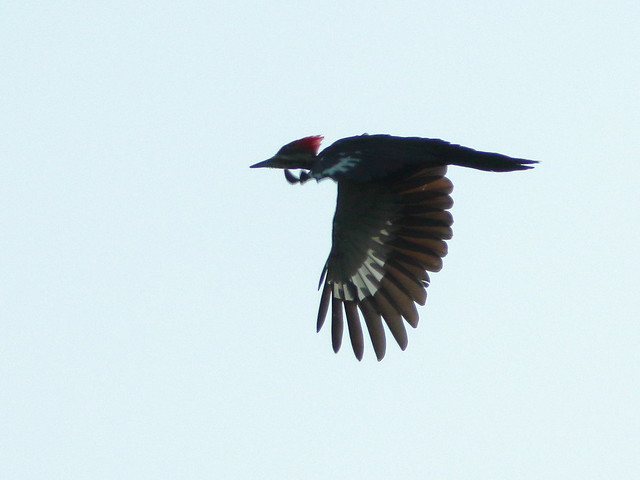
These pre-dawn fly-over shots of a Pileated Woodpecker barely revealed its red crest:

Some mornings I returned with no images at all, so I must reach back a few weeks for some photos not shared in earlier posts:

On August 2, a Great Egret settled into the grass along the path, probably hoping to capture insects and lizards:


The Northern Cardinals were reclusive and not singing, but a juvenile male peered out at me on August 5: 

A Mourning Dove foraged on the gravel track:

A Great Egret rested in a treetop:

I obtained a better flight shot of a female Pileated Woodpecker back in July:

Loggerhead Shrike on July 19:

Our local Wounded Wetlands are bordered by residential properties. I fear that insecticides are having an adverse effect upon butterfly populations. Many residents are utilizing automated  backyard "mosquito misting systems." They dispense aerosols into the air "a few times per day" around the clock. 

Advertisers of these multiple continuous dispersion devices emphasize the dangers of insects in Florida and push them as effective in preventing insect-borne diseases. Most claim to use only pyrethrin, touted as a "natural" or "organic" product derived from chrysanthemumsWhile non-toxic to humans and pets, pyrethrins can be deadly to bees, butterflies, caterpillars and other insects which commonly visit residential gardens. Pyrethrins are relatively safe when applied to individual plants, but it is also used as an aerosol to "knock down" flying insects. 

Alone, pyrethrins are not very potent when dispersed in this manner. To make them more effective they may be mixed with other ingredients to increase effectiveness. For example, a "pyrethrin" aerosol may contain piperonyl butoxide (PBO), a toxic non-organic ingredient which retards the breakdown of pyrethrins. Some mosquito control systems advertise that they utilize innocent-sounding combinations of natural oils and unspecified EPA-approved control products. (Then there is the fact that many home and residential insecticides contain neonicotinoids... but that is another story. End of rant)    

Butterflies have been unusually scarce in numbers and variety. This is a Zebra longwing, the State Butterfly of Florida:

White Peacock:

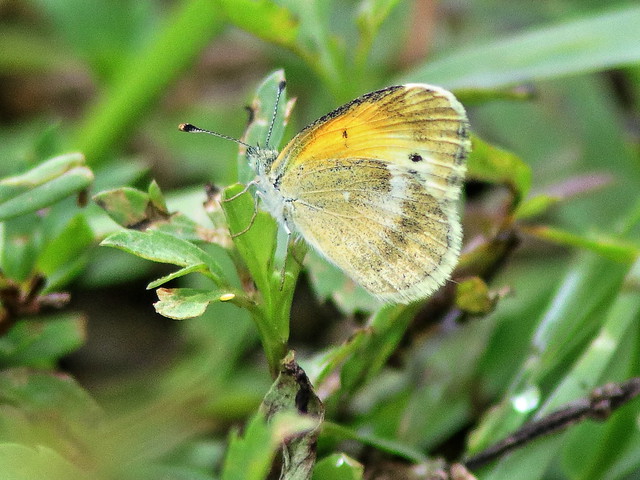
A tiny Dainty Sulphur:
This Orange-barred Sulphur (Phoebis philea) is a very large tropical species with a wingspan of 2 3/4 - 3 1/2 inches (7.0--8.9 cm). It is fairly common in south Florida, but its habits of flying erratically and usually high in the trees makes it difficult to identify and photograph. This was my first image of one from a distance, visiting a Firebush (Hamelia patens), heavily cropped and over-exposed:

Often, before sunrise, I stop on a peninsula which thrusts out into the lake, listening for owls and nightjars and watching the morning light play over the clouds. It is interesting to see how the rising sun illuminates the clouds as it moves up towards the horizon. These two photos of the same clouds were taken 5 minutes apart, just before and after sunrise on August 11:


= = =  = = =  = = = =  = = = = =

Linking to:


Nature Thursday

Skywatch Friday

Weekend Reflections

Saturday's Critters

BirdD'Pot

Camera Critters

All Seasons

Wordless Wednesday (on Tuesday)

Natasha Musing

Our World Tuesday

________________________________________________

Please visit the links to all these posts to see some excellent photos on display
________________________________________________

Thursday, August 12, 2021

Silent sunrise

We usually set out into the local Wounded Wetlands preserve about an hour before sunrise. This provides an opportunity to hear (and sometimes see) nocturnal bird species such as owls and nightjars. 

For the first half hour it is nearly pitch dark unless the Moon is in an early phase. Flashlights are essential, if only to keep us from stumbling on the rocks or avoid stepping on a snake. Wildlife photography is essentially impossible without artificial light. 

Below the horizon, the sun progressively brightens the sky and its glare obscures the stars and all but the brightest planets. Depending upon the seasons (which affect the angle at which the sun approaches the horizon) "civil twilight," also known as the "crepuscular" period, begins when the sun is 6 degrees below the horizon and ends 20-30 minutes later at sunrise. The morning chorus of bird song usually builds up during this period and tapers off after sunrise. 

Now, many birds are undergoing the post-breeding molt. To save the energy needed to replenish their feathers, they are quiet and reclusive. For the past two to three weeks the morning chorus has dwindled into a few solo notes from...

...Northern Cardinals...

...Northern Mockingbirds...

...and Carolina Wrens:

One advantage of the early walks is that we are spared the heat of the sun. Heat exhaustion is a threat when, soon after sunrise, temperatures and humidity quickly become oppressive.

Another advantage is the opportunity to see some marvelous skies. I know that trying to interpret cloud formations can be a bit silly, but could this possibly be a swordsman ready to do battle with a monstrous dragon?

Persistence of Saharan dust in the atmosphere this past week enhanced the morning colors. Shadows of clouds on the eastern horizon created ever-changing interruptions of the crepuscular rays:

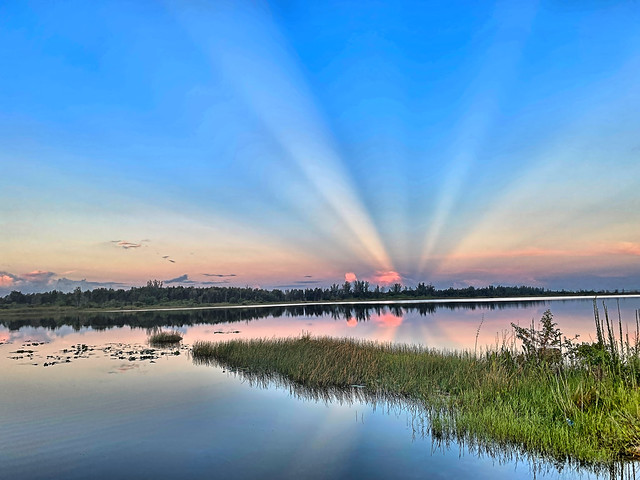
On the opposite horizon, the anticrepuscular rays filled the sky and converged over the Wet Prairie...

...and reflected on the lake:

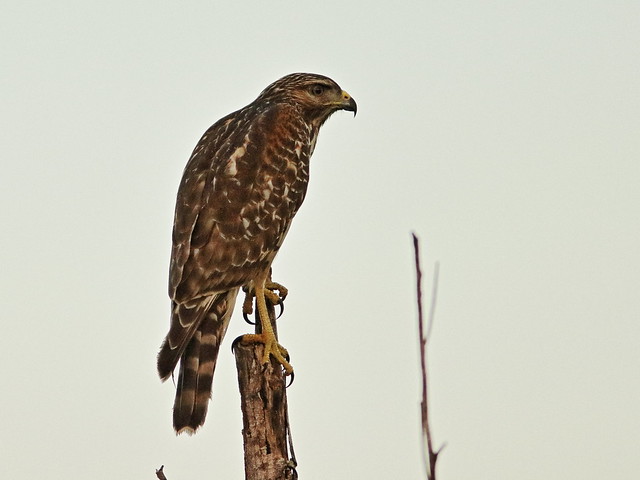
In the poor morning light, an immature Red-shouldered Hawk roosted next to the lake:

It took flight and landed on a flimsy branch atop a Pond Cypress:


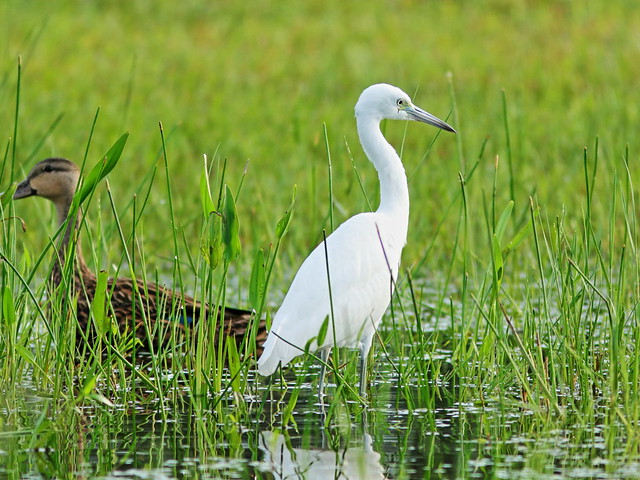
At nearby Chapel Trail preserve, an immature Little Blue Heron foraged with a Mottled Duck:


In our back yard early in the morning,  a Muscovy Duck loafed on the decoy which serves as a float for the intake of our lawn irrigation system:

An Anhinga entertained us by resting on the same decoy: 

Later, the Anhinga decided to bask on our patio. These are my iPhone photos, taken through the glass of the patio door:


Since my DSLR camera cannot zoom, its viewfinder captured only the Anhinga's neck and head as it aired its wings. It was next to a Coontie which I had recently planted. I liked the aesthetics of the portrait as well as the symbolism. The Anhinga is a representative of the ancient Darter family whose fossil records date back 40-50 million years. The Coontie is a primitive Cycad which originated some 280 million years ago:

As to be expected, my visits to medical facilities increase with age, but they can provide photo opportunities for some interesting reflections:

That's Planet Jupiter, still visible high in the blue sky above the Cleveland Clinic in Weston, Florida:

The fountains turned on and spoiled the reflection:

= = =  = = =  = = = =  = = = = =

Linking to:


Skywatch Friday

Weekend Reflections

Saturday's Critters

BirdD'Pot

Camera Critters

All Seasons

Wordless Wednesday (on Tuesday)

Natasha Musing

Our World Tuesday

________________________________________________

Please visit the links to all these posts to see some excellent photos on display
________________________________________________

Thursday, July 22, 2021

Saharan dust

South Florida has settled into a rather boring but typical wet season pattern following the spate of tropical storms which culminated in Elsa. We are also in the middle of the Saharan dust season. Dry air masses laden with dust have been coursing over from the African continent. This has the welcome effect of reducing the intensity of the tropical storms which spawn cyclones in the eastern Atlantic ocean.

Visits to nearby Chapel Trail Nature Preserve were not very productive. The high water levels dilute out aquatic prey and wading birds are free to forage over a much greater expanse. 

Often I can find a dozen or more Gray-headed Swamphens, but this morning there was only one:

A pair of Northern Cardinals foraged on the boardwalk for the fallen fruit of an overhanging tree:

The male cardinal perched on the boardwalk railing near an interpretive sign:

A male Anhinga, partially hidden in the spike-rush, dried his wings:

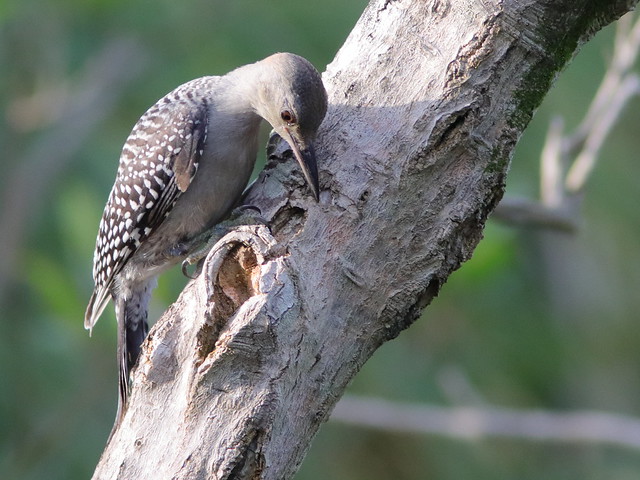
A juvenile Red-bellied Woodpecker searched for food on the trunk of a small tree:


White-winged Doves nest along the boardwalk:


Swamp Lily:

Brown Basilisk:

The Sarahan dust is said to stabilize the weather, which has been rather monotonous, with warm days and nights along with intermittent "pop-up" showers. This past week's forecast was remarkable (32.2 to 25.5 Celsius):

The dust can produce very colorful sunrises and sunsets. Fifteen minutes before sunrise this past Saturday morning, the unseen sun was reflecting off a pink mass in the upper atmosphere:

Within minutes, sunlight had illuminated the expanse of the dust cloud:

While the sky directly overhead was otherwise clear, storm clouds were lined up along the Atlantic coast to the east. The shadows of the tops of the clouds broke the rays of the rising sun. The rays reflected off the dust layer and converged over the Everglades on the opposite (western) horizon. The anti-solar rays were creating a "false sunrise," so I hurried to the lake to catch the reflections on the still water:


= = =  = = =  = = = =  = = = = =

Linking to:


Fences Around the World

Nature Thursday

Skywatch Friday

Weekend Reflections

Saturday's Critters

BirdD'Pot

Camera Critters

All Seasons

Wordless Wednesday (on Tuesday)

Natasha Musing

Our World Tuesday

________________________________________________

Please visit the links to all these posts to see some excellent photos on display
________________________________________________