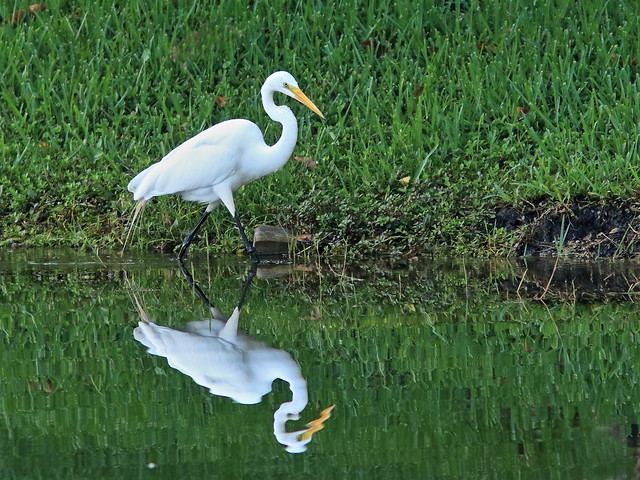
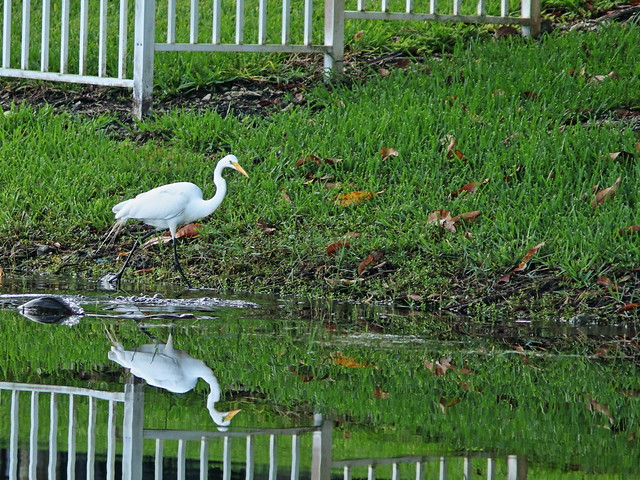
Showing posts with label Double-crested Cormorant. Show all posts

Thursday, November 25, 2021

Happy Thanksgiving

 Our back yard birds kept me busy. Some perched close by, as did this Northern Mockingbird, atop the "For Sale" signpost:


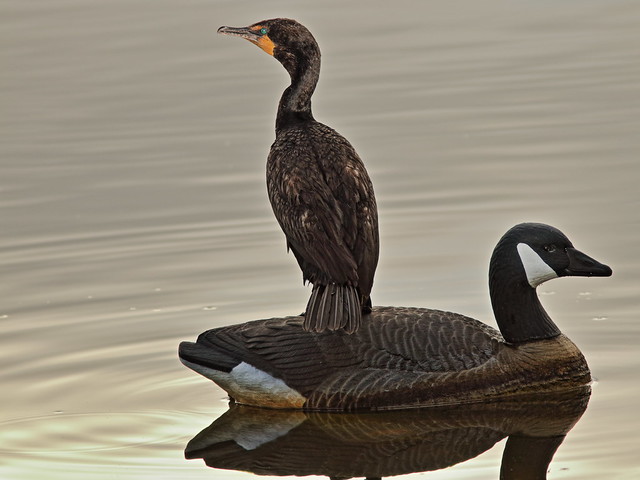
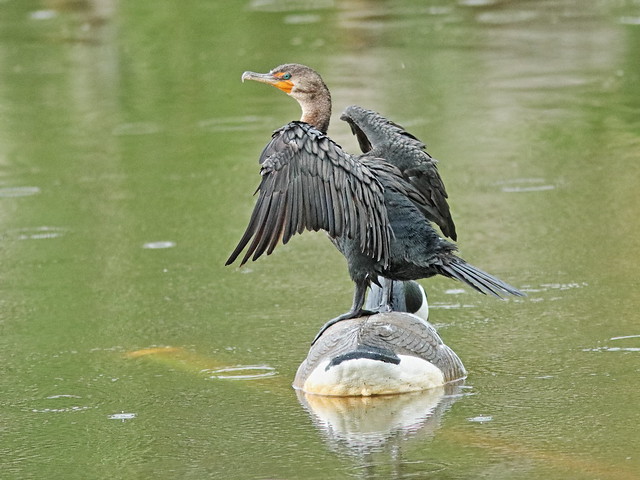
A Double-crested Cormorant climbed up on the goose decoy which serves as a float for the intake of our irrigation system...

...and spread its wings to dry:

The next day its turquoise-blue eyes glistened in the sunlight:
The immature Yellow-bellied Sapsucker made numerous visits to tend the sap wells on the trunk of our Mahogany tree:

Far across the lake, I obtained distant shots of three heron species in one frame, a Snowy Egret with Little Blue and Tricolored Herons:

A Great Egret flew in near the Snowy Egret:

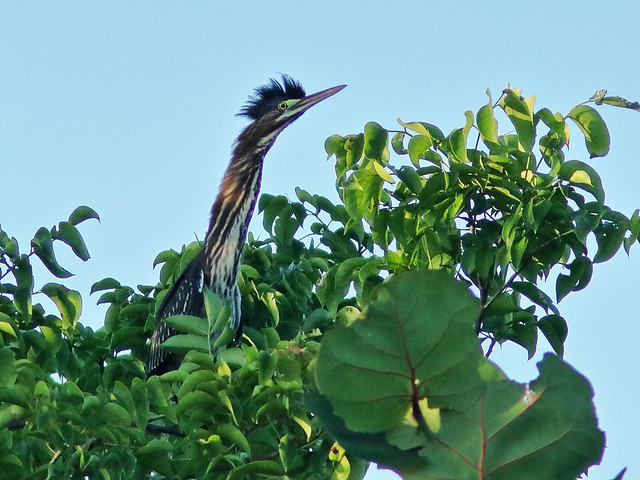
I almost overlooked a Green Heron perched among the other waders:

Thankfully, I was feeling good and visited Chapel Trail for a second time this week. We had to kill time as our home was being inspected prior to sale. It was rainy and the light was very poor.  I captured fleeting images of only two species...

Blue-gray Gnatcatcher:


White-eyed Vireo:

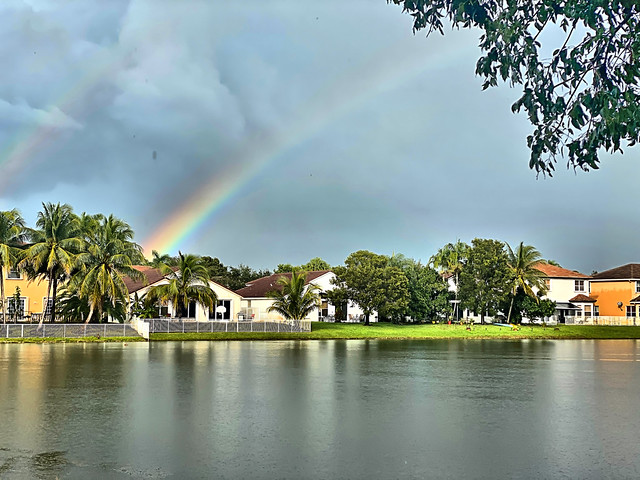
An afternoon shower produced a nice rainbow over our lake: 

Clouds moved away to the east, over the ocean...

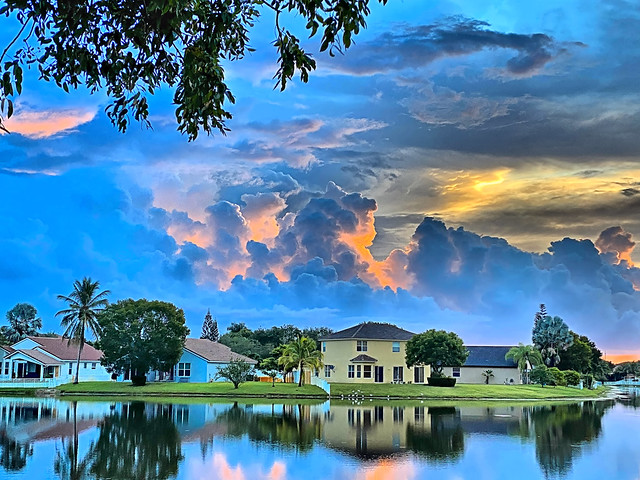
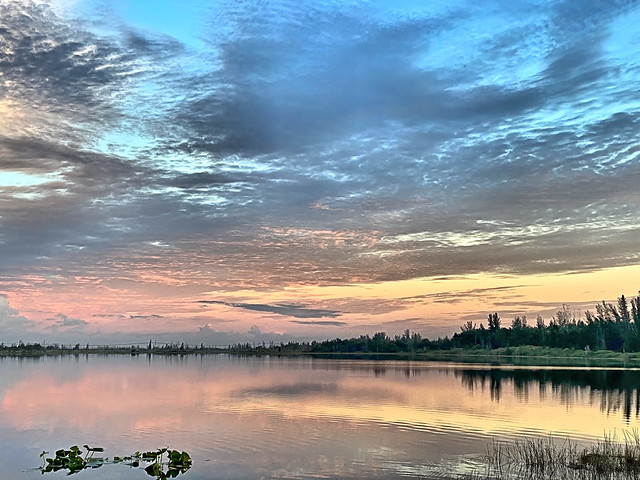
...and reflected the setting sun:

Just before Thanksgiving Day I received a copy of this wonderful documentary on Bald Eagles and other birds of prey in the USA. It was produced as part of a popular wildlife series for the Arab World. I was interviewed to feature our local eagle nest (beginning around 7:00 minutes). Though it does not have English subtitles, it has very informative segments (in English) on urban eagles, the place of eagles in Native American culture, Florida Audubon EagleWatch, the American Eagle Foundation and also falconry. The series attracts millions of viewers.

If you have trouble viewing it, please visit this link: https://youtu.be/WDmWCTKs3ZI


= = =  = = =  = = = =  = = = = =

Linking to:

Garden Affair


Skywatch Friday

Weekend Reflections

Saturday's Critters

BirdD'Pot

All Seasons

Wordless Wednesday (on Tuesday)

Natasha Musing

Our World Tuesday

________________________________________________

Please visit the links to all these posts to see some excellent photos on display
________________________________________________
Thursday, October 28, 2021

My Patch list # 1-10

My health condition now (hopefully temporarily) prevents me from straying very far from home. Therefore I will take advantage of my forced leisure to reflect on the birds I have seen since moving from New Mexico to south Florida. This list only includes bird species seen in our back yard and the preserve adjacent to our home, the West Miramar Water Conservation Area in Broward County, Florida (AKA "Wounded Wetlands"). 

We moved to Florida in 2004, but I only started to report sightings on eBird late in 2008. I did not take up photography until 2008 and deemed two of my earlier sightings important enough to report retroactively. I  picked out a representative photo of each species, not necessarily the first one taken, but always one among many from the Wounded Wetlands. My checklist includes a total of 185 species to date for this location, most of which I eventually photographed here. 

# 1. American Flamingo, 12 Jul 2005

I was fishing in our back yard lake when I looked up in amazement as a flock of four long-legged, crooked-billed flamingos coursed from south to north right over in front of me. I was not sure at the time that this was a most unusual sighting, indeed the first flock reported locally in several years. I saw four again over the lake the next evening, flying almost the same course. 

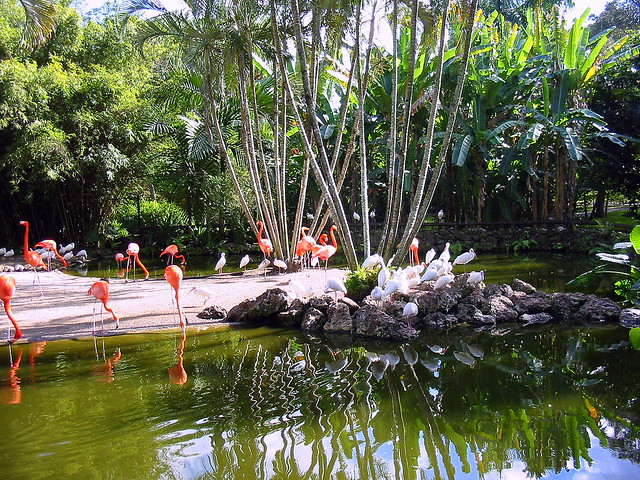
Flamingos once roamed extensively over South Florida, but in recent years the only reliable sightings were of a flock at the southern tip of the peninsula at Snake Bight. Inquiries about all known captive flamingos confirmed that none had escaped. Here is a photo of those in the nearest flock, confined in Flamingo Gardens:

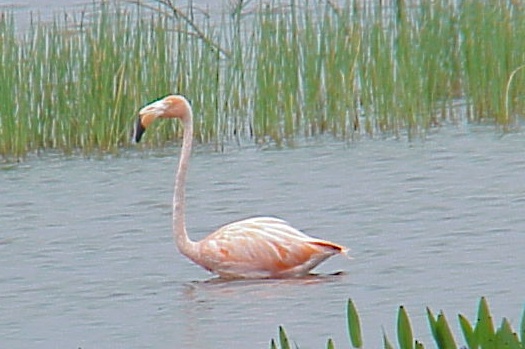
I put the word out on the Internet and others discovered them, a flock of "seven or eight or up to twenty" foraging in a wetland preserve adjacent to the north end of my Patch. I was not carrying a camera, but David Tringo, a neighbor, took this photo and kindly permitted me to publish it: 


# 2. Savannah Sparrow, 26 Dec 2008. This is a photo of one in November, 2018:

# 3. Rock Pigeon, 23 Oct 2009. That day I photographed a feral albino specimen, very likely an escapee from a wedding celebration or peace demonstration:

# 4. White-winged Dove, 23 Oct 2009. This one was looking for nesting materials on our driveway:

# 5. Mourning Dove. 23 Oct 2009. 

# 6. Killdeer, 23 Oct 2009

# 7. Anhinga, 23 Oct 2009

# 8. Double-crested Cormorant, 23 Oct 2009

# 9. Great Blue Heron, 23 Oct 2009

# 10. Great Egret, 23 Oct 2009

Our walks usually started out about an hour before sunrise, to take advantage of the cooler temperatures and listen to the owls and nightjars. The peninsula in the wetlands lake provided a wide open view over the Everglades to the west.   An advantage to being a stay-at-home birder is that I can see the sunrise on the eastern horizon, which is obscured by the trees out in the wetlands. 

The morning after I got home from the hospital this was the view of sunrise from our back patio:

A flock of White Ibises foraged on the lawn of a home across the lake:

Later in the day the overcast sky provided a shadow-less view of a Great Egret, which hurried along our lawn. It appeared to be intently watching a prey item along the shore:

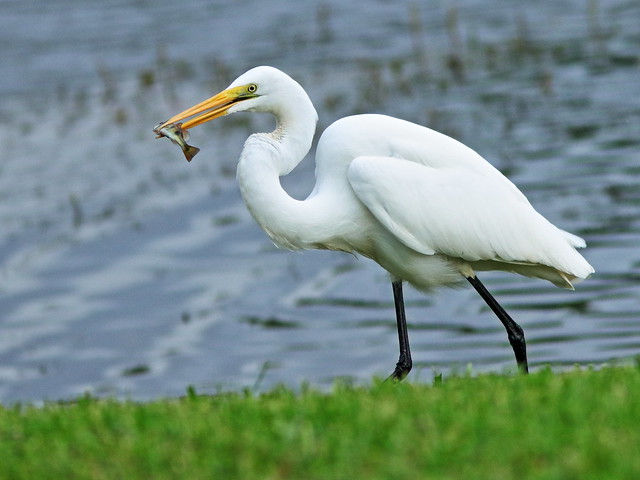
It plunged and came up with a small Peacock Bass:


= = =  = = =  = = = =  = = = = =

Linking to:


Garden Affair


Skywatch Friday

Weekend Reflections

Saturday's Critters

BirdD'Pot

Camera Critters

All Seasons

Wordless Wednesday (on Tuesday)

Natasha Musing

Our World Tuesday

________________________________________________

Please visit the links to all these posts to see some excellent photos on display
________________________________________________

Thursday, June 25, 2020

Crops & Clips: Early Birds

It's odd how one's definition of "elderly" can change over the years. My private family medicine practice included delivering babies. I always referred my high-risk patients to an Obstetrician. These included any pregnant women who were at high risk, among them "elderly primigravida"-- those whose first pregnancy occured after they were 35 years old. When I was in my 40's I probably would have classified someone in their 70s as "elderly."

However, when I reached 70 years of age I would not have liked being called "elderly," Those are folks who are frail and "really old." They probably were hard of hearing, all went to bed early, got up several times to pee, and were up and about well before the sun was shining. I'm now a mid-octogenarian but that's not me, not quite. Happy to say, I must have made a pact with the Devil when given a choice between losing my hearing or my water. I can still bird by ear!

My advice to older people, both as a physician and in retirement, as a US Forest Service volunteer interpreter on high-altitude trails, was that they should guard against heat stress and especially dehydration. MaryLou and I follow these instructions by venturing out on our morning walks while the sun is well below the horizon. Although she often gets home before sunrise, I carry water and walk back on the shady side of the path. 

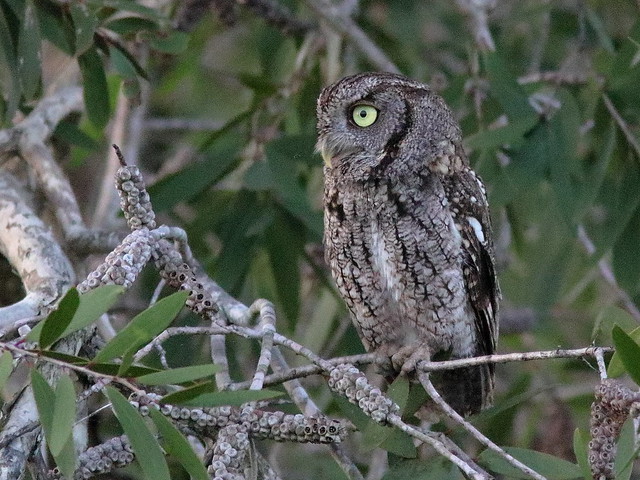
Encounters with nocturnal and crepuscular species are the rewards of early birding. More often they are heard but go unseen. This past week a pair of Eastern Screech-Owls stayed out late enough for me to take advantage of dawn's early light. The pair illustrated the two color forms of this species, gray and rufous. 

Gray morphs are more common, present in more than 90% of Eastern Screech-Owls. I enjoyed capturing their varied postures:

Eastern Screech-Owl 05-20200622

Eastern Screech-Owl 06-20200622

Eastern Screech-Owl 03-20200622

It was more difficult for me to see the rufous owl in the dim light. Indeed, in the dark, our eyes are less sensitive to red (high-wavelength) colors than to the the lower (blue) end of the spectrum. Perhaps this is the female of the pair, as rufous morphs occur more frequently in warm and moist climates and are more numerous in females:  

Eastern Screech-Owl, rufous morph 01-20200624

Eastern Screech-Owl, rufous morph 02-20200624

Eastern Screech-Owl, rufous morph 03-20200624

Screech-owls are quite vocal and sometimes continue to call after sunrise. They may attack a human who approaches too close to their nest. I had one hit me in the forehead and another nearly carried off my hat as I was trying to locate their nest hole in a dead palm. As a kid I remember when screech-owls which nested in a neighborhood church steeple attacked womens' hats as they walked into church.  

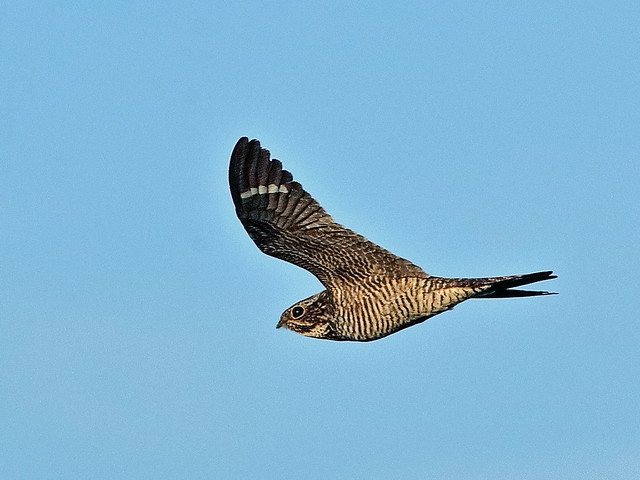
The Common Nighthawk, a species of Nightjar, seems to become more active during the half hour before sunrise. At least two pairs are defending nesting territories along our route. They circle overhead and dive down and pull up sharply to create a startling "boom."  

This male nighthawk (distinguished by large white markings on its wings, throat and tail) swooped down so close to me that I could not fit him in the frame:

Common Nighthawk 03-20200520

The female Common NIghthawk has smaller white patches, restricted to her wings:

Common Nighthawk female 02-20200529

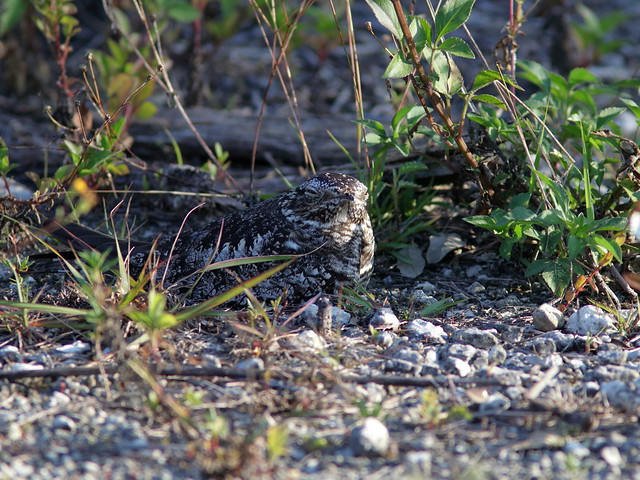
This female Common Nighthawk was almost invisible as she sat on her eggs, eyes closed:

Common Nighthawk female incubating 02-20190529

Two other Nightjar species are more nocturnal. I have identified them by voice but so far have had only fleeting sightings and no photos. The Eastern Whip-poor-will is a winter visitor, replaced in spring by the Chuck-wills-widow which breeds locally.  This eBird bar chart depicts the weekly frequency of my local sightings of the three Nightjar species over the past ten years:  

Nightjhars in Miramar WCA

In mid-June, we walked out under the waning crescent of the Strawberry Moon:

Strawberry Moon waning crescent 20200616 

I enjoy standing at the shore of the lake and just listening to the sounds of nature. With the COVID-19 lockdown in place it was much more quiet and  peaceful-- few airplanes and greatly reduced traffic sounds. Sunrise occurs over the populated area, so its beauty competes with power poles: 

Sunrise 01-20200621

Opposite the sunrise, the view over the placid lake and distant Everglades is subdued but colorful:

View to west at sunrise 01-20200618

View to west at sunrise 02-20200618

The red epaulets of a Red-winged Blackbird glow in the gloaming:

 Red-winged Blackbird 02-20200622

This is a Little Blue Heron "shot in the dark" before sunrise:

Little Blue Heron before sunrise 03-20200617

A Fish Crow is a silhouette even by day:

Fish Crow 01-20200624

The morning rays catch the outstretched neck of a partially-hidden Green Heron:

Green Heron 03-20200624

In our back yard, a dimly-lit Double-crested Cormorant hitches a ride on a decoy:

Double-crested Cormorant on decoy 20200618

Lights, camera, action! A Great Egret reflects in front of a neighbor's fence:

Great Egret 01-20200618

Great Egret 02-20200618

A tiny Dainty Sulphur brightens up a grubby spot on the ground:

Dainty Sulphur 20200506


= = =  = = =  = = = =  = = = = =

Linking to:

Fences Around the World

Skywatch Friday

Weekend Reflections

Saturday's Critters

BirdD'Pot

Camera Critters

All Seasons

Wordless Wednesday (on Tuesday)

Our World Tuesday


________________________________________________

Please visit the links to all these posts to see some excellent photos on display
________________________________________________