Showing posts with label Pileated Woodpecker. Show all posts

Thursday, August 19, 2021

A quiet wet week with few butterflies

In early August, morning rain and some necessary appointments have limited and shortened my excursions into the Wounded Wetlands. Predictably, bird counts were low, averaging about 15 common species. We also escaped dual threats from tropical storms Fred and Grace. 

Most photos were taken in bad light due to cloud cover or very early observations.

This Belted Kingfisher was a surprise on August 5, the first County record for the fall migratory season. 


An adult Bald Eagle provided me with a distant early morning view:

In one frame it ventured into full sunlight:

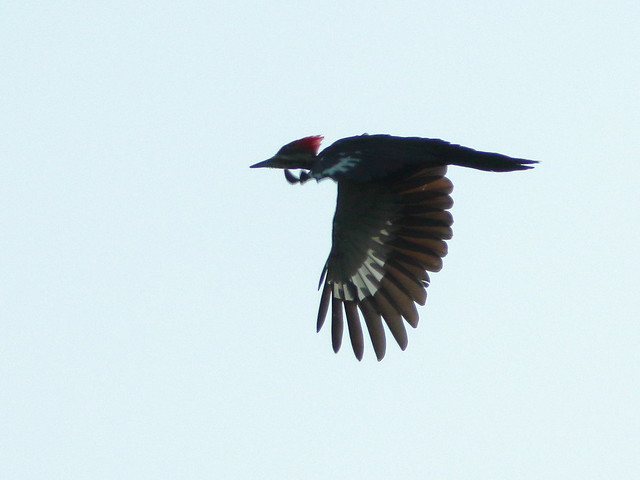
These pre-dawn fly-over shots of a Pileated Woodpecker barely revealed its red crest:

Some mornings I returned with no images at all, so I must reach back a few weeks for some photos not shared in earlier posts:

On August 2, a Great Egret settled into the grass along the path, probably hoping to capture insects and lizards:


The Northern Cardinals were reclusive and not singing, but a juvenile male peered out at me on August 5: 

A Mourning Dove foraged on the gravel track:

A Great Egret rested in a treetop:

I obtained a better flight shot of a female Pileated Woodpecker back in July:

Loggerhead Shrike on July 19:

Our local Wounded Wetlands are bordered by residential properties. I fear that insecticides are having an adverse effect upon butterfly populations. Many residents are utilizing automated  backyard "mosquito misting systems." They dispense aerosols into the air "a few times per day" around the clock. 

Advertisers of these multiple continuous dispersion devices emphasize the dangers of insects in Florida and push them as effective in preventing insect-borne diseases. Most claim to use only pyrethrin, touted as a "natural" or "organic" product derived from chrysanthemumsWhile non-toxic to humans and pets, pyrethrins can be deadly to bees, butterflies, caterpillars and other insects which commonly visit residential gardens. Pyrethrins are relatively safe when applied to individual plants, but it is also used as an aerosol to "knock down" flying insects. 

Alone, pyrethrins are not very potent when dispersed in this manner. To make them more effective they may be mixed with other ingredients to increase effectiveness. For example, a "pyrethrin" aerosol may contain piperonyl butoxide (PBO), a toxic non-organic ingredient which retards the breakdown of pyrethrins. Some mosquito control systems advertise that they utilize innocent-sounding combinations of natural oils and unspecified EPA-approved control products. (Then there is the fact that many home and residential insecticides contain neonicotinoids... but that is another story. End of rant)    

Butterflies have been unusually scarce in numbers and variety. This is a Zebra longwing, the State Butterfly of Florida:

White Peacock:

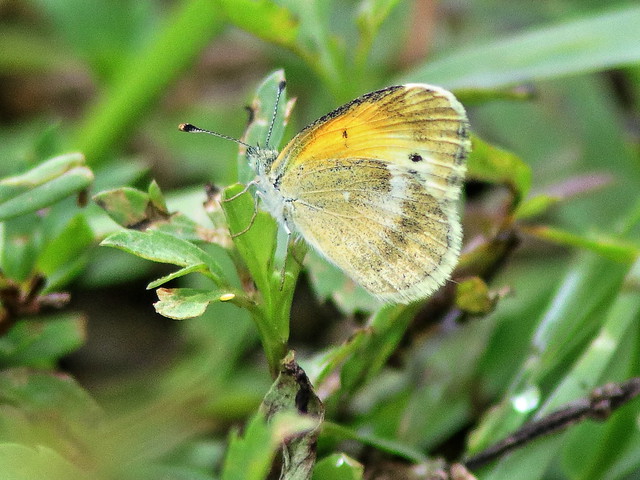
A tiny Dainty Sulphur:
This Orange-barred Sulphur (Phoebis philea) is a very large tropical species with a wingspan of 2 3/4 - 3 1/2 inches (7.0--8.9 cm). It is fairly common in south Florida, but its habits of flying erratically and usually high in the trees makes it difficult to identify and photograph. This was my first image of one from a distance, visiting a Firebush (Hamelia patens), heavily cropped and over-exposed:

Often, before sunrise, I stop on a peninsula which thrusts out into the lake, listening for owls and nightjars and watching the morning light play over the clouds. It is interesting to see how the rising sun illuminates the clouds as it moves up towards the horizon. These two photos of the same clouds were taken 5 minutes apart, just before and after sunrise on August 11:


= = =  = = =  = = = =  = = = = =

Linking to:


Nature Thursday

Skywatch Friday

Weekend Reflections

Saturday's Critters

BirdD'Pot

Camera Critters

All Seasons

Wordless Wednesday (on Tuesday)

Natasha Musing

Our World Tuesday

________________________________________________

Please visit the links to all these posts to see some excellent photos on display
________________________________________________

Thursday, June 10, 2021

Listing bird species in the Wounded Wetlands

My list of bird species seen in our local south Florida birding patch (West Miramar Water Conservation Area aka the Wounded Wetlands) had reached 182 at the end of 2020. Over the years the productivity of the patch has followed the Law of Diminishing Returns. I began keeping my sightings records in eBird in 2009, when my yearly total for this location included 47 different species. 

The year 2010 began with a flourish, adding 6 new species on January 10, including my first Short-tailed Hawk. It was this light morph. Its tail looks red due to refraction of sunlight:

The year 2010 finally yielded 33 new species, which increased the patch's total output to 80 species, about 70% of the prior year's productivity. The pattern continued during the next 5 years (2011-2015), with new species numbering 27, 13, 14, 15 and 9, during which time the productivity rate gradually decreased to 49% (averaging about 10% per year) despite an increase in my total to 158 species.

Grasshopper Sparrow, February 2, 2011

Each of the next five years (2016-2020) added only single-digit new species counts, bringing my total to 182 with an average productivity rate of 13% (pitifully, only 2.6% annually).  

Clay-colored Sparrow, November 17, 2016:

Despite the pandemic, I added five new birds in 2020. Indeed, it was liberating to walk mask-less in the Wounded Wetlands. 

My highlight new species in 2020 was a Yellow Warbler (actually there were two), my only Florida sighting of this species, on August 18:

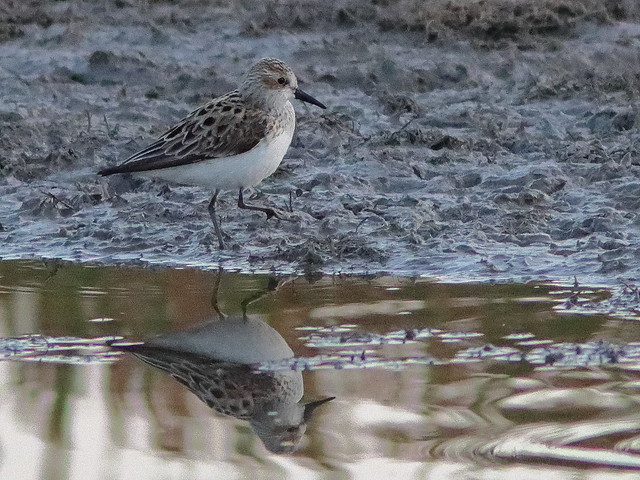
The Law of Diminishing Returns was working against me when 4 Semipalmated Sandpipers appeared at the edge of the lake on May 24, 2021. This species can be difficult to distinguish from the Western Sandpiper. 

Over the years I have seen small sandpipers, but never well enough to distinguish their species unless they had the yellow legs of a Least Sandpiper, another member of the Calidris genus. 

Yet I assumed that I must have reported the species earlier. Nope, it was always entered as a Semipalmated/Western Sandpiper, not "countable" by eBird. I had backed into a new species! 

Semipalmated Sandpiper #183 in the Wounded Wetlands, foraging in very early morning light. Note the webbing which covers only the base of its toes, hence its name:


Here are Least and Semipalmated Sandpipers in much better light, feeding in a pond near our second home in Illinois, July 17, 2012. The Least Sandpiper displays its yellow legs:

Diminishing returns indeed. So far this year my addition of one species has raised my total count for this patch by only 0.54%. 

As my musing maysuggest, I have not been out in the field very often this past week.  Avian highlights were a Pileated Woodpecker...


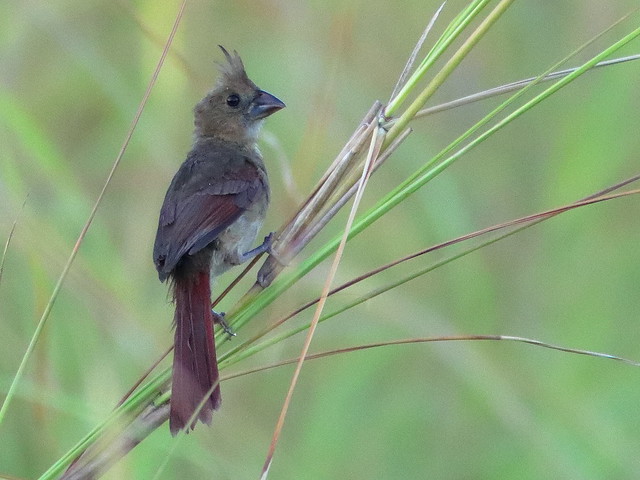
...and a juvenile female Northern Cardinal:


A young Raccoon silently watched me from behind a tree trunk:

In the lake, Longnose Gar:

The pilot of a motorized parachute was checking his phone:

Before sunrise on May 30, Jupiter and Saturn were lined up with the Moon in Aquarius (iPhone photo):

Hand-held DSLR photo of Jupiter and three of its moons, a bit jittery:

Storm clouds to the east  broke up the rays of the rising sun...

...which reflected on the smoke from several wildfires and converged on the western horizon:

= = =  = = =  = = = =  = = = = =

Linking to:


Skywatch Friday

Weekend Reflections

Saturday's Critters

BirdD'Pot

Camera Critters

All Seasons

Wordless Wednesday (on Tuesday)

Natasha Musing

Our World Tuesday

________________________________________________

Please visit the links to all these posts to see some excellent photos on display
________________________________________________

Thursday, March 4, 2021

Crops & Clips: Flashback three years to March, 2018

Going through the archived photos from past years excites fond memories and often gives me an idea of what may again be out there in the wild this year. March is a month of transition, as winter residents depart and spring migrants start arriving. During February my daily bird sightings can become a bit monotonous as the same twenty or so species seem tp show up every morning. However, by late March there is greater diversity. I look for favorite themes and memes in the monthly collection-- critters of all kinds (especially birds), skies and reflections, flowers and fences. 

We spent the entire month at home in south Florida. Our morning walk on March 1st yielded nice photos of a Green Heron in subdued morning light:


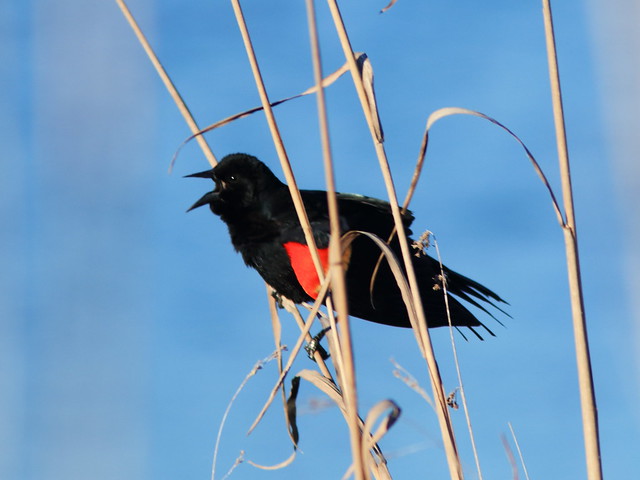
Red-wing Blackbirds males had returned earlier to set up territories and now were rounding up harems: 

Females were present in greater numbers:

A male Boat-tailed Grackle seemed to be checking his reflection:

Overhead on the first day of March were Bald Eagles, one carrying a small fish...


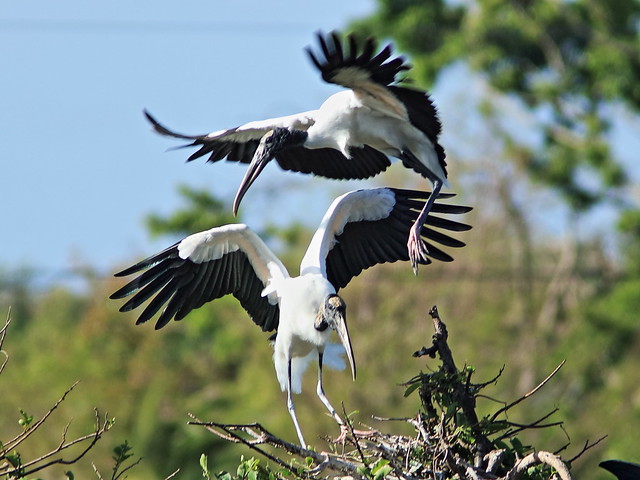
...and a Wood Stork:

A male Bobcat crossed in front of us on March 2. Males occupy a very large territory (in roadless wilderness habitat, up to 30 square miles vs about 6 square miles for females) and visit several females during the breeding season, which peaks in February and March:

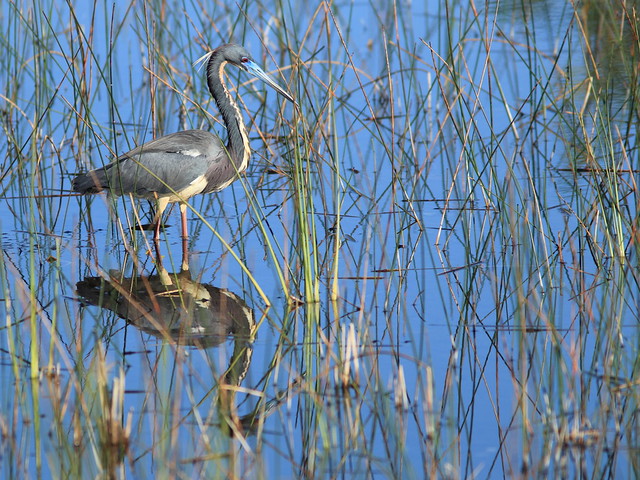
This Tricolored Heron's bill was turning blue, an indication that it is approaching breeding condition:

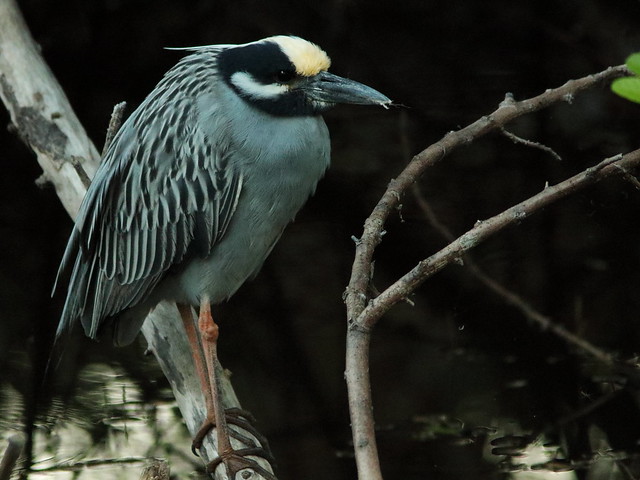
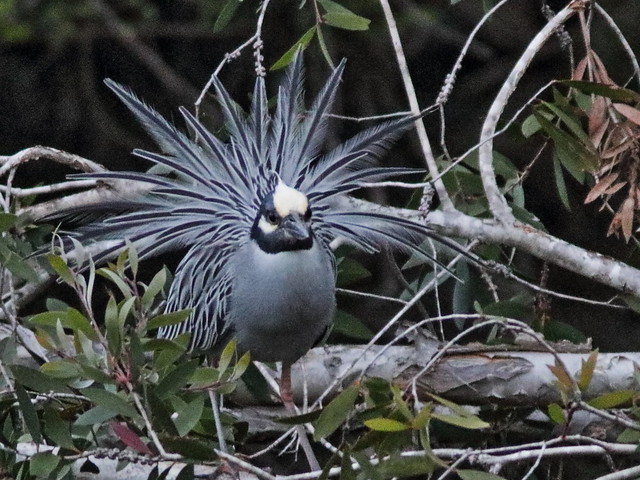
Although streaky and dull for most of the year, the head of this male Yellow-crowned Night-Heron turns clear with a yellow wash and its legs turn from gray to red as spring approaches:

Later in the month, a male extended his scapular plumes in a courtship display.

Pileated Woodpeckers had become more vocal and conspicuous. This is a female. The male has a red "mustache:":

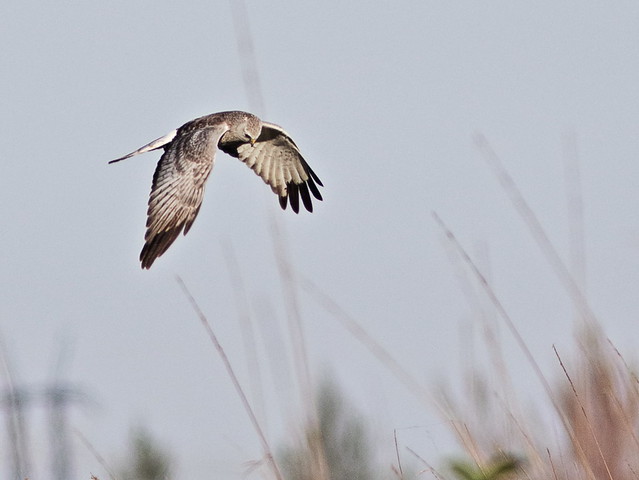
A Northern Harrier male "Gray Ghost" searched for prey over the wetlands:


Yellow-bellied Sapsuckers would soon be migrating back to their northern breeding range:

Northern Cardinals were in full breeding plumage:


Great Crested Flycatchers would soon be breeding:

At the local nest, the adult Bald Eagle (Pride) was tending to the one surviving eaglet

Still present on March 17th, the Yellow-rumped Warblers will have migrated far to the north before the month's end:


American Kestrels would also soon abandon their winter range:

Killdeer were courting:

Prairie Warblers were with us most of the year but would soon undertake a "lateral" migration to nest in the coastal mangroves:

The prior year, for the first time ever, Wood Storks were recorded breeding on an island in a city park to our north. They had returned. On March 27 I counted over 100 adults:


Great Blue Heron on March 28:

A pregnant White-tailed doe was a sure sign of spring:

Sunlight breaking through the fog on March 17:

Up North, the ground was beginning to thaw, hence the Farmer's Almanac name for March's full Moon-- the Worm Moon.

Full Worm Moon on March 3:


Waning crescent on March 13:


= = =  = = =  = = = =  = = = = =

Linking to:

Nature Thursday

Skywatch Friday

Weekend Reflections

Saturday's Critters

BirdD'Pot

Camera Critters

All Seasons

Wordless Wednesday (on Tuesday)

Natasha Musing

Our World Tuesday

________________________________________________

Please visit the links to all these posts to see some excellent photos on display
________________________________________________