Showing posts with label Short-tailed Hawk. Show all posts

Thursday, June 10, 2021

Listing bird species in the Wounded Wetlands

My list of bird species seen in our local south Florida birding patch (West Miramar Water Conservation Area aka the Wounded Wetlands) had reached 182 at the end of 2020. Over the years the productivity of the patch has followed the Law of Diminishing Returns. I began keeping my sightings records in eBird in 2009, when my yearly total for this location included 47 different species. 

The year 2010 began with a flourish, adding 6 new species on January 10, including my first Short-tailed Hawk. It was this light morph. Its tail looks red due to refraction of sunlight:

The year 2010 finally yielded 33 new species, which increased the patch's total output to 80 species, about 70% of the prior year's productivity. The pattern continued during the next 5 years (2011-2015), with new species numbering 27, 13, 14, 15 and 9, during which time the productivity rate gradually decreased to 49% (averaging about 10% per year) despite an increase in my total to 158 species.

Grasshopper Sparrow, February 2, 2011

Each of the next five years (2016-2020) added only single-digit new species counts, bringing my total to 182 with an average productivity rate of 13% (pitifully, only 2.6% annually).  

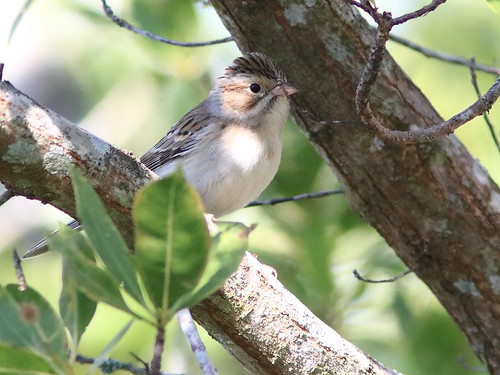
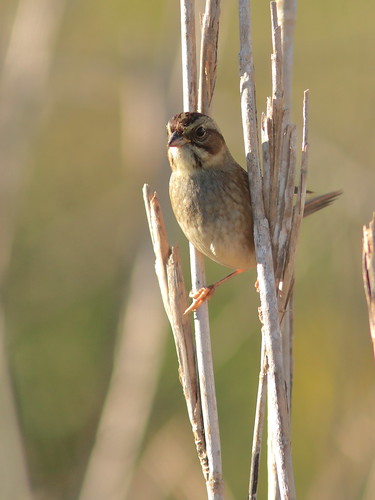
Clay-colored Sparrow, November 17, 2016:

Despite the pandemic, I added five new birds in 2020. Indeed, it was liberating to walk mask-less in the Wounded Wetlands. 

My highlight new species in 2020 was a Yellow Warbler (actually there were two), my only Florida sighting of this species, on August 18:

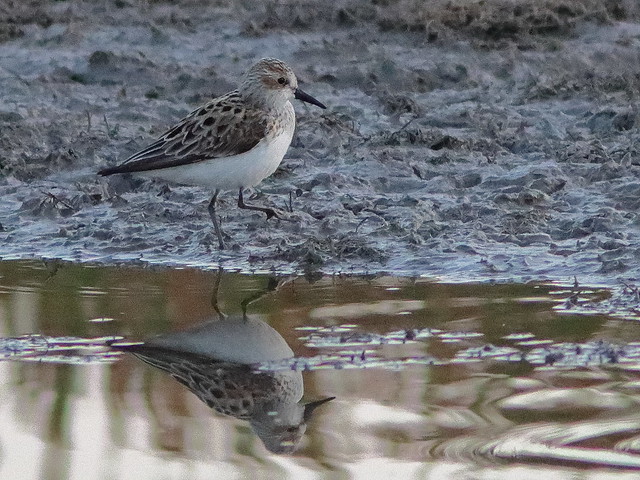
The Law of Diminishing Returns was working against me when 4 Semipalmated Sandpipers appeared at the edge of the lake on May 24, 2021. This species can be difficult to distinguish from the Western Sandpiper. 

Over the years I have seen small sandpipers, but never well enough to distinguish their species unless they had the yellow legs of a Least Sandpiper, another member of the Calidris genus. 

Yet I assumed that I must have reported the species earlier. Nope, it was always entered as a Semipalmated/Western Sandpiper, not "countable" by eBird. I had backed into a new species! 

Semipalmated Sandpiper #183 in the Wounded Wetlands, foraging in very early morning light. Note the webbing which covers only the base of its toes, hence its name:


Here are Least and Semipalmated Sandpipers in much better light, feeding in a pond near our second home in Illinois, July 17, 2012. The Least Sandpiper displays its yellow legs:

Diminishing returns indeed. So far this year my addition of one species has raised my total count for this patch by only 0.54%. 

As my musing maysuggest, I have not been out in the field very often this past week.  Avian highlights were a Pileated Woodpecker...


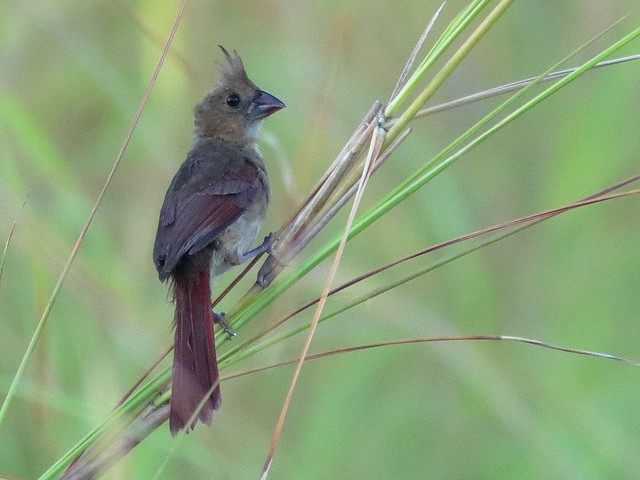
...and a juvenile female Northern Cardinal:


A young Raccoon silently watched me from behind a tree trunk:

In the lake, Longnose Gar:

The pilot of a motorized parachute was checking his phone:

Before sunrise on May 30, Jupiter and Saturn were lined up with the Moon in Aquarius (iPhone photo):

Hand-held DSLR photo of Jupiter and three of its moons, a bit jittery:

Storm clouds to the east  broke up the rays of the rising sun...

...which reflected on the smoke from several wildfires and converged on the western horizon:

= = =  = = =  = = = =  = = = = =

Linking to:


Skywatch Friday

Weekend Reflections

Saturday's Critters

BirdD'Pot

Camera Critters

All Seasons

Wordless Wednesday (on Tuesday)

Natasha Musing

Our World Tuesday

________________________________________________

Please visit the links to all these posts to see some excellent photos on display
________________________________________________

Thursday, December 5, 2019

Crops & Clips: Flashback to December, 2016

Time to look back three years and remember how it was back then and imagine how it might be this December. I will try to find photos which reflect favorite memes: critters of all kinds (especially birds), skyscapes, reflections, fences, flowers and scenes which speak for themselves. 

We spent the entire month at our Florida home, preferring this rather than braving the cold at our condo in NE Illinois. Fair weather let us get out into our local wetlands nearly every morning.

Palm Warblers were our daily avian companions. They are usually so abundant in residential neighborhoods that some people call them "Florida Sparrows." Their long legs are an adaptation for foraging on the ground and they constantly wag their tails up and down:

Palm Warbler 20161202

A Palm Warbler explores the crisscross bark on the trunk of a native Cabbage Palmetto (aka Sabal Palm), so named because its terminal bud may be removed, cooked and eaten as "heart of palm." This also kills the tree: 

Palm Warbler on Cabbage Palm trunk 2-20161202

A visit to nearby Chapel Trail Nature Preserve yielded views of Wood Storks, a species which was formerly a common back yard visitor but whose numbers were sharply declining in south Florida. A tactile feeder, the Wood Stork stirs the shallow water with its bubble-gum pink feet to frighten prey into its open jaws: 

Wood Stork 20161202 

Commonly, sight-feeding herons join storks and both may mutually benefit from the association. Great Egret with Wood Stork:

Stork and Egret 20161202

Tricolored Heron on the boardwalk railing:

Tricolored Heron 20161202

Pine Warblers are fairly common at Chapel Trail in December. This was no exception:

Pine Warbler 5-20161203

Out on the local wetlands, just before sunrise as temperatures dropped, fog developed over the water. The sun is just touching the Pine Bank behind the Wet Prairie: 

Sun reaching Pine Bank 20161213

On another still morning, smoke from trash burning on a nearby farm created a fine layer just above  the head of this Great Egret:

Great Egret under smoke layer at dawn 20161227

White-eyed Vireo:

White-eyed Vireo 01-20161226

Northern (Yellow-shafted) Flicker in flight:

Northern Flicker 01-20161222

Only a few times have I found a Short-tailed Hawk roosting close by. This is the light morph:

Short-tailed Hawk 07-20161220

A few days later, a dark morph Short-tailed Hawk flew overhead:

Short-tailed Hawk 03-20161231

Here is the first and only Ruby-crowned Kinglet I have ever seen in the local patch (December 28, 2016):

Ruby-crowned Kinglet 04-20161228

Ruby-crowned Kinglet 03-20161228

That same day a male Painted Bunting appeared:

Painted Bunting male 01-20161228

It was surprisingly inconspicuous amid the red and green of the Brazilian Pepper bush:

Painted Bunting 05-20161228

A few species remind me of how the subsequent two Decembers then changed for the worse. Hurricane Irma was to strike in October, 2017 and it had a very adverse effect upon the butterflies, so abundant in 2016. Probably  the hardest hit was the Julia longwing. They are still quite scarce now in 2019. 

This is a male Julia:

Julia male 20161229

The female Julia is paler and has different wing markings:

Julia longwing female 5-20161231

The undersides of both male and female Julia are similar. This is a female:

Julia longwing female 2-20161231

Gulf Fritillary butterflies were also markedly reduced and their numbers remain depressed:

Gulf Fritillary on Bidens alba 20161217

White Peacocks seemed more resilient. After almost disappearing in 2018, their population has bounced back:

White Peacock 20161217

Zebra heliconians have also recovered and are again quite common:

Zebra Heliconian 03-20161225

A trio of rather similar species--  a Soldier:

Soldier 20161225

Queen:

Queen butterfly 20161204

Monarch:

Monarch butterfly 20161231

Orb Weaver. Note that the two thick main support strands are reinforced with zigzagging strands of heavy silk. (It has been said that its pattern sometimes resembles a printed message, but I cannot read this one):

Spider in orb 20161229

Besides birds, butterflies, blooms and berries, I did see a few mammals. Among them, a curious Gray Squirrel in the front yard,,,

Gray Squirrel 04-20161224 

...a White-tailed Doe...

White-tailed Deer doe 04-20161219


...and a Feral Cat, which still wanders in the patch::

Feral cat 20161230

Among the more than 800 photos I processed, I found only one image of a fence. Reflections of a Great Egret and a neighbor's fence:

Great Egret at fence 20161226
= = =  = = =  = = = =  = = = = =

Linking to Misty's  CAMERA CRITTERS,

Linking to Eileen's SATURDAY'S CRITTERS,

Linking to SKYWATCH FRIDAY by Yogi, Sylvia and Sandy

Linking to WEEKEND REFLECTIONS by James

Linking to BirdD'Pot by Anni

Linking to Our World Tuesday by Lady Fi

Linking to Wild Bird Wednesday by Stewart

Linking to Wordless Wednesday (on Tuesday) by NC Sue

Linking to ALL SEASONS by Jesh

 Linking to Fences Around the World by Gosia
________________________________________________

Please visit the links to all these memes to see some excellent photos on display
________________________________________________

Thursday, November 7, 2019

Crops & Clips: Flashback to November, 2016

The month of November, 2016 started on a sad note. MaryLou's oldest brother who lived in Tucson, Arizona was recuperating from complications which followed a leg fracture. We planned to visit him and made flight reservations, also hoping to do some birding while out there. His condition suddenly deteriorated the day before our scheduled arrival. He had turned gravely ill with pneumonia and sepsis.

We flew out the first day of November and visited him that evening in a rehabilitation facility. He was very weak but alert and involved with events surrounding the World Series and the presidential election. We stayed at nearby Davis-Monthan Air Force Base and visited with him the next morning. We planned to spend more time with him, but he passed away that night. 

We had reservations to return to Florida on November 4 and had time to briefly visit Sweetwater Wetlands and the Arizona-Sonora  Desert Museum before flying home.

I had to pore over nearly 1,000 processed photos from November to highlight favorite memes, such as critters (plenty of birds!), skies, reflections, flowers, fences and scenes which speak for themselves. 


My first images were from Sweetwater Wetlands. Our visit was much too brief, given the circumstances.

Yellow-headed Blackbirds flew overhead:

Yellow-headed Blackbirds 20161103

Yellow-headed Blackbirds 2-20161103

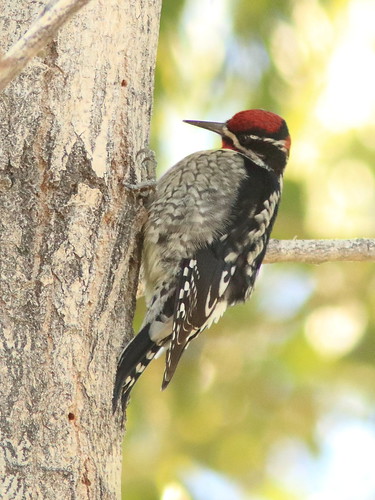
The Red-naped Sapsucker is the western counterpart of our Yellow-bellied Sapsucker:

Red-naped Sapsucker 04-20161103

Red-naped Sapsucker 03-20161103

The Verdin inhabits thorny shrubs in the arid lands of southern Arizona:

Verdin 091-20161103

Long ears serve to dissipate body heat of the Desert Cottontail:

Desert Cottontail 02-20161103

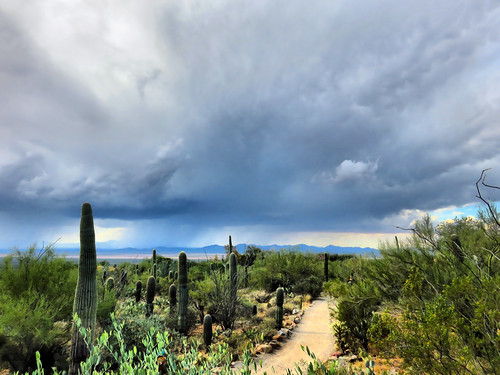
The next morning, rain was threatening when we visited the Arizona-Sonora Desert Museum, but most of it evaporated before reaching the ground:

Arizona-Sonora Museum HDR 02-20161103

Arizona-Sonora Museum HDR 01-20161103

Tucson desert HDR 20161103

Cactus Wrens were common:

Cactus Wren 20161103

Cactus Wren 2-20161103

Butterflies included a Common Checkered-Skipper:

Common Checkered-Skipper male 2-20161103

Back home in Florida, our winter resident birds were settling in. Among them was a fairly rare Bell's Vireo:

Bell's Vireo 6-20161107

Marsh Wrens appear irregularly during the winter months:

Marsh Wren 03-20161119

Eastern Phoebes stay for the winter:

Eastern Phoebe 20161119

This phoebe is dwarfed by the heavy guard rail fence along the "road to nowhere:"

Eastern Phoebe 20161110

Clay-colored Sparrows made their first (and so far only) appearance in our local wetlands:

Clay-colored Sparrow 02-20161117

Clay-colored Sparrow 01-20161117

Wintering Palm Warblers were numerous:

Palm Warbler 20161117

Swamp Sparrows were reliably present but few in number:

Swamp Sparrow 08-20161121

Swamp Sparrow 05-20161121

Female Ruby-throated Hummingbird:

Ruby-throated Hummingbird 20161123

Sharp-shinned Hawk:

Sharp-shinned Hawk DARK 02-20161114

Dark morph of a Short-tailed Hawk:

Short-tailed Hawk in flight HDR 01-20161121

The local pair of Bald Eagles, after losing their first brood earlier in the year, had successfully reared one eaglet which remained dependent well into September. Now they were refurbishing their nest in preparation for the new season:

Bald Eagles 0909 more interaction 20161128

A large male Bobcat was visiting, probably meeting up with one of the resident females:

Bobcat crop 01-20161123

Zebra heliconian at the flower of a Firebush (Hamelia patens):

Zebra heliconian on Firebush 20161113


A "mirrored sunrise" on November 27 is an illusion caused by convergence  of the parallel rays of the rising sun on the opposite (western)  horizon. Conditions are best when the sky is clear overhead but the tops of storm clouds over the Atlantic Ocean break up the light to form the rays:

 Mirrored Sunrise HDR 20161127

The sky was clearing up after a rain storm on November 28:


Sky clearing HDR 20161125

= = =  = = =  = = = =  = = = = =

Linking to Misty's  CAMERA CRITTERS,

Linking to Eileen's SATURDAY'S CRITTERS,

Linking to SKYWATCH FRIDAY by Yogi, Sylvia and Sandy

Linking to WEEKEND REFLECTIONS by James

Linking to BirdD'Pot by Anni

Linking to Our World Tuesday by Lady Fi

Linking to Wild Bird Wednesday by Stewart

Linking to Wordless Wednesday (on Tuesday) by NC Sue

Linking to ALL SEASONS by Jesh

 Linking to Fences Around the World by Gosia

________________________________________________

Please visit the links to all these memes to see some excellent photos on display

_______________________________________________