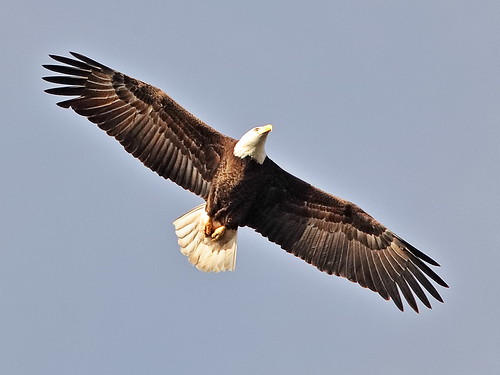
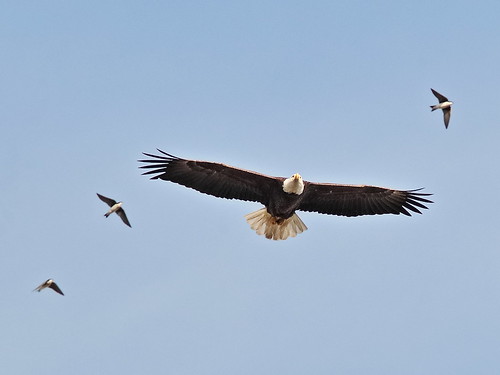
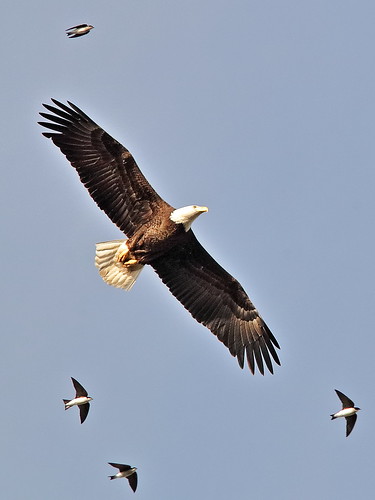
Our local pair of Bald Eagles share responsibility for incubating the eggs, the first of which was laid around December 9 or 10. The female usually sits on them overnight and takes turns with the male during the day. On the morning of December 27 the male (Pride) took over incubation duties and his mate (Jewel) stretched her wings and circled overhead:
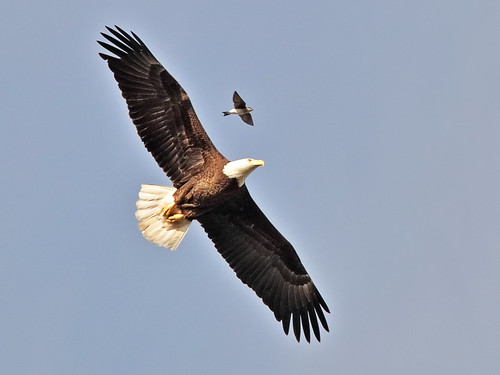
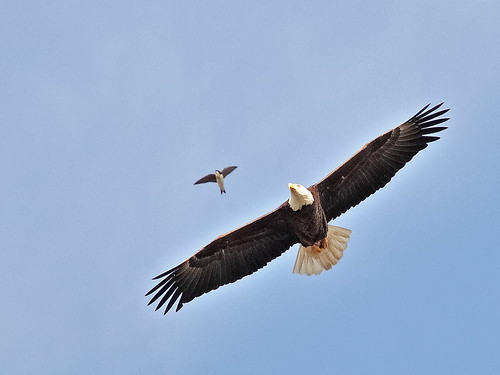
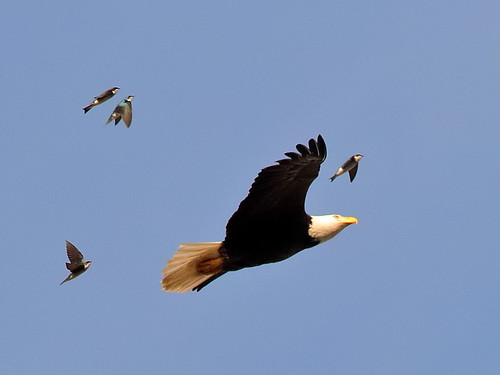
First one, and then a flock of Tree Swallows joined her. They did not attack or disturb her, but just floated around in circles with her:
One may ponder the reason for this behavior. The swallows are migrants from the north and they have no territory to defend. Did the swallows perceive a threat? If so, there was no sign of this, as they glided effortlessly with the large bird and rotated together, gaining altitude before departing. Perhaps heat from the pavement of the roadway created a local updraft, and all simply took advantage of it. For me, the uplifting beauty of nature was a sight to behold and enjoy.
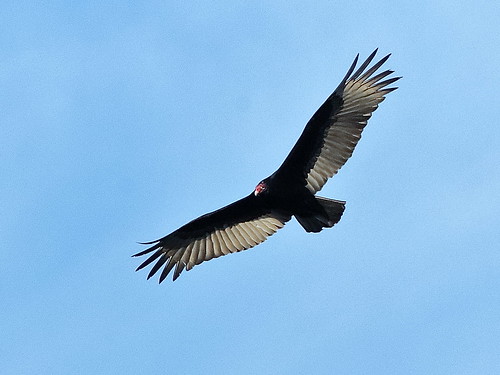
A Turkey Vulture also rode on the rising currents. Its wingspan is about 6 feet, about a foot less than that of the female eagle. Its tail is long but its neck is short. From a distance it may almost appears headless. Its silvery flight feathers contrast with the darker leading edge of the wing:
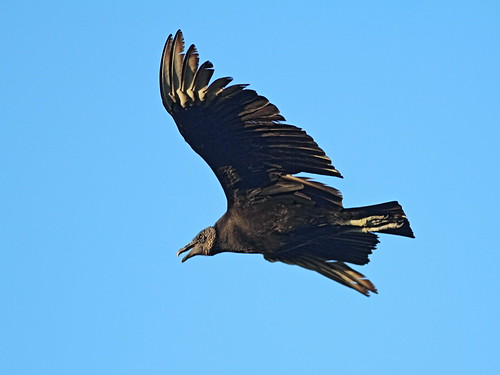
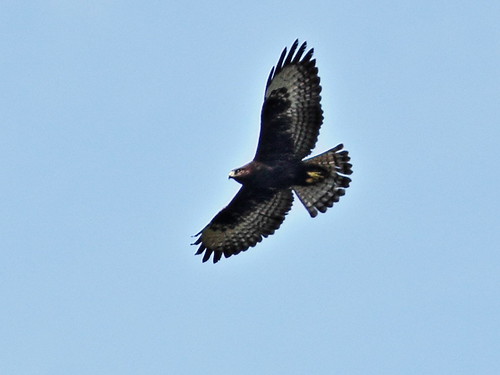
Flocks of Black Vultures were also present. Smaller than Turkey Vultures, they look "front-heavy" with short tails and they extend their necks in flight.
Black Vultures have whitish wingtips and relatively shorter wings (4.5 to 5.5 feet) and must flap often and strongly to gain altitude:
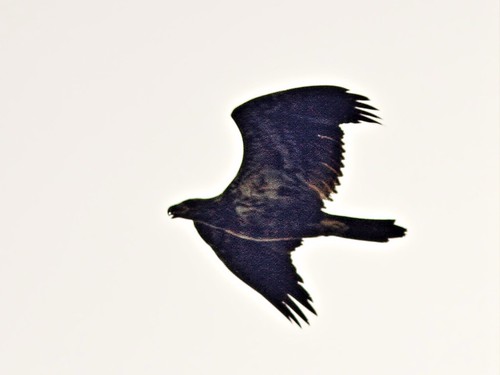
Sometimes an immature Bald Eagle may join a flock of vultures. Turkey Vultures have an exceptionally keen sense of smell. Until the eagle becomes fully competent as a hunter, it will often feed on carrion. A meal of roadkill may be its last, as many are struck by motor vehicles. This is a juvenile (first year) bird, as evidenced by its dark bill and bulging secondary wing feathers. Its head and tail will turn almost completely white when it is about four years old:
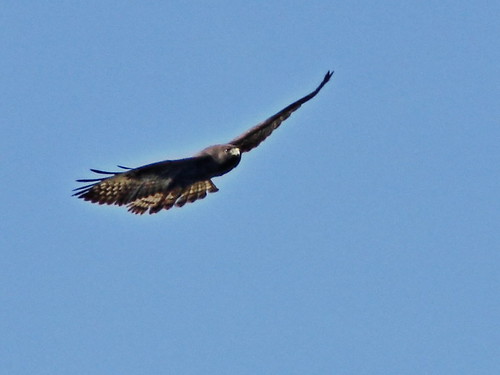
A few times I have identified a Short-tailed Hawk flying with vultures. The association may allow the hawk to escape detection before it drops like a stone to catch an unwary bird:
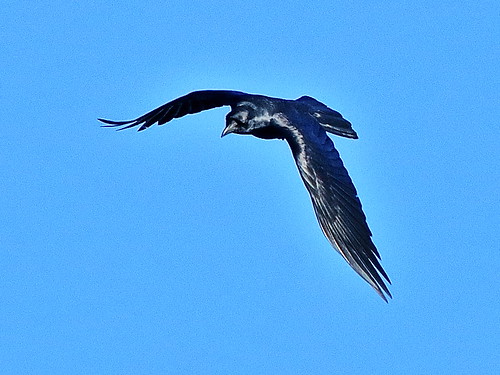
Fish Crows often loaf in the vicinity of the eagle nest, which if left unguarded may provide a meal of leftover prey, or worse, an egg or nestling. They can be distinguished from hawks and vultures by the fact that they almost never soar, beating their wings constantly as if "rowing a boat:"
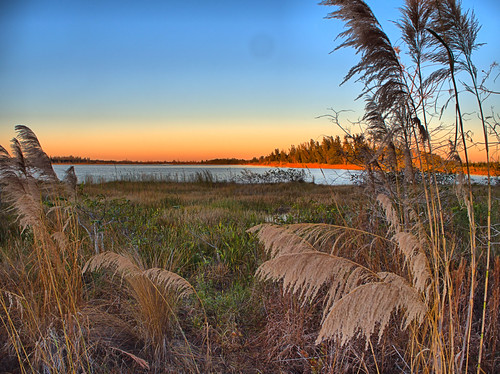
We have enjoyed deliciously cool and clear mornings out on our local wetlands. Still air sets up beautiful reflections. From our shadowed vantage point on the lakeside marsh, we watch as the sun, rising in a cloudless sky, touches the pine bank on the opposite shore:
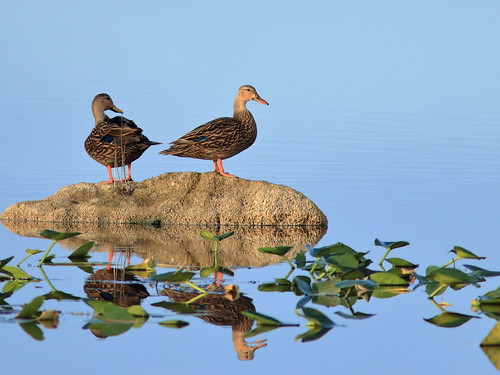
Mottled Ducks bask in full morning light:
= = = = = = = = = = = = = = = Linking to Misty's CAMERA CRITTERS,
We departed from our south Florida home on April 21, just as spring migration was beginning. Our destination was our condo in NE Illinois, just emerging from two weeks of unusually cold and wet weather.
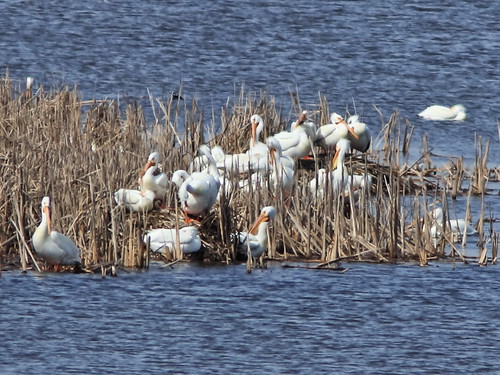
The next morning we headed to nearby Nelson Lake Marsh/Dick Young Forest Preserve, where we were surprised to find a large flock of migrating American White Pelicans. I counted at least 60. This is at the eastern edge of their northbound migration from wintering grounds in the Western and Central US.
American
White Pelicans commonly winter in Florida and along the Gulf of Mexico
but migrate in a northwesterly direction, generally avoiding the eastern
coastal areas. (*See end note)
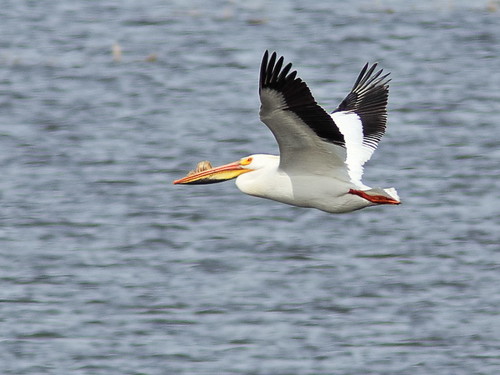
During breeding season the adults grow a vertical fibrous plate on their upper mandibles which is shed before they migrate southbound:
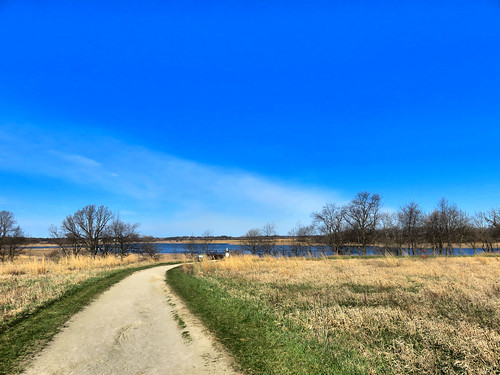
The prairie was just starting to geen up. This is the east entry path, looking towards the viewing platform which overlooks the lake:
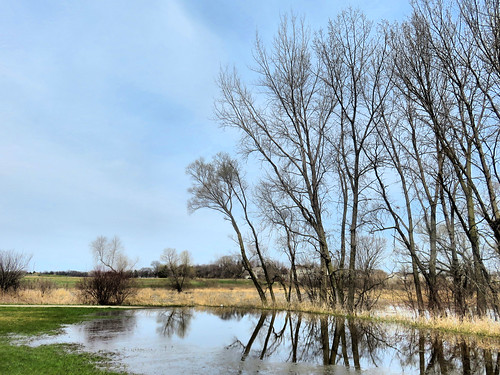
On our way back to the condo we stopped at Jones Meadow Park, where the path had been flooded because of rain and snow-melt. The bare trees cast nice reflections:
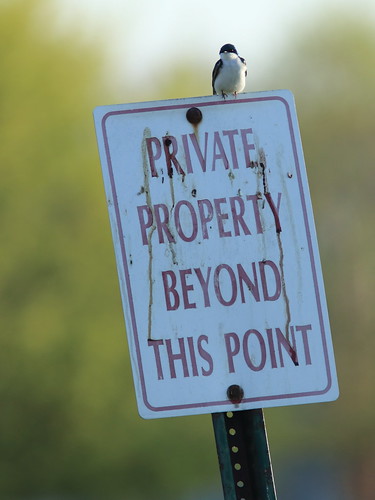
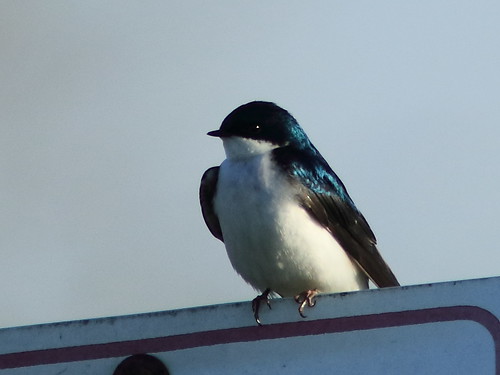
A Tree Swallow defiled the warning sign:
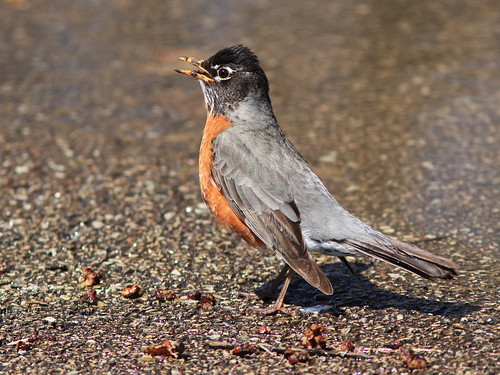
Seeing an American Robin is quite a thrill. While they migrate into Florida, they rarely appear in our neighborhood:
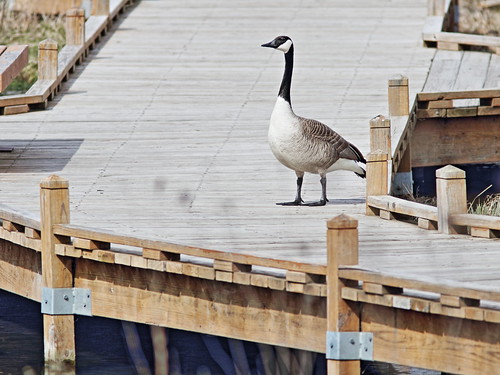
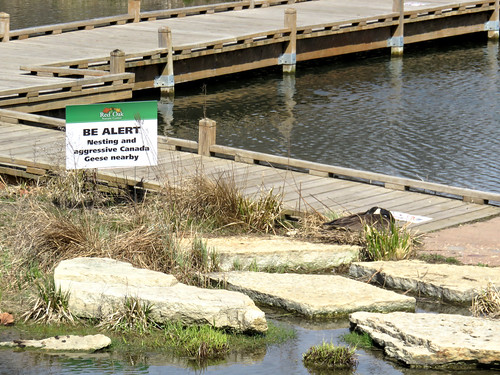
The next day we visited Lippold Park in Batavia, Illinois. The Canada Geese were nesting. At the end of the boardwalk an especially protective pair guarded their eggs and even attacked some visitors. We steered clear:
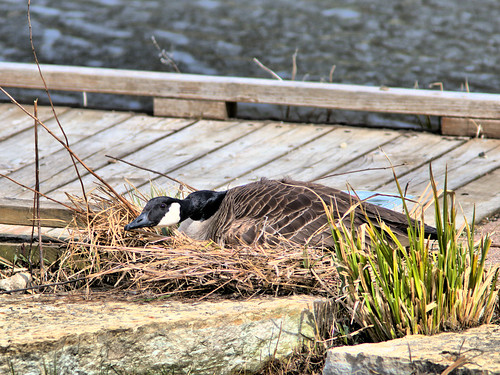
We observed the incubating female from across the pond:
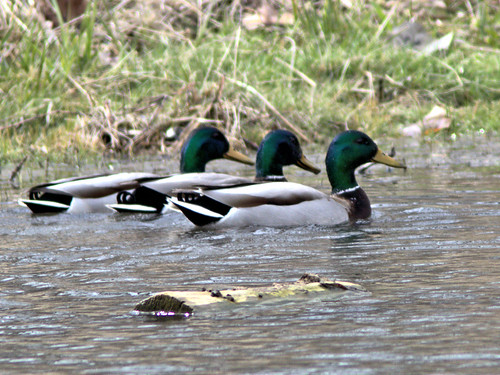
Three male Mallards swam in closed ranks:
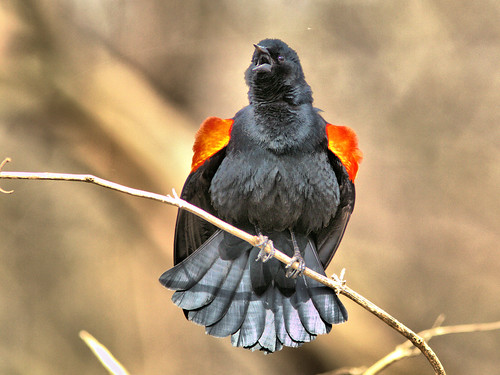
I obtained one of my nicest photos of a male Red-winged Blackbird as it sang "Conk-ra-lee!"
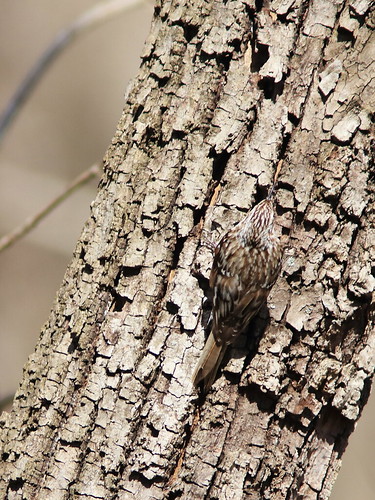
In the wooded area, a Brown Creeper was almost invisible against the bark of a tree:
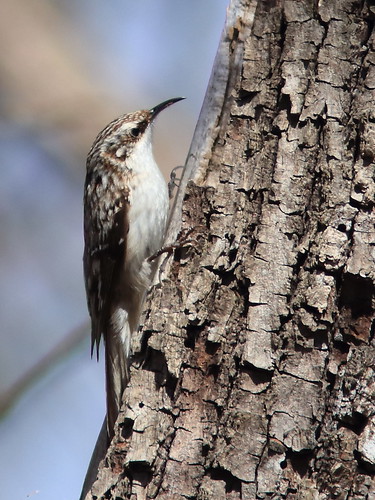
I finally obtained a side view:
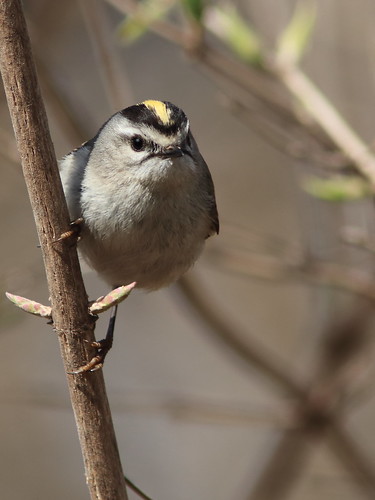
A sweet little Golden-crowned Kinglet posed very briefly:
We are in the throes of marketing our condo-- so much stuff to move out and donate or give away. Our granddaughters were given two new puppies this week-- so much excitement! They will never forget Siboney but the girls are absolutely thrilled with their pets...
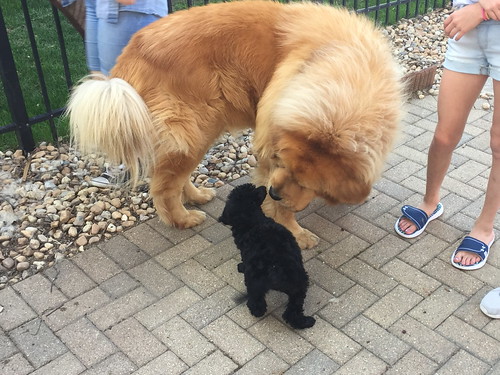
...a tiny (but eventually full-sized) Poodle puppy named Cazador ("Hunter" in Spanish) meets old Tibetan Mastiff Agramonte for the first time:
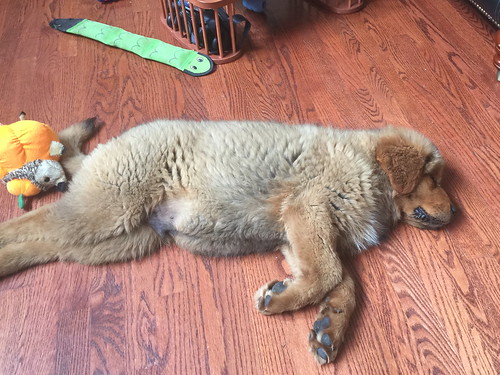
The next day, Moncada (4 month old Tibetan Mastiff, named after General Guillermon Moncada, hero of the Cuban War of Independence and civil rights advocate) arrived-- here napping after having great fun with his new little "brother"...
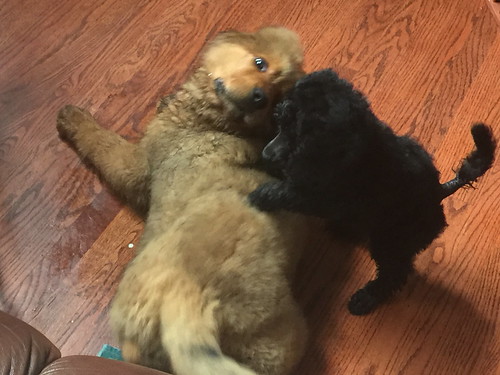
...and they got along splendidly, even after Cazador jumped on him and woke him up!:
With so much going on I may need to take a break but will try to get out as much as possible while my emails pile up! Sorry if I have not yet gotten back to everyone who have posted such great comments (they get a priority position in my in-box!).
*PS: We have had them in our local south Florida "Wounded Wetlands," where in 2012, I documented their cooperative fishing style (pardon my New Jersey accent):
= = = = = = = = = = = = = = = Linking to Misty's CAMERA CRITTERS,
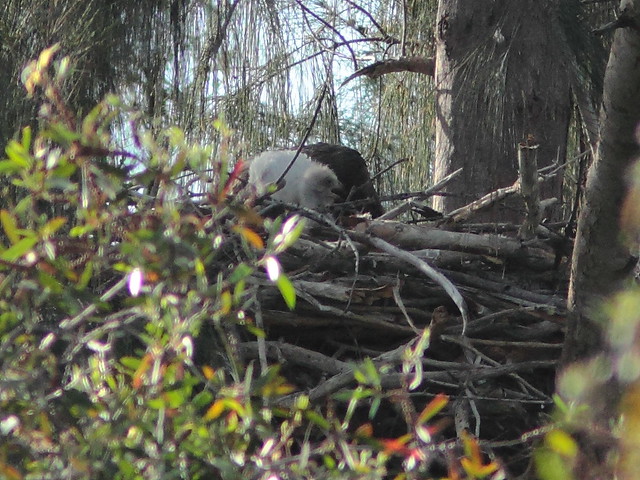
My weekly potpourri gathered from the archives features... Looking back, as I did last month, when I reviewed my photos from a single month in the past to see how far I had to get into the month to find all five of the memes featured in this page. I will try for two for each theme, and since Critters occupy such large share of my portfolio, I removed a limit on my faves in this category, as spring is in the air! This post features February, 2012. I reached my goal by the 16th of the month. So much to look forward to this month! CRITTERS: First look at baby Bald Eagle, February 2, 2012 Cattle Egret, February 5, 2012
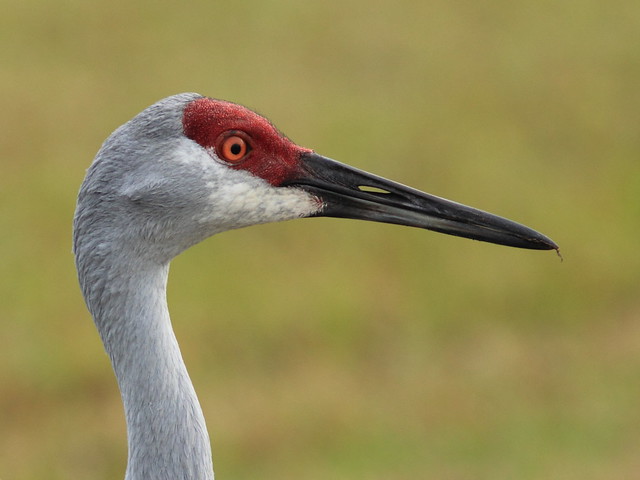
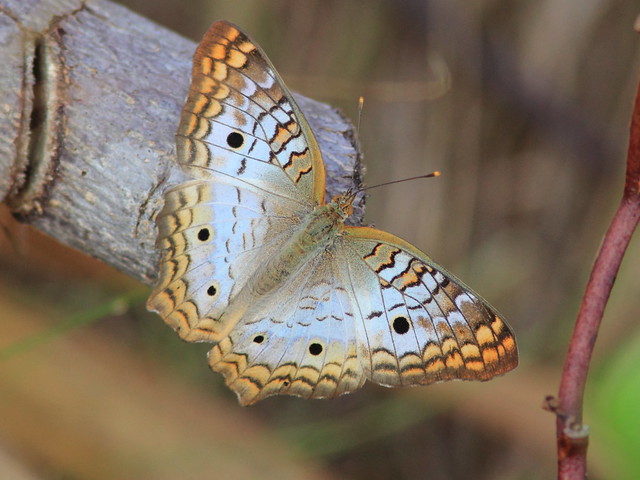
Sandhill Crane. February 5, 2012 White Peacock, February 16, 2012: The eaglet is growing up rapidly (February 17, 2012):
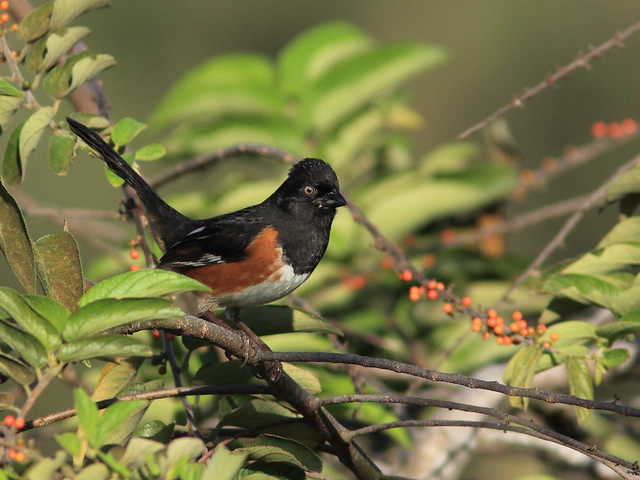
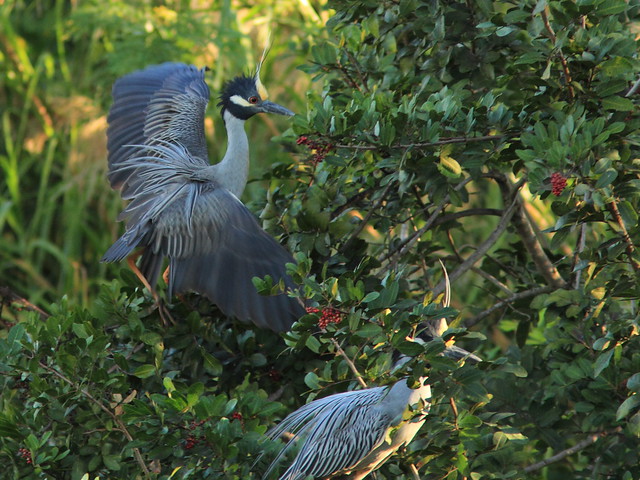
Eastern (Yellow-eyed) Towhee arrives, February 29, 2012, my "half birthday" which comes around only every 4 years (can I get any longevity credit for that? This is only the second time in my whole life that I will be 50% on my way to 80 years old-- the first was when I was 40): The Yellow-crowned Night-Herons are feeling amorous, February 29, 2012 (can't wait to see them nesting next month!):
Linking to Eileen's SATURDAY'S CRITTERS, ________________________________________________
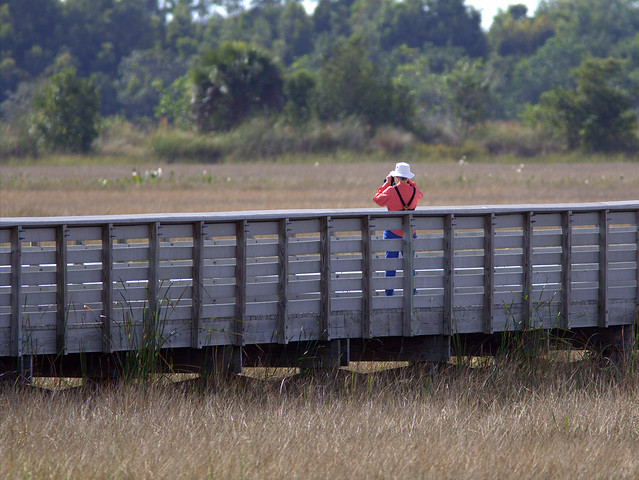
FENCE: Mary Lou on Chapel Trail boardwalk, February 2, 2012 Linking to GOOD FENCES by Tex (Theresa).
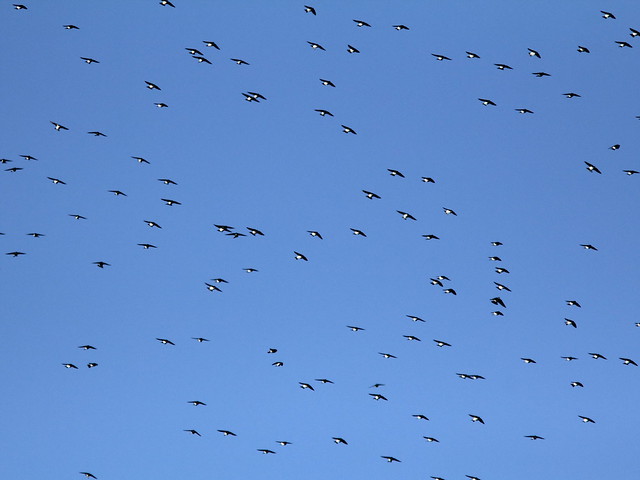
________________________________________________ SKYWATCH: Tree Swallows, February 13, 2012 (yes. I kept my mouth closed!) Linking to SKYWATCH FRIDAY by Yogi, Sylvia and Sandy ________________________________________________
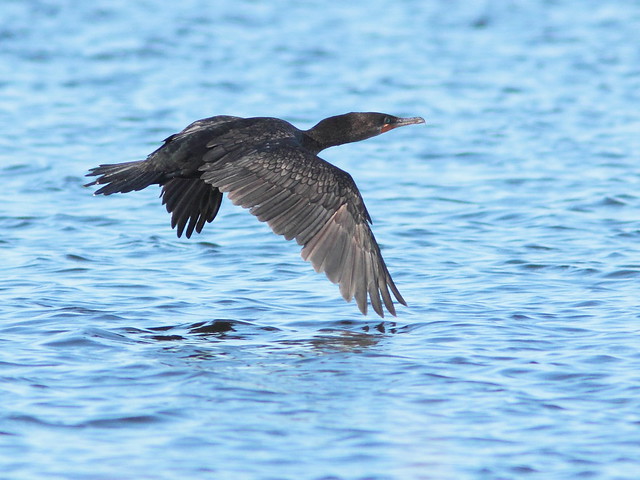
REFLECTION: Double-crested Cormorant, February 13, 2012 Motled Duck, February 15, 2012 Linking to WEEKEND REFLECTIONS by James ________________________________________________
Also: Linking to BirdD'Pot by Anni Linking to Wild Bird Wednesday by Stewart ________________________________________________ Please visit the links to all these memes to see some excellent photos on display ________________________________________________
As we entered the final week of our stay in Illinois at the peak of spring migration, we tried to get out every morning. The weather was mostly cooperative but temperatures varied wildly, going down to freezing one night and the next day we were in the mid-80s (F). Although our hopes were high, we were disappointed at how few warblers we were seeing. Some birders were reporting well over a dozen species but we were lucky to find 3 or 4. Others reported similar bad luck in our usual haunts. Indeed, one morning we found not a single warbler. We also missed a favorite target bird, the Scarlet Tanager, although I got a fleeting look at one flying several hundred yards away at Bliss Woods. Rather than grouse about what might have been, we should rejoice in the variety of habitats we visited and the beautiful birds we did see, most of which are uncommon or unseen in South Florida. I love getting good shots of small birds, so I was elated when they appeared among the flowers, as did this Baltimore Oriole in Fabyan West Park... ...and this Killdeer in Jones Meadow Park. Six Great Egrets roosted on a dead tree at Jones Meadow. I almost forgot I was not back in Florida when one left its roost and settled at the edge of the lake. A Green Heron lifted off from a hiding place nearby. Jones Meadow provided us with our only sighting of a Chestnut-sided Warbler. Tree Swallows had already set up housekeeping. These two seemed to be having a property dispute. Mallard Drakes dabbled in the wetlands next to the lake. Were their mates sitting on eggs? Rose-breasted Grosbeaks became quite numerous. A House Wren fluttered his wings as he sung his heart out. A nest must have been nearby, as he was reluctant to leave the trunk of this old dead tree. Field Sparrows were claiming nesting territory along the margins of the prairie at Aurora West Forest Preserve. I particularly liked this pose. Demure Warbling Vireos sang loudly in the trees but rarely ventured out from the leafy cover. At Nelson Lake, an Eastern Meadowlark was in full song. A male Northern Cardinal stopped singing just long enough to stare down from his perch. An American Goldfinch added another touch of color. It was unusual to see a lone Sandhill Crane overhead, bugling as if calling for a lost lover. Among the "little birds," a pair of Clay-colored Sparrows gave me my best photos of this species, even though they were reluctant to come out from behind the branches. The budding trees attracted House Finches. This male was particularly bright. Yellow Warblers were common along the Fox River, at Les Arends Forest Preserve... ...but a few miles up-river, Fabyan West preserve presented us with our most treasured sighting-- a Yellow-throated Warbler, which is near the northern limit of its range. Singing high in an oak tree and flitting from branch to branch, it was not an easy capture. The Yellow-throated Warbler is aptly named. Another nice warbler was nearby-- the Blackburnian. The Orchard Oriole, smaller than the Baltimore Oriole and brick-red rather than bright orange, has been my "nemesis bird," as I had never gotten a good view of one. The Japanese Garden at Fabyan sheltered one that finally came out into the open! An American Robin fed its two chicks. In fairness to the mammal kingdom, here is a cute chipmunk in a beautiful setting inside the Japanese Garden. We cannot overlook the spring flowers, such as these tree blossoms... ...or the Wild Blue Phlox. I'm quite sure that this is a Hickory tree bud, but it is an object of unexpected beauty.