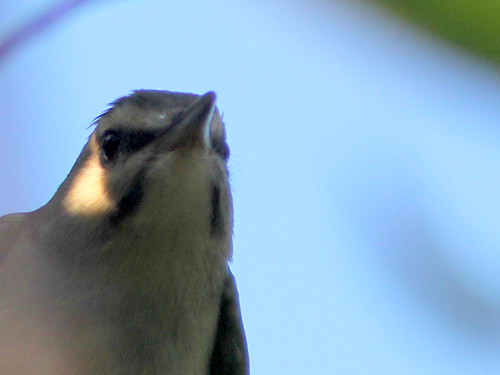
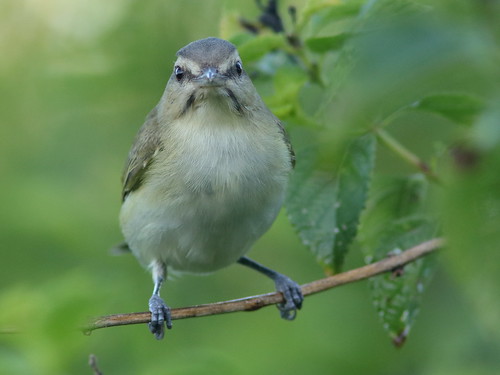
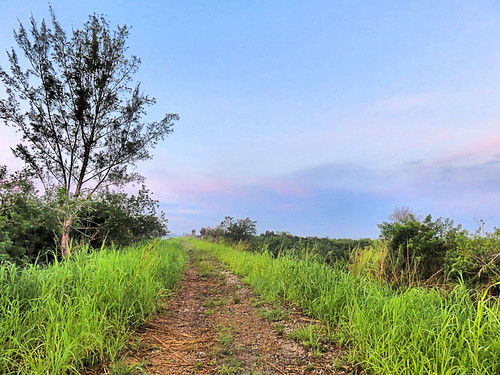
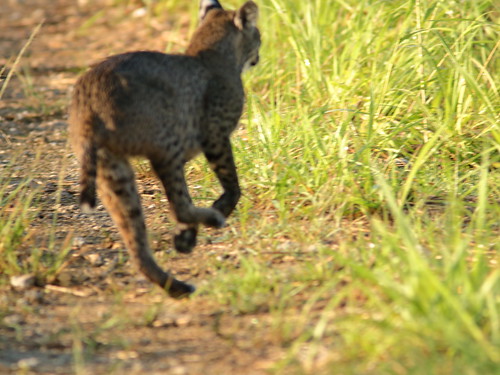
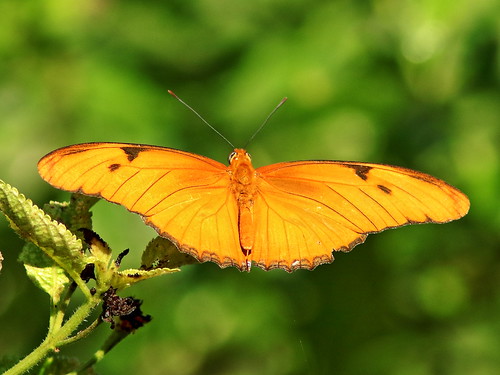
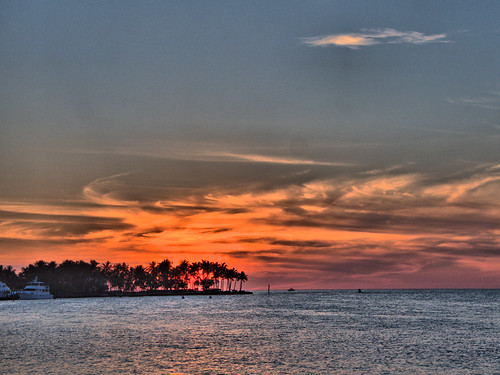
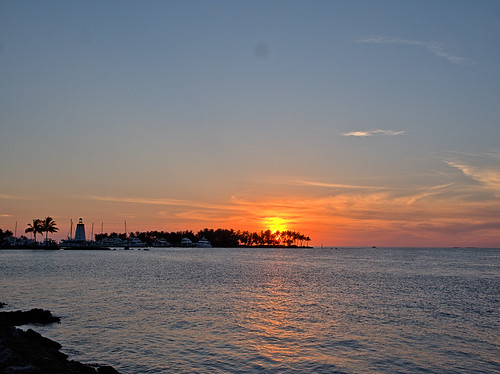
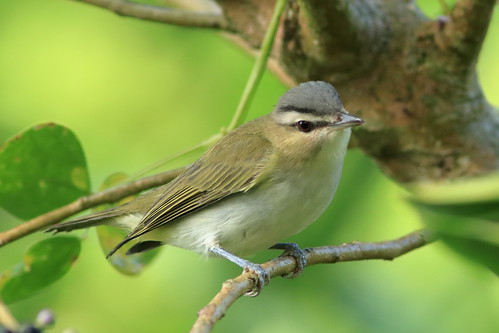
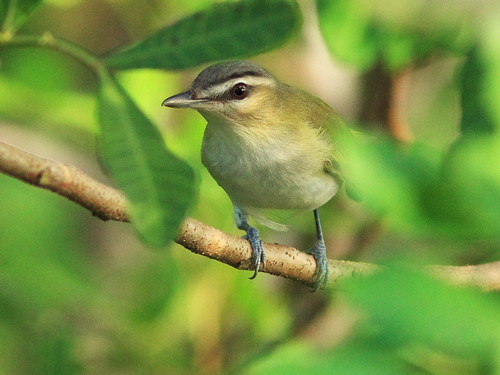
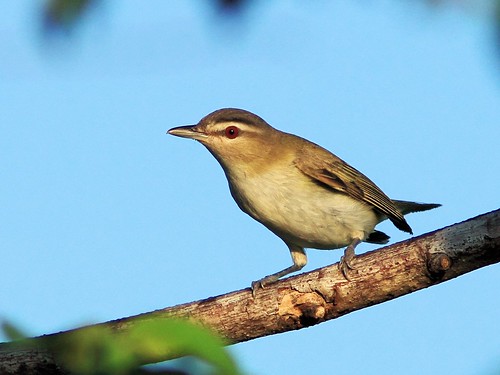
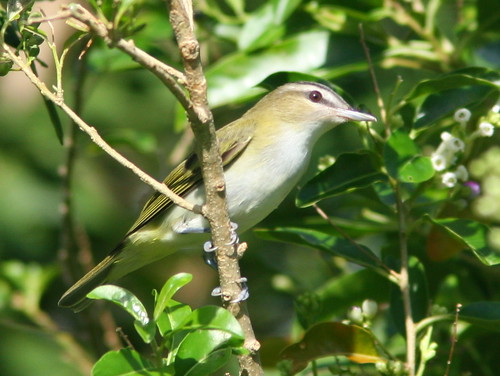
It has been an eventful few days in our neighborhood Wounded Wetlands. Although spring migration has been slow, I added a (heard-only) Chuck-will's-widow to my patch list. A poor recording is my only documentation with no photos to share. It was quite near the trail about 40 minutes before sunrise. As has been the case with the Whip-poor-will, it stopped calling about a half hour before sunup. An unusual visitor was this Black-whiskered Vireo. It was only my second sighting at this location, and one of only two recorded in Broward County so far this year. I found the first one at almost this exact spot on April 20, 2011. Its namesake throat stripes are distinctive: This time I got much better photos when, for a few seconds, it sat still out in the open after it ate Lantana berries (May 4, 2019): Black-whiskered Vireos breed in The Bahamas and Caribbean islands, but their US range is generally restricted to a migratory population in coastal mangroves of southern Florida. Their secretive habits make them hard to find as they glean for insects among the leaves. They are closely related to the similar Red-eyed Vireo. In fact, at first I misidentified it as the latter species. Close inspection reveals that, although its eyes have a reddish tint, it has a more massive bill and a duller brownish back: Here is a Red-eyed Vireo for comparison (October 12, 2018): Two different Bobcats showed up, only two days apart. The first was a small female which stared at me from the high grass on the left side of this trail: She jumped out and over the trail just as I raised my camera (May 3): The other Bobcat was a large male, seen only about 100 yards away from where I saw the female. He walked leisurely across the gravel road (May 5): He crouched down for a moment to check me out: Male Bobcats usually occupy much larger territories than females. They seek out and mate with several but do not take part in rearing or defending the young. One of the local females appears to be quite pregnant (April 13, 2019): We would expect her to avoid contact with the male and take such steps as covering feces and hiding in with her kits in a den. I can tell that a male is around when I find fresh Bobcat scat piles out in the open and close to each other, as this is one way they mark their territory. A White-winged Dove peered out from the shadows (May 4): Loggerhead Shrikes had disappeared for over two weeks, so I was happy when one posed in early morning sun on May 4: That same day I saw my first Julia longwing of the spring season. They have been very scarce since Hurricane Irma ravaged the area almost two years ago. This is a fresh male: I had to get down on the ground to get a side view of a tiny but beautiful Dainty Sulphur: We spent the week after Easter at Tranquility Bay resort on the Florida Keys. These are views from the beach at sunset (April 22-25):
= = = = = = = = = = = = = = = Linking to Misty's CAMERA CRITTERS,
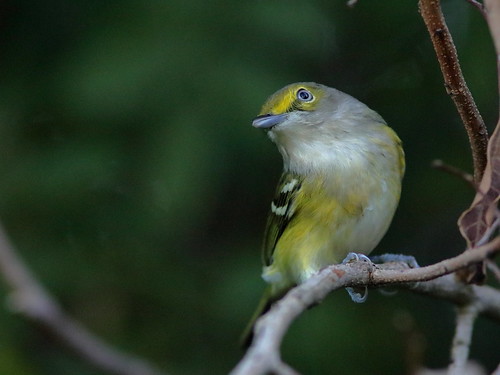
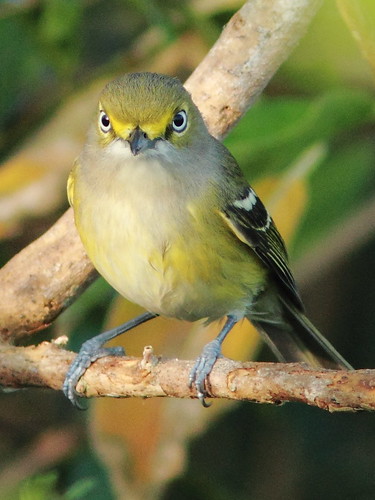
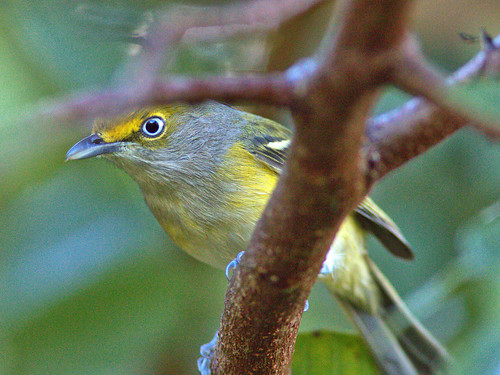
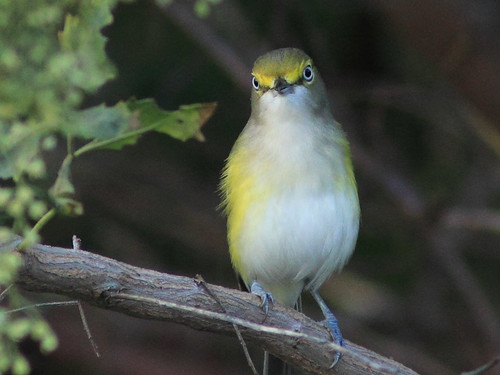
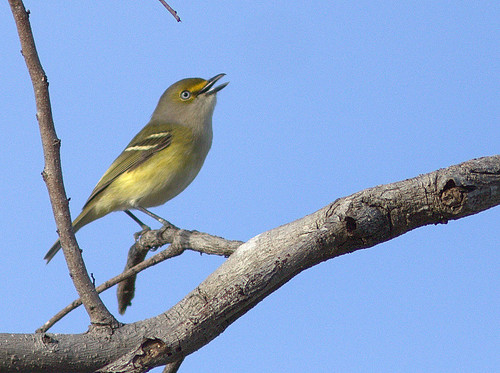
The White-eyed Vireo is a permanent resident in south Florida, although the winter population is supplemented by migrants from the eastern half of the US. I have heard it singing all year long, though the frequency and volume of its song is reduced during the winter months.
Although often shy and retiring, it is one of my favorite photographic subjects. Like all birds, it is incapable of changing its facial expressions, but it can assume some very interesting postures which seem to be communicating its thoughts.
Is it looking for a bug up there or wondering what I am doing here?
Is it angry?
Shy?
Proud?
Or simply exuberant?
Vireos are small and rather inconspicuous birds, mostly native to the New World, with most species concentrated in Central America and northern South America. They eat insects and also fruit, especially during winter. About a dozen vireo species inhabit the US. Most are brown or greenish, and some show yellow tints. A vireo's bill is more stout than that of warblers and its upper mandible is slightly hooked.
A common visitor during migration is the Red-eyed Vireo:
It is a common breeding bird in Canada and much of northern and eastern US. While it does nest down into Florida we do not find it breeding in the southern tip of the peninsula. Thus we wait for migration to hear them as they pass through and rarely stay for the winter. Most continue on to spend the winter in northern South America. They sing persistently up north, but we can hear their distinctive repetitive but varied 2-3 note slurred song during spring migration.
The Red-eyed Vireo is larger, about an inch longer (6 inches) than the White-eyed species. It can be very hard to find as it stalks among the leaves in search of insects:
The light must be right to catch the red in its eyes:
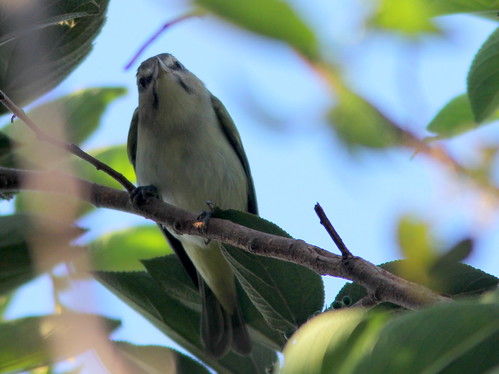
The plumage of the Black-whiskered Vireo is similar to that of the Red-eyed Vireo, but it sports its namesake "whiskers." It inhabits coastal mangroves in south Florida, but I was lucky to see it once in our local wetlands, 18 miles inland:
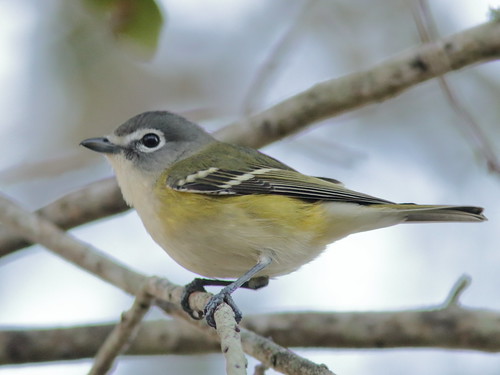
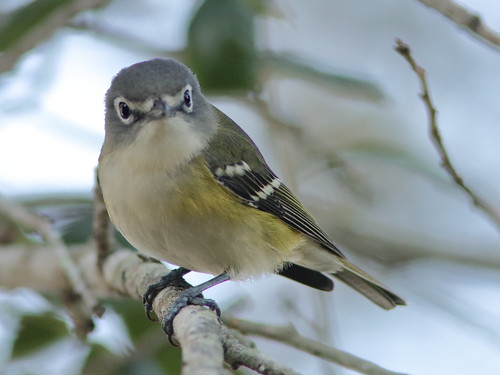
Another winter visitor which has been numerous this week is the Blue-headed Vireo. Its white "spectacles" contrast strikingly with its dark blue head:
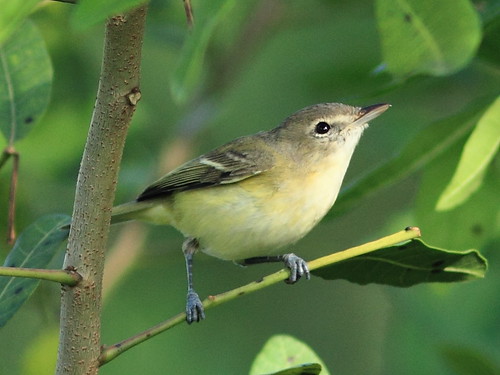
An unusual migrant visited us for four winters between 2009 and 2017. Bell's Vireo is about a half inch smaller than the White-eyed Vireo which often accompanied it. This species breeds to the west, in central and southwestern US. Normally, it migrates through Texas, New Mexico and Arizona to its wintering grounds on the Pacific coast of Mexico. Over the years a few vagrants have wintered in Florida. There were only 24 Florida records between 1947-1976, less than once a year!
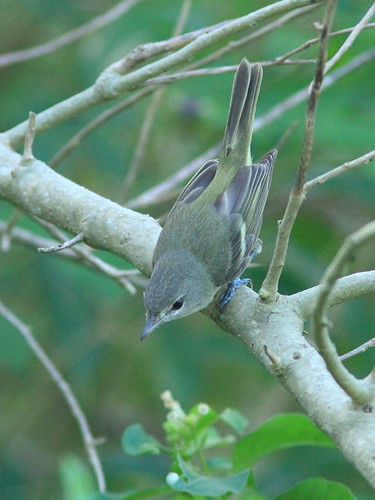
Bell's Vireo is rather plain, and easily overlooked:
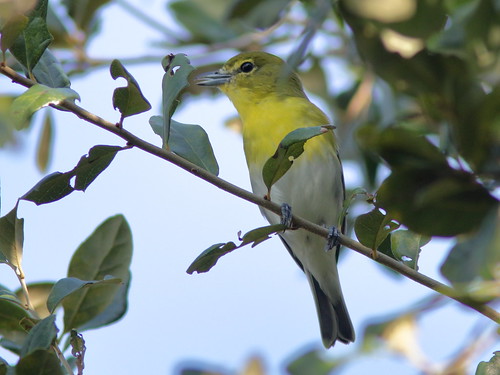
On of my most recent "first seen" birds in our local wetlands was this colorful Yellow-throated Vireo:
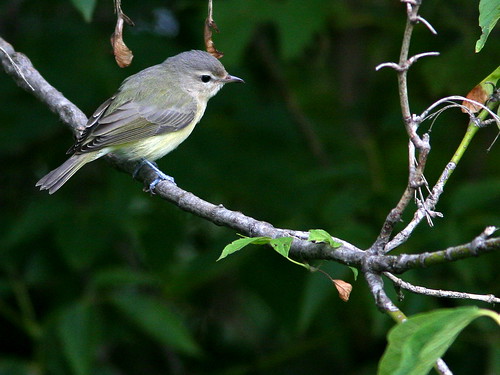
The Warbling Vireo has been present several times, but my best photos of it were those I took in Illinois, such as this one:
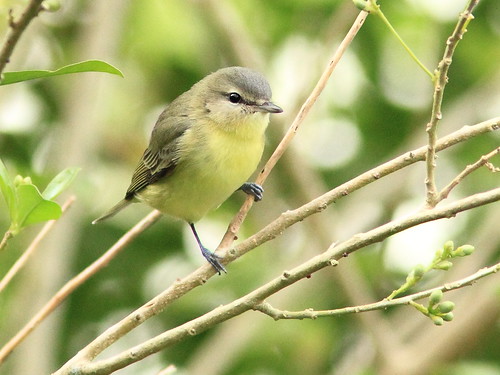
The Philadelphia Vireo is another unusual visitor to south Florida, but i did photograph it here on two occasions. Its voice is very similar to that of the Red-eyed Vireo. It usually migrates from its Canadian breeding grounds to Central America by way of the western coast of the Gulf of Mexico. It is quite colorful:
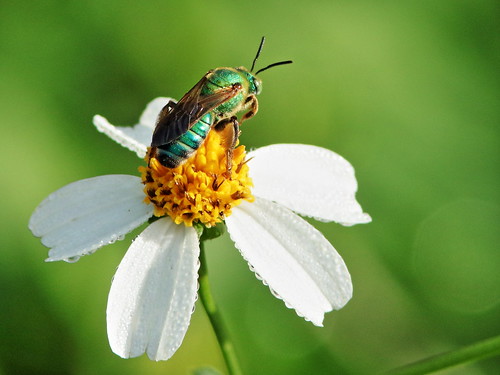
While I have seen other vireo species elsewhere, this covers all my Florida sightings. This week was not all about vireos. An Agapostemon Sweat Bee visited the flowers of Bidens alba:
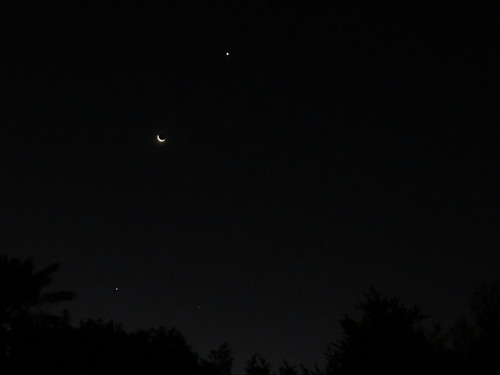
Venus, the Moon and Jupiter were aligned as we walked out 45 minutes before sunrise on January 3. I even saw Mercury closer to the horizon, the first time in my life!
Images of a very old Moon just before it disappeared into the sunrise on January 4th:
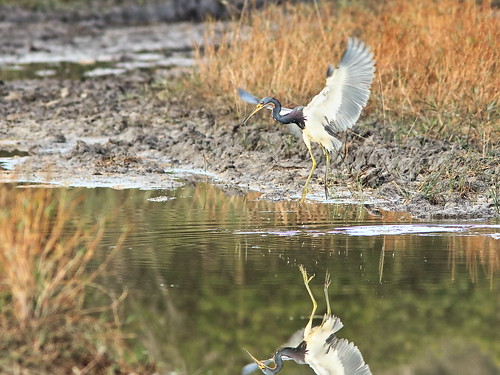
A Tricolored Heron danced with its reflection:
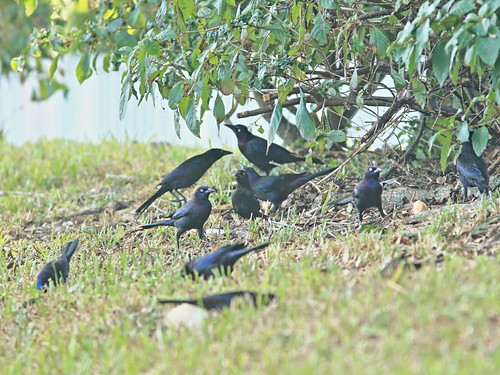
Common Grackles congregated along a neighbor's fence:
= = = = = = = = = = = = = = = Linking to Misty's CAMERA CRITTERS,
Birding is an exercise in statistics. Finding a certain bird depends upon the probability that the birder's path will intersect with that of the bird at a given moment in time. For more common birds, this probability is high because we are not looking for a single bird, but rather one that represents the species. A knowledge of birds' habits and habitats greatly increases the chance of a successful quest; the bank robber selects banks because "that's where the money is." Very few other birders visit our favorite birding patch, mostly because it is only accessible via private or posted land. Trails in the patch itself are open but there are restrictions against use of motorized vehicles, overnight camping and open fires. There are no Internet bulletins alerting us to unusual finds. Although we have seen some birds that are uncommon, we have reported only one or two truly unusual species from this location. We walk the same old local patch, morning after morning. Often we are there before the sun rises and may walk and watch for two or more hours. We see the same old resident birds, and the same old migrants visit or stay for the winter. Our expectations are not high. If we set out to see a specific less common species, more than likely we will fail in our quest. Yet we are open to discovery. We notice the incremental changes-- the rise and ebb of water levels in the wetlands, the flowering and the fruiting, destruction and sometimes restoration. We have grown accustomed to all the snags and rocks and shadows that look like distant birds and mammals, and we notice the new garbage bag or the out-of-place shadow that may be a fox, or a Bobcat. We are always alert for non-avian subjects. During the past seven years of walking this patch nearly every morning we have found 135 species of birds, recorded since 2009 in our eBird List of Species, West Miramar Water Conservation Area. Most of these we documented among over 5700 photographs on FLICKR for this site alone. Interestingly, some of these we have seen only once or twice. Despite our regular observations of this area, we have been there only a tiny fraction of all the daylight (and none of the nighttime) hours over the past nine years since first setting foot there. Statistically, our records are insignificant. How many birds have we missed just by minutes or days or years? On a still morning the slight rustling in a shrub, easy to overlook, revealed the first Orange-crowned Warbler we ever saw in the patch, though once we learned where to look for them we have seen several more. The stirring of a single blade of grass invited us to find our first Rough Green Snake, wet from the morning dew. It responded to my approach by retreating across a sandy patch and rearing up towards me like a tiny cobra. A flash of yellow color in the brush disappeared as suddenly as it appeared, and a lucky photo documented our first and only Yellow-breased Chat. Uncommon but not rare, our patch must have been visited by many more chats besides this one so fortuitously sighted. A shy and retiring Black-whiskered Vireo showed itself during only one of our hundreds of visits to this particular thicket. How many times had it been there when I was otherwise occupied? A dull-plumaged Bell's Vireo presented an identification challenge. We have seen it only twice, in October of 2009 and 2012. Short-tailed Hawks flew over only twice. This is the more common dark morph, seen this past October. I wonder how many I missed by not scrutinizing the vulture flocks which help disguise them from their usual prey of small birds. This dissimilar light morph was the first Short-tailed Hawk on my life list of species first seen (and photographed). A few more spectacular birds have shown up on only one occasion. They include a small flock of Roseate Spoonbills that appeared in late November, 2012 and stayed for three weeks. Remarkably, the spoonbills were joined by our first and only flock of White Pelicans, a species that also lingered for several days. Neither species has reappeared since. Reddish Egrets are rarely seen away from the coastal brackish waters, yet a single immature bird visited us,18 miles inland, and lingered for over a month. As is typical, it pranced about erratically in search of prey. The highlights among rare visitors were two Whooping Cranes, the first ever reported this far south in Florida. They were captive-reared in Wisconsin and released to migrate on their own. One injured its foot and had to be treated and rehabilitated and was released in Tennessee. The other lacked survival skills and was relocated to a ranch in central Florida. Sadly, both perished during the winter. If this video does not display, please visit this link: http://www.youtube.com/watch?v=FeKMkfJOlco&featu