You may have been following the adventures of the two captive-reared juvenile Whooping Cranes that visited our local patch. They were among the six that were allowed to find their own way south from Wisconsin. Part of the International Crane Foundation's "Direct Autumn Release" experiment, they were not assisted by the "Operation Migration" ultralight aircraft. This year their journey was fraught with danger.
Five of the six departed from Horicon National Wildlife Refuge on the last day of October, 2012 and flew 1200 miles to Clay County, Florida in only six days. Only two days later, on November 8, the flock of 5 was tracked by satellite to Everglades National Park at the southern tip of Florida. The next day they had doubled back nearly 100 miles north to a ranch in Hendry County, Florida. The sixth crane finally migrated from Wisconsin with a flock of Sandhill Cranes in late November and on December 9 had settled down for the winter in Volusia County, Florida.
Three of the five cranes remained in Hendry County, but on December 22, two cranes (a female nicknamed Tussock and a male called Cypress) relocated to the wetlands adjacent to our home in Broward County, about 50 miles to the southeast. Unfortunately, two of the three remaining Hendry County cranes expired on the ranch during late December or early January. As related in an earlier post Tussock suffered an injured foot and had to be captured. After a week of treatment at Disney Animal Kingdom, she was released in Tennessee on February 9 to join a group of other Whooping and Sandhill Cranes. Cypress was subsequently captured on February 10 and released to rejoin the surviving crane "Fireweed" on the J-Seven Ranch in Hendry County.
The ranch owners invited several of us who had provided ground observations in Broward County to come up and see "our" crane, but before we got up there, we were disappointed to hear that Cypress migrated north in late February or early March. For a time Fireweed was also presumed to have died, as his satellite signal constantly pointed to one spot, and ground searches were not successful. Rhonda Roff and Margaret England from the Hendry-Glades Audubon Society joined four of us from South Broward Audubon. Minutes after we enjoyed coffee with John and Gretchen Ward, owners of J-Seven, we received a call that announced, to our great surprise, Fireweed had turned up on a neighboring ranch, Devil's Garden Bird Park (DGBP).
Doug and Catherine Zipperer, owners of DGBP, invited us all to come over. We headed there immediately.

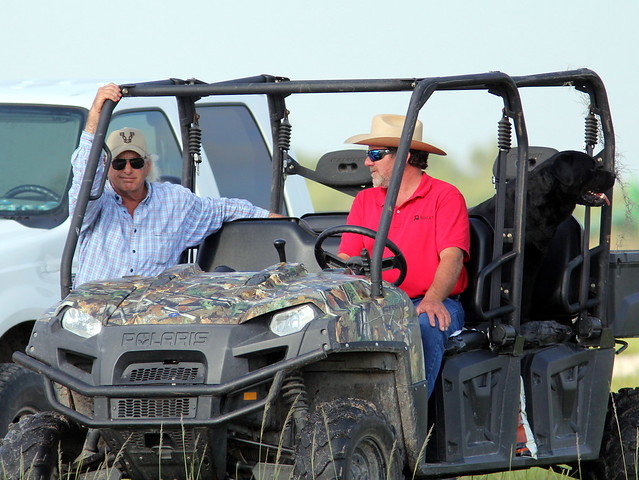
Neighboring ranchers John Ward and Doug Zipperer chatted as we scoped out the first overgrown pasture.

Devil's Garden Bird Park provides guided custom birding tours for the public, but the Zipperers extended us the courtesy of lending us an extra Ranger all-terrain vehicle so that we could travel cross-country if necessary.
 Fireweed was readily located, foraging with a flock of Sandhill Cranes near the entrance road.


A Crested Caracara posed on a fence post.

Many Eastern Meadowlarks sang in the prairie.

Red-shouldered Hawks were conspicuously present.

As we approached a beautiful native Cabbage Palm-Live Oak Hammock, Swallow-tailed Kites wheeled overhead.

Inside the hammock, a pair of Barred Owls flew towards us, most likely because their newly-fledged young were hidden deeper in the trees. We did not advance, but watched the owls as they called "Who cooks for you?".

We returned to J-Seven, where John Ward guided us on a tour of wonderfully varied habitats. Two newly-fledged Bald Eagles flew up in front of us.

A little while later they returned to their nest to feed.

An adult eagle flew high overhead.

In a well-concealed nest, two Red-shouldered Hawk chicks waited to be fed.


Several pairs of Burrowing Owls nested in berms on the grazing land.


Glossy Ibises foraged in the wet prairies.

In the wetlands, we had magnificent views of Roseate Spoonbills.


A flock of Wild Turkeys scurried in the tree groves.

A wild sow hurried away with her piglets as we approached.

Caracaras nested in the top of a Cabbage Palm.


We really worked up an appetite, and Gretchen spread out a delicious lunch for us in the chickee. Their hospitality was overwhelmingly warm! From left to right, Barry Heimlich, John Ward, Gretchen Ward, Helen Harringer, John Abbott, Margaret England, and Rhonda Roff.

One of my projects has been keeping watch over a Bald Eagle nest in neighboring Pembroke Pines. Over five breeding seasons, since 2008, I have collected information about their breeding activities. Dozens of other nest watchers who have an interest in protecting their habitat and learning about the eagles' behavior contribute their ground observations to my Pembroke Pines Eagle Nest Watch FORUM, and I compile the data to obtain a broader picture of their breeding biology. Here is a spreadsheet and a table comparing milestone events in each breeding cycle.
Watching an eagle at its nest can be like watching grass grow. Yet, sometimes subtle behavioral changes can signal important events, such as the laying of the first egg and its hatching. Although our attention may be focused on the eagle, we are not oblivious to other happenings.
Once a hummingbird appeared at the nest and perched right in front of an eagle as it was incubating. It was so interesting to ponder the difference in size between these two extremes that I totally forgot that I had a camera! Another time, an Osprey angrily followed an eagle that was carrying a fish to the nest site. Undoubtedly, the eagle had stolen its meal. Rather than flying directly to the nest, the eagle circled and flew off out of sight, emerging a few minutes later with the fish but without the Osprey.
However, I was lucky enough to capture some unexpected scenes. Most recently was an encounter between several Fish Crows and a Merlin, just one day after the single eaglet had fledged and disappeared. The crows were harassing one of the adult eagles as it was roosting near the nest. I interpreted this a a possible attempt to distract the eagle so that others of the flock could steal remains of prey that the adult had left in the nest to attract the missing youngster.
The crows repeatedly dived down just over the eagle's head whenever the eagle was occupied with preening.

 The eagle seemed only mildly disturbed.
 Just after I photographed one of the crows there was a rush of wings from behind me.
 A Merlin was in full pursuit of the crow. I must apologize for the poor quality of my photos as the light was harsh and I did not have time to switch my shutter settings.
 The crow headed for the Merlin's favorite roosting place, but had to yield its perch under attack.

 The crow actually started out after the Merlin!
 The battle went on for several minutes, the crow intent on returning to the falcon's favored roost.

 Finally the crows relented and the Merlin settled down.
 A couple of days before, a Cattle Egret stole my attention as it chased after Halloween Pennant dragonflies. The egret stealthily crept up on an insect (Click on the image to see the location of its prey).
 Success! (Note that the egret has pinkish-orange breeding plumes).

 Other incidental sightings of note include this Swallow-tailed Kite that passed directly over the eagle nest.
 A pair of Red-shouldered Hawks courted on a tall light fixture nearby.
 A dark morph Short-tailed Hawk, ready to pounce upon any unsuspecting smaller bird disguised itself by soaring in a flock of vultures.
 A Sharp-shinned Hawk raced overhead.
 A flock of Cedar Waxwings once appeared against a rainy sky.
 A Palm Warbler visited as I watched the nest, up close and personal.
 Flocks of long-legged waders, such as these Wood Storks, flew overhead.
 A colony of Monk Parakeets occupied a nest on a light pole across the street from the nest.
 An oddity was this Northern Mockingbird with a badly deformed bill. It was singing vigorously as I took its picture.
 A Gray Squirrel tight-roped across in front of the eagle nest.
 Some of the sightings must be classified as "un-natural."